 SS
SS
Key Takeaways
- Ireland is the only large EU market where English is the national working language, which makes it structurally different from everywhere else.
- The Netherlands and the Nordics have the highest English proficiency and the largest genuinely English-working sectors on the continent.
- Four sectors run in English almost everywhere: technology, shared service centres, international organisations and academic research.
- Southern and Central Europe require the local language for most of the market, with substantial English-working exceptions in specific cities.
- The ceiling is real. Working in English is viable for a career; social integration and the wider market generally are not.
The genuinely English markets
Where you can build a whole career without another language.
Ireland. English is the working language of the entire economy, plus EU membership, plus an extraordinary concentration of American multinationals. For an English-speaking graduate wanting EU access this is structurally the best option in Europe and it is not close.
Malta. English is an official language and widely used in business, with gaming and financial services sectors that hire internationally.
And that is the complete list of EU countries where English alone opens the whole market. Everywhere else, English opens part of it.
Where English opens a large part of the market
The next tier, and where most opportunity actually is.
The Netherlands. Among the highest English proficiency in the world, with technology, international headquarters and much of Amsterdam's professional economy operating in English. Dutch opens the rest, and the international sector alone is substantial.
The Nordics — Sweden, Denmark, Norway, Finland, Iceland. Very high proficiency, English-working technology sectors, and international companies operating in English throughout. The wider market and particularly the public sector require the local language.
Estonia. Technology runs in English and the startup ecosystem is international.
Luxembourg. Finance and the EU institutions operate substantially in English.
Belgium (Brussels). The EU institutions, NATO and the enormous surrounding policy ecosystem run in English and French.
Portugal. High English proficiency with technology and shared services operating in English.
Cyprus. English is widely used in business, with shipping and financial services particularly accessible.
The four sectors that run in English everywhere
Regardless of country, these are your options if you have no local language.
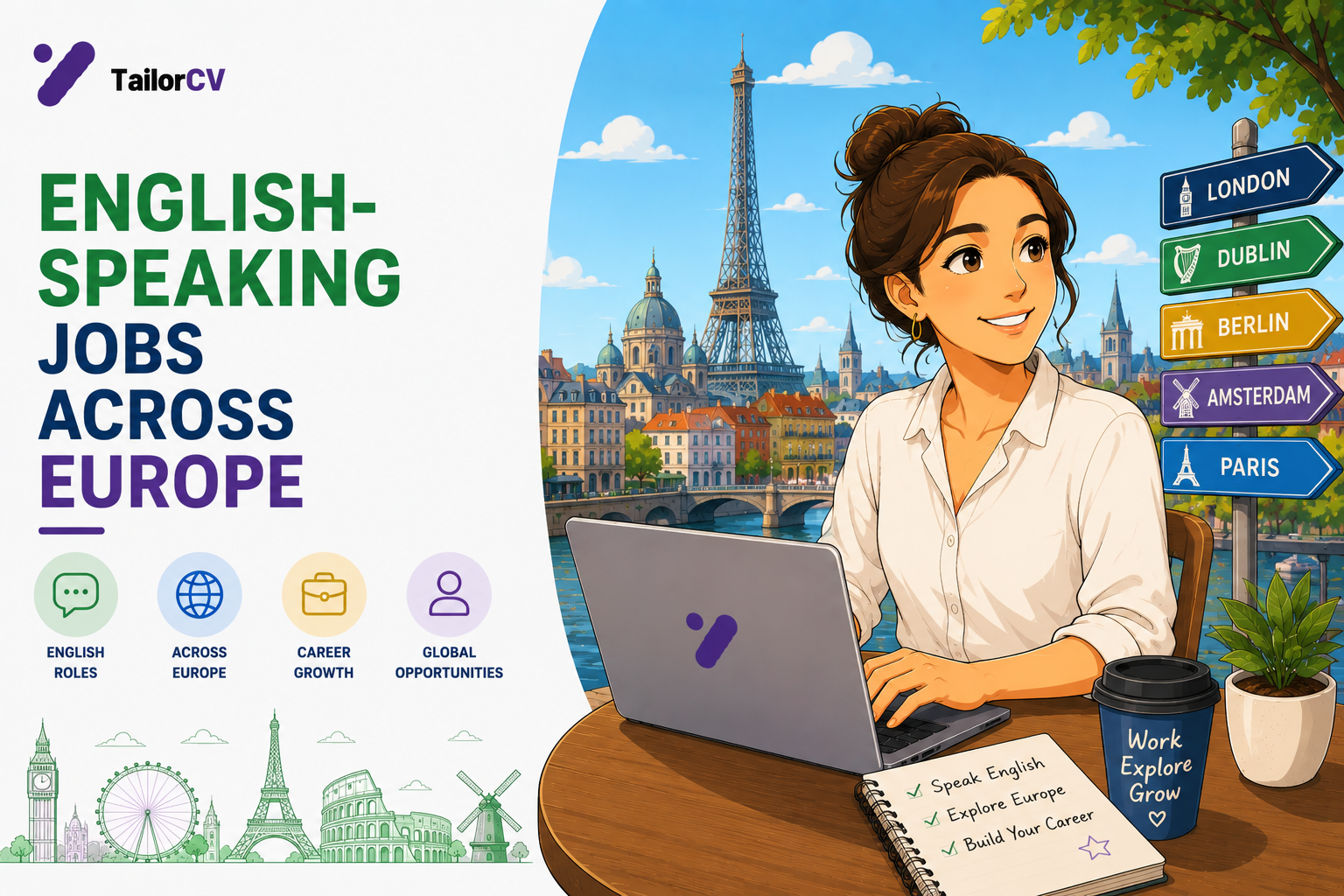
Technology. Software teams across the continent operate in English because the teams are international. This is the single most reliable English-language career in Europe.
Shared service centres. Multinationals running European finance, IT, HR and customer functions from Poland, Czechia, Portugal, Spain, Hungary and Romania — and they recruit specifically for English plus another European language. This is the most accessible entry into Central and Southern Europe.
International organisations. The EU institutions, UN agencies in Vienna, Rome, Geneva and Copenhagen, NATO, and the development banks. English and French dominate.
Academic research. Universities and research institutes across Europe operate research in English, publish in English and hire internationally.
And a partial fifth: international education, where English-medium schools across the continent employ English-speaking teachers.
The honest ceiling
What working in English does not get you.
Most of the domestic market stays closed. Public sector, healthcare, education, law, client-facing commercial roles and the majority of small and medium employers require the local language everywhere except Ireland and Malta.
Progression can slow. In some organisations the senior roles interface with local clients, regulators or institutions, and that requires the language.
Social integration is the real ceiling. People who work in English and never learn the local language overwhelmingly report that this, rather than the job, is what makes them leave after two or three years.
Citizenship generally requires the language, at varying levels, in almost every European country.
Which means the practical advice is: English gets you in, and the local language determines whether you stay. Treat learning it as part of the move rather than as an optional extra, even if your job never requires it.
Practical steps if English is your only language
Concrete actions rather than general advice.
Put Ireland at the top of the list if EU access matters. Nothing else combines an English-speaking economy with EU membership and this density of international employers.
Identify which of the four English sectors your field maps onto — technology, shared services, international organisations, or research. If it maps onto none of them, you have a harder problem than country selection.
Search in English deliberately. Filter job boards by language, use LinkedIn rather than domestic-language platforms, and target international employers explicitly.
State your language position honestly on applications, including any local language you are learning and at what level. Demonstrated effort is genuinely well received.
Start learning before you arrive. Even A2 changes how you are received, and arriving at zero makes the first year harder than it needs to be.
And plan for the ceiling. Decide now whether this is a two-year experience or a permanent move, because the language answer differs completely between them.
Learning the language while working in English
The practical question everyone faces.
Start before you arrive. Even A1 changes your first months, and arriving at zero makes everything harder.
Use the free provision. Sweden's SFI, Finland's integration training, Denmark's language schools and equivalents elsewhere are publicly funded and generally good.
Employer support is common. Many international companies fund language lessons, and asking is normal.
Set a functional goal, not a perfect one. B1 is enough to have a conversation, follow a meeting and read official correspondence, and it is achievable in a year of consistent effort.
Practise outside work. If your workplace runs in English, the language has to come from elsewhere — clubs, sport, volunteering, a language exchange.
Accept the awkward phase. There is a period where you understand more than you can say and every conversation is effortful. Everyone goes through it and it ends.
And be honest about your level on CVs and in interviews throughout. Overstating is found out and understating costs you nothing.
The remote work alternative
Which changes this whole question.
Working remotely for a company elsewhere removes the language constraint from your employment entirely.
Several countries built visas for exactly this — Spain, Portugal, Estonia, Greece, Croatia and others.
The arbitrage is real — a Northern European or American salary against Southern or Central European costs.
But the social question remains. Working remotely in a country whose language you do not speak is more isolating than working locally in English, not less, because you lose the colleagues who would otherwise be your first network.
So the language advice does not change. If anything it matters more, because remote workers have to build a life deliberately rather than having one arrive with the job.
Sector by sector, where English works
A more granular map than the country-level view.
Software engineering. English across the continent. The most reliable English-language career in Europe by a wide margin.
Data and analytics. Largely English in international companies and shared service centres.
Finance. English in international banking, funds and the Luxembourg and Dublin centres; local language in domestic retail banking.
Consulting. English at the international firms for regional work; local language for domestic client work.
Marketing. English for international and product marketing; local language for market-specific work, and increasingly local language is essential.
Sales. Almost always requires the target market's language, which is why multilingual candidates are so employable.
Engineering. Varies enormously — English at international R&D centres and multinational projects, local language at most domestic manufacturers.
Healthcare. Local language, universally and non-negotiably, plus registration requirements.
Education. English at international schools and English-medium universities; local language everywhere else.
Law. Local language and local qualification, with narrow exceptions in international arbitration and EU practice.
Public sector. Local language, universally.
And research. English almost everywhere, which makes academia one of the most internationally accessible careers on the continent.
Mini checklist
- unchecked: Ireland considered first if EU access matters and you have only English
- unchecked: The four English-working sectors identified in your field
- unchecked: Shared service centres considered if you have a second European language
- unchecked: Netherlands and Nordics assessed for technology roles
- unchecked: International organisations checked if relevant
- unchecked: Local language learning planned regardless of job requirement
- unchecked: Ceiling implications understood for your target country
- unchecked: Citizenship language requirement noted if settlement matters
- unchecked: Social integration factored into the decision
Scenarios
Scenario 1: You speak only English and want EU access
Ireland. English is the working language of the whole economy, it is an EU member, and it hosts an extraordinary concentration of international employers. Nothing else in Europe combines those three.
Scenario 2: You are a software developer
You have the widest choice of anyone. Technology runs in English across the continent, and the Netherlands, Nordics, Estonia, Ireland, Poland and Portugal are all genuinely open to you.
Scenario 3: You speak English plus one more European language
Target the shared service centres in Poland, Czechia, Portugal, Spain and Hungary. They recruit specifically for that combination, frequently require no local language, and they are the most accessible professional entry into those markets.
Tip: Learn the local language even if your job does not require it. Working in English is viable for a career and it is not viable for a life, and the people who leave Europe after two years are overwhelmingly the ones who never started.
Do's and Don'ts
Do
- Consider Ireland first if you have only English
- Target the four English-working sectors
- Use a second European language for shared services
- Plan language learning as part of the move
- Understand the ceiling in your target country
- Check the citizenship language requirement
Don't
- Assume high English proficiency means English-language jobs
- Expect the public sector to be accessible
- Treat language learning as optional
- Ignore shared service centres
- Assume progression is unaffected long term
- Underestimate the social integration problem
Common Mistakes
- Confusing proficiency with opportunity. Dutch and Nordic people speak excellent English; most of their job markets still run locally.
- Missing Ireland. Structurally the best option for an English-only graduate wanting EU access.
- Ignoring shared services. The most accessible entry into Central and Southern Europe.
- Skipping the language. It is why people leave, far more often than the job is.
- Assuming no ceiling. Progression in many organisations eventually requires the local language.
- Forgetting citizenship requirements. Almost every European country requires the language for naturalisation.
Related Guides
Keep building on this with the related guides in this series:
- Southern Europe versus Northern Europe for Graduate Jobs
- Small Rich Countries - A Career Guide
- Graduate Jobs in Ireland - How the Market Works
- Working in Poland as an International Graduate
- Best Countries for International Graduates
You can also check your resume's ATS score for free, generate a tailored cover letter, or build a portfolio website in minutes.
Frequently Asked Questions
Where in Europe can I work with only English?
Ireland and Malta are the only EU countries where English alone opens the whole market. Everywhere else it opens specific sectors — technology, shared services, international organisations and research.
Is the Netherlands really English-friendly for jobs?
For technology, international headquarters and much of Amsterdam's professional economy, genuinely yes. The public sector, healthcare, education and most SMEs require Dutch.
What are shared service centres?
Multinational operations running European finance, IT, HR and support functions from Poland, Czechia, Portugal, Spain and elsewhere, recruiting for English plus another European language.
Does high English proficiency mean English-language jobs?
No, and this is the most common misunderstanding. Dutch, Nordic and Portuguese people speak excellent English; their job markets still largely operate in their own languages.
Will not speaking the local language limit my career?
Eventually, in many organisations, where senior roles interface with local clients or regulators. The bigger limit is social, and it is the main reason internationals leave.
Do I need the language for citizenship?
In almost every European country, yes, at varying levels. If settlement is your goal, treat language learning as a requirement rather than an option.
What should I do if English is my only language?
Prioritise Ireland for EU access, identify which of the four English-working sectors your field fits, search deliberately in English, state your language position honestly, and start learning the local language before you arrive.
How do I learn the language while working in English?
Start before arriving, use publicly funded provision like Sweden's SFI or Finland's integration training, ask your employer about support, target B1 rather than perfection, and practise outside work since your workplace runs in English.
Does remote work solve the language problem?
It removes it from your employment and makes it more important socially. Remote workers lose the colleagues who would otherwise be their first network, so building a life deliberately matters more, not less.
Which sectors run in English across Europe?
Software engineering most reliably, plus data and analytics, international finance, shared service centres, international organisations and academic research. Healthcare, law and the public sector require local languages universally.
What is your resume scoring right now?
Scan it against a job description and get your ATS match score in about a minute.
Drop your resume here or choose a file
PDF only. Max 2 MB.
We never share your data or use it to train AI models.

Was this guide useful?
Be the first to rate it.