 SS
SS
Key Takeaways
- Job hunting in Japan is a year-long structured process that begins well over a year before you would start work.
- Summer internships in the penultimate year function as an early screening and relationship-building stage rather than as work experience.
- The main application and interview period is concentrated and largely synchronised across companies.
- An informal offer, or naitei, arrives months before you graduate and comes with its own conventions.
- Foreign students frequently discover the cycle too late, which is the most common and most avoidable problem.
The shape of the cycle
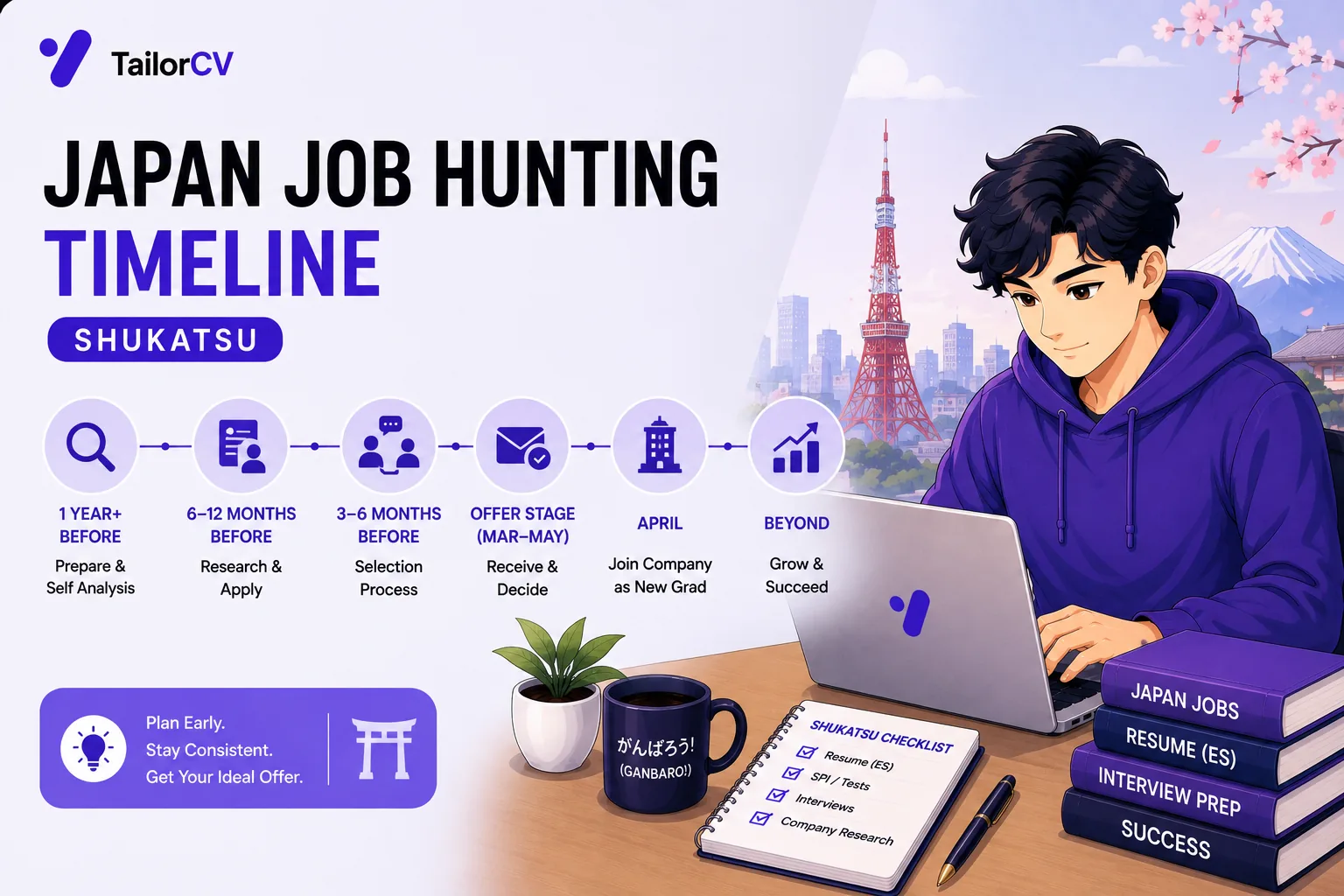
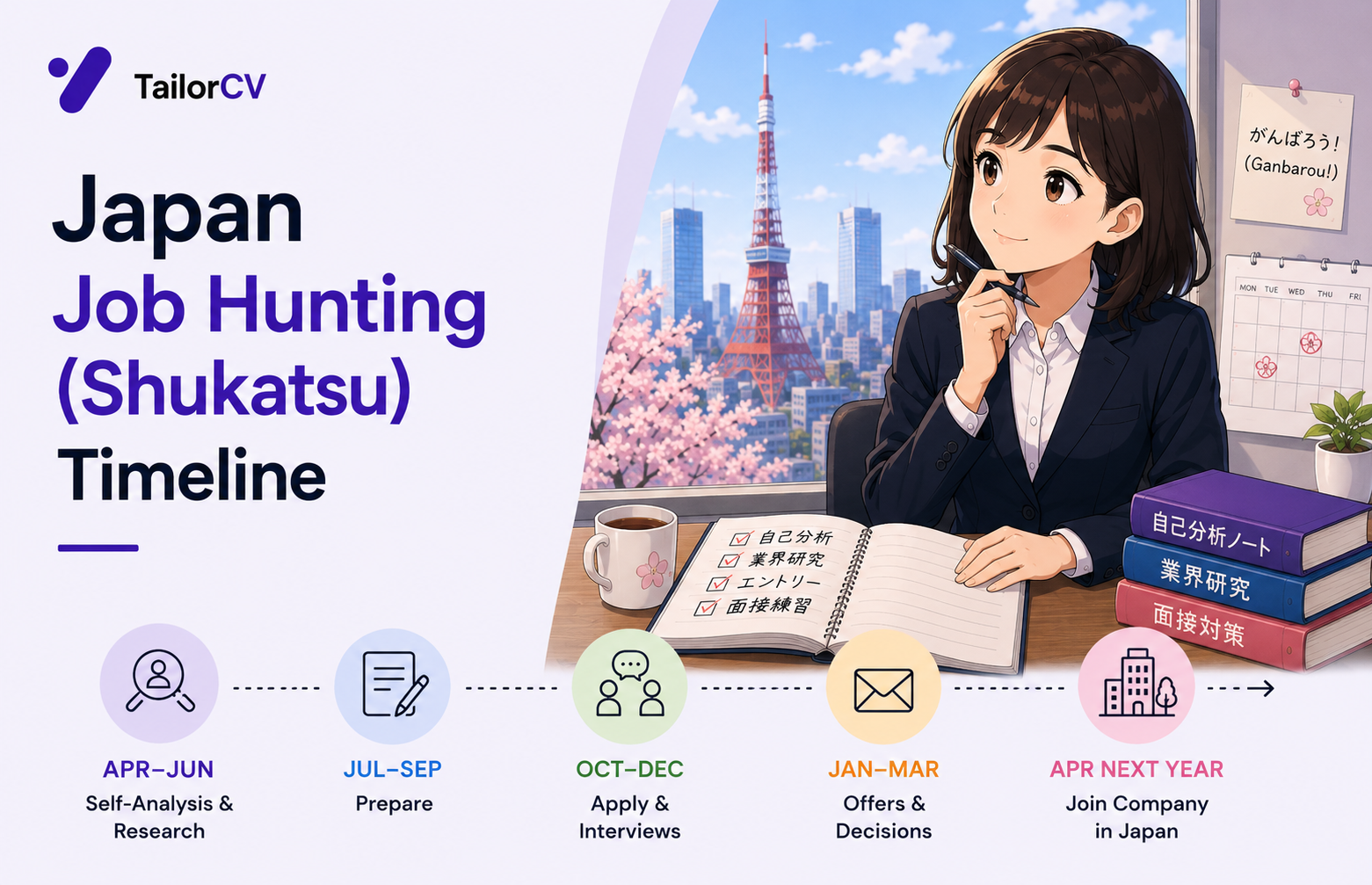
The conventional pattern runs roughly like this, though individual companies increasingly vary it.
Penultimate year, spring and early summer. Preparation begins. Self-analysis, industry research, and registration with job-hunting platforms. Students start attending company information sessions and seminars.
Penultimate year, summer. Summer internships. These are frequently short — sometimes days rather than months — and function largely as an introduction to the company and an early look at candidates. Participation matters more for the relationship and the information than for the work itself.
Penultimate year, autumn and winter. Autumn and winter internships, more information sessions, and continued preparation. Aptitude test practice begins in earnest.
Penultimate year, late winter into spring. Company information sessions intensify significantly, and application submission opens for many companies.
Final year, spring. The main selection period. Written applications, aptitude tests, group discussions, and successive interview rounds.
Final year, early to mid. Informal offers begin to be issued.
Final year, autumn. A formal offer ceremony traditionally marks acceptance.
The April after graduation. Cohort entry, with everyone starting together.
Two things to notice. The decisive activity happens more than a year before you would start work. And the process is largely synchronised, which means you are moving through it alongside most of your cohort simultaneously rather than on your own timetable.
What each stage actually requires
Self-analysis. A formal expected step. Reflecting on your history, motivations, strengths and values, and being able to articulate them consistently. This underpins everything written and spoken later, and students who skip it produce applications that read as generic.
Industry and company research. Attending information sessions, understanding the sector, and being able to explain specifically why this company. The same principle that decides applications everywhere applies here with more weight, because the process has more opportunities to test it.
Entry sheets. Written applications with substantial free-response questions about your motivation, your self-analysis and your reasons for applying. These are read carefully and are a genuine screening stage.
Aptitude tests. Standardised testing covering language, numerical reasoning and personality assessment. Widely used and practised for extensively — the testing guide covers the formats.
Group discussions. Candidates discuss a topic while assessors observe. Assessed on how you work with others rather than on winning the argument.
Multiple interview rounds. Frequently three or more, progressing from junior staff to senior management, with consistency across rounds mattering considerably.
The final interview, typically with senior management, often as much about character and commitment as capability.
Where foreign students go wrong on timing
Discovering the cycle too late. The single most common problem. A student who begins thinking about work in their final autumn has missed the main selection period for most companies entirely.
Assuming internships are optional work experience. In this system they function as an early stage of the recruiting relationship, and skipping them means arriving at the main round without the familiarity other candidates have.
Underestimating preparation time. Self-analysis, industry research and aptitude test practice together represent months of work, not weeks.
Not registering on the platforms early. Much of the information flow — session announcements, application openings — runs through job-hunting platforms that students join well in advance.
Applying the timeline from another country. A student expecting an autumn cycle with a summer start, as in US recruiting, will be roughly a year out of phase.
If you are outside the standard cycle
Companies increasingly recruit year-round, particularly in technology, at foreign-affiliated firms and for specialist roles. This is a genuine and growing alternative to the synchronised system.
Second new graduate hiring exists for people who graduated recently but did not enter through the standard cycle, or who left a first job early.
Mid-career hiring is structured entirely differently and generally expects relevant experience.
Foreign-affiliated companies frequently run on their own timelines, closer to the conventions of their home markets, and are often more accessible in English.
Graduate school shifts your cycle by the length of the programme and gives you another pass at the standard system.
What actually happens at each stage
- Company information sessions, running for a substantial period before formal applications open, attending these is genuinely part of building your own understanding of specific companies and, in many cases, part of how companies build their eventual applicant pool, treating them as optional or purely promotional is a mistake many international students make.
- Entry sheet submission, a detailed written application, often including several substantial essay-style responses about your background, motivations and specific interest in the company, these are read and scored, and a generic response reused across many companies is noticed and scored poorly, exactly the same principle that applies to written applications everywhere, applied within a considerably more formal and detailed local convention.
- Aptitude and written testing, covered separately, a standard early filtering stage at most large employers.
- Multiple interview rounds, generally increasing in seniority of interviewer as you progress, culminating in a final round that frequently involves senior leadership.
- The informal offer, extended before any formal, official offer, carrying real social weight within this system as discussed in the broader shinsotsu system guide.
Building your own calendar around this
Start attending information sessions and building your target company list well before the formal application window opens, this preparatory period is genuinely part of the process, not idle time before things properly begin.
Prepare your entry sheet responses with real specificity for each company, generic responses are noticed, the same discipline that improves any written application anywhere applies here, with a considerably higher bar for depth and specificity than a brief Western cover letter.
Practise aptitude and written tests specifically, covered in the group interview and testing guide, these are trainable and a real early filter.
Managing the workload across a full cycle
This process runs for a genuinely extended period and demands sustained effort alongside your studies, similar to the sustained effort structured graduate recruiting requires in other intensive markets, pacing yourself deliberately across the full cycle, rather than front-loading all your energy into the earliest weeks, produces better outcomes over the whole process.
Build a realistic weekly routine covering information sessions, entry sheet preparation and interview practice, rather than treating the whole timeline as a single undifferentiated block of activity, structure genuinely helps manage what is otherwise an overwhelming volume of parallel processes.
Take care of your own wellbeing across a genuinely demanding period, the sustained intensity of this system, combined with the real social weight attached to its various stages, makes this a genuinely stressful period for many students, worth building in deliberate breaks rather than running continuously at full intensity throughout.
Adjusting your approach if you started late
If you find yourself starting this process later than the typical timeline suggests is ideal, this is recoverable, though it requires a genuinely more concentrated effort in a shorter window.
Prioritise the companies and industries where you have the strongest genuine fit first, rather than attempting to cover the same breadth a student who started earlier managed across a longer period, focused depth on fewer targets often outperforms thin coverage across many when time is genuinely constrained.
Some companies and industries run supplementary hiring rounds later in the cycle, or maintain more flexible, rolling processes throughout the year, particularly true of international companies and some newer domestic firms, worth researching these specifically if your own timeline does not align with the earliest and most competitive window.
Managing multiple parallel processes without losing track
Given the volume of companies many students engage with simultaneously across this extended timeline, a genuinely organised system for tracking where you stand with each is essential, not optional.
Record the specific stage, key dates, and any particular details discussed for every company you are engaging with, a simple spreadsheet works well, this becomes genuinely important as the number of parallel processes grows, since confusing details between companies during a later interview stage reflects poorly and is entirely avoidable with basic organisation.
Review your own tracker regularly rather than only when a specific deadline is imminent, a weekly review habit catches upcoming deadlines and lets you allocate your preparation time deliberately across your active processes, rather than reacting to whichever deadline happens to be most urgent at any given moment.
Tip: Build a spreadsheet of every target company's specific dates before the season opens. Shūkatsu punishes disorganisation more than almost any other hiring system — the calendar is the whole game.
Common Mistakes
- Starting in the final year. Starting in the final year the main selection period is largely over by then for the conventional cycle.
- Skipping summer internships. They function as relationship-building and early screening rather than as work experience.
- Neglecting aptitude test practice. Widely used, heavily practised for by other candidates, and entirely trainable.
- Treating self-analysis as optional. It underpins the entry sheets and the interviews.
- Applying a foreign country's calendar. Applying a foreign country's calendar the Japanese cycle runs more than a year ahead of the start date.
- Not registering on job-hunting platforms early. Much of the information flow runs through them.
Related Guides
Keep building on this with the related guides in this series:
- English-Speaking Jobs in Japan - Where They Actually Are
- Group Discussions and Aptitude Tests in Japanese Recruiting
- Internships in Japan for International Students
- Japanese Language Requirements for Jobs in Japan
- Teaching in Japan - The JET Programme and the Alternatives
- JLPT N2 and N1 - What They Actually Mean for Employment in Japan
You can also check your resume's ATS score for free, generate a tailored cover letter, or build a portfolio website in minutes.
Frequently Asked Questions
When should international students start preparing?
Well before the formal timeline, attending information sessions and building language ability, where needed, takes real lead time that is worth starting a year or more in advance where possible.
Does the timeline differ for international students?
The formal structure is generally the same, though foreign multinationals sometimes run a distinct, more flexible timeline, worth researching your specific target employers directly.
What happens if I am not ready by the main application window?
Some companies run supplementary or later hiring rounds, and foreign multinationals in particular often hire on a more rolling basis, worth researching these alongside the main synchronised cycle if your own timeline does not align perfectly with it.
How many companies should I realistically target?
Enough to build a genuine, well-researched target list rather than a small handful, while still being able to prepare specific, high-quality entry sheet responses for each, quality of preparation per company matters considerably here.
When should I actually start?
Preparation in the spring of your penultimate year, with summer internships that same year. Anything later means catching up.
Are the dates the same at every company?
The conventional pattern is broadly shared, and individual companies increasingly vary it — particularly technology firms and foreign-affiliated companies. Check each target rather than assuming.
Do I need to do summer internships?
They are not formally required and they matter considerably, both for the relationship with the company and for understanding the industry before the main round.
What is a naitei?
An informal offer of employment, issued months before graduation, with its own conventions around acceptance — covered in the naitei guide.
Can I job hunt while studying abroad?
It is harder because so much of the process is in-person, and some companies run sessions and interviews for students overseas. Starting early and using online channels matters more if you are not in Japan.
What if I want a specialist technical role?
Those increasingly recruit year-round on more flexible timelines — see technology hiring.
What is your resume scoring right now?
Scan it against a job description and get your ATS match score in about a minute.
Drop your resume here or choose a file
PDF only. Max 2 MB.
We never share your data or use it to train AI models.

Was this guide useful?
Be the first to rate it.