TD
TD
Key Takeaways
- US campus hiring runs roughly 9-12 months ahead of the start date. A summer 2027 internship is largely filled by October 2026.
- The biggest single mistake is treating spring as recruiting season. For most large employers it is the clearance sale, not the opening.
- Banking and consulting recruit earliest, big tech next, and most other industries hire far closer to the start date.
- Missing the autumn window is survivable, but the strategy changes completely: off-cycle and smaller employers replace career fairs.
- International students should map application deadlines against work-authorisation paperwork, which has its own separate calendar.
Why the calendar is so far ahead
American campus recruiting is unusual. In many countries a graduate applies in their final semester and starts a few months later. In the US the big employers run a structured pipeline that closes long before graduation, because the internship is the hiring funnel.
The logic is straightforward from the employer's side. They convert interns into full-time hires, so the full-time class is largely decided by the previous summer's intern class. To have interns in summer 2027, they must select them by late 2026. To select them then, applications open in August and September 2026.
If you internalise nothing else: the application deadline for a job is usually in the calendar year before the job starts.
The economics behind the calendar
It helps to see why an employer would commit to hiring someone eighteen months before they need them, because the logic explains most of the behaviour that follows.
A structured campus programme costs a great deal before it produces anything. Recruiters travel, career fair slots are bought, interviewers are pulled off billable work, offers carry signing bonuses, and interns need desks, laptops, mentors and managers who spend a summer supervising rather than delivering. A large employer may spend more on acquiring an intern class than the class produces in output.
That only makes sense if the internship reliably produces full-time hires. So employers optimise for conversion, and conversion requires selecting interns early enough to have them in the building the summer before the graduate class starts.
Competition compresses it further. If your competitor makes offers in October and you make them in January, you are choosing from whoever your competitor declined. Every firm knows this, so every firm moves earlier, until the calendar reaches a floor set by how early students can plausibly be assessed.
The result is a market where the timing is a coordination problem rather than a considered decision. Nobody thinks recruiting sophomores for jobs three years out is ideal. It is simply where the equilibrium settled.
What this means if you are reading this late
There is a specific psychological trap in all of this. Because the calendar is counter-intuitive, students routinely discover it after the window has closed and conclude that they have failed. They have not — they have missed one channel of one market, and the response is to change channel rather than to conclude anything about themselves.
The rest of this article covers both cases: how to use the window if you still have it, and what the market looks like once it has passed.
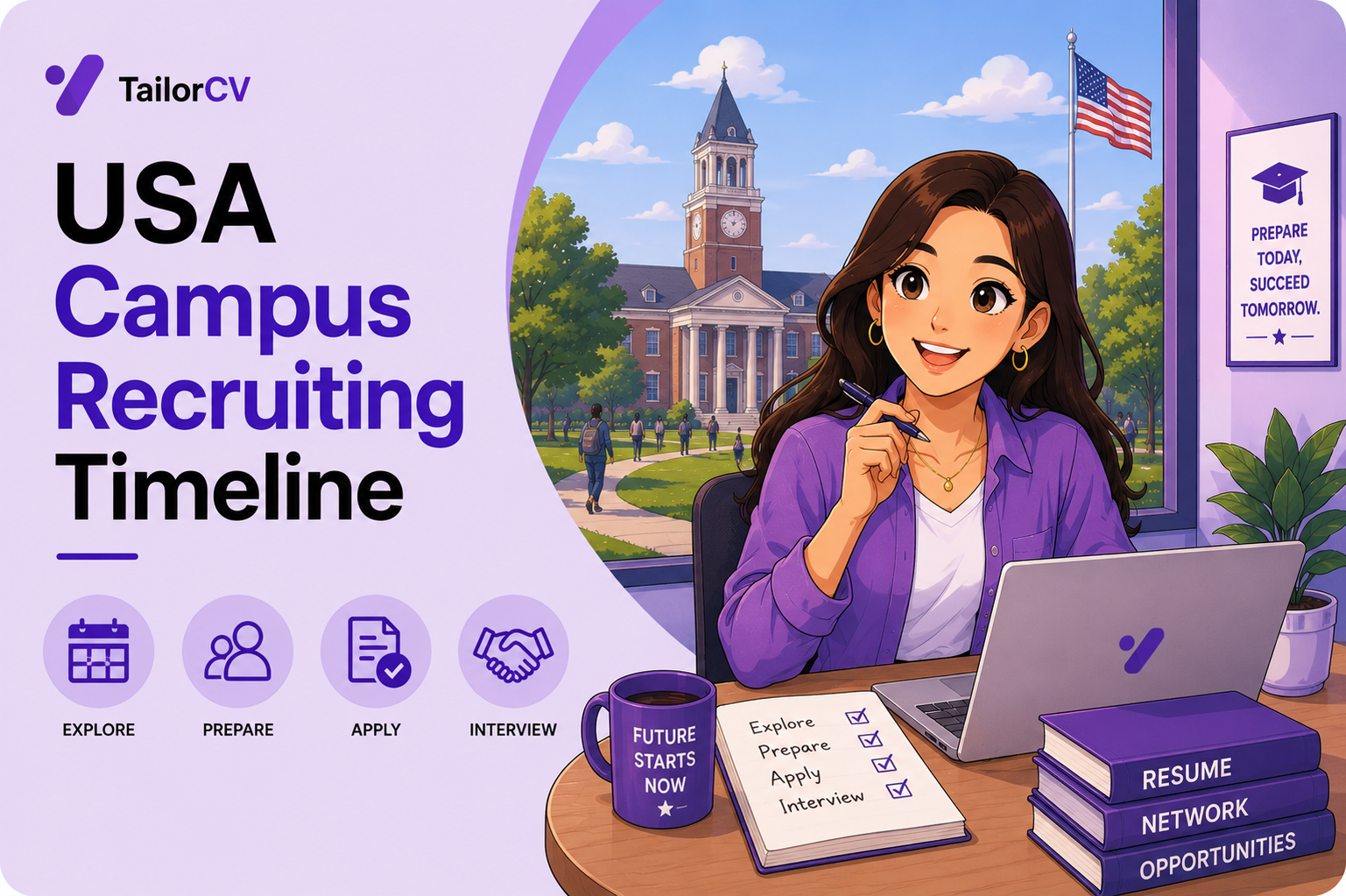
The month-by-month calendar
The dates below describe large, structured employers. Smaller companies compress everything into a few weeks near the start date.
| Period | What is happening | Who should be acting |
|---|---|---|
| July - August | Applications open, often quietly. Banking and consulting are first. | Rising seniors and rising juniors |
| September | Career fairs, first-round interviews, coffee chats. Peak volume. | Everyone recruiting for next year |
| October | Offers go out for finance and consulting. Big tech interviews run. | Anyone still applying — this is the deadline cliff |
| November - December | Remaining offers close. Deadlines pass quietly. | Late applicants, off-cycle roles |
| January - February | Spring recruiting: leftovers, smaller firms, some tech backfill | Students who missed autumn |
| March - April | Off-cycle and startup hiring. Government and non-profit run later. | Final-semester seniors without offers |
| May - August | Internships run. Return offers are decided. | Interns converting to full-time |
The shape matters more than the exact dates. Roughly 70% of structured campus hiring decisions are made between August and November. Spring is a much smaller, less structured market.
Industry differences are large
- Investment banking and consulting are the earliest and most rigid. Some firms recruit sophomores for junior-year internships, which means the pipeline effectively starts in year two.
- Big tech and quant run in autumn but often reopen in January, because they hire in larger numbers and have more attrition in the pipeline.
- Healthcare, government, education and most non-profits hire much closer to the start date, sometimes only two or three months ahead.
- Startups almost never plan a year ahead. They hire when they have a need and money, which can be any month.
If your target industry is in the last two groups, autumn panic is wasted energy. If it is in the first two, autumn is the whole game.
What actually happens in an autumn cycle
The visible part is the career fair. The invisible part is a screening process that started before it.
Most large employers open the application first, screen resumes, then use the career fair to meet candidates already in the pipeline. Arriving at a career fair without having applied is not fatal, but it is a weaker position than the students who applied in August and are there to be recognised.
Screening is usually resume-first and automated. Your document is parsed, scored against the role, and either surfaced or not. This is where most rejections happen and where almost no feedback exists. Running your resume through an ATS score check before you submit tells you what the parser actually extracted, which is a different question from whether the resume reads well.
The conversion funnel, honestly
For a large employer, a typical autumn cycle looks like this:
- Thousands of applications per role family
- A few hundred pass the resume screen
- Roughly half of those complete an online assessment
- Under a hundred reach a first-round interview
- A final round produces the offers
The steepest drop is the first one. Time spent tailoring the resume to the specific posting has a much higher return than time spent polishing later stages you may never reach. The difference between a tailored and a generic resume is largest exactly at this screen.
What the resume screen is actually doing
Understanding this stage changes how you spend your time, because it is where most applications die and where the least feedback exists.
When you submit, your document is parsed into structured fields — name, education, employers, dates, skills. That extraction is mechanical and it fails in predictable ways. Two columns get read across, so a job title ends up glued to a skills list. Tables flatten unpredictably. Text boxes are frequently skipped entirely. Contact details in a header can vanish, which means a recruiter who wants to call you cannot.
Then the extracted text is matched against the posting. This is not a keyword-stuffing game, but it is a language game: if the posting says "PostgreSQL" and your resume says "Postgres", a literal matcher does not connect them. If the posting asks for "data pipelines" and you wrote "ETL work", the same problem.
The practical sequence is therefore: make it parse, then make it match, then make it read well. Most students do these in reverse order, polishing prose in a document the parser is mangling.
A free ATS score check does the first two mechanically. The cheap manual version: export your PDF, select all, copy, paste into a plain text file. That is roughly what the parser sees. If your sections are interleaved or your phone number is missing, fix the layout before touching a single sentence.
Why volume alone does not work
Students who discover the screen often respond by applying to far more roles with the same document. This produces more rejections rather than more interviews, because the failure was never volume.
The two variables are how many applications you send and how well each matches the posting. Sending 200 unmatched applications and 40 matched ones takes similar effort; the second produces interviews. This is the entire argument for tailoring per posting, and it is why the difference between tailored and generic shows up most sharply at exactly this stage.
The practical compromise during a busy autumn is a stable base resume plus two genuinely variable elements per application: the skills ordering and two or three bullets rephrased in the posting's vocabulary. That is ten minutes per application, not an hour, and it moves the number that matters.
If you have missed the autumn window
This happens to a lot of people, including plenty who end up fine. The strategy has to change, though — repeating the autumn playbook in March does not work because the roles are gone.
Stop chasing the same employers. The named companies that recruit on campus have filled their classes. Applying to their closed autumn postings is where the effort goes to die.
Move to employers who hire on demand. Smaller companies, regional firms, startups and any organisation without a formal campus programme hire when they need someone. Their timelines are weeks, not months.
Use off-cycle openings. Large employers do post individual roles outside the campus cycle when someone declines an offer or leaves. These are not advertised at career fairs and are found on company career pages.
Increase volume, but keep tailoring. Off-cycle hiring is a numbers game in a way autumn is not. The trap is letting volume kill quality — sending the same untargeted resume 200 times produces 200 rejections. A realistic daily application target with tailored documents beats mass-sending by a wide margin. A browser extension that tailors as you browse postings is worth setting up if you are applying at volume.
International students have a second calendar
If you need work authorisation, you are managing two timelines at once, and the paperwork one is less forgiving.
The recruiting calendar is a market. The immigration calendar is a set of legal deadlines. Missing the first costs you an opportunity; missing the second can cost you your ability to work at all.
Practical consequences:
- Apply earlier than domestic classmates, not later. Sponsorship questions slow employers down, so you want to be in the pipeline before they are deciding between finalists.
- Know your own dates before an employer asks. "I am eligible to work for X months without sponsorship, and would require it after that" is a far stronger answer than uncertainty.
- Understand which employers sponsor before you spend an application on them. Some are explicit on their careers pages.
The mechanics of OPT, CPT and work authorisation matter here, as does knowing how the H-1B lottery affects new grads before you sign anything.
What to do right now, by year
First and second year. Nothing urgent, with one exception: if you want banking or consulting, sophomore-year programmes exist and they matter. Otherwise focus on having something concrete to put on a resume — coursework alone screens badly. Projects that get freshers interviews is a more useful investment than early applications.
Penultimate year, spring. Get the resume into shape before August. This is the single highest-leverage month because the document you write in April is the one that gets screened in September.
Penultimate year, August-October. Apply. This is the window. Volume matters here more than at any other point in the cycle.
Final year, autumn. Full-time applications, plus return-offer decisions if you interned.
Final year, spring. Off-cycle strategy as described above.
Building a target list that survives the season
Most students assemble a list of employers by recognition — the names they have heard of. That produces a list where every entry is contested by thousands of applicants, and where a bad autumn leaves nothing.
A list that holds up has three tiers.
Tier one: reach employers. The recognisable names with structured programmes. Apply, but understand the odds. Five to ten of these is plenty; adding a fifteenth adds almost nothing to your expected outcome.
Tier two: strong employers you had not heard of. Regional firms, mid-market companies, the second and third names in an industry you only know the leader of. These hire real graduates into real jobs, and their applicant pools are a fraction of the size. This tier should be the largest.
Tier three: employers where you have an actual connection. An alumnus, a former manager, a family contact, someone you met at a fair. Small tier, highest conversion rate per application.
Finding tier two is the work most students skip. Practical sources: the client lists and case studies of companies you admire, the vendors and suppliers named in industry publications, the sponsors of professional association events, the "similar companies" panels on employer profiles, and the employment records of graduates two years ahead of you.
Thirty to forty employers across the three tiers is a workable list. Fewer than fifteen is fragile; more than sixty stops being a list and becomes a spreadsheet you do not maintain.
Tracking, and why it decides your November
By the middle of an autumn cycle you will have applied to dozens of roles across several channels, spoken to people at career fairs, and had assessments expire in a busy inbox. Without a record, three things go wrong.
You duplicate applications. Applying twice to the same requisition through different channels looks careless and some systems flag it.
You cannot answer the phone. A recruiter calls in November about a role you applied to in September. "Remind me which position that was?" is a poor opening, and it happens constantly.
You miss expiries. Online assessments frequently expire within days. They arrive by email during a period when your inbox is full of them.
The tracker does not need to be sophisticated. Company, role, requisition number, date applied, channel, status, next action, and any name you spoke to. A spreadsheet is entirely adequate. The discipline is updating it the moment you apply rather than at the end of the week, because at the end of the week you will not remember.
One column earns its place more than the others: next action, with a date. A pipeline without next actions is a list of things you did, not a plan.
What to do in the quiet weeks
Between the September application push and the October interview rounds there is a period where nothing appears to be happening. It feels like waiting. It is the highest-leverage stretch of the entire autumn, because everyone else is also waiting.
Four things worth doing in it:
Interview preparation, properly. Not reading about interviews — practising aloud, timed, with someone else asking follow-ups. The gap between an answer you have thought about and one you have said out loud is much larger than people expect.
Deepen the research on tier-one employers. The "why this company" answer is where final rounds are decided, and it takes real reading to produce something a competitor's name could not be substituted into.
Send the follow-ups you owe. The people you met at career fairs, the alumni who replied, the recruiter who said to stay in touch. This is where warm contacts either mature or lapse.
Keep building evidence. A project finished in October is a legitimate resume item for the spring off-cycle round, and gives you something new to say to an employer who rejected you in the autumn.
Common Mistakes
- Waiting until spring semester. By far the most common and most costly error. The roles are already filled.
- Applying only through the career fair. The fair is one channel and often not the primary one. Company career pages open earlier.
- Sending one resume to every employer. The screen is automated and matches language. One document cannot match forty different postings.
- Ignoring the online assessment deadline. Many employers send a timed test after the application and expire it in days. It lands in email and is easy to miss.
- Treating the internship as separate from full-time. For most large employers the internship is the full-time pipeline. Skipping it means competing for a much smaller number of direct-entry seats.
- Not tracking what you applied to. By November you will not remember. When a recruiter calls about a role you applied to in August, you need to know which one.
Frequently Asked Questions
When should I start applying for a summer internship?
Applications generally open in July and August for the following summer, with the heaviest volume in September. For banking and consulting, assume earlier. If you are applying in February for that summer, you are looking at a much smaller pool of remaining roles.
Is it too late if I have not applied by December?
Not too late to get a job, but too late for most structured campus programmes. Shift to off-cycle roles, smaller employers and companies without formal campus hiring. The search takes a different shape rather than ending.
Do all US employers recruit this early?
No, and this is widely misunderstood. Early recruiting is concentrated in finance, consulting and large tech. Healthcare, government, education, non-profits and most small businesses hire much closer to the start date.
How many applications is realistic in an autumn cycle?
There is no universal number, but students who succeed in competitive fields usually submit in the dozens, not single digits, while still tailoring each one. The failure mode is choosing between volume and quality when you need both.
Does the career fair matter if I have already applied online?
Yes, but as reinforcement rather than as the application itself. It puts a face to a resume already in the system. Attending without applying means the recruiter has nothing to look up afterwards.
Should I accept an early offer or wait for a better one?
This is a genuine dilemma in autumn, because banking and consulting offers land before technology and most other sectors have finished interviewing. Ask the employer for an extension first — it is normal and frequently granted. If it is not, weigh a real offer against a hypothetical one honestly: the offer in hand has a known value, and the alternative is a probability. Reneging after accepting is the one option to avoid, because it damages a relationship your university may also depend on.
How do I keep applying while I have interviews running?
Deliberately, and on a schedule. The common failure is stopping applications the moment a promising process starts, then restarting from zero when it ends in a rejection. Keep a small weekly application quota running regardless of what else is happening — five well-tailored applications a week costs an evening and means a rejection never leaves you with an empty pipeline.
What if my degree does not obviously map to a job title?
Translate rather than apologise. Employers hire for what you can do, and most graduate roles do not require a specific degree. Identify the two or three capabilities the posting actually needs — analysis, writing, building something, managing a process — and lead with evidence of those. A history graduate with a demonstrable data project competes perfectly well for an analyst role.
What if my university does not have strong campus recruiting?
Then company career pages and referrals replace the career fair. The calendar is the same — employers still open applications in August regardless of whether they visit your campus. You are simply sourcing the postings yourself rather than having them brought to you.
What is your resume scoring right now?
Scan it against a job description and get your ATS match score in about a minute.
Drop your resume here or choose a file
PDF only. Max 2 MB.
We never share your data or use it to train AI models.

Was this guide useful?
Be the first to rate it.