 SS
SS
Key Takeaways
- Shukatsu is a synchronised national process that begins well over a year before graduation, and missing the window is difficult to recover from.
- Everyone starts together and companies hire on a fixed calendar, so being three months late is a real disadvantage rather than a minor one.
- Companies recruit for potential and general aptitude rather than for a specific role, so your major matters less than you might expect.
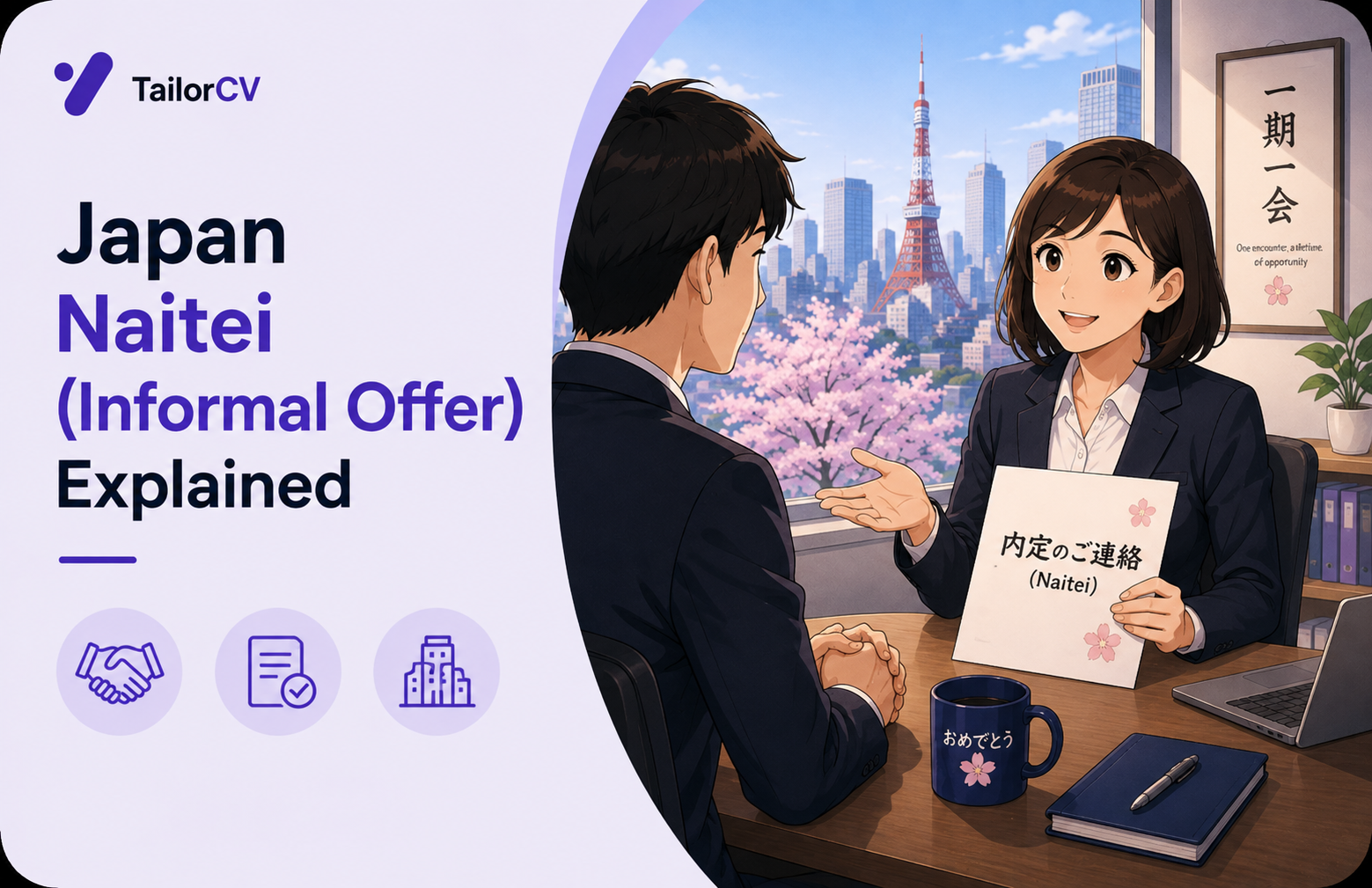
- Naitei is an informal job offer given months before graduation, and receiving one usually ends your search.
- International students can participate, and some employers actively want them - but the timeline and the document conventions catch people out.
Japanese graduate recruitment - 就活 (shukatsu) - is unlike anything in most other countries. It is a synchronised national process where an entire cohort of students job-hunts simultaneously, on a broadly agreed schedule, wearing near-identical recruit suits, for jobs that start on the same date in April.
For international students in Japan, the practical problem is usually not eligibility. It is that shukatsu starts far earlier than they expect. By the time it feels like time to look for a job, the process has been running for a year.
This guide covers the calendar, the stages, and what to do if you are outside the standard track.
Before it starts, make sure your documents are ready - check them with the free ATS score checker.
Why It Works This Way
Japanese hiring for new graduates - 新卒採用 (shinsotsu saiyo) - is built around a different premise from most markets.
Companies hire for potential rather than for a specific role. You are recruited into the company, trained, and then assigned to a department. This is why your major matters less than in most countries, why a liberal arts graduate can end up in a technical function, and why the selection process focuses heavily on general aptitude and personal qualities rather than specific skills.
It also explains the synchronisation. Everyone is assessed on comparable general criteria at the same time, and everyone starts together in April.
This is changing. More companies now run year-round hiring, mid-career recruitment has grown substantially, and some employers hire for specific roles. But the traditional cycle still dominates graduate recruitment.
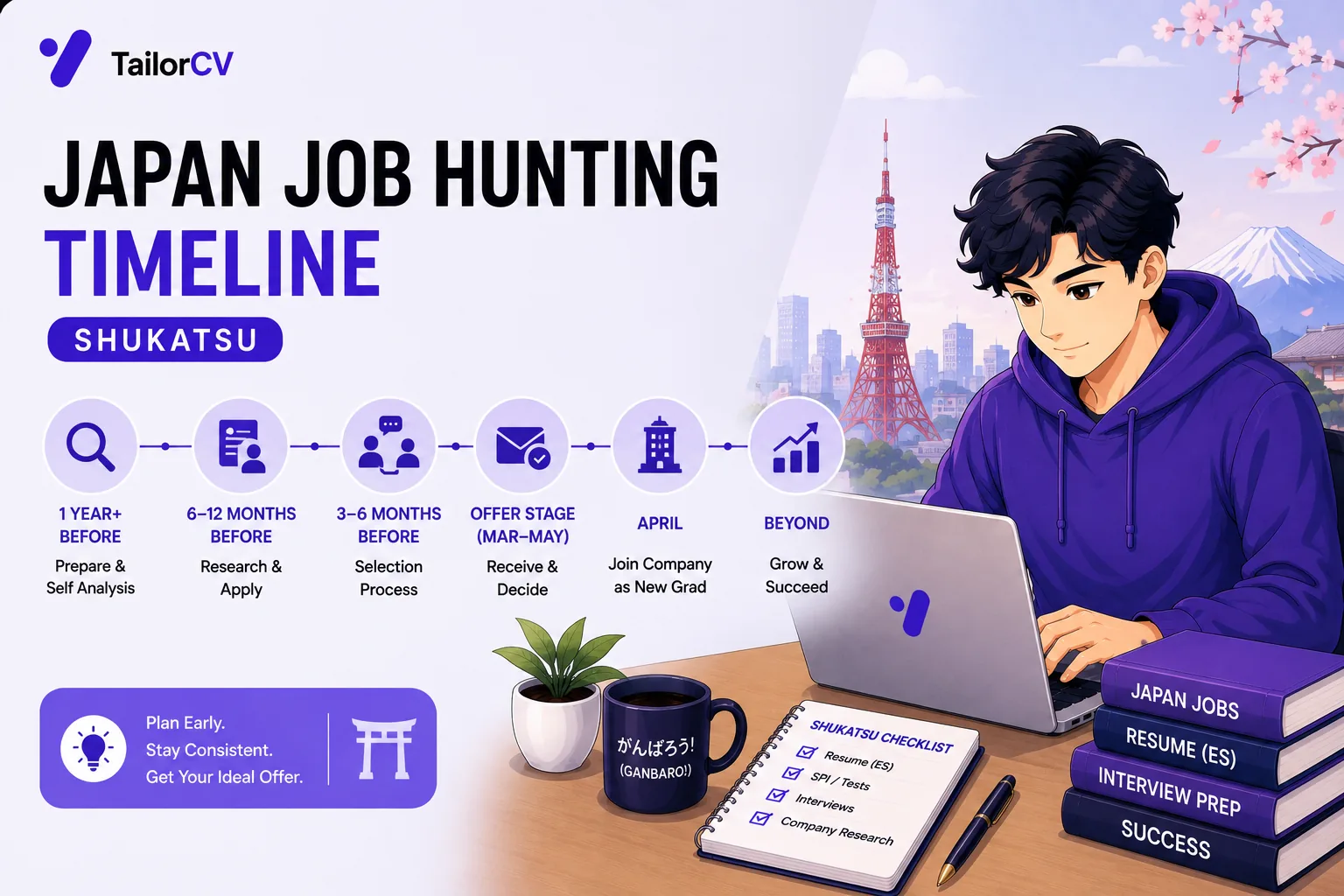
The Timeline
Roughly, for students graduating in March and starting in April:
Two years before graduation, from around summer: self-analysis (自己分析), industry research, and internship applications. Internships in Japan are frequently short - a few days to a few weeks - and function partly as a recruiting channel.
Summer and autumn, roughly 18 months before: summer internships. These matter more than the length suggests, because they build company relationships and some lead directly to early selection.
Autumn and winter: company information sessions (説明会), winter internships, and continued research. OB/OG visits begin - meeting alumni from your university who work at target companies, which is a distinctive and genuinely useful part of the process.
March, roughly a year before graduation: formal application season opens. Company entry sheets (ES) are submitted, and this is the moment most students think of as the start - though the preparation began long before.
Spring: written tests including SPI aptitude assessments, group discussions, and early interview rounds.
June onward: selection interviews intensify, and naitei - informal job offers - begin to be issued.
October: formal naitei ceremonies at many companies.
The following April: you start work.
The critical point: by the time formal applications open in March, students who did summer internships and OB visits already have relationships and in some cases early selection tracks. Starting in March means starting behind.
The Stages in Detail
Self-analysis (自己分析)
A distinctive and heavily emphasised step. Students are expected to reflect systematically on their strengths, values, formative experiences, and motivations, and to be able to articulate them consistently.
It sounds soft, and it directly determines the quality of your entry sheets and interview answers. The questions - why this industry, why this company, what defines you - all draw on it.
Entry sheets (ES)
Application documents, usually with several free-text questions of a few hundred characters each:
- 志望動機 - your motivation for applying to this company
- 自己PR - self-promotion, your strengths with evidence
- ガクチカ (学生時代に力を入れたこと) - what you focused on during your student years
These are individually assessed, not skimmed, which is why volume applications fail. The gakuchika question in particular expects a specific, structured story about something you committed to - a club, a part-time job, research, a project - and what you learned.
Written tests
SPI is the most common aptitude test, covering language and non-verbal reasoning, sometimes with a personality assessment. Other formats exist including tamatebako and GAB.
These are practisable, and practice measurably improves scores - the same logic as any aptitude test, covered in the campus placement aptitude test guide.
Group discussions
Groups of students discuss a topic while assessors observe. Contribution quality and group behaviour are scored rather than airtime - bringing in a quiet participant scores well, dominating does not. The mechanics are the same as in campus placement group discussion tips.
Interviews
Multiple rounds, typically increasing in seniority. Heavily focused on motivation, self-understanding, and fit rather than technical assessment. Etiquette is weighted seriously - see Japan interview etiquette.
Naitei
An informal offer, given months before graduation and generally honoured. Accepting typically means ending your search - continuing to interview after accepting is possible but socially awkward and sometimes discouraged.
International Students
You can participate in shukatsu, and some companies actively recruit foreign students - particularly those seeking global capability or specific language skills.
What helps:
Japanese ability. N2 or above is generally expected for standard shukatsu. Below that, target companies with English-language tracks - which exist but are a smaller set.
Starting on time. The most common failure. If you arrive for a master's programme in autumn and start looking in your final spring, you have missed the cycle.
Understanding the documents. Entry sheets, rirekisho, and later shokumu keirekisho all follow conventions - see the rirekisho guide and the shokumu keirekisho guide.
Visa clarity. Employers will ask about your status of residence and your intention to change it after graduation - see the Japan work visa guide.
Commitment. You will be asked how long you plan to stay in Japan, and the answer matters. Vagueness costs offers.
Alternative routes exist. Mid-career hiring, foreign-owned companies, and modern startups largely operate outside the shukatsu calendar and hire year-round. If you missed the cycle or your Japanese is not at N2, these are the realistic path - see IT jobs in Japan for foreigners and how to get a job in Japan as a foreigner.
Common Mistakes
Starting too late. By the time formal applications open in March, students who did summer internships and OB visits already hold relationships and sometimes early selection tracks - so a March start is genuinely behind rather than on time.
Skipping self-analysis. It feels soft and it directly determines the quality of every entry sheet and interview answer you give afterwards, because all of them draw on the same material.
Writing generic entry sheets. These are individually assessed rather than skimmed, so a motivation answer that could apply to any company in the industry scores near zero.
Neglecting SPI practice. It is a learnable format under time pressure, and familiarity measurably improves scores - yet many students treat it as something that cannot be prepared for.
Ignoring OB/OG visits. Meeting alumni at target companies is a distinctive and genuinely useful part of the process, and it is one of the few places where individual initiative visibly differentiates you.
Assuming your major determines your role. Companies hire for potential and assign departments afterwards, so a technical degree does not guarantee a technical placement and a humanities degree does not exclude one.
Applying to too many companies superficially. Entry sheets and interviews both reward specific knowledge of the employer, and spreading across forty companies produces forty generic applications.
Being vague about how long you will stay. Japanese employers weigh commitment heavily for foreign candidates, and an uncertain answer is interpreted unfavourably rather than as honesty.
Frequently Asked Questions
What is shukatsu?
Japan's synchronised graduate job-hunting process. An entire cohort applies simultaneously on a broadly fixed national calendar, for jobs that start together the following April.
When does shukatsu start?
Preparation begins well over a year before graduation, with summer internships around 18 months out and formal applications opening around March of the preceding year. The effective start is much earlier than the formal one.
Can international students participate?
Yes, and some companies actively recruit foreign students. Japanese ability around N2 is generally expected for standard shukatsu, and starting on the same timeline as domestic students matters more than anything else.
What is naitei?
An informal job offer issued months before graduation, generally honoured by both sides. Accepting usually means ending your search.
Does my university major matter?
Less than in most countries. Companies hire for general potential and assign departments after joining, which is why selection focuses on aptitude and personal qualities rather than specific skills.
What if I miss the shukatsu cycle?
Mid-career recruitment, foreign-owned companies, and modern startups hire year-round outside the traditional calendar. These are the realistic route if you missed the window or your Japanese is below N2.
How many companies should I apply to?
Fewer, with genuine research, beats many superficial applications - entry sheets are individually assessed and interviews reward specific company knowledge. Japanese students often apply to a large number, but the ones who convert do so on the applications they researched properly.
Make sure your documents are ready before the cycle starts. Check your ATS score free.
Make This Practical
Work backwards from your graduation date and mark the summer internship window, because that is the real start of shukatsu rather than the March application opening. If you are an international student arriving for a two-year programme, this means beginning in your first year rather than your final one.
Then do the self-analysis properly, however soft it feels. Your motivation answers, self-PR, and gakuchika story all draw on the same material, and students who skip this step write entry sheets that read as interchangeable - which is exactly what gets them screened out.
Finally, prepare the parts that are mechanically improvable and build relationships early. Practise SPI under time pressure using the approach in the campus placement aptitude test guide, do OB/OG visits at target companies, prepare group discussions with campus placement group discussion tips, and build your documents to convention with the rirekisho guide. If the cycle has passed, the year-round routes in IT jobs in Japan for foreigners remain open.
What is your resume scoring right now?
Scan it against a job description and get your ATS match score in about a minute.
Drop your resume here or choose a file
PDF only. Max 2 MB.
We never share your data or use it to train AI models.

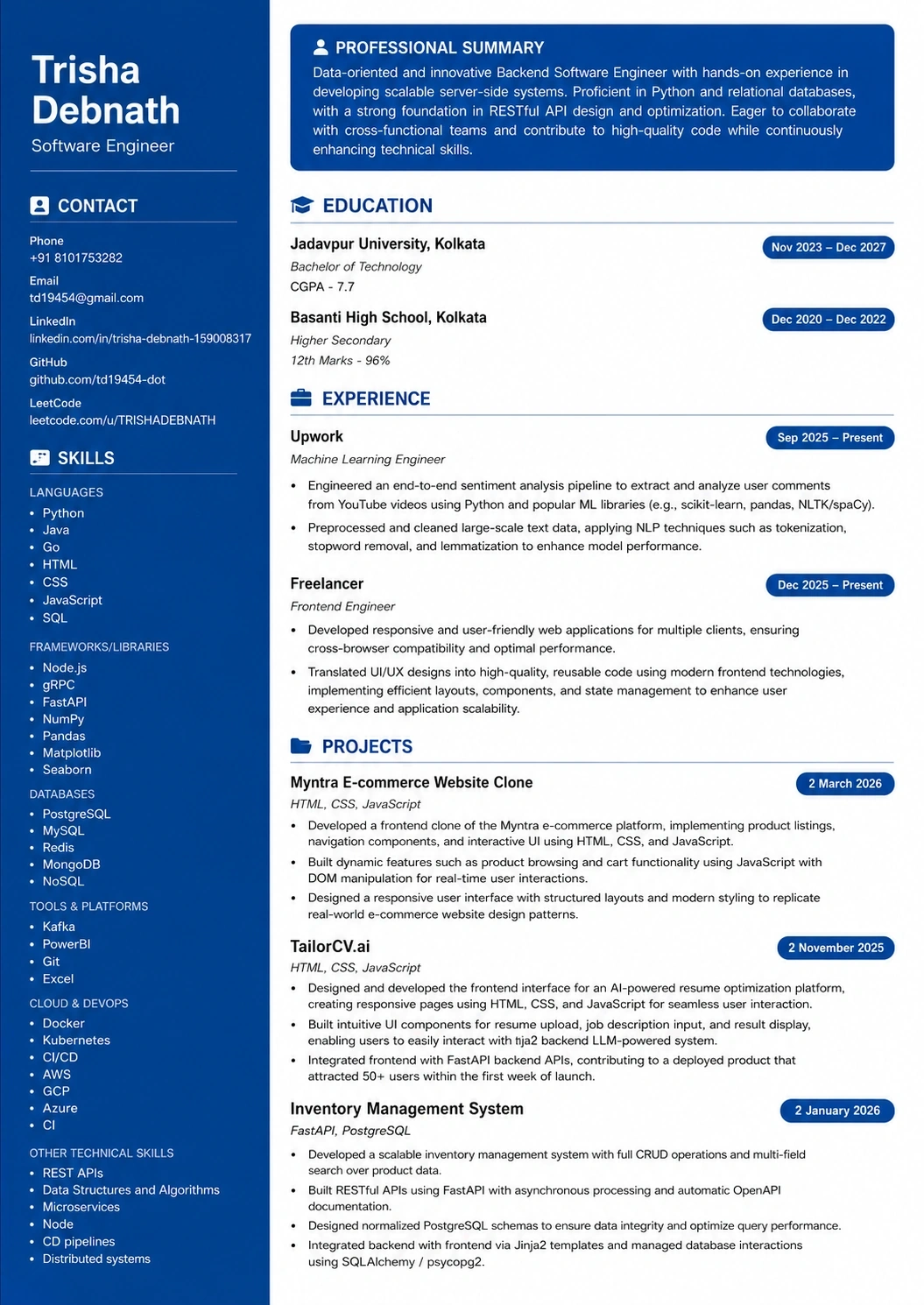
Templates that keep this structure intact
This template is ATS-tested — start from it and the formatting rules in this guide are already handled.
Was this guide useful?
Be the first to rate it.