 SS
SS
Key Takeaways
- Standardised aptitude testing is used widely and is frequently an early, mechanical filter before any human reads your application.
- The tests cover language and numerical reasoning plus a personality component, and the difficulty is speed rather than content.
- Group discussions assess how you work with others, not whether you win the argument.
- Both stages are trainable, and Japanese students practise for them extensively, which is the standard you are competing against.
- Foreign candidates face an additional language load on the tests, making practice more important rather than less.
The aptitude tests
What they are. Standardised assessments used widely in Japanese graduate recruiting, typically combining a language section, a numerical reasoning section and a personality inventory. The SPI (by Recruit Management Solutions) is by far the most widely used test family — knowing this matters practically because SPI-specific practice books and prep apps are the standard resource Japanese students use, and searching for SPI preparation directly gets you the highest-yield material. Tamatebako and other SHL Japan tests are the next most common alternative, particularly at certain large corporations, with a somewhat different question style worth recognizing so you're not caught off guard mid-test. The Uchida-Kraepelin test — a distinctive continuous-addition exercise assessing concentration and work pace over time — still appears at some more traditional employers and is worth knowing exists, since its format (add single-digit numbers in a row, repeatedly, for an extended period) looks nothing like the other tests and can otherwise be genuinely disorienting to encounter unprepared.
Where they sit. Usually early, after the written application and before interviews. At high-volume employers this is a genuine mechanical filter — fail it and no human reads what you wrote.
The language section tests vocabulary, reading comprehension and logical relationships between words and statements.
The numerical section tests arithmetic reasoning, ratios, percentages, probability and data interpretation. The mathematics is not advanced; the time pressure is severe.
The personality inventory assesses working style and traits. There is no right answer and consistency matters — answering to project an image rather than honestly produces contradictory patterns that are visible.
Format varies. Some are taken at testing centres, some online at home, some at the company's offices. Check which applies.
Preparing for them
Practice is the whole strategy, and it works because the difficulty is format and speed rather than knowledge.
Practice books are standard. Japanese students work through them extensively — this is normal, expected preparation, and it is the standard you are measured against.
Practise under time pressure from the start. Untimed practice builds accuracy, and accuracy is not what is being tested. The same principle applies to psychometric testing anywhere, and it is the single most common preparation error.
Learn the recurring question types. Both sections use a limited set of patterns, and recognising a pattern instantly is most of the speed advantage.
For foreign candidates, the language section carries an additional load. You are reading and reasoning in a second language under time pressure, which is genuinely harder. This is an argument for more practice, not for skipping it.
Answer the personality section honestly and consistently. Inconsistent patterns are detectable and reflect worse than an ordinary profile would.
Group discussions
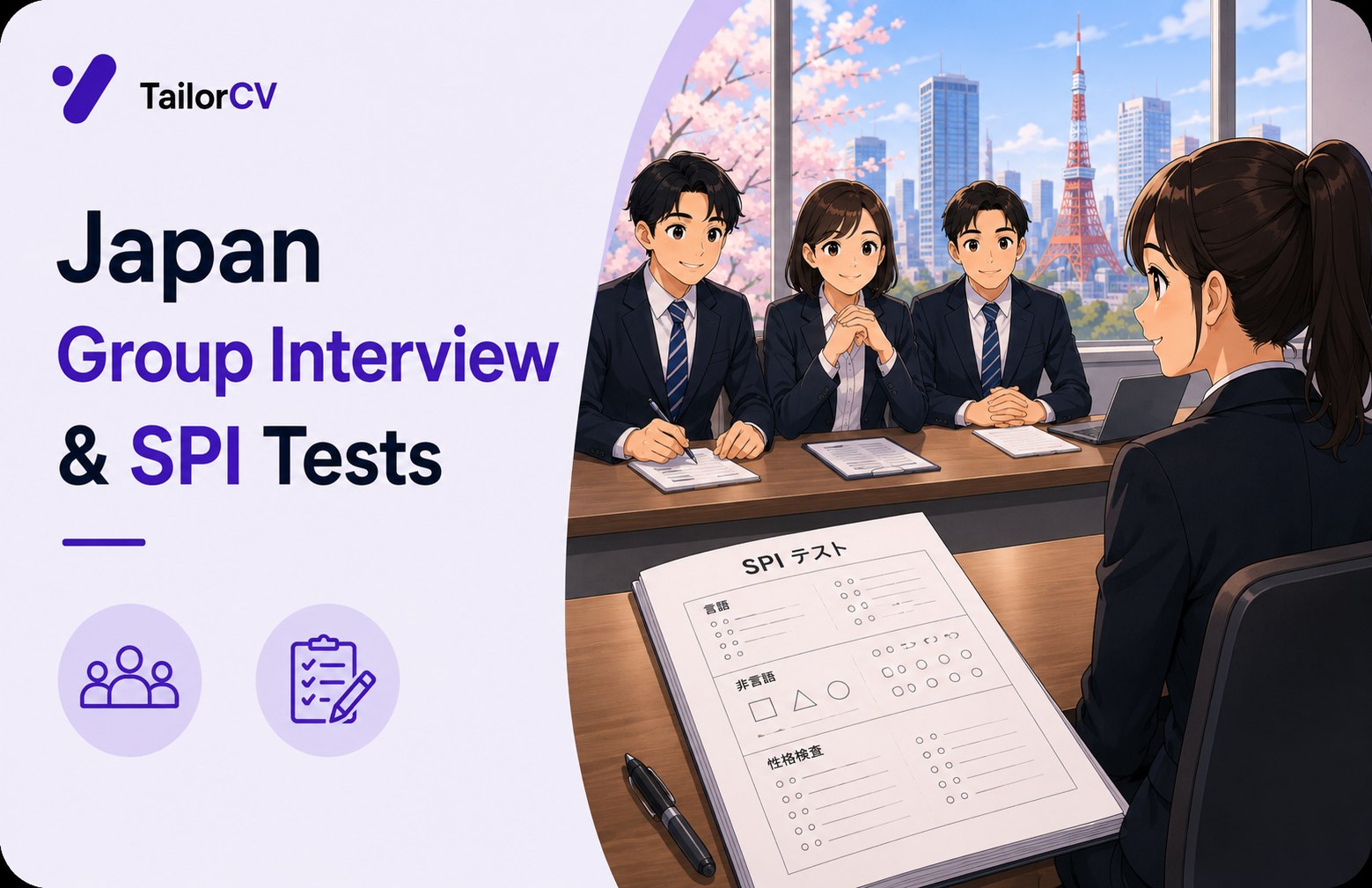
The format. Several candidates given a topic and a time limit, asked to discuss and frequently to reach a conclusion, while assessors observe without participating.
What is assessed. How you operate with other people — whether you contribute substance, listen and build on others, help the group manage its time, and handle disagreement constructively. The group's conclusion matters far less than your conduct reaching it.
Behaviours that score well. Contributing early so you are visible. Building explicitly on what someone else said. Bringing in a quieter participant. Watching the clock and saying so. Summarising where the group has reached partway through — almost nobody does this and every assessor notices.
Behaviours that fail. Dominating, which reads as poor collaboration. And disappearing, which is more common and equally fatal, because an assessor cannot score what you did not do.
Roles. Groups sometimes assign a facilitator, timekeeper or presenter. Any of these is fine and none is necessary — the assessment is on how you contribute, not on which label you hold.
For foreign candidates, the challenge is participating fluently in a fast Japanese discussion. Practising in a group beforehand is worth considerably more than reading about it.
The group interview format, specifically
Several candidates are assessed together, either in a group discussion exercise or answering questions in sequence within the group, this is a genuinely distinct format from an individual one-to-one interview, worth practising specifically rather than assuming individual interview skills transfer directly.
What is actually being assessed is how you behave within a group, whether you contribute genuinely, listen and build on what others say, and handle disagreement constructively, dominating the conversation is not the goal, similar in principle to group interview assessment in other markets that use this format, though the specific register expected here leans toward the measured, collaborative style discussed in the broader interview guide.
Practise this format specifically with friends beforehand, the first attempt at a genuinely unfamiliar format is rarely a candidate's best performance.
Aptitude and written testing
A standard written test covering verbal reasoning, numerical ability and sometimes general knowledge or personality assessment is a common early stage at many large employers, this functions as a genuine early filter, similar in principle to aptitude testing used broadly in structured graduate hiring internationally.
This is trainable through dedicated practice, practice materials for this specific test format are widely available, worth investing real preparation time here since it is one of the more directly improvable stages of the overall process.
Speed under time pressure is generally the binding constraint, rather than the underlying difficulty of the material itself, practising under a genuine timer, rather than untimed, builds the actually relevant skill.
Building a sustainable testing preparation routine
Set aside consistent, regular practice time for aptitude testing across several weeks, rather than cramming immediately before your first real test, similar to the same sustained preparation discipline that works for any timed aptitude assessment, consistent shorter sessions generally outperform occasional long ones.
Review your specific errors carefully after each practice set, most candidates' mistakes cluster into a small number of recurring types, identifying and correcting these specifically is more efficient than repeating generic practice indefinitely.
What happens if you do not pass the aptitude test
Some companies allow a retake after a defined period, others do not for that specific application cycle, worth checking the specific policy where stated, and using any interval productively to genuinely improve your speed and accuracy through further practice.
A single company's test result does not affect your standing with a different company, each employer's process is independent, worth continuing to apply broadly rather than treating one disappointing result as representative of your overall prospects.
Tip: Buy one SPI practice book and work through it under a timer. The difficulty is speed, not content — candidates who fail this stage almost always ran out of time rather than not knowing the material.
Common Mistakes
- Not practising the aptitude tests. Japanese students prepare extensively and it is the standard you are measured against.
- Practising untimed. Speed under pressure is the actual test.
- Answering the personality section strategically. Inconsistency is visible and reflects poorly.
- Trying to win the group discussion. It assesses collaboration, not debate.
- Staying silent in the group discussion. Staying silent in the group discussion an assessor cannot score what you did not contribute.
- Underestimating the language load. It is genuinely harder and it is trainable.
Related Guides
Keep building on this with the related guides in this series:
- Japanese Interview Questions - What Mensetsu Actually Tests
- English-Speaking Jobs in Japan - Where They Actually Are
- Internships in Japan for International Students
- Japanese Language Requirements for Jobs in Japan
- Teaching in Japan - The JET Programme and the Alternatives
- JLPT N2 and N1 - What They Actually Mean for Employment in Japan
You can also check your resume's ATS score for free, generate a tailored cover letter, or build a portfolio website in minutes.
Frequently Asked Questions
How is a group interview different from a normal interview?
You are assessed alongside other candidates simultaneously, the focus is on how you contribute and interact within the group, rather than solely on individual answers, worth practising this specific format deliberately.
Is the aptitude test hard to pass?
The underlying material is generally not advanced, the genuine difficulty is speed under time pressure, dedicated timed practice meaningfully improves most candidates' results.
Should I try to dominate the group interview to stand out?
No, this generally reads poorly, genuine contribution and collaborative behaviour is what is actually being assessed, not dominance.
How do I prepare for the aptitude test specifically?
Use available practice materials and, critically, practise under a genuine timer rather than untimed, since speed is generally the binding constraint rather than the underlying difficulty.
How much practice do the aptitude tests need?
Enough to be comfortable with the format and fast under time pressure — typically weeks of consistent work with practice materials rather than a single session.
Can I retake a test if I do badly?
Generally not within the same application. Some test results can be reused across applications depending on the format, which makes the first attempt more consequential.
Is the group discussion competitive against other candidates?
No. Assessment is generally against criteria rather than by ranking, which means helping the group costs you nothing and behaving competitively is marked down.
What if my Japanese is not fast enough for the discussion?
Practise in groups beforehand, prepare useful phrases for contributing and summarising, and contribute early rather than waiting for a perfect moment. Some employers, particularly English-operating ones, run these in English.
Do all companies use these stages?
Widely used in conventional graduate recruiting, and less so at technology companies and foreign-affiliated firms hiring for specific roles — see the technology route.
Does the personality test have right answers?
No, and it does have consistency. Answer honestly rather than constructing a profile you think they want.
Was this guide useful?
Be the first to rate it.