TD
TD
Key Takeaways
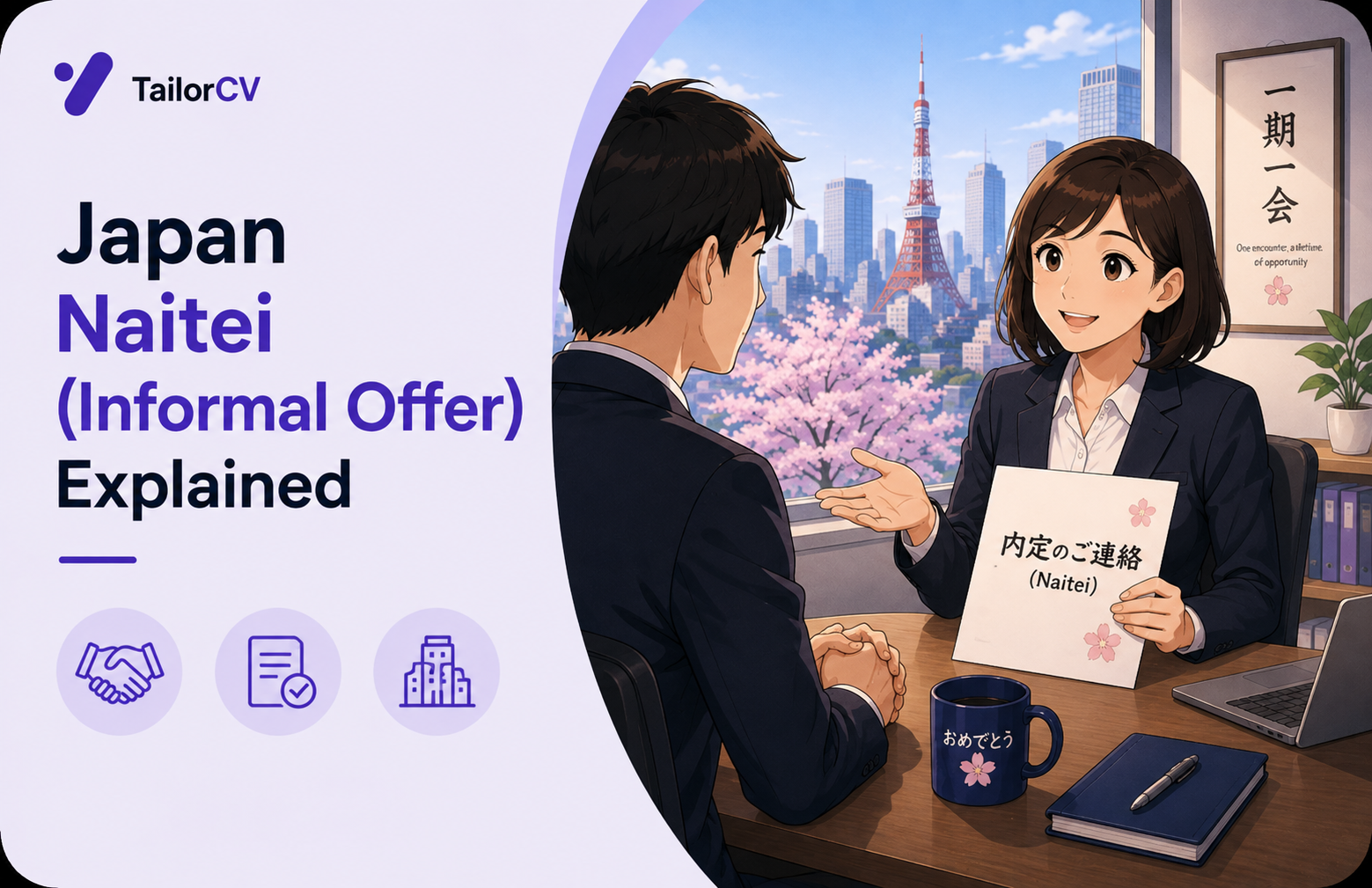
- A naitei is an informal offer of employment issued months before graduation and before any formal contract.
- It is not legally a completed employment contract and it is treated with considerable social weight.
- A formal ceremony traditionally marks acceptance and effectively signals the end of your job hunt.
- Holding multiple offers is common during the process; holding them indefinitely after accepting one is not.
- Declining after acceptance is possible and carries real reputational cost, particularly through your university.
What it actually is
An informal commitment to employ you, issued after you clear the selection process and typically many months before you would start work in April.
Not yet a formal contract. The formal employment agreement comes later. The naitei is a promise on both sides — the company intends to hire you, and you intend to join.
Timing. Issued during the main selection period, which concludes long before graduation. Students frequently have their employment settled a year before they start.
Why the gap exists. The system recruits well in advance and everyone enters together in April, which means a long period between the decision and the start date.
The social weight is the important part. Legally it is informal; practically it is treated as a serious mutual commitment, and behaviour around it is governed by convention as much as by contract.
The acceptance process
A period of holding multiple offers is normal. Candidates progress through several companies simultaneously and may receive more than one informal offer.
Companies apply pressure to commit. Once an offer is issued, companies frequently want confirmation, and some run events and communications specifically to keep successful candidates engaged and discourage them from continuing to search.
A formal acceptance ceremony — 内定式 (naitei-shiki) — traditionally takes place in the autumn (commonly October 1st), marking your commitment. Attending is generally understood as accepting, which is why the date matters practically: it's often treated as the real deadline for making up your mind, well before any written contract follows.
Rescission does happen, rarely — 内定取消 (naitei torikeshi). Companies can and occasionally do withdraw an informal offer, typically citing serious cause (company financial distress, a candidate failing to graduate, or misconduct discovered after the offer). It's uncommon enough to be newsworthy when it happens at scale, and Japanese courts have in some cases found an unjustified rescission to constitute a breach of an implied employment contract — worth knowing the term exists so you recognize it if a company ever raises the possibility, rather than assuming it's an empty threat with no real precedent either way.
After acceptance, the expectation is that your search ends. Continuing to interview elsewhere after accepting is viewed considerably more negatively than in markets where candidates routinely keep options open.
Pre-employment contact continues. Companies typically maintain contact through the months before April with events, correspondence and sometimes training, which is part of building the cohort relationship.
Declining, and what it costs
It is possible. People do decline informal offers, including after accepting, and it is not a legal impossibility.
It carries real social cost. The convention is strong and departing from it is noticed.
Your university may be involved. Institutions frequently have relationships with employers and an interest in maintaining them. Declining after acceptance can affect your university's standing with that company and, in some cases, involve your career centre directly. This is a meaningful difference from markets where an offer is purely bilateral.
Do it as early as possible and communicate directly. If you know you will not accept, saying so promptly and politely is far better than delaying. A phone call rather than an email is the conventional expectation.
Be honest and brief. An apologetic, clear explanation is the right register. Elaborate justification is not required.
The practical advice: avoid accepting an offer you are not reasonably certain about. The convention makes reversal costly in a way that is easy to underestimate from outside.
For foreign candidates specifically
Understand the commitment before accepting. The social weight is heavier than the legal status suggests, and this is exactly the kind of convention that is invisible unless someone explains it.
Your visa depends on it. The work visa application follows from having an offer, and the timeline runs from your acceptance toward an April start. Changing employers late complicates this materially.
The gap before starting is long. Months between acceptance and beginning work, during which you may still be studying. Plan the practical logistics — status change, accommodation, relocation — well ahead rather than in the final weeks.
Ask about pre-employment expectations. Some companies run training, events or correspondence during the gap, and knowing what is expected of you avoids appearing disengaged.
If you are also considering other countries, resolve that before accepting rather than after. Holding a Japanese informal offer while continuing to pursue opportunities elsewhere sits badly with the convention.
Why this stage carries such real weight
Accepting this informal offer is generally understood within the local system as a genuine, serious commitment, this reflects the traditional employment structure and cultural expectations around this system, discussed in more depth in the broader shinsotsu system guide, continuing to actively interview elsewhere after accepting is viewed considerably more seriously here than simply continuing a search after accepting an offer might be treated in some other job markets.
Withdrawing from an accepted informal offer, while not unheard of, carries genuine social and reputational consequences within this system, worth being genuinely decided before accepting rather than treating it as a flexible placeholder.
What happens between the informal and formal offer
A period generally exists between this informal offer and the eventual formal, official start of employment, during which some employers maintain periodic contact or organise informal events with the incoming cohort, understand what your specific employer expects during this period.
If your circumstances genuinely change during this period, a serious personal or academic issue, for instance, communicate honestly and promptly with the employer rather than simply disappearing, this is understood to happen occasionally and is handled far better through honest communication than through silence.
Deciding before you are actually offered
Think through in advance what would make you comfortable accepting an informal offer from a specific company, rather than deciding in the moment under the genuine social pressure this stage can carry, having clarity beforehand about your own priorities makes the actual decision considerably easier when it arrives.
If you are genuinely still deciding between multiple companies at this stage, communicate honestly about your timeline where possible, rather than accepting prematurely simply to end the uncertainty.
Understanding what happens between acceptance and your actual start
Some companies organise periodic events or maintain contact with their incoming cohort during the period between this informal offer and the actual formal start of employment, understand what your specific employer expects and plans during this period, since expectations genuinely vary by company.
Use this period productively, continuing any relevant language study, completing your studies properly, and in some cases beginning informal preparation the company suggests, rather than treating it as entirely disconnected from your eventual start.
Tip: Decide before the 内定式 (naitei-shiki) ceremony, usually held on October 1st. Attending is generally read as acceptance, so treat that date — not the written contract — as your real deadline.
Common Mistakes
- Treating it as non-binding. The social weight is the operative constraint.
- Accepting while intending to keep searching. Contrary to convention and damaging when discovered.
- Declining late or by email. Early and direct is the expectation.
- Not understanding your university's involvement. Institutional relationships can be affected.
- Ignoring the long gap before starting. Visa, relocation and logistics need planning.
- Accepting without certainty. Reversal is costly in a way that is easy to underestimate.
Related Guides
Keep building on this with the related guides in this series:
- English-Speaking Jobs in Japan - Where They Actually Are
- Group Discussions and Aptitude Tests in Japanese Recruiting
- Internships in Japan for International Students
- Japanese Language Requirements for Jobs in Japan
- Teaching in Japan - The JET Programme and the Alternatives
- JLPT N2 and N1 - What They Actually Mean for Employment in Japan
You can also check your resume's ATS score for free, generate a tailored cover letter, or build a portfolio website in minutes.
Frequently Asked Questions
Is this informal offer legally binding?
Generally understood as carrying real social and practical weight, though the specific formal legal status can vary, treat it as a genuine, serious commitment regardless of its precise formal legal characterisation.
Can I keep interviewing at other companies after accepting?
Technically possible and viewed considerably more seriously here than in some other job markets, worth being genuinely decided before accepting rather than treating this stage as a flexible placeholder.
What if my circumstances change after accepting?
Communicate honestly and promptly with the employer rather than going silent, this is understood to occasionally happen and is handled far better through direct communication.
When does this become a formal, official offer?
Generally at a later point closer to the actual start of employment, understand your specific employer's own timeline and any expectations during the intervening period.
Is a naitei legally binding?
It is not a completed formal employment contract, and it is treated as a serious mutual commitment. The practical constraint is convention rather than enforcement.
Can I hold more than one?
During the process, yes — progressing with several companies is normal. After formally accepting one, continuing to hold others contradicts the convention.
What happens at the acceptance ceremony?
It is a formal event marking your commitment to join, traditionally held in the autumn. Attending is generally understood as acceptance.
Can I decline after accepting?
Yes, and it carries real social cost and may involve your university. Do it as early as possible, by phone, honestly and briefly.
When do I get the actual contract?
The formal employment agreement typically comes later, closer to your start date.
What if the company withdraws the offer?
Rare, and it does happen in unusual circumstances. If it occurs, speak to your university's career centre promptly, since institutions frequently have channels for exactly this situation.
What is your resume scoring right now?
Scan it against a job description and get your ATS match score in about a minute.
Drop your resume here or choose a file
PDF only. Max 2 MB.
We never share your data or use it to train AI models.

Was this guide useful?
Be the first to rate it.