 TD
TD
Key Takeaways
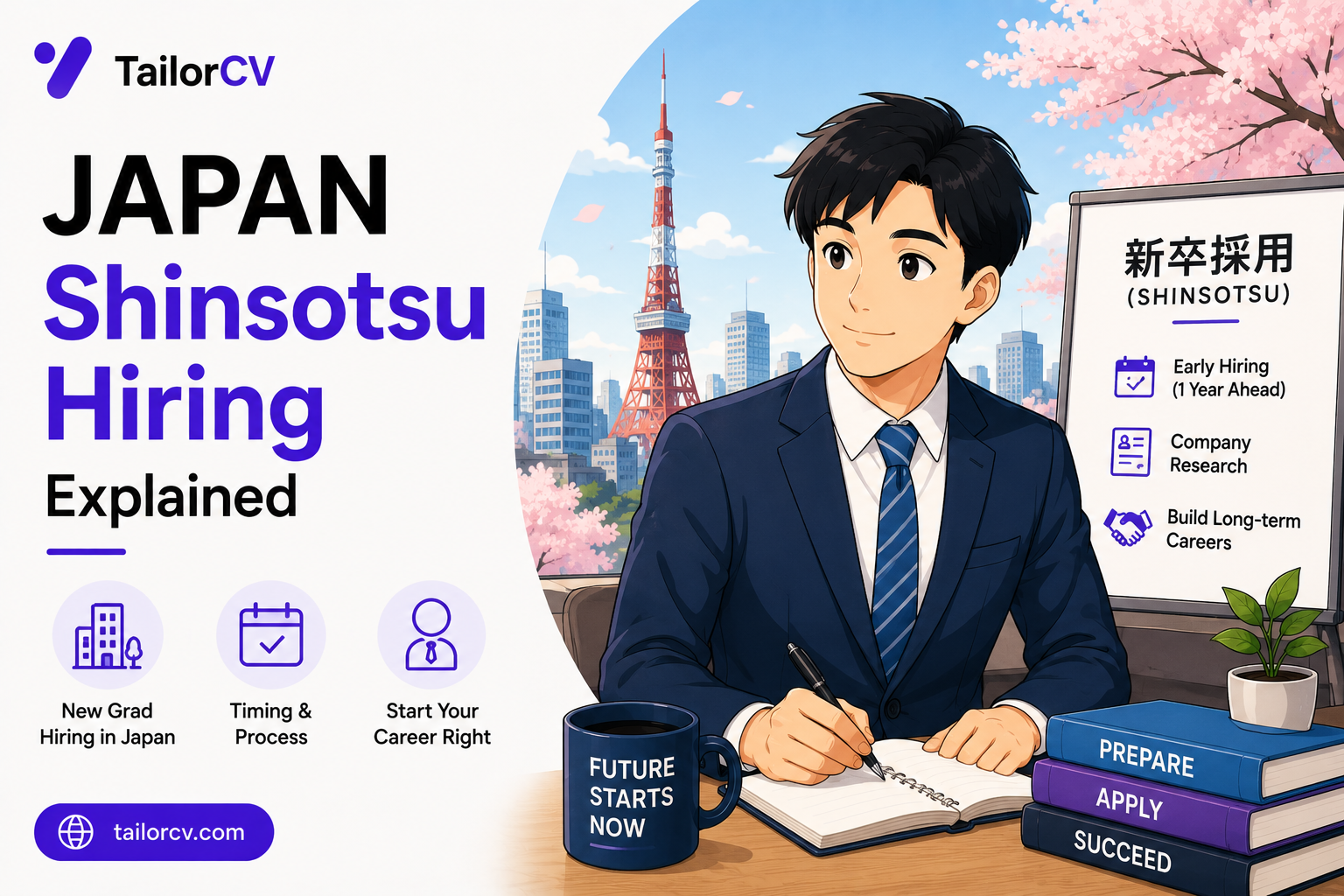
- Japan runs a distinct system for hiring new graduates — shinsotsu recruiting — that operates on a fixed annual cycle and differs fundamentally from mid-career hiring.
- Companies hire for potential and general aptitude rather than for a specific role, and assign your position after you join.
- The cycle is long, formal and synchronised, with most students following the same calendar simultaneously.
- Foreign graduates can and do enter this system, and doing so requires understanding its conventions rather than applying Western job-search habits.
- Missing the shinsotsu window means entering the mid-career market instead, which is structured very differently.
What shinsotsu recruiting actually is
A separate hiring category. Japanese companies traditionally distinguish sharply between new graduate hiring and mid-career hiring. These are different processes with different criteria, different calendars and often different entry points into the organisation.
Hiring for potential, not for a role. This is the most important structural difference from Western graduate recruiting. Companies frequently recruit generalists, assess aptitude, personality and fit, and then assign a department after joining — sometimes after a period of training. You may not know your actual job until well after accepting.
Simultaneous mass entry. New graduates traditionally join together, typically in April, in a cohort. This shapes everything: the calendar, the training, the internal culture, and the way careers progress in the early years.
A long, formal process. Multiple rounds spread over months, with heavy emphasis on written applications, aptitude testing and repeated interviews assessing fit and character as much as capability.
Why it exists in this form. The system reflects a model of long-term employment where a company invests in developing generalists internally rather than hiring specialists for defined roles. That model has evolved considerably and its structural legacy remains visible in how graduates are recruited.
What this means practically
Your degree subject matters less than you would expect for many companies, particularly in generalist tracks. Companies recruiting for potential are frequently open to graduates of any discipline, which is a genuine difference from markets where the degree gates the role.
You are being assessed as a person, over a long process. Consistency across rounds, how you present yourself, and whether you seem like someone who will fit and stay are weighted heavily. This is why the process runs so many rounds.
Self-analysis is a formal step. Japanese job hunting includes an expected process of reflecting on your own history, motivations and character, and being able to articulate them coherently. This is not optional preamble — it underpins the written applications and the interviews.
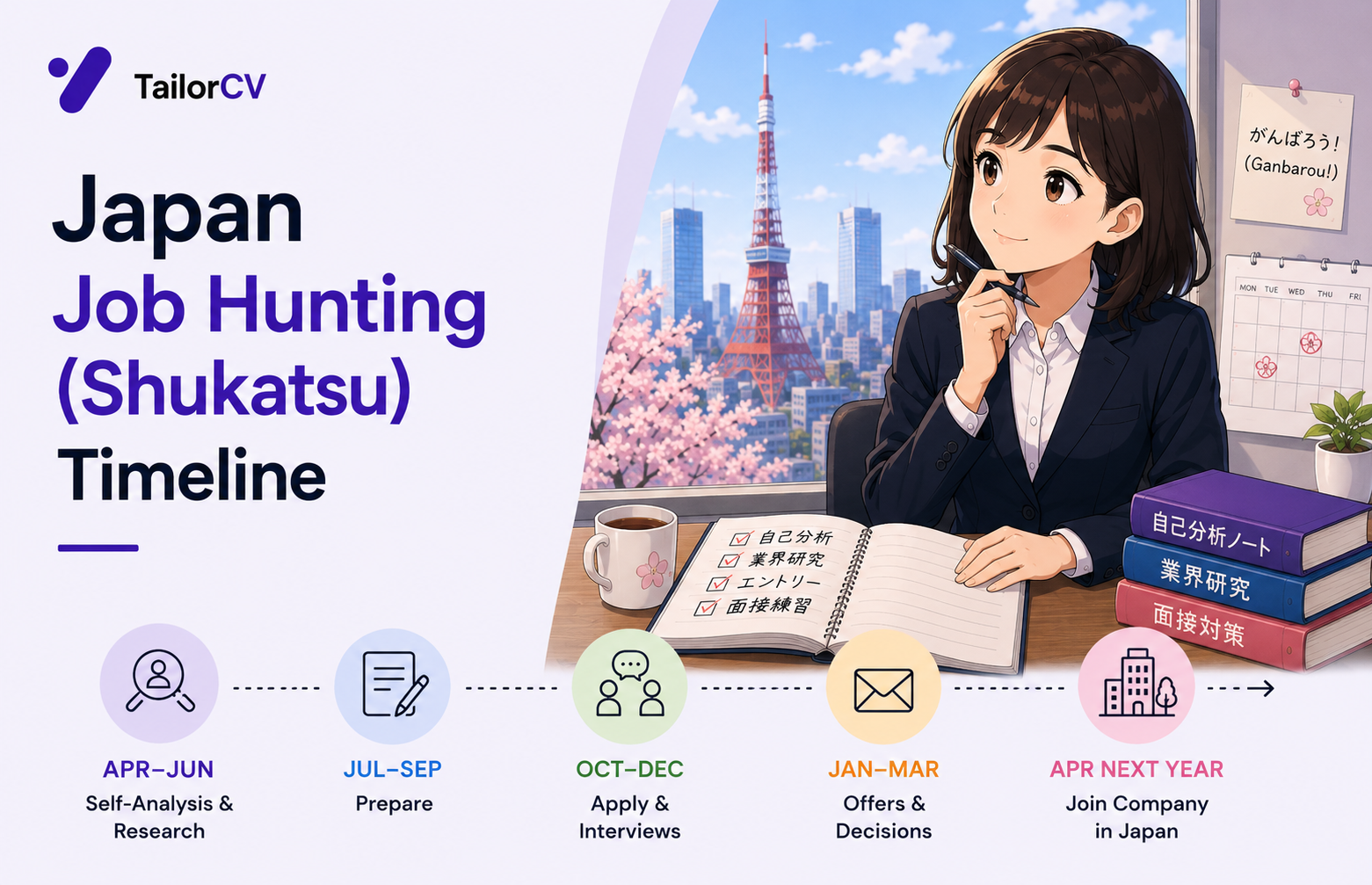
The calendar is largely fixed and shared. Most students in a cohort go through the same stages at roughly the same time, which is very different from the staggered, employer-specific timelines of many other markets. The detailed timeline is worth understanding before anything else.
Specialist and technology hiring is changing this. A growing number of companies, particularly in technology and at foreign-affiliated firms, hire for specific roles on more flexible timelines — see technology hiring for foreign graduates.
Where foreign graduates fit
You can enter this system, and increasing numbers of foreign students at Japanese universities do.
Japanese language ability is frequently the binding constraint. Generalist tracks at traditional Japanese companies typically expect a high level of business Japanese, because the entire process — and the job — runs in Japanese. The language requirements vary considerably by employer type and are the single biggest determinant of which companies are realistic.
English-conducted routes exist at foreign-affiliated companies, some technology firms and companies with global operations, covered in the English-speaking jobs guide.
Visa status follows employment. A work visa is applied for by the employer once you have an offer, and the category depends on the role and your qualifications.
Studying at a Japanese university helps considerably, both for access to the campus recruiting channels and because the entire shinsotsu system is built around students at Japanese institutions.
Applying from overseas is harder but possible, particularly for specialist and technology roles and at companies actively recruiting internationally.
The shinsotsu system, in more depth
Understanding why this system exists, not only what it requires, makes the whole calendar considerably easier to navigate.
A single, largely synchronised annual hiring cycle for new graduates has been the dominant model at large Japanese employers for decades, this is genuinely different from the rolling, year-round hiring common in many other major economies, and it produces a distinctive set of behaviours worth understanding rather than fighting against.
Nearly the entire eligible graduating cohort enters the process at the same time, applies to a similar set of large, well-known employers, and receives informal offers on a broadly similar timeline, this synchronisation is deliberate and long-standing, reflecting an employment model that traditionally emphasised long-term development within a single company over lateral, experience-based hiring.
The system has evolved over recent years, with somewhat more flexibility introduced for mid-year and rolling hiring at some employers, particularly at foreign multinationals and some newer domestic companies, worth understanding that the traditional synchronised model, while still dominant at many large traditional employers, is no longer the only path.
What makes this different from Western hiring
The process assesses potential and cultural fit more than specific prior experience or a defined skill set, this reflects the traditional expectation of extensive internal training after joining, rather than assuming a new hire arrives fully formed and ready to contribute immediately in a narrow specialism.
A very large number of company information sessions and events happen before formal applications even open, attendance at these is genuinely part of how companies build their eventual applicant pool and how students narrow their own choices, this is a distinct and substantial phase worth taking seriously rather than treating as optional promotional material.
The informal offer, extended well before an official start date, carries real social and psychological weight within this system, accepting one is generally understood as a serious commitment, and the practice of continuing to interview elsewhere after accepting one, while not unheard of, is viewed considerably more seriously here than simply continuing a search after accepting an offer in many other job markets.
International students and the shinsotsu system
International students studying at Japanese universities generally participate in the same system as domestic students, though language ability, covered separately, is a real and significant factor in how competitive you are within it.
Foreign multinationals operating in Japan sometimes run a somewhat different, more flexible process, closer to hiring convention in their home markets, worth understanding this distinction when deciding where to focus your effort, since the preparation and expectations genuinely differ between a traditional large domestic employer and an international company's Japan office.
If your Japanese language ability is not yet at a professional working level, this meaningfully narrows which employers within this system are realistically viable, the language requirements guide covers this in more depth, worth reading alongside this article to calibrate your realistic target list honestly.
Building your own strategy within this system
Start attending information sessions and researching target companies well before the formal application window opens, this preparatory phase is genuinely part of the process rather than idle time, students who begin engaging early build a considerably stronger foundation than those who wait for formal applications to open.
Decide honestly whether the traditional synchronised system, or the more flexible route offered by some foreign multinationals and newer domestic companies, better fits your own circumstances and language ability, rather than defaulting to one without genuinely weighing both, the broader visa and language considerations covered elsewhere in this series affect which route is realistically more accessible to you specifically.
Keep a genuine, organised record of every company you engage with, every information session attended, and every stage of each application, the volume of parallel processes within this system is considerable, and losing track of where you stand with a specific employer is a genuinely avoidable and costly mistake.
The rhythm of a typical year within this system
Understanding the broad shape of a year makes the whole process considerably less overwhelming. Information sessions and preparatory research generally begin well before formal applications, followed by a concentrated period of entry sheet submissions, aptitude testing, and multiple interview rounds, culminating in informal offers extended over a defined window before the eventual formal start of employment.
This rhythm repeats broadly each year across the traditional system, and while specific dates shift somewhat year to year and company to company, understanding the general shape lets you plan your own preparation realistically rather than reacting to each stage as it arrives.
International students in particular benefit from mapping this rhythm against their own academic calendar early, since coursework, examinations and language study all need to fit around a hiring process that follows its own largely fixed annual pattern, rather than adjusting to accommodate any individual student's academic schedule.
Comparing this system to hiring conventions elsewhere
Coming from an educational or professional background shaped by rolling, experience-based hiring, the synchronised nature of this system can initially feel restrictive, worth reframing this genuinely as a different set of trade-offs rather than a strictly worse system, the predictability and structure it offers, everyone moving through a broadly similar process on a broadly similar timeline, has real advantages that a more individualised, rolling system does not provide.
The traditional emphasis on hiring for potential rather than narrow prior experience genuinely benefits candidates without a directly matching background, a graduate whose degree does not map precisely onto a specific role is not automatically disadvantaged the way they might be in a system that screens heavily on demonstrated prior experience in the exact function, worth understanding this as a genuine structural advantage of the system for career changers and those from less conventional academic paths.
Understanding both the advantages and genuine constraints of this system honestly, rather than assuming it simply mirrors hiring conventions you may be more familiar with from elsewhere, is what actually lets you navigate it effectively.
Tip: If you graduated more than a year ago, search specifically for 第二新卒 (daini shinsotsu) roles. It is a recognised category for recent graduates outside the standard cycle, and many candidates never learn it exists.
Common Mistakes
- Applying Western job-search habits. Applying Western job-search habits the system has its own conventions and ignoring them reads as unprepared.
- Underestimating the language requirement. Underestimating the language requirement for generalist tracks at traditional companies it is usually decisive.
- Missing the calendar. Missing the calendar the cycle is fixed and shared; entering late means entering a different market.
- Expecting to choose your role. Many companies assign your department after you join.
- Treating self-analysis as a formality. It underpins the written applications and the interviews.
- Assuming your degree subject determines your options. Assuming your degree subject determines your options for generalist tracks it frequently does not.
Related Guides
Keep building on this with the related guides in this series:
- Sōgō Shōsha - Japan's Trading Companies and Graduate Hiring
- English-Speaking Jobs in Japan - Where They Actually Are
- Group Discussions and Aptitude Tests in Japanese Recruiting
- Internships in Japan for International Students
- Japanese Language Requirements for Jobs in Japan
- Teaching in Japan - The JET Programme and the Alternatives
You can also check your resume's ATS score for free, generate a tailored cover letter, or build a portfolio website in minutes.
Frequently Asked Questions
Is the entire Japanese job market really this synchronised?
Large traditional employers largely follow this synchronised model, though flexibility has increased over recent years, and foreign multinationals and some newer domestic companies often run somewhat different, more flexible timelines.
Do I have to accept the first informal offer I receive?
No, though withdrawing after accepting is viewed more seriously here than in some other job markets, worth being genuinely decided before accepting rather than treating it as a placeholder while you continue looking.
How early should international students start preparing?
Considerably earlier than the formal timeline suggests, information sessions and early relationship-building with target companies begin well before formal applications open, and language preparation, if needed, takes real time to build.
Can foreigners join the shinsotsu system?
Yes, and increasing numbers do, particularly graduates of Japanese universities. Language ability is usually the main practical constraint.
Do I need to speak Japanese?
For generalist tracks at traditional Japanese companies, business-level Japanese is generally expected. English-conducted routes exist at foreign-affiliated companies and some technology firms.
What if I miss the new graduate cycle?
You would generally enter the mid-career market, which is structured differently and typically expects relevant experience. Some companies also run "second new graduate" hiring for recent graduates within a few years of finishing.
Does my major matter?
Less than in many markets for generalist tracks, since companies hire for potential and assign roles later. It matters considerably more for technical and specialist positions.
When does everything actually happen?
The cycle runs over roughly a year with fixed conventional stages — the timeline guide covers the sequence in detail.
Is this system changing?
Yes, gradually. Specialist hiring, year-round recruitment and more flexible career paths are increasingly common, particularly in technology and at foreign-affiliated companies.
What is your resume scoring right now?
Scan it against a job description and get your ATS match score in about a minute.
Drop your resume here or choose a file
PDF only. Max 2 MB.
We never share your data or use it to train AI models.

Was this guide useful?
Be the first to rate it.