 TD
TD

Key Takeaways
- Every applicant claims the same soft skills, so listing them differentiates nobody.
- A claim is not evidence. "Excellent communicator" says nothing; "presented forecasts to a 40-person sales org" shows it.
- If a scan says you are missing soft skills, that is usually the safest part of the list to ignore.
- The exception: when a posting names one as a genuine requirement, evidence it in a bullet rather than listing it.
- Space spent on soft-skill lists is space not spent on the specifics that actually rank you.
Almost every resume has a line like "Communication · Teamwork · Problem-solving · Attention to detail · Leadership." Almost no recruiter reads it. Here is why, and what to do with that space instead.
Why Listed Soft Skills Are Ignored
Everyone claims them. When 300 applicants all list "strong communication skills", the line carries no information. It cannot separate anyone from anyone.
They are unfalsifiable. Nobody writes "poor attention to detail." A claim that nobody would ever contradict is not evidence of anything.
They are not checkable. A recruiter can verify you used Salesforce by asking a question. There is no equivalent question for "team player" that a prepared candidate cannot answer.
So the line gets skipped. Our post on how recruiters read a resume in six seconds covers where attention actually goes — and it is not the adjective list.
What the Matching Does With Them
Soft skills usually carry low weight in match scoring, for a practical reason: they appear in nearly every resume, so they discriminate poorly between candidates.
This is why, when a scan returns a missing list containing "communication", "collaboration" and "attention to detail", those are typically the safest items to ignore. Fixing them moves the number slightly and changes your actual standing very little. The items worth your twenty minutes are the required technical and domain gaps — see which missing skills actually matter.
Show It Instead
The qualities themselves are real and employers genuinely care about them. The mistake is asserting rather than demonstrating.
Communication
❌ Excellent written and verbal communication skills. ✅ Wrote the monthly performance summary read by the regional leadership team; presented quarterly results to a 40-person sales org.
Leadership
❌ Proven leadership abilities. ✅ Led a team of 4 analysts; onboarded and trained 6 new hires over two years, all of whom passed probation.
Problem-solving
❌ Strong analytical and problem-solving skills. ✅ Diagnosed a reconciliation error that had understated inventory by 3% for six months; rebuilt the check that now catches it automatically.
Teamwork / collaboration
❌ Collaborative team player. ✅ Partnered with engineering and merchandising to ship the pricing dashboard now used daily by 30 store managers.
Attention to detail
❌ Meticulous attention to detail. ✅ Maintained 99.8% accuracy across 1,200 monthly claim submissions; zero audit findings in three years.
Notice what happens: the reader infers the soft skill and learns something concrete about your work. One line does both jobs. Our guide to quantifying achievements covers finding these numbers.
The Exception: When a Posting Names One
Sometimes a soft skill is a genuine, stated requirement — client-facing roles, people management, teaching, care work, anything where the interpersonal work is the job.
When a posting explicitly requires it, do include the term, but attach it to evidence rather than listing it alone:
Managed relationships with 12 enterprise accounts, including quarterly business reviews and escalation handling; renewal rate 94%.
That contains "relationship management" and "escalation" as matchable language while proving both. This is the same principle as naming a skill in the bullet that already demonstrates it.
What to Do With the Space
A soft-skills line typically occupies one to three lines of a page you are fighting to keep tight. Better uses:
- Tools and systems the posting actually names — these are matched and verified.
- Domain and industry context — "retail", "B2B SaaS", "HIPAA-covered environment". Frequently omitted and frequently required.
- Certifications — checkable, and often a hard requirement.
- One more achievement bullet with a number in it.
If you want a skills section — and you should — make it concrete. Tools, platforms, languages, methods, certifications.
Should You Delete Them Entirely?
Not necessarily. A short, honest line is harmless, and some ATS configurations do look for a small number of stated competencies.
A reasonable compromise: keep two or three that are genuinely central to the target role, and cut the generic filler. "Stakeholder management · Cross-functional coordination" on a programme manager's resume is defensible. "Communication · Teamwork · Hard-working · Motivated" on anyone's resume is not.
What you should not do is spend a paragraph on them, or let them push a real achievement off the page.
The Interview Test
A useful check for any soft skill on your resume: if an interviewer asked "tell me about a time you demonstrated this," could you answer immediately with a specific story?
If yes, that story belongs on the resume instead of the adjective. If no, the claim should not be there at all — see improving your score without lying.
Frequently Asked Questions
Do employers care about soft skills? Very much. They just do not believe self-assessments of them. Evidence works; assertion does not.
My scan says I am missing soft skills. Should I add them? Usually not. They are lightly weighted and adding them changes little. Fix the required technical and domain gaps first.
What if the job description lists soft skills as requirements? Include the language, attached to a bullet that proves it rather than in a bare list.
Are soft skills more important for entry-level roles? They are weighted more when there is less experience to assess — but the same rule applies. Show them through coursework, part-time work or projects rather than claiming them.
Where should a skills section go? Near the top for technical roles where tools are the filter; below experience where the work history carries more weight.
Check What Is Actually Missing
If a scan handed you a long missing list, the useful move is separating the items that matter from the ones that do not.
Run your resume against the posting and look at the missing list. Set aside the generic soft skills — they are rarely why you were filtered — and focus on required tools, credentials and domain terms you have but did not state.
Free, about a minute. See also which missing skills actually matter and weak resume bullets.
What is your resume scoring right now?
Scan it against a job description and get your ATS match score in about a minute.
Drop your resume here or choose a file
PDF only. Max 2 MB.
We never share your data or use it to train AI models.
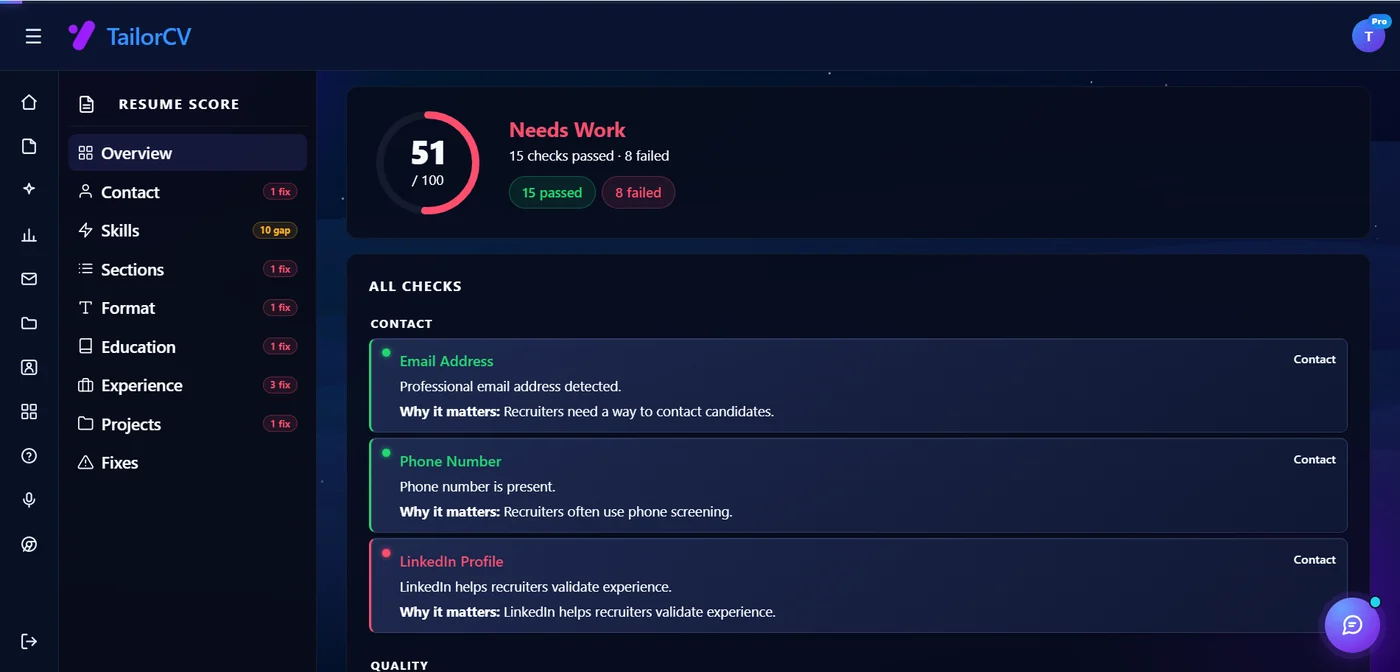
Templates that keep this structure intact
This template is ATS-tested — start from it and the formatting rules in this guide are already handled.
Was this guide useful?
Be the first to rate it.