 SS
SS
Key Takeaways
- In Malaysia, "CV" and "resume" are usually used interchangeably for a concise 1–2 page application document.
- The traditional distinction — a long, detailed CV vs a short, targeted resume — still applies to academic, research, and some medical/government roles.
- Whatever you call it, most Malaysian private-sector roles want a tailored, ATS-ready 1–2 page document.
- The exception: academia and research expect a full, multi-page CV listing publications, grants, and teaching.
- When unsure, follow the language and expectations of the specific job posting.
"Please submit your CV." "Attach your resume." In Malaysia, you'll see both requests — often for the same kind of job — and it's easy to wonder whether you're supposed to send two different documents. The short answer: for most Malaysian jobs, "CV" and "resume" mean the same thing, but there are important exceptions where the difference genuinely matters.
This guide clears up the confusion for good: what a CV and a resume actually are, how the terms are used in Malaysia, which document specific employers expect, and how to make sure whatever you send gets you shortlisted.
What Is a Resume?
A resume is a concise, targeted summary of your professional qualifications — typically one to two pages. It's tailored to a specific job, highlighting the skills, experience, and achievements most relevant to that role. Its purpose is to earn you an interview, not to document your entire career.
Key features of a resume:
- Short: one to two pages.
- Tailored: adjusted for each application.
- Selective: includes only what's relevant to the target role.
- Results-focused: achievements with measurable impact.
This is what the vast majority of Malaysian employers actually want, whatever word they use. Our guide to writing a resume for Malaysia jobs covers the exact structure.
What Is a CV (Curriculum Vitae)?
In its traditional sense, a Curriculum Vitae is a comprehensive, detailed record of your entire academic and professional history — and it can run to many pages. It's the standard in academia, research, and scientific fields, where completeness matters more than brevity.
A traditional CV includes:
- Full education history and qualifications.
- Complete list of publications, research, and conference presentations.
- Grants, awards, and fellowships.
- Teaching and supervision experience.
- Professional memberships and full work history.
Unlike a resume, a traditional CV is not trimmed for a specific job — it's a complete professional record.
How the Terms Are Used in Malaysia
Here's where it gets practical. In everyday Malaysian hiring:
- Private sector, MNCs, GLCs, SMEs: "CV" and "resume" mean the same thing — a concise 1–2 page document. When a posting says "send your CV," it wants what the rest of the world would call a resume.
- Academia, research, universities: "CV" means the full, traditional curriculum vitae — multi-page and comprehensive.
- Some medical, scientific, and senior government roles: may expect the longer, detailed CV format.
So the same word can mean two different things depending on the sector. The safest approach is to read the job posting carefully and match its expectations.
Which Should You Use? A Simple Decision Guide
- Applying to a company (any industry, any size)? Send a concise, tailored 1–2 page resume — even if they call it a "CV."
- Applying to a university, research institute, or academic post? Send a full, traditional CV with publications and academic detail.
- Applying to a medical, scientific, or senior government role? Check the posting; it may want the longer CV. When unsure, ask the recruiter.
- Genuinely unsure? Default to the concise, tailored 1–2 page document — it's right for the overwhelming majority of Malaysian roles.
Length: The Practical Rule
- Resume (most jobs): one page for fresh graduates and early-career candidates; up to two pages for experienced professionals.
- Academic CV: as long as needed to fully document your record — often three or more pages.
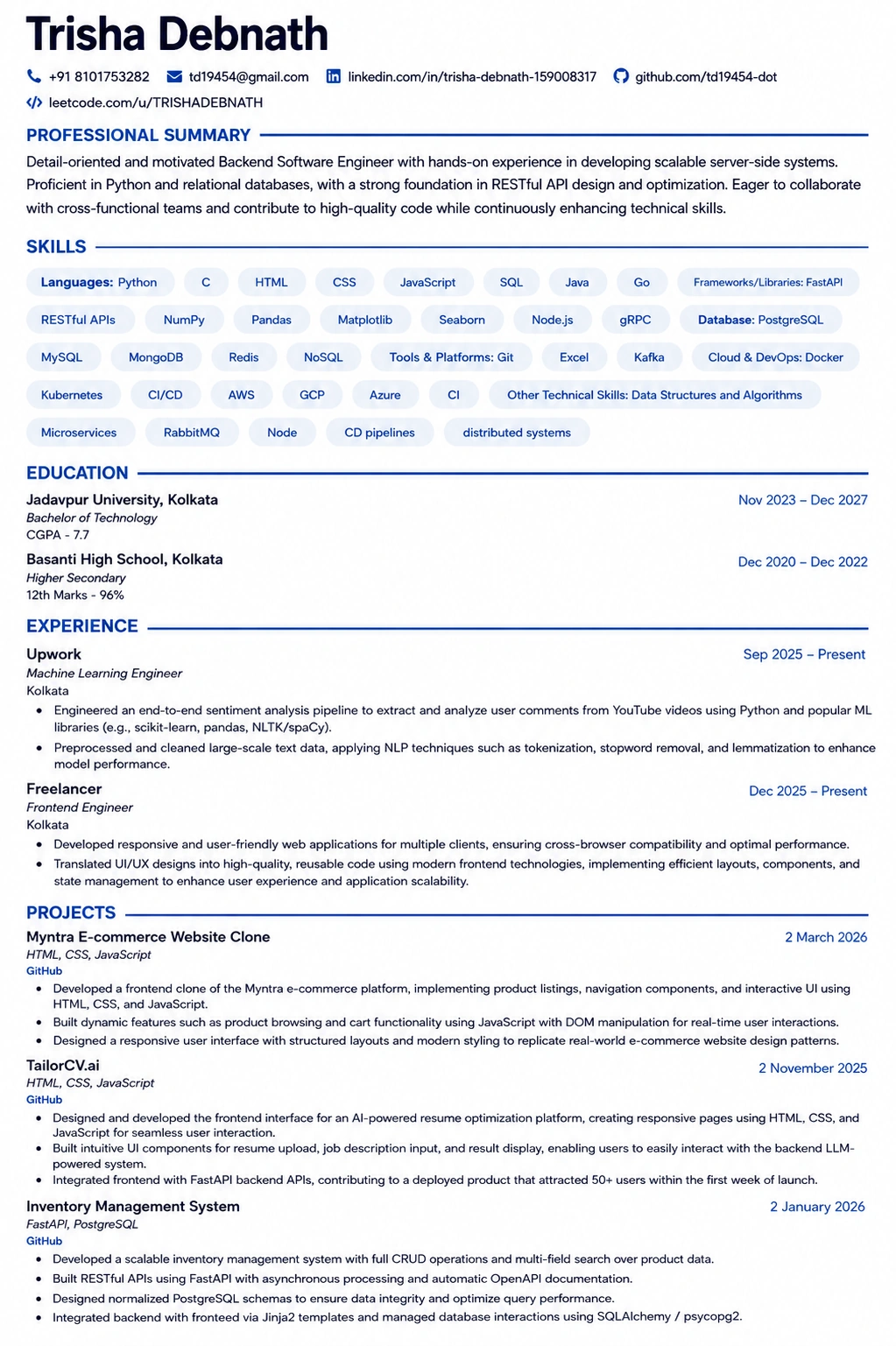
Your resume after optimization
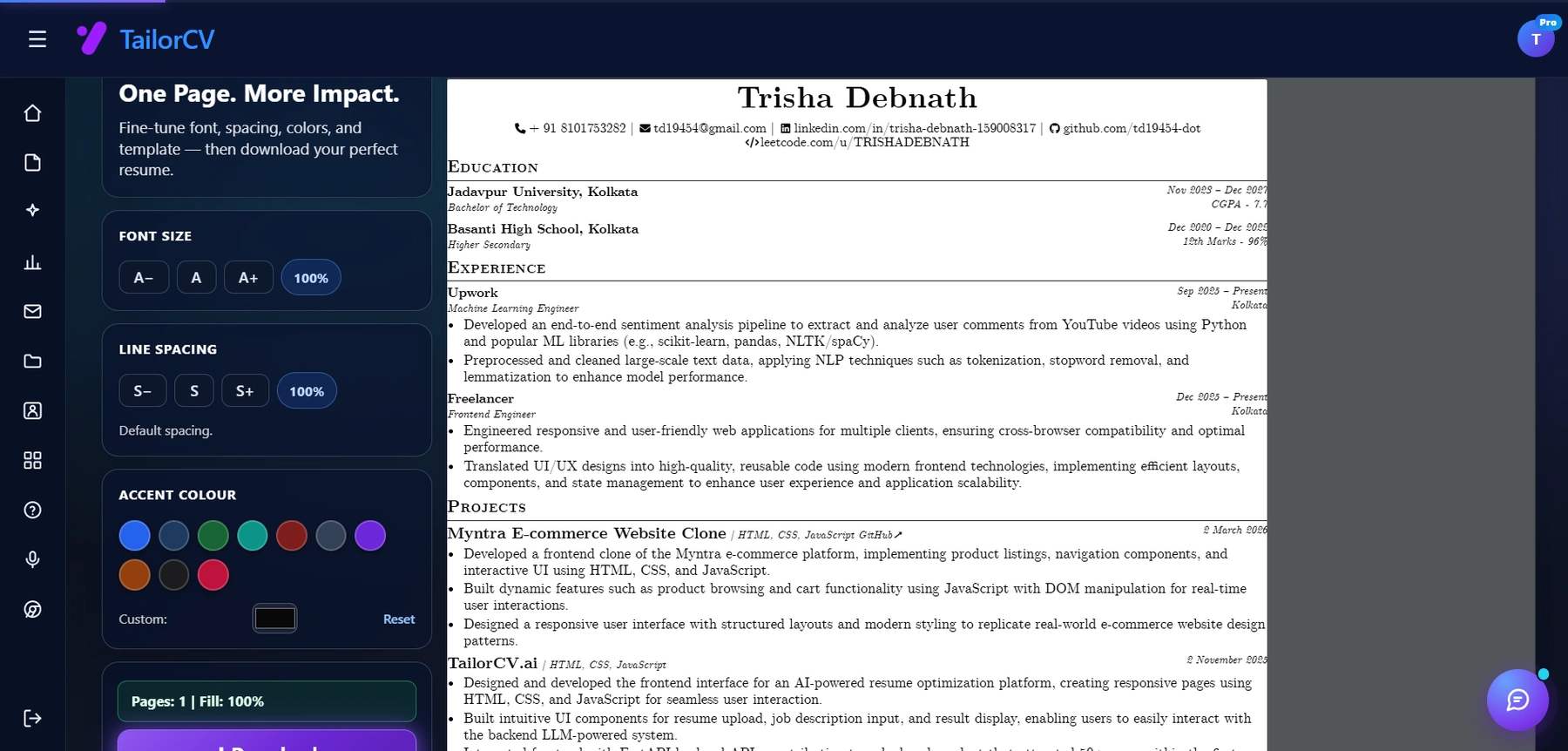
Font size, spacing, accent colour and template are all adjustable, with a live page counter.
Never pad a resume to look more impressive, and never trim an academic CV so much that it omits required detail. Match the format to the purpose.
Whatever You Send, Make It ATS-Ready
Here's the point most people miss: for company roles, both your "CV" and your "resume" will likely be screened by an Applicant Tracking System before a human reads it. That means:
- Clean, single-column formatting — no tables, text boxes, or images for key content.
- Standard section headings.
- A text-based PDF you can highlight and copy.
- Keywords matched to the job description.
Learn the full mechanics in how ATS works in Malaysia, and test your document against each posting with the free ATS score checker. (Academic CVs submitted directly to a hiring committee are less likely to be ATS-screened, but clean formatting still helps.)
Building Yours the Right Way
- For a company role, build a tailored, ATS-safe resume with the TailorCV resume builder and tailor it to each posting with the resume optimizer.
- Match each role's language using best resume keywords for Malaysian jobs.
- Add a targeted cover letter — see the Malaysia cover letter guide.
For the full job-search picture, see how to get a job in Malaysia.
Why the Confusion Exists in the First Place
The CV-vs-resume muddle in Malaysia isn't random — it comes from the country's mixed influences. Malaysia's education and public sectors inherited British conventions, where "CV" traditionally refers to the application document most people use. Meanwhile, the private sector, dominated by American MNCs and global business norms, increasingly uses "resume" for the same short, tailored document and reserves "CV" for the long academic record. Add the influence of international job portals, and you get postings that use both words, sometimes in the same advertisement, to mean the same thing. Understanding this history is oddly reassuring: the inconsistency is in the labels, not in what employers actually want. For virtually every company role, the underlying expectation is identical — a concise, tailored, professional document that earns you an interview.
How Recruiters Read Each Format Differently
It helps to picture what happens on the other side. When a corporate recruiter opens your "CV," they spend a handful of seconds scanning for relevance: your current role, your most recent achievements, your key skills, and whether you fit the posting. A five-page document forces them to hunt, and hunting under time pressure usually ends in a rejection. A tight one-to-two-page resume respects their time and puts your best material where their eyes land first.
An academic hiring committee reads completely differently. They expect to study a full record — your publications, the journals you've published in, your grants, your teaching load, your conference history — because those details are the qualifications for the role. Brevity there reads as thinness, not efficiency. The lesson: format follows audience. Give each reader the document their process is built around.
Government and Public-Sector Applications
Malaysia's public sector adds another wrinkle. Applications to federal government positions often run through centralised systems (such as the SPA portal for many civil-service roles) with their own structured forms, rather than a free-form resume upload. In these cases you're frequently filling in prescribed fields — personal particulars, qualifications, and experience — rather than submitting a designed document. Some statutory bodies, GLCs, and universities sit between the two worlds, using their own application portals with varying levels of detail. The practical rule holds: read the specific application's instructions and provide exactly what's asked, in the format and language (often including Bahasa Malaysia) it specifies.
Modern and Digital "Resumes"
Increasingly, your "resume" in Malaysia isn't only a document — it's a small ecosystem:
- Your LinkedIn profile functions as a living, searchable resume that recruiters mine directly. Keep it consistent with your document version and optimise it — see LinkedIn optimization for Malaysian job seekers.
- An online portfolio is effectively a visual resume for tech, design, and creative fields — build one from your resume with the TailorCV portfolio builder.
- Job-portal profiles (JobStreet, Hiredly) parse your uploaded resume into structured data, so the document you upload still needs to be clean and keyword-aligned.
Whatever the medium, the same principle applies: tailored, relevant, and easy to scan wins. The document is the core; the digital versions extend its reach.
A Quick Do's and Don'ts Reference
Do:
- Send a concise 1–2 page resume for any company role, whatever the posting calls it.
- Tailor it to each specific job.
- Keep formatting clean and ATS-friendly.
- Match the language of the posting (English or Bahasa Malaysia).
- Reserve the long CV format for academic, research, and specified roles.
Don't:
- Send a five-page "CV" to a private-sector employer.
- Over-trim an academic CV and drop required detail.
- Include your full IC number or unnecessary personal data by default.
- Assume one document fits every application — always tailor.
- Ignore the ATS for company roles.
How to Structure a Professional Resume (Company Roles)
For the concise document almost every Malaysian company wants, use this proven structure:
- Header: name, phone, professional email, city, and LinkedIn URL. No photo, age, IC number, or marital status needed for private-sector roles.
- Professional summary: two or three lines capturing who you are, your strongest skills, and what you offer — tailored to the role.
- Skills: a clean list of hard skills, tools, and languages — easy keywords for the ATS.
- Work experience: reverse-chronological, each role with achievement bullets (action verb + task + quantified result).
- Education: degree, institution, year, and CGPA if strong or if you're a fresh graduate.
- Extras where relevant: certifications, projects, awards, volunteer work.
Keep it to one page for early-career candidates and up to two for experienced professionals. The TailorCV resume builder produces exactly this structure in an ATS-safe layout.
How to Structure an Academic CV (Academic & Research Roles)
If you genuinely need a traditional CV — for a university, research institute, or academic post — the expectation is completeness, and the ordering signals your priorities. A typical academic CV runs, in order:
- Contact details and academic title.
- Education (degrees, institutions, dates, thesis titles, supervisors).
- Research interests and expertise.
- Publications (journal articles, books, chapters, conference papers) — often the centrepiece.
- Grants and funding awarded.
- Teaching and supervision experience.
- Conference presentations and invited talks.
- Awards, fellowships, and honours.
- Professional memberships and service (peer review, committees).
- References.
There is no length limit — an established academic's CV may run many pages. Never trim publications or grants to save space; here, completeness is the point.
Side-by-Side: The Same Person, Two Documents
To make the difference concrete, imagine a PhD graduate applying for two very different roles. Here's how the same background is presented.
As a resume, applying for a data analyst role at an MNC:
Dr. Aisha Karim
Data Analyst
+60 12-345 6789 | aisha.karim@email.com | Kuala Lumpur | linkedin.com/in/aishakarim

PROFESSIONAL SUMMARY
Analytical researcher turned data professional with strong Python, SQL, and
statistical modelling skills. Built predictive models and automated reporting
that cut analysis time by 60%. Skilled at turning complex data into clear,
actionable recommendations.

SKILLS
Python, R, SQL, Power BI, machine learning, statistical analysis, data visualisation

EXPERIENCE
Research Fellow — Universiti Malaya                          2021–2025
- Built machine-learning models in Python to analyse large datasets, improving
  prediction accuracy by 25%.
- Automated a reporting pipeline that saved the team 10 hours weekly.
- Presented findings to non-technical stakeholders and secured RM200k in funding.

EDUCATION
PhD in Statistics, Universiti Malaya, 2021
One page, skills-first, results quantified in business terms — exactly what a corporate recruiter and their ATS want.
As an academic CV, applying for a university lectureship:
Dr. Aisha Karim
Curriculum Vitae

EDUCATION
PhD in Statistics, Universiti Malaya, 2021 (Thesis: "…"; Supervisor: Prof. …)
MSc in Statistics, …
BSc (Hons) in Mathematics, …

RESEARCH INTERESTS
Bayesian modelling, machine learning, applied statistics …

PUBLICATIONS
1. Karim, A. et al. (2024). "…" Journal of …
2. …  (full list continues)

GRANTS & FUNDING
- RM200,000 research grant, 2023 …

TEACHING EXPERIENCE
- Tutor, Statistical Methods, 2019–2021 …

CONFERENCE PRESENTATIONS
- …

PROFESSIONAL MEMBERSHIPS & SERVICE
- Peer reviewer, … ; Member, …
Multi-page, complete, and ordered to foreground scholarship. Same person, same achievements — two entirely different documents, each matched to its audience.
Converting an Academic CV Into an Industry Resume
Many people leaving academia for industry in Malaysia struggle precisely because they submit a long academic CV to a company. If you're making this move, translate rather than trim blindly:
- Lead with a skills-focused summary aimed at the industry role, not your research niche.
- Reframe research as transferable skills: project management, data analysis, problem-solving, writing, presenting, securing funding (budget management), and mentoring (leadership).
- Compress publications into a single line or omit them unless directly relevant; industry rarely needs the full list.
- Quantify impact in business-relevant terms.
- Cut to one or two pages.
The result is a resume an employer — and their ATS — can actually use. Test it with the resume optimizer against the specific role.
International Students and Overseas Graduates
If you studied abroad and are returning to Malaysia — or you're a foreign graduate applying to Malaysian roles — the CV-vs-resume question has an extra layer. Your overseas university may have taught a particular convention (a US "resume," a UK "CV," or a European Europass format), but what matters is what the Malaysian employer expects. For company roles, that's a concise, tailored 1–2 page document, whatever your university called it. Translate any overseas academic-style CV into a focused industry resume, adjust to Malaysian norms (see how to write a resume for Malaysia jobs), and if you're relocating, pair it with the guidance in getting a job in Malaysia as a foreigner. The core discipline is the same everywhere: match the document to the audience in front of you.
Common Scenarios, Quickly Answered
To cut through any remaining doubt, here's how to handle the situations job seekers most often ask about:
- "An MNC posting says 'submit your CV.'" Send a concise, tailored 1–2 page resume. They mean the short document.
- "I'm applying to a local SME that asked for a resume." Same — a clean 1–2 page tailored document.
- "I'm applying for a university lecturer or researcher post." Send the full academic CV with publications, grants, and teaching.
- "A hospital or research institute asked for my CV." Check the posting; it may want the longer format. When unsure, ask, and default to including relevant detail.
- "A government role directs me to an online portal." Fill in the prescribed fields exactly as asked, in the specified language.
- "I have both an academic background and want an industry job." Convert your CV into a focused resume — lead with skills, compress publications, and cut to two pages.
In almost every private-sector case, the answer is the same concise, tailored, ATS-ready document. Only genuine academic and research contexts call for the long CV.
The Photo and Personal Details Debate in Malaysia
One area that genuinely differs by market: some older Malaysian resume templates include a photo, IC number, date of birth, and marital status. Modern best practice — especially for MNCs and international employers — is to omit these, keeping the focus on skills and reducing bias. For certain local, government, or traditional employers, some personal details may still be requested. The safe approach: leave them off by default, and add only what a specific posting explicitly asks for. Never include your full IC number on a document you send widely.
International CV Conventions and Malaysia's MNCs
Because Malaysia hosts so many multinationals, you may encounter different national conventions:
- US usage: "resume" means the short document; "CV" is reserved for academia. This matches Malaysia's private-sector usage.
- UK/European usage: "CV" often means the short 1–2 page application document (what Americans call a resume). Europe also has the standardised Europass CV.
- Academic usage everywhere: "CV" means the long, comprehensive record.
If you're applying to an MNC, the safest reading is: unless it's an academic or research post, they want a concise, tailored 1–2 page document — whatever term the posting uses.
Common Mistakes Around CV vs Resume
- Sending a 5-page "CV" to a company. For private-sector roles, keep it to 1–2 tailored pages regardless of the word used.
- Trimming an academic CV too much. Academic committees expect completeness — don't cut publications or grants.
- Assuming one document fits all. Adjust length and detail to the sector and role.
- Ignoring the ATS. For company roles, formatting and keywords decide whether your document is even read.
- Not tailoring. Whatever you call it, a generic document underperforms a tailored one.
Frequently Asked Questions
Is a CV the same as a resume in Malaysia? For most jobs, yes — the terms are used interchangeably for a concise 1–2 page document. The exception is academia and research, where "CV" means the long, comprehensive format.
How long should my CV/resume be in Malaysia? For company roles, one to two pages. For academic and research roles, as long as needed to document your full record.
A company asked for my "CV" — should I send a long document? No. For company roles, send a concise, tailored 1–2 page resume even when they say "CV."
Do I need different documents for different jobs? You need a tailored version for each application, but the format stays the same within a sector. Only switch to the long academic CV format for academic/research roles.
Should I include a photo and personal details on my Malaysian resume? Modern best practice, especially for MNCs, is to omit photos, IC numbers, date of birth, and marital status — keeping the focus on skills and reducing bias. Add such details only if a specific posting explicitly requests them, and never put your full IC number on a widely shared document.
I'm leaving academia for industry — do I use my CV? No. Convert your academic CV into a concise 1–2 page industry resume: lead with a skills-focused summary, reframe research as transferable skills, compress or omit the publications list, quantify impact, and cut to one or two pages.
A UK company calls it a "CV" — is that the long format? Not usually. In UK and European usage, "CV" often means the short 1–2 page application document. Unless it's an academic post, send the concise, tailored version.
Final Thoughts
In Malaysia, don't let the "CV vs resume" wording confuse you: for almost every company role, they want the same thing — a concise, tailored, ATS-ready 1–2 page document. Only academic, research, and some specialised roles want the traditional multi-page CV.
Whatever the posting calls it, build it well with the TailorCV resume builder, tailor it to the role with the ATS optimizer, and you'll send exactly what the employer is looking for.
What is your resume scoring right now?
Scan it against a job description and get your ATS match score in about a minute.
Drop your resume here or choose a file
PDF only. Max 2 MB.
We never share your data or use it to train AI models.
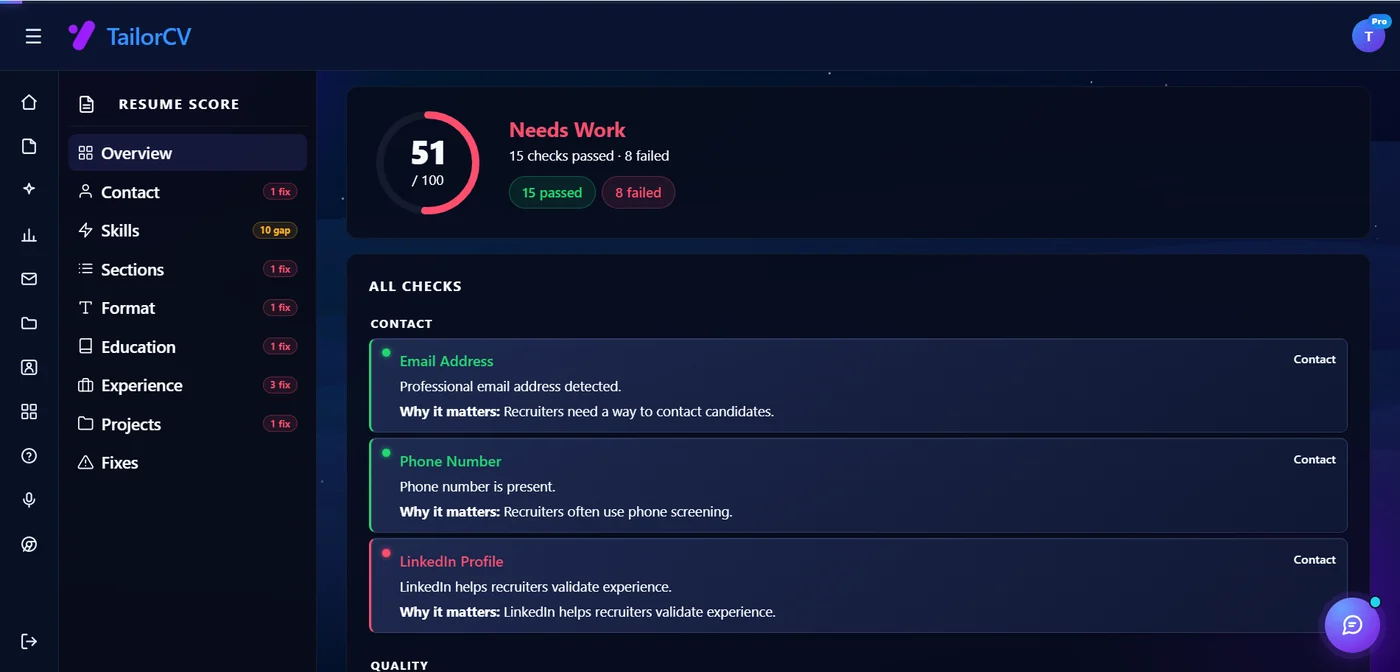
Templates that keep this structure intact
This template is ATS-tested — start from it and the formatting rules in this guide are already handled.
Was this guide useful?
Be the first to rate it.