 SS
SS
Key Takeaways
- The most damaging mistake is letting ChatGPT invent skills — it fails at the interview, not the ATS.
- Pasting a resume in and asking it to "improve this" silently deletes content you needed.
- ChatGPT cannot see the job posting unless you paste it, and most people do not.
- Formatting is lost on the way in and on the way out; the ATS reads the file, not the chat.
- Every mistake here has a prompt-level fix, and none of them require abandoning AI.
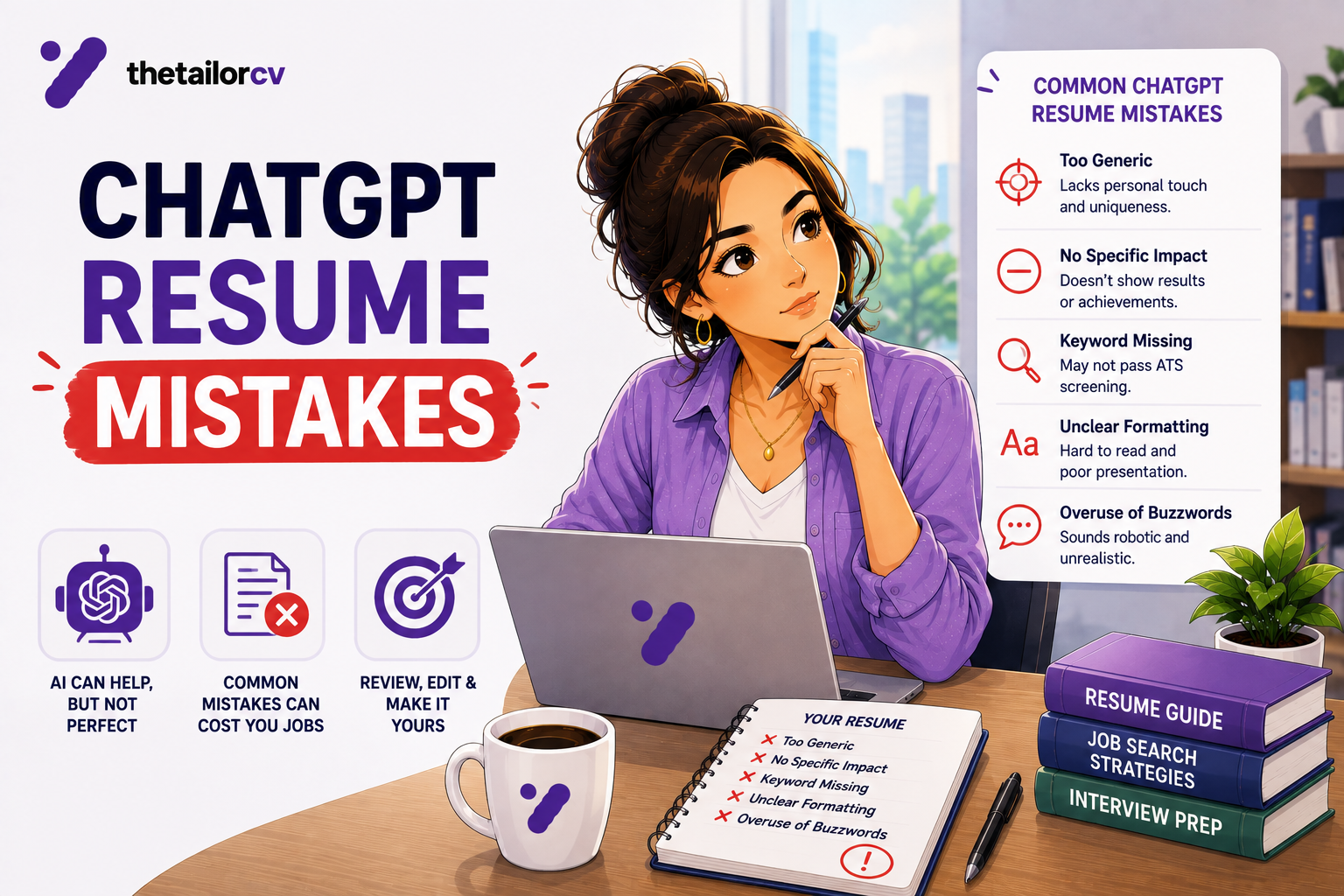
ChatGPT is genuinely useful on a resume. It is also responsible for a specific set of failures that are easy to spot once you know them. These are the nine we see most often, with the fix for each.
If you want prompt wording to start from, 15 ChatGPT resume prompts covers that. This post is about what goes wrong.
1. Letting It Invent Skills You Do Not Have
The mistake. You paste the job description and ask for a resume that matches it. ChatGPT obligingly adds Kubernetes, Tableau and stakeholder management — because you asked it to match, and it has no way to check what is true.
Why it is the worst one. It does not fail at the ATS. It fails in the interview, when someone asks you to walk through a decision you never made. That is unrecoverable in a way a low score is not.
The fix. Give it a hard constraint in the prompt: "Only rewrite what is already in my resume. Do not add any skill, tool or achievement that is not present. If the job needs something I lack, tell me instead of writing it in." Then check the output against your original line by line.
This constraint is enforced structurally in our tailoring flow — it rewrites bullets to carry the posting's language only where your existing experience supports the claim — but in a chat window, you have to impose it yourself, every time.
2. Saying "Improve This" and Losing Half Your Resume
The mistake. You paste 900 words, ask it to improve them, and get back 600. Three bullets from your second job are gone. You do not notice because the output reads well.
Why it happens. Models compress. Given a long input and a vague instruction, they summarise — and summarising a resume means dropping your least-headline achievements, which are often the ones matching this particular posting.
The fix. Work one section at a time. Paste a single role, ask for a rewrite of those bullets only, and diff the result. If you must do the whole thing at once, add: "Return the same number of bullets for each role. Do not merge or drop any."
3. Not Giving It the Job Description
The mistake. Asking for "a stronger resume" with no target. You get generically stronger writing, which is not the same as a better match.
Why it matters. Resumes are not scored in the abstract. They are scored against one posting's requirements — that is the entire premise of how ATS matching works. Without the posting, ChatGPT is optimising for nothing in particular.
The fix. Always paste the full job description, then ask: "Which requirements in this posting does my resume fail to evidence?" That question is more useful than any rewrite, because it tells you where the real gaps are before you change a word.
4. Trusting It to Know What an ATS Wants
The mistake. Asking "will this pass the ATS?" and believing the answer.
Why it is unreliable. ChatGPT has no access to the parser that will actually read your file. It will confidently tell you a two-column layout is fine, or that a skills table is ATS-friendly, based on general text rather than on parsing your document. Our guide to what actually breaks parsing covers the real failure modes — tables, text boxes, headers, columns — and they are structural, not linguistic.
The fix. Use ChatGPT for language, and something that actually parses the file for parsing. Running the real file through a scanner tells you what a parser extracts; a chat window can only guess.
5. Losing the Formatting on the Way In and Out
The mistake. Copy-pasting from a PDF into chat, then pasting the result back into a document. Both directions destroy structure — bullet characters become dashes, section headings become plain paragraphs, dates lose alignment.
Why it matters. The ATS reads the file, not your chat transcript. A resume that looks fine in the chat window can parse into a mess. Our ATS-friendly formatting guide covers what survives.
The fix. Keep formatting authority in your document, not in chat. Use ChatGPT to produce the words, then paste the words into your existing template and check the exported file — not the chat output.
6. Accepting the First Draft
The mistake. Taking output that reads well and stopping there.
Why it is a trap. The first draft is always the most generic. It is written for the average person in your role because that is the safest completion. "Improved team efficiency" reads fine and says nothing — this is exactly the pattern in why your resume gets no responses.
The fix. Push back once, specifically: "This is too generic. Here are the real numbers: [X]. Rewrite using these." The second draft is usually the usable one. If you have no numbers, how to quantify achievements covers finding them.
7. Letting It Write Your Summary From Nothing
The mistake. "Write me a professional summary" with no input. You get: "Results-driven professional with a proven track record of delivering innovative solutions in fast-paced environments."
Why it is bad. The summary is the most-read section on the page and this version could belong to anyone in any industry. It is the single clearest generic-resume signal, and it appears in the first three seconds of reading.
The fix. Write it yourself first — clumsily is fine — then ask for tightening. Three facts is enough: what you do, how long, and the one result you are proudest of. Reverse the order and you get adjective soup.
8. Using the Same Output for Every Application
The mistake. Generating one AI-improved resume and sending it everywhere. This is the most common one and the least noticed, because the resume genuinely is better than what you started with.
Why it still fails. Better writing is not the same as a better match. Two postings for the same job title routinely emphasise different things, and one resume cannot match both — the reasoning is in tailored vs generic.
The fix. One version per posting. If that sounds like too much work, that is the actual argument for a tool that does it automatically — our extension generates the version from the job page, and every version stays in My Resumes.
9. Not Reading It Aloud Before Sending
The mistake. Sending output you have read silently and quickly.
Why it catches things. Reading aloud exposes register mismatches instantly — the sentence that sounds like a consultant wrote it, the verb nobody in your field uses, the claim slightly larger than the truth. It takes ninety seconds and catches most of what the previous eight mistakes produce.
The fix. Read every line aloud. If you would not say it to a person, cut it. Then check the honesty question on each bullet: could you talk for two minutes about this in an interview? If not, it does not belong there.
The Pattern Underneath All Nine
Every mistake here is the same mistake in a different costume: asking ChatGPT to generate content instead of sharpen content you supply.
Given a thin prompt, it produces the statistically average resume for your role. That resume is well-written, professional, and matches no specific job. Given your real numbers and a real posting, it does something genuinely useful — it makes your evidence read better.
The tool is not the problem. The prompt is.
Frequently Asked Questions
Is ChatGPT good enough on its own for a resume? For phrasing, yes. For matching a resume to a posting and checking how a parser reads the file, no — it cannot see the file or the parser. Most people need both.
Will recruiters know I used ChatGPT? They will notice if the result is generic, which is a different thing. We cover what actually gives it away in can recruiters tell if your resume was written by AI.
What is the single most important rule? Never let it add a skill you cannot discuss in an interview. Everything else costs you a callback; that one costs you credibility in the room.
Should I paste my whole resume or one section? One section. Whole-resume prompts silently drop content — mistake #2.
Does this apply to other AI tools too? Yes. The failure modes come from how language models complete text under thin instructions, not from any one product.
Where To Start
If you have already run your resume through ChatGPT and want to know whether it helped, do not guess. Scan it against a real job description and look at what comes back missing — that is what the recruiter's system sees, regardless of who wrote the words. It is free and takes about a minute.
If the score is lower than you expected, why is my ATS score low covers the usual causes, and fixing weak bullets covers the rewriting.
What is your resume scoring right now?
Scan it against a job description and get your ATS match score in about a minute.
Drop your resume here or choose a file
PDF only. Max 2 MB.
We never share your data or use it to train AI models.

Templates that keep this structure intact
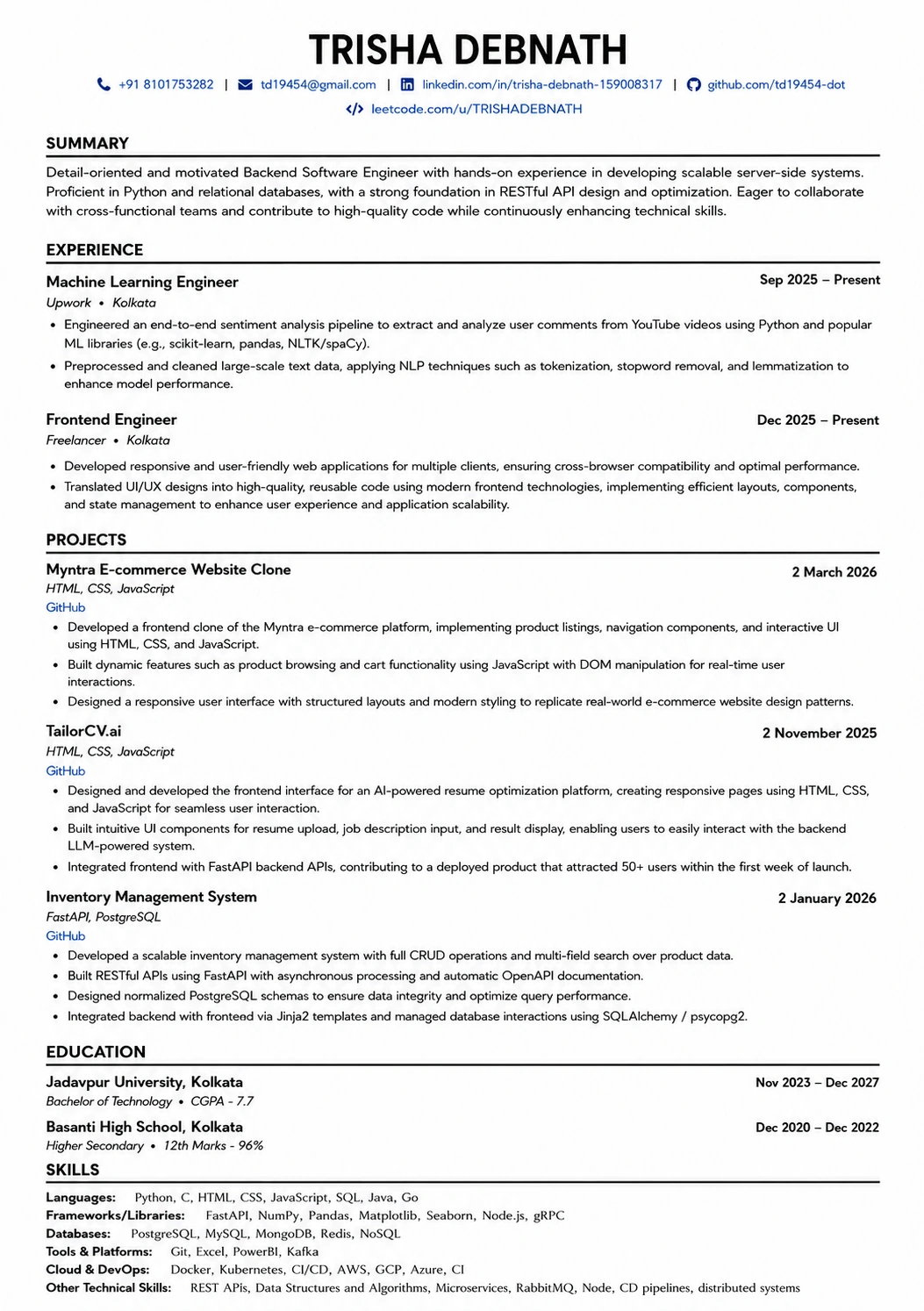
This template is ATS-tested — start from it and the formatting rules in this guide are already handled.
Was this guide useful?
Be the first to rate it.