 TD
TD
Key Takeaways
- No ATS in common use flags resumes as AI-written. There is no "AI detector" step between you and the recruiter.
- Recruiters do not detect AI. They detect generic — and AI writing is generic by default, which is why the two get confused.
- The giveaway is almost never vocabulary. It is the absence of specifics only you could know.
- AI detection tools are unreliable enough on short documents that serious recruiters do not use them for hiring decisions.
- Used correctly, AI is fine. The failure mode is letting it invent content instead of sharpening yours.
If you have used ChatGPT on your resume and are now nervous about sending it, here is the short answer: nobody is running your resume through an AI detector, and the ATS is not looking for one. What a recruiter can spot is a resume that says nothing specific — and that is a real risk with AI, for reasons worth understanding.
Does the ATS Detect AI-Written Resumes?
No. This is worth stating plainly because the fear is widespread and the mechanics are simple.
An applicant tracking system parses your resume into structured fields — name, contact, employment history, education, skills — and matches that content against the job requisition. That is what it is built to do. Our guide to how ATS parsing actually works walks through the pipeline, and there is no AI-detection stage anywhere in it.
The ATS asks does this candidate match the requirements, not who or what typed these words. A resume written by AI and a resume written by hand are scored identically if they carry the same evidence. Our ATS myths post covers several other fears in this category that also turn out to be unfounded.
Do Recruiters Run AI Detectors?
Overwhelmingly, no — and the ones who have tried mostly stopped.
AI detection tools are unreliable on short, formulaic documents, and a resume is the most formulaic document in professional life. Resumes have always used compressed, verb-led, achievement-focused phrasing. That is exactly the register detectors flag. A perfectly human resume written by a careful writer in 2019 will often score as "likely AI" today, and detectors are known to misfire on non-native English writing in particular.
A recruiter who rejected candidates on a detector's say-so would be throwing away good applicants at a high rate. Most recruiters know this. The screening reality is closer to what we describe in how recruiters read a resume in six seconds: they are scanning for fit, not running forensics.
So What Do Recruiters Actually Notice?
They notice that the resume could belong to anyone.
This is the crucial reframing. Recruiters do not think "this was written by AI." They think "this is generic" — and then they move on. The reason AI gets blamed is that generic is the default output of a language model given a thin prompt. Ask for "a strong bullet point about my marketing job" and you will get something that describes a thousand marketing jobs equally well.
That was already the most common resume failure before AI existed. Our post on why your resume gets no responses covers the same problem in resumes written entirely by hand. AI did not create it. AI made it faster to produce.
The Six Tells
These are what an experienced reader actually reacts to. Notice that only one is about word choice.
1. Achievements with no numbers. "Significantly improved team efficiency" is the classic. Improved from what, to what, over how long? Our guide to quantifying achievements covers what to do when you genuinely do not have metrics — and there is almost always something countable.
2. Responsibilities described instead of results. "Responsible for managing the social media calendar" is a job description, not an accomplishment. AI reproduces job-description language because that is what it was given.
3. Adjective stacking. "Dynamic, results-driven professional with a proven track record of delivering innovative solutions." Every word is positive and none of it is information. A human writing quickly does this too, but AI does it relentlessly.
4. Uniform bullet rhythm. Real careers are uneven — a big project one year, maintenance the next. When every bullet is the same length with the same verb-metric-outcome shape, it reads as manufactured. Some unevenness is a signal of truth.
5. Vocabulary that does not match the industry. Every field has its own register. A software engineer says "shipped" and "on-call"; a nurse says "triaged" and "handoff". Generic AI output uses management-consultant English everywhere, and a specialist notices immediately.
6. Claims that collapse under a follow-up question. This is the only genuinely dangerous one. If the resume says you "led migration to a microservices architecture" and you cannot describe the trade-offs in an interview, you have a serious problem. Everything above costs you a callback; this costs you your credibility in the room.
Why the "Delve" Theory Is Mostly Wrong
You have probably seen lists of "AI words" — delve, leverage, spearheaded, robust, tapestry. The advice is to strip them out.
This is mostly superstition. "Spearheaded" and "leveraged" appeared in resumes for decades before ChatGPT existed; they are on every action-verb list ever published, including ours. Deleting them changes nothing about whether your resume is specific.
Worse, word-hunting distracts from the actual fix. A resume full of banned words but packed with concrete detail reads as human. A resume scrubbed of every flagged word but still saying "improved efficiency" reads as empty. Specificity is the signal. Vocabulary is noise.
How to Use AI Without Producing Any of This
The failure mode is asking AI to generate content. The correct use is asking it to sharpen content you supply.
Give it the raw facts first. Not "write a bullet about my support job" but "I handled about 40 tickets a day, cut average response time from 6 hours to 90 minutes over four months, and wrote the onboarding doc the team still uses." Now it has something only you know. The output will be specific because the input was.
Never let it add a skill you do not have. This is the line that matters. If the job description mentions Kubernetes and your resume does not, the fix is not to insert Kubernetes — it is to decide whether you have real adjacent experience worth stating honestly. This constraint is built into how our tailoring works: it rewrites bullets to carry the posting's language only where your existing experience supports the claim, and it will not manufacture evidence.
Keep your own voice on the summary. The summary is the most-read and most-generic section on most resumes. Write it yourself, badly if necessary, then ask AI to tighten it. Reversing that order produces the adjective soup in tell #3.
Read every line aloud before sending. If you would not say it to a person, cut it. This single habit catches most of the six tells.
Our ChatGPT resume prompts post has specific prompt wording, and AI resume tailoring in a human voice covers keeping your register intact through the rewriting step.
The Real Risk Is Not Detection
Here is the thing worth worrying about instead.
If AI writes your resume from a thin prompt, it will produce a resume for a generic candidate in your field — not for you, and not for the specific job. That resume will match every posting equally badly. The tailored vs generic comparison covers what that costs in callbacks, and it is more than most people expect.
A resume is not filtered for being AI-written. It is filtered for not matching the posting. Those are completely different problems, and only the second one is actually happening to you.
If your resume came from a tool, a writer or a template, tailoring a resume you didn't write gives a three-pass audit to run first.
Frequently Asked Questions
Will an ATS reject my resume for being AI-generated? No. Applicant tracking systems parse and match content against requirements. They have no AI-detection step.
Should I run my resume through an AI detector before applying? It would not tell you anything useful. Detectors misfire badly on short formulaic documents, and resumes are the most formulaic documents there are. Spend that time adding specifics instead.
Is it dishonest to use AI on my resume? Using AI to phrase your real experience more clearly is no different from using a spell-checker or asking a friend to edit. Using it to claim experience you do not have is dishonest — and it fails at the interview regardless of how it was written.
Do I need to remove words like "spearheaded"? No. Those words predate AI by decades. Specificity is what matters, not vocabulary.
How do I know if my resume reads as generic? Cover the name at the top and ask whether it could belong to any competent person in your field. If yes, it is too generic — and that is fixable by adding numbers and specifics, not by changing words.
What To Do Right Now
The fear about detection is misplaced, but the underlying worry — is my resume too generic? — is worth taking seriously, because that is the thing actually costing callbacks.
The fastest way to find out is not to guess. Scan your resume against a job description you care about and look at which of the posting's requirements it fails to evidence. That gap is what a recruiter sees, whether the words came from you, from ChatGPT, or from a template you downloaded in 2019. It is free, it takes about a minute, and it answers a much more useful question than "does this sound like AI."
If the score comes back low, why is my ATS score low walks through the usual causes, and fixing weak resume bullets covers the rewriting itself.
What is your resume scoring right now?
Scan it against a job description and get your ATS match score in about a minute.
Drop your resume here or choose a file
PDF only. Max 2 MB.
We never share your data or use it to train AI models.

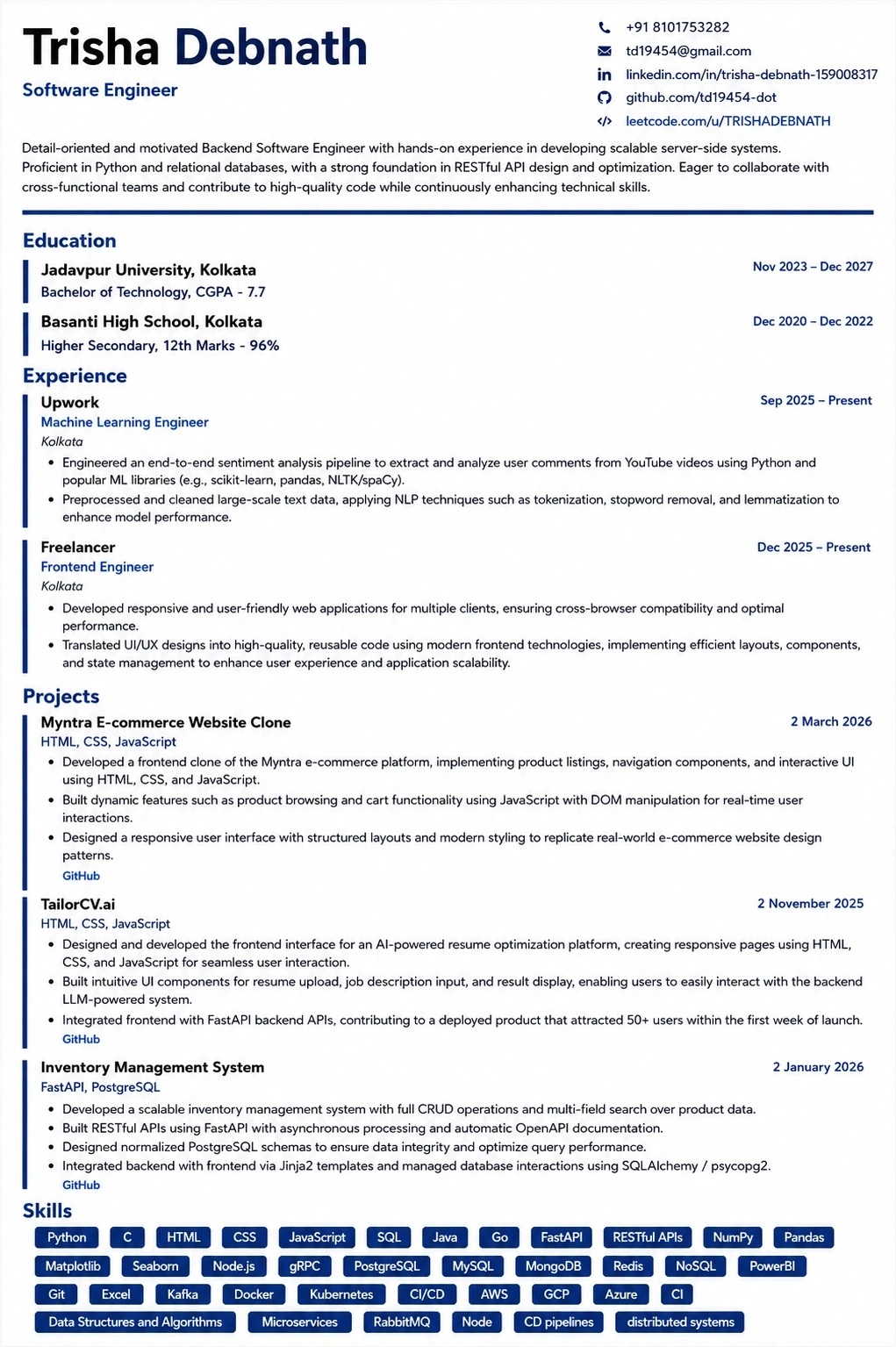
Templates that keep this structure intact
This template is ATS-tested — start from it and the formatting rules in this guide are already handled.
Was this guide useful?
Be the first to rate it.