 SS
SS

Key Takeaways
- Chinese hiring runs on platform search more than on applicant tracking systems, so the keywords that matter are the ones recruiters type into a search box.
- Standard job titles beat creative internal ones - a recruiter searching 产品经理 or "Product Manager" will not find your "Growth Ninja".
- Bilingual keyword pairing matters: include both the Chinese term and the English one where a recruiter might search either.
- Tools and technologies should be named exactly, including the Chinese platforms and systems local employers actually use.
- Keyword stuffing fails here as everywhere - the term has to be attached to evidence you can defend in interview.
Keyword advice for the Chinese job market gets written as though it were the American one, which produces guidance about applicant tracking systems that misses how most screening actually happens.
The domestic platforms build a structured profile from your uploaded resume, and recruiters search that structure directly. So the practical question is not "what will an ATS parse" but "what will a recruiter in Shanghai type into a search box, and will my profile come back."
The answer changes which words you use and where you put them.
Before optimising anything, confirm your resume parses cleanly - the free ATS score checker shows what a machine extracts from your file.
Start With the Job Title
This is the highest-leverage keyword on your resume, and the one most often wasted.
Recruiters search by title. If your last role was internally called "Customer Happiness Lead" and the market calls it "Customer Success Manager", you will not appear in the search that matters.
The fix: use the standard market title as your primary title, and put the internal one in brackets if it carries information.
Customer Success Manager (internal title: Customer Happiness Lead)
Bilingual pairing. On a Chinese-language resume, use the standard Chinese title. Where the English term is also commonly used in your industry - which is frequent in technology, finance, and multinationals - including both costs one line and doubles your search surface:
产品经理 / Product Manager
Common pairs worth knowing include 软件工程师 (Software Engineer), 数据分析师 (Data Analyst), 市场经理 (Marketing Manager), 人力资源 (Human Resources), 运营 (Operations), and 销售经理 (Sales Manager).
Which version leads depends on your audience - the Chinese resume format guide covers building the bilingual pair properly.
Keywords by Category
Technology
Name the specific technology, not the family. "Programming languages" returns nothing; Python, Java, Go, C++, Rust do.
Include the domestic ecosystem, which foreign applicants routinely omit and local recruiters routinely search: Alibaba Cloud (阿里云), Tencent Cloud (腾讯云), Huawei Cloud, WeChat Mini Program (小程序) development, DingTalk integration. If you have worked with these, they are differentiators.
Standard international terms still apply - Kubernetes, Docker, microservices (微服务), distributed systems (分布式系统), machine learning (机器学习).
Marketing and e-commerce
The domestic platform vocabulary is essential here and has little overlap with Western terms: WeChat (微信), Weibo (微博), Douyin, Xiaohongshu, Tmall (天猫), Taobao (淘宝), JD (京东), private domain traffic (私域流量), KOL and KOC marketing, livestream commerce (直播带货).
A marketing resume for China that lists only Google Ads and Facebook is describing channels that are not the main market.
Finance and accounting
CPA, ACCA, CFA, financial modelling (财务建模), audit (审计), tax planning (税务筹划), IFRS, and the Chinese accounting standards where relevant.
Supply chain and manufacturing
Sourcing (采购), quality control (质量控制), supplier management (供应商管理), lean manufacturing, Six Sigma, customs and import-export (进出口), ISO certifications by number.
Cross-functional terms
Project management (项目管理), stakeholder management, cross-border (跨境), B2B and B2C, KPI, OKR.
The general method for extracting these from a posting rather than guessing is in best resume keywords to beat ATS.
Keywords Specific to Foreign Applicants
If you are not a Chinese national, several terms function as screening fields, and leaving them off means the recruiter has to assume.
Visa and permit status. "Valid China work permit", "work permit transfer", "requires sponsorship". Recruiters filter on this early, and being explicit saves a wasted round. The mechanics are in the China work visa guide.
Language level. "HSK 4", "HSK 5", "business Mandarin", "conversational Mandarin". State the level as a concrete credential rather than an adjective - the honest framing is covered in working in China without Mandarin.
Location. "Based in Shanghai", "currently in China", "open to relocation to Shenzhen". Platform search is heavily location-filtered, so a missing or vague city genuinely removes you from results.
Market knowledge. "China market entry", "cross-border e-commerce", "APAC region", "China-Europe trade". If your value is the bridge between markets, name both sides.
Where to Put Them
Placement matters as much as selection.
Job titles carry the most weight in search. Get these right first.
The skills section is where explicit terms belong. Group them so they are scannable rather than running them into a paragraph - see the resume skills section guide.
Experience bullets are where keywords earn credibility, because the term appears attached to a result. "Managed Tmall flagship store, growing GMV 38% year on year" carries the keyword and the evidence in one line.
The job objective line - the 求职意向 field standard on Chinese resumes - should carry your target title verbatim.
Not in images, headers, or footers. Text there is frequently lost in extraction, taking the keyword with it. The failure modes are catalogued in ATS resume formatting mistakes.
The Honesty Constraint
Every keyword on your resume is a claim you will be asked about.
Chinese interviews frequently include a technical round that tests the specifics, and interviewers will switch to Mandarin to check a claimed language level. A keyword you cannot defend costs you more than its absence would have.
The rule is simple: include the term if you have genuinely used the thing. If you have used it lightly, keep it but qualify it in the bullet rather than inflating it. Stuffing produces exactly the pattern described in how recruiters spot generic resumes - a skills list that no experience bullet supports.
Common Mistakes
Creative job titles. Invisible to search.
English only for domestic employers. Halves your discoverability on Chinese-language platforms.
Omitting the domestic platform vocabulary. A marketing resume without WeChat, Douyin, or Xiaohongshu reads as someone who has not worked in the market.
Listing skill categories instead of skills. "Cloud technologies" is not searchable; "Alibaba Cloud" is.
Burying keywords in a paragraph. Recruiters scan. Group them.
No visa or location line. Forces the recruiter to guess, and guesses go against you.
Stuffing a skills block with terms no bullet supports. It is visible and it undermines the rest.
Frequently Asked Questions
Should my resume be in Chinese or English?
Match the posting. For domestic employers, Chinese substantially improves both screening and search discovery. For multinationals, English is fine. Including the English term alongside the Chinese one for job titles and technologies is a low-cost way to cover both searches.
Do Chinese companies use ATS software?
Some do, particularly multinationals, but a larger share of screening happens through the domestic recruitment platforms and their own search and filtering. The practical requirement is the same either way - your resume must parse into clean structured text.
How many keywords should I include?
There is no target number. Include the terms that describe what you have genuinely done, get your job titles standard, and make sure each significant skill appears in an experience bullet as well as the skills section.
Will keyword stuffing get me more interviews?
It may get you more search hits and fewer offers. Interviewers test the specifics, and a skills list unsupported by your experience section is a recognisable pattern.
Which keywords matter most for foreign applicants?
Visa status, language level, and location - because recruiters filter on all three before assessing anything else. After that, whatever specifically differentiates you from the local candidate pool.
How do I find the right keywords for a specific job?
Take them from the posting itself. The requirements section names the terms the recruiter will search. The method is in how to tailor your resume for every job.
See which keywords your resume is missing against a real job description. Check your ATS score free.
Make This Practical
Fix your job titles first. Replace any creative or internal title with the standard market term, and add the Chinese equivalent alongside it where a recruiter might search either.
Then rebuild the skills section around specific named tools rather than categories, including the domestic platforms relevant to your field, and make sure each significant one also appears in an experience bullet with a result attached - the method is in how to write resume bullet points.
Finally, add the three screening fields foreign applicants forget: visa status, language level, and city. Run the result through the free ATS score checker against a real posting, format it to local convention with the Chinese resume format guide, and upload it to the right platforms using the best job sites in China.
See which keywords you are missing
Scan your resume against the posting and get the exact terms it did not find.
Drop your resume here or choose a file
PDF only. Max 2 MB.
We never share your data or use it to train AI models.

Where those keywords actually go
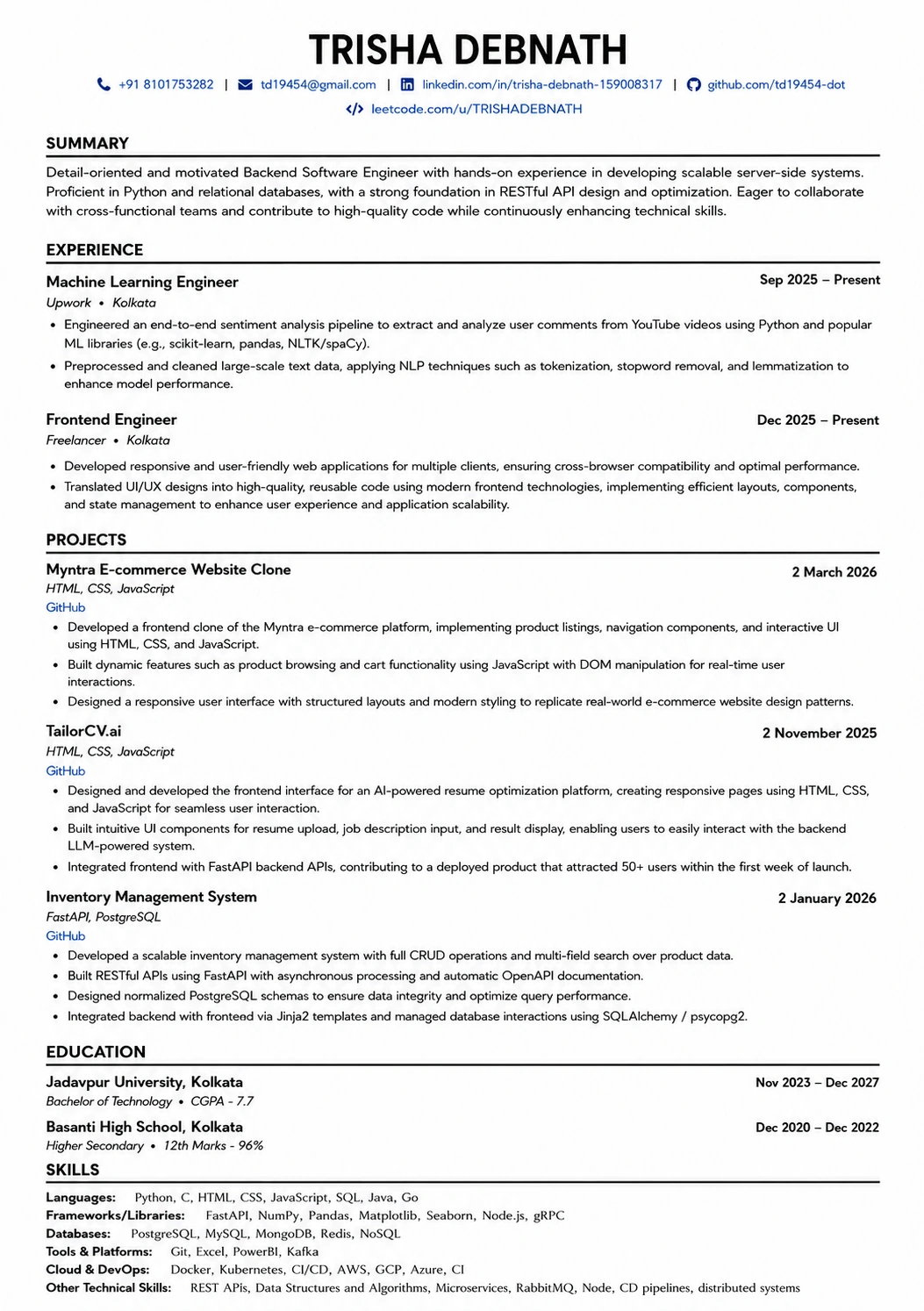
A layout with a real skills section gives the parser somewhere clean to find every term you just added.
Was this guide useful?
Be the first to rate it.