SS
SS
Key Takeaways
- Expect personal questions that would be off-limits in the US or UK - age, marital status, family plans - and prepare a calm answer rather than being caught off guard.
- Hierarchy is visible in the room: who speaks, who sits where, and who you address first all carry meaning.
- Foreign candidates are always assessed on commitment - how long you will stay is a real evaluation criterion, not small talk.
- Modesty in self-presentation is expected, which means letting evidence carry the claim rather than the adjective.
- Interviews increasingly happen over WeChat video, so treat that channel as professionally as any other.
The technical bar in a Chinese interview is not unusual. What surprises Western candidates is everything around it - the questions that get asked, the register that reads as appropriate, and how much of the assessment is about whether you are going to stay.
None of this is difficult once you know it is coming. The failure mode is being surprised mid-interview and reacting in a way that reads as defensive or arrogant when you meant neither.
This guide covers the format, the questions, and the conventions.
Before you get to the interview stage, make sure your resume is clearing the screen - the free ATS score checker shows what recruiters' systems extract from it.
The Format
Expect multiple rounds, often more than a Western process of equivalent seniority.
HR screen - a first call covering background, availability, salary expectations, and for foreign candidates, visa status. Often by phone or WeChat.
Technical or functional round - with the team or a manager. Content is comparable to what you would expect anywhere; preparation resources like technical interview preparation transfer directly.
Senior management round - more common than in the West, including for mid-level roles. This round frequently focuses less on skills and more on judgement, attitude, and fit.
Final HR discussion - offer, package, and logistics.
Panel interviews are common, and in a panel the seniority order matters. Greet the most senior person first, and address answers primarily to whoever asked, with periodic eye contact across the panel.
Questions You Will Be Asked
The personal ones
Questions about age, marital status, whether you have children, and whether you plan to have them are asked more openly in China than in markets where they are legally restricted. Foreign candidates often find this uncomfortable.
You have three options, and all are reasonable:
- Answer briefly and move on. The simplest path, and the one most candidates take.
- Answer the underlying concern. The question behind "are you planning to have children" is usually about continuity. "I'm committed to being here for the long term and see this as a multi-year move" addresses it.
- Redirect politely. "I'd rather focus on what I can bring to the role" is acceptable if delivered warmly, though it may read as evasive.
What does not work is visible irritation. Treat it as a difference in convention rather than an affront.
The commitment questions
Every foreign candidate is assessed on this, and it is the single most important thing to prepare.
- How long do you plan to stay in China?
- Why China specifically?
- What ties do you have here?
- What would make you leave?
The employer is weighing a real cost - sponsoring a work permit, onboarding you, and losing you in eighteen months. Answer with specifics. "I have been here two years, my partner works in Shanghai, and I am studying for HSK 5" is a far stronger answer than "I love the culture."
The practical ones
Visa status, current permit, notice period, and salary expectations come up early - often in the first call. Know your answers. The permit mechanics, including how transfers work if you already hold one, are in the China work visa guide.
The standard ones
Strengths, weaknesses, why this company, biggest achievement, handling conflict. The usual set, best prepared with the STAR structure covered in behavioral interview questions and answers.
Tone: Confidence Without Self-Promotion
This is the hardest adjustment for Western candidates, particularly Americans.
Western interview coaching teaches you to claim credit clearly and speak in the first person singular. In a Chinese interview, unmodulated self-promotion can read as immature rather than confident.
The adjustment is not to undersell yourself. It is to let the evidence do the claiming:
Instead of: "I completely turned around the department's performance." Try: "The team's delivery time went from six weeks to three over the year I led that project."
Same fact, and the second version is more convincing anyway. This is the same principle that makes resume bullets work - see how to write resume bullet points.
Credit the team where the team was involved. This is expected and does not diminish you - claiming sole credit for collective work is what damages you.
Practical Etiquette
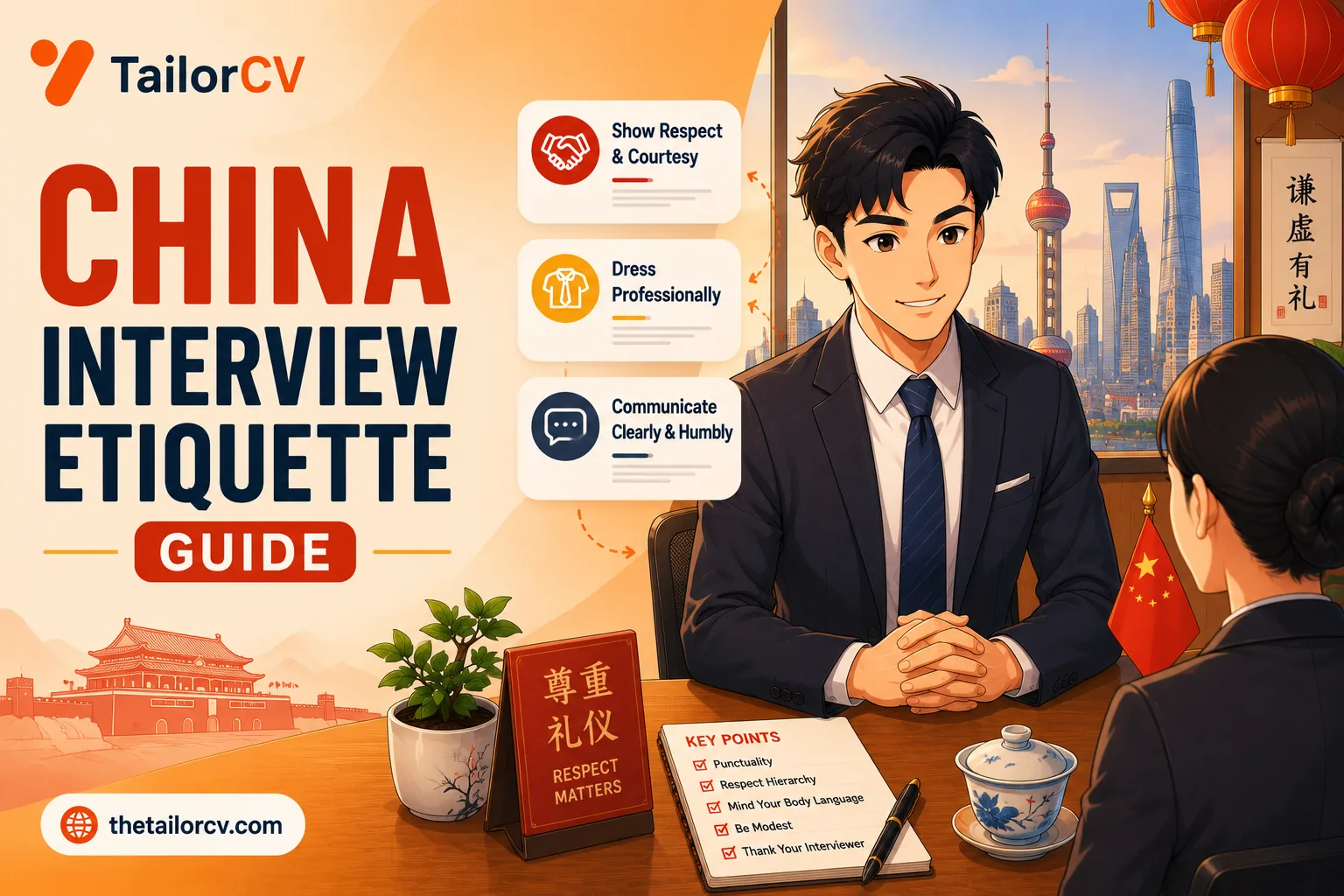
Punctuality. Arrive ten to fifteen minutes early. Lateness is read seriously.
Dress. Formal and conservative, more so than in a Western startup context. Overdressing is a much smaller error than underdressing.
Business cards. If exchanged, present and receive with both hands, read the card before putting it away, and do not write on it or pocket it carelessly.
Greeting. A handshake is standard, generally lighter than a Western one. Wait for the most senior person to initiate.
Names and titles. Use surname plus title - Manager Wang, Director Li. Do not move to first names until invited.
Phone. Silent and out of sight.
Notes. Bring a notebook. Taking notes reads as attentive.
Questions at the end. Have some, and make them about the work and the team rather than benefits. Save the package discussion for the HR round or the offer stage, which is where the negotiation covered in salary negotiation belongs.
Video and WeChat Interviews
A large share of first-round interviews happen over video, frequently on WeChat rather than Zoom or Teams.
Treat it exactly as an in-person interview. Neutral background, good lighting, dressed as you would be in the office, and a tested connection. Check your WeChat display name and profile photo before the call - a nickname and a holiday photo is not the impression you want in the moment they open the chat.
Connectivity is worth planning for. If you are joining from outside China, test the platform in advance rather than discovering a problem at the start of the call. General remote interview practice is in remote job interview preparation.
Common Mistakes
Reacting badly to personal questions. Prepare an answer. Visible offence ends interviews.
Over-selling. Reads as immature rather than confident. Let the numbers carry it.
Being vague about your plans. "I'll see how it goes" is an honest answer that will cost you the offer.
Negotiating too early. Save package discussion for HR or the offer stage.
Ignoring hierarchy. Addressing the most junior person in a panel because they are friendliest is a misread.
Criticising a previous employer. Poorly received here, as most places, but particularly so.
Not asking anything. Reads as disinterest.
Overstating your Mandarin. It will be tested, sometimes mid-interview by switching language. Be accurate about your level - the realistic picture is in working in China without Mandarin.
After the Interview
Send a short thank-you message. WeChat is acceptable and often faster-read than email, though email is safer for formal contexts. Keep it to a few lines: thank them, reference one specific thing discussed, restate interest.
Timelines can run longer than Western processes, particularly where multiple approval layers are involved. Following up once after a week is fine; following up repeatedly is not. The general approach is in how to follow up after an interview.
Frequently Asked Questions
Are personal questions about age and marriage really legal in China?
Employment discrimination rules exist, but the norms around what is asked in interviews are different from the US or UK, and these questions are asked commonly in practice. Prepare an answer rather than expecting the question not to come.
How formal should I dress?
More formal than the equivalent Western role would require. Business attire is the safe default, including for tech companies. You can adjust downward once you see the office.
Should I try to speak Mandarin in the interview?
If you have genuine ability, yes - even a few sentences signals commitment. If you do not, do not fake it. Interviewers sometimes switch languages to test a claimed level.
How many rounds should I expect?
Commonly three to four, sometimes more. A senior management round is normal even for mid-level positions.
Is it rude to negotiate salary?
No, but timing matters. Raise it at the HR or offer stage rather than in a technical round. For foreign hires, note that salary also interacts with work permit eligibility, so an unusually low figure is worth questioning.
What should I ask them?
Ask about the team structure, what success looks like in the first year, and why the role is open. For foreign candidates, also ask directly how they handle work permit sponsorship - it is a legitimate question and shows you understand the process.
Make sure you reach the interview stage in the first place. Check your ATS score free.
Make This Practical
Prepare the commitment answer first, in writing. How long you plan to stay, why China, and what ties you here. It is the question that decides foreign hires and the one candidates most often improvise badly.
Then prepare for the personal questions so they do not land cold, and rewrite two of your strongest achievements into evidence-led phrasing rather than claim-led, using how to quantify achievements on your resume as the model.
Finally, get the logistics right. Test your video setup and clean up your WeChat profile, confirm your visa answer against the China work visa guide, and make sure the resume that got you here is tailored per role with how to tailor your resume for every job and formatted to local convention using the Chinese resume format guide.
Was this guide useful?
Be the first to rate it.