SS
SS
Key Takeaways
- A Chinese resume (简历, jiǎnlì) usually includes a photo and personal details that Western resumes deliberately omit - this is convention, not oversharing.
- Most candidates need two versions: a Chinese-language resume for domestic employers and an English one for multinationals.
- Your WeChat ID matters more than your phone number for follow-up, and leaving it off costs you replies.
- Education is weighted heavily, and university tier is read as a signal in a way it is not in the US or UK.
- Applications mostly flow through domestic platforms with their own filters, so the resume must be readable as structured text, not just as a designed page.
If you send a standard Western resume to a mainland Chinese employer, it will not be rejected outright - but it will look incomplete. Recruiters will notice what is missing, and a resume that raises questions before it answers them starts at a disadvantage.
The differences are not cosmetic. Chinese hiring convention asks for information that Western guidance actively tells you to leave out, organises the page around different priorities, and runs through a different set of platforms. This guide covers what mainland employers expect, how to build the bilingual pair, and which Western habits to keep.
Before you adapt anything, it helps to know how your current resume performs as a structured document. Run it through the free ATS score checker to see what a parser actually extracts.
What Makes a Chinese Resume Different
Three things surprise most applicants coming from a Western market.
The photo is expected
A formal headshot in the top corner is standard on Chinese-language resumes. This is the opposite of US and UK convention, where photos are discouraged partly for anti-discrimination reasons. In China it is normal, and its absence is noticed.
Use a plain background, business attire, neutral expression. A cropped holiday photo reads as carelessness.
Personal details are included
Chinese resumes commonly list details a Western resume would never carry: date of birth or age, gender, hometown or place of household registration (户口, hùkǒu), and sometimes marital status and height. Norms are shifting, particularly at younger and more international companies, but the traditional format still expects them.
If you are uncomfortable with any of these, the practical middle ground is to include date of birth and nationality and leave the rest off. That is common enough not to stand out.
Education carries more weight
On a Western resume, education drops below experience within a few years of graduating. On a Chinese resume it often stays near the top for longer, and the specific university matters. Graduates of the well-known national university tiers are read differently, and many job postings state a minimum education level explicitly.
For foreign applicants, the practical version of this is: name your university clearly, include the country, and add a short qualifier if the institution is not internationally recognisable.
The Standard Structure
A Chinese resume runs in roughly this order:
- Photo and personal information - name in Chinese and English, age, nationality, contact details
- Job objective (求职意向) - the specific role and city you are applying for
- Education - institution, dates, major, degree, notable results
- Work experience - reverse chronological
- Projects - especially for technical and fresh-graduate applicants
- Skills and certifications - including language levels
- Awards and activities
The job objective section is worth attention because it has no direct Western equivalent. It is a single line naming the position and location - not a summary paragraph. If you want a summary as well, keep it to two lines and put it after. The resume summary guide covers how to write one that says something.
Length
One page for early career, two for experienced. The same discipline as anywhere else applies - see the ideal resume length guide.
Contact Details: WeChat Is Not Optional
This is the single most common practical mistake foreign applicants make.
WeChat is the default channel for professional communication in China. A recruiter who wants to reach you will frequently try WeChat before email, and often instead of a phone call. A resume without a WeChat ID makes you harder to contact than the candidate below you.
Include:
- Name in Chinese characters if you have a Chinese name, alongside the English
- Mobile number with country code
- Email - a mainstream provider is fine, but note that some international services can be unreliable to reach from within China
- WeChat ID
- City you are currently in and whether you are able to relocate
Leave out the full street address. City is enough.
The Bilingual Problem
Most people applying into China need two resumes, not one translated resume.
The Chinese version
For domestic companies, state-owned enterprises, and most local teams. Written in simplified Chinese for the mainland. This should follow the structure above in full, photo and personal details included.
Do not run your English resume through a translation tool and send the output. Machine translation of job titles and achievement bullets produces phrasing that reads as foreign in a way that undermines otherwise strong content. If your Chinese is not strong enough to write it, have a native speaker review it.
The English version
For multinationals, foreign-invested companies, and international teams within Chinese firms. This can follow a more standard international structure - closer to what the international resume tailoring guide describes - though including a photo is still common and rarely counts against you.
Which to send
If the job posting is in Chinese, send Chinese. If it is in English, send English. If you genuinely cannot tell, send both in one PDF - Chinese first.
Language Levels Are a Scored Field
Language ability is treated as a concrete credential rather than a soft claim, and vague phrasing wastes the line.
If you are a foreign applicant: state your HSK level if you have taken the exam. "HSK 5" communicates more in two characters than a paragraph of self-assessment. If you have not taken it, describe function rather than fluency - "conversational Mandarin, able to handle daily work communication" is honest and useful.
If you are a Chinese applicant applying to a multinational: your CET-4 or CET-6 result, IELTS, or TOEFL score belongs here, with the number.
Roles genuinely open to non-Mandarin speakers exist, particularly in international companies and specific industries - the tradeoffs are covered in working in China without Mandarin.
Writing the Experience Section
The formatting conventions differ; the writing principles do not.
Weak:
Responsible for marketing work at the company.
Strong:
Led product launch campaigns across three tier-one cities, growing WeChat follower base from 12,000 to 47,000 in eight months.
Chinese-language resumes often lean more descriptive than achievement-focused, but quantified results are read well by essentially every employer, and they are what distinguishes you from the other applicants with identical job titles. The method is in how to write resume bullet points and how to quantify achievements on your resume.
Two China-specific notes:
Name the scale. Numbers that would be unremarkable elsewhere may be small in a Chinese market context, and numbers that sound implausible elsewhere are normal here. Give the figure and let the reader judge.
Explain foreign employers. A recruiter in Chengdu may not recognise a well-known mid-sized company from your home country. One clause of context - industry and size - solves it.
How Applications Actually Get Screened
Recruitment in China runs primarily through domestic platforms rather than the company-hosted applicant tracking systems common in the US. LinkedIn's local operation has wound down, so it is no longer the route it once was for domestic roles, though it remains relevant for multinationals hiring into China.
The practical consequence for your resume is the same either way: it must survive being read as structured text. Platform filters, keyword search by recruiters, and any ATS a multinational uses all depend on your resume parsing cleanly.
That means the usual structural discipline - standard section headings, no text inside images, no critical information in headers or footers, a real PDF rather than a scan. The failure modes are catalogued in ATS resume formatting mistakes and the ATS resume checklist.
The photo requirement and clean parsing are compatible, incidentally. An image in the corner is fine. Text baked into an image is not.
Which platforms to use, and how they differ, is covered in the best job sites in China.
Common Mistakes
Sending a Western resume unchanged. No photo, no personal details, no job objective. It reads as a partial application.
Translating rather than rewriting. Direct translation of achievement bullets produces awkward phrasing that distracts from good content.
Omitting WeChat. You become the harder candidate to contact, for no benefit.
Using traditional characters for mainland applications. Traditional is used in Hong Kong and Taiwan; the mainland uses simplified.
Vague language claims. "Some Chinese" tells a recruiter nothing. A level or a functional description tells them what to expect on a call.
A casual photo. It is a formal document. The photo should match.
Ignoring the city. Chinese hiring is highly city-specific. A resume that does not say where you are, or whether you will move, leaves the reader guessing - and the differences between markets are real, as Shanghai vs Shenzhen tech jobs sets out.
Frequently Asked Questions
Do I really need a photo on my resume for China?
For Chinese-language resumes sent to domestic employers, yes - it is the expected convention and its absence is noticeable. For English resumes to multinationals it is optional, though still common and rarely a disadvantage.
Should I include my age and marital status?
Age and date of birth are standard. Marital status and hometown are traditional but increasingly optional, particularly at younger companies. Including date of birth and nationality while omitting the rest is a common compromise.
Can I apply with only an English resume?
For multinationals and foreign-invested companies, usually yes. For domestic employers, a Chinese version substantially improves your odds - even if the role itself is conducted partly in English.
How important is my university?
More than in most Western markets. Chinese employers read institution tier as a signal, and some postings state education requirements explicitly. Foreign applicants should name the university and country clearly, adding a line of context if it is not widely known internationally.
What resume file format should I send?
PDF, unless the posting or platform specifies otherwise. It preserves your layout and parses reliably. Some domestic platforms generate their own standardised profile from your uploaded file, which is another reason the underlying text must be clean.
Not sure your resume survives parsing before any of this matters? Check your ATS score free.
Make This Practical
Start with the structure. Add the photo, personal information block, and job objective line, and move education up if you graduated within the last few years. Add your WeChat ID to the contact line.
Then fix the writing. Rewrite your experience bullets as outcomes with numbers using how to write resume bullet points, add a context clause to any employer a Chinese recruiter would not recognise, and state your language level as a concrete result rather than an adjective.
Finally, build the second version and check both parse. Run each through the free ATS score checker, fix anything flagged by the ATS resume checklist, and tailor per posting using how to tailor your resume for every job. If you are still deciding whether China is the right move, how to get a job in China as a foreigner covers the wider process.
Does your formatting survive the parser?
Upload your resume and see what an ATS actually reads back.
Drop your resume here or choose a file
PDF only. Max 2 MB.
We never share your data or use it to train AI models.

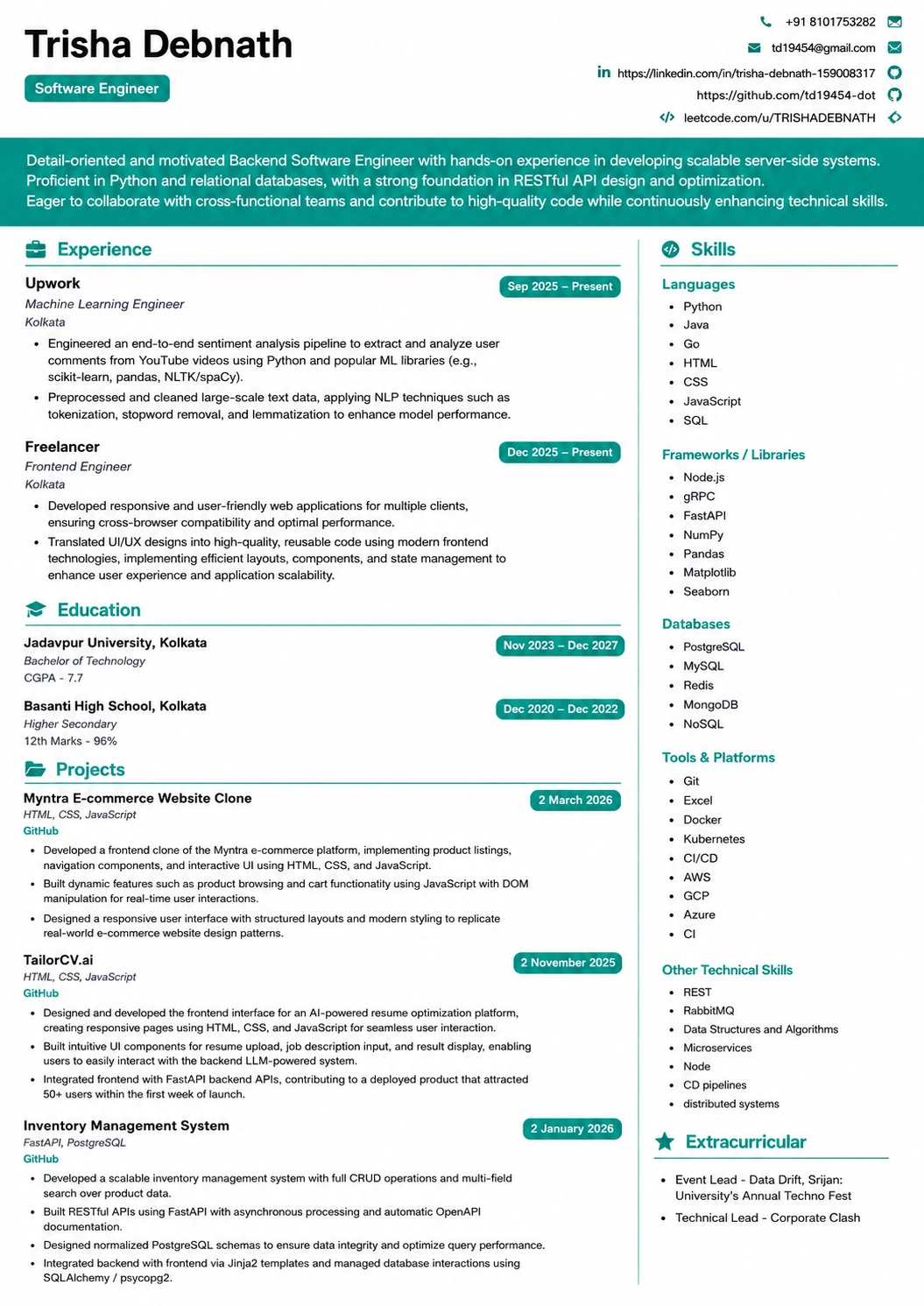
A layout that parses cleanly
Single column, standard headings, no text boxes — the formatting rules in this guide, already applied.
Was this guide useful?
Be the first to rate it.