TD
TD
Key Takeaways
- Keywords help you pass ATS screening and appear in recruiter searches at global employers in Japan.
- The most powerful keywords are the hard skills, tools, and titles in each job description.
- Language credentials — JLPT and TOEIC scores — are high-value keywords in the Japanese market.
- Always mirror the exact terms in the job posting where they're true of you.
- Use keywords naturally and honestly — stuffing backfires with both the ATS and recruiters.
Keywords are what get an English resume noticed in Japan's global and tech job market — both by the applicant tracking systems (ATS) many international employers use and by the recruiters who search LinkedIn and resume databases. Using the right skills, language credentials, and industry terms — the exact words employers scan for — can be the difference between landing in the interview pile and being filtered out. And in Japan specifically, some keywords (like your JLPT and TOEIC scores) carry unusual weight.
This guide covers the best resume keywords for jobs in Japan in 2026: the categories that matter, examples by field, the Japan-specific credentials to feature, and how to use them naturally.
Why Keywords Matter in Japan
Many global companies, tech firms, and international employers in Japan screen English resumes with an ATS and rank candidates by keyword relevance — see ATS and English resumes for Japan. Recruiters also search resume databases and LinkedIn using specific skills and titles. If your resume lacks the terms they search, you stay invisible — no matter how qualified you are. Keywords make you findable and rank you higher.
The Most Important Keywords: From the Job Description
Your single best source of keywords is the job posting itself. Employers list the skills, tools, and qualifications they want — those are the terms the ATS is configured to find. For every application:
- Read the job description closely.
- Identify the repeated skills, tools, and terms.
- Mirror that exact language on your resume where it's genuinely true of you.
Tailoring keywords to each job is the highest-return optimisation you can make. The TailorCV resume optimizer compares your resume to a specific job description, scores the match, and shows the keywords you're missing — take the guesswork out.
Japan-Specific Keywords to Feature
These credentials and terms carry special weight in the Japanese market:
- JLPT (Japanese Language Proficiency Test): state your level explicitly — "JLPT N2", "JLPT N1". This is one of the most valuable signals for any role touching Japanese business.
- TOEIC: widely used to certify English ability in Japan — include your score (e.g. "TOEIC 900").
- Bilingual / Business-level Japanese / Native English — clear language-level descriptors.
- Japan / APAC market experience — where relevant.
- Visa status — noting eligibility can help (confirm details separately).
Feature language credentials prominently — see the Japanese resume guide for context on how these are valued.
High-Value Skill Keywords by Field
Use these as prompts — always match them to the specific job and your real experience.
Technology / IT (a top sector for foreigners)
- Programming languages and frameworks (e.g. Python, Java, JavaScript, React) as relevant
- Cloud (AWS, Azure, GCP), DevOps, CI/CD
- Data analysis, SQL, machine learning
- Agile, Scrum, software development lifecycle
Finance and Business
- Financial analysis, forecasting, modelling
- Risk, compliance, audit
- FP&A, reporting, budgeting
- Project management, stakeholder management
Engineering and Manufacturing
- Relevant engineering disciplines and CAD/tools
- Quality control, process improvement, Lean, Kaizen
- Production, supply chain
English Teaching / Education
- ESL/EFL, curriculum, lesson planning
- TEFL/TESOL certification
- Classroom management
Sales, Marketing, and International Business
- Business development, account management
- Digital marketing, SEO, CRM (e.g. Salesforce)
- Market research, localisation
Soft-Skill and Culture Keywords
Japanese workplaces value certain qualities — where genuine, reflect them:
- Teamwork, collaboration, harmony
- Reliability, diligence, attention to detail
- Cross-cultural communication, adaptability
- Long-term commitment
Back these with evidence rather than listing them as empty adjectives.
How to Use Keywords Naturally
- Weave them into achievement bullets: "Built a Python data pipeline that reduced reporting time by 40%" beats a bare keyword list.
- Include a skills section listing your core tools and competencies — easy for ATS and recruiters to scan.
- State language credentials clearly near the top or in a dedicated section.
- Use exact terms and sensible variations (e.g. spell out and abbreviate: "Search Engine Optimization (SEO)").
- Stay honest — only claim skills you have; you'll be tested in interviews.
What an ATS score report actually shows you

The score matters less than the breakdown beside it - each check names what passed, what failed and why, which is the list you actually work through.
Don't Overdo It
Keyword stuffing — cramming irrelevant terms or repeating them unnaturally — hurts you. Modern ATS and recruiters flag it, and it makes your resume unreadable. Aim for natural, relevant, honest usage. Quality and fit beat volume.
Put It All Together
- Build a clean, ATS-friendly resume with the TailorCV resume builder.
- For each job, tailor keywords and check your match with the resume optimizer.
- Ensure the format is parser-friendly — see ATS and English resumes for Japan.
- Mirror your keywords on LinkedIn, which global recruiters in Japan search.
- Add a targeted cover letter — see the Japanese cover letter guide.
For the wider job search, see how to get a job in Japan as a foreigner and the best job sites for Japan.
Frequently Asked Questions
What are the best keywords for a resume for jobs in Japan? The skills, tools, and titles in the specific job description, plus Japan-specific credentials like your JLPT and TOEIC scores. Mirror the posting's language where it's true of you.
How important are JLPT and TOEIC scores on a resume? Very — they're trusted, concrete credentials in the Japanese market. State your levels/scores explicitly (e.g. "JLPT N2", "TOEIC 900").
How do I find the right keywords for each job? Read the job description for its repeated skills and terms, or use the TailorCV resume optimizer to compare your resume to the posting and reveal missing keywords.
Can I use too many keywords? Yes — keyword stuffing backfires with ATS and recruiters. Use relevant terms naturally and honestly within real achievements.
Final Thoughts
The best resume keywords for jobs in Japan are the ones that match each job description — plus the Japan-specific credentials, especially your JLPT and TOEIC scores, that employers here trust. Mirror the posting's language honestly, weave keywords into quantified achievements, and keep the format ATS-friendly.
Build your resume with the TailorCV resume builder, and let the resume optimizer show you exactly which keywords each Japanese job is looking for. The right words, used honestly, get you found — and get you interviews.
See which keywords you are missing
Scan your resume against the posting and get the exact terms it did not find.
Drop your resume here or choose a file
PDF only. Max 2 MB.
We never share your data or use it to train AI models.
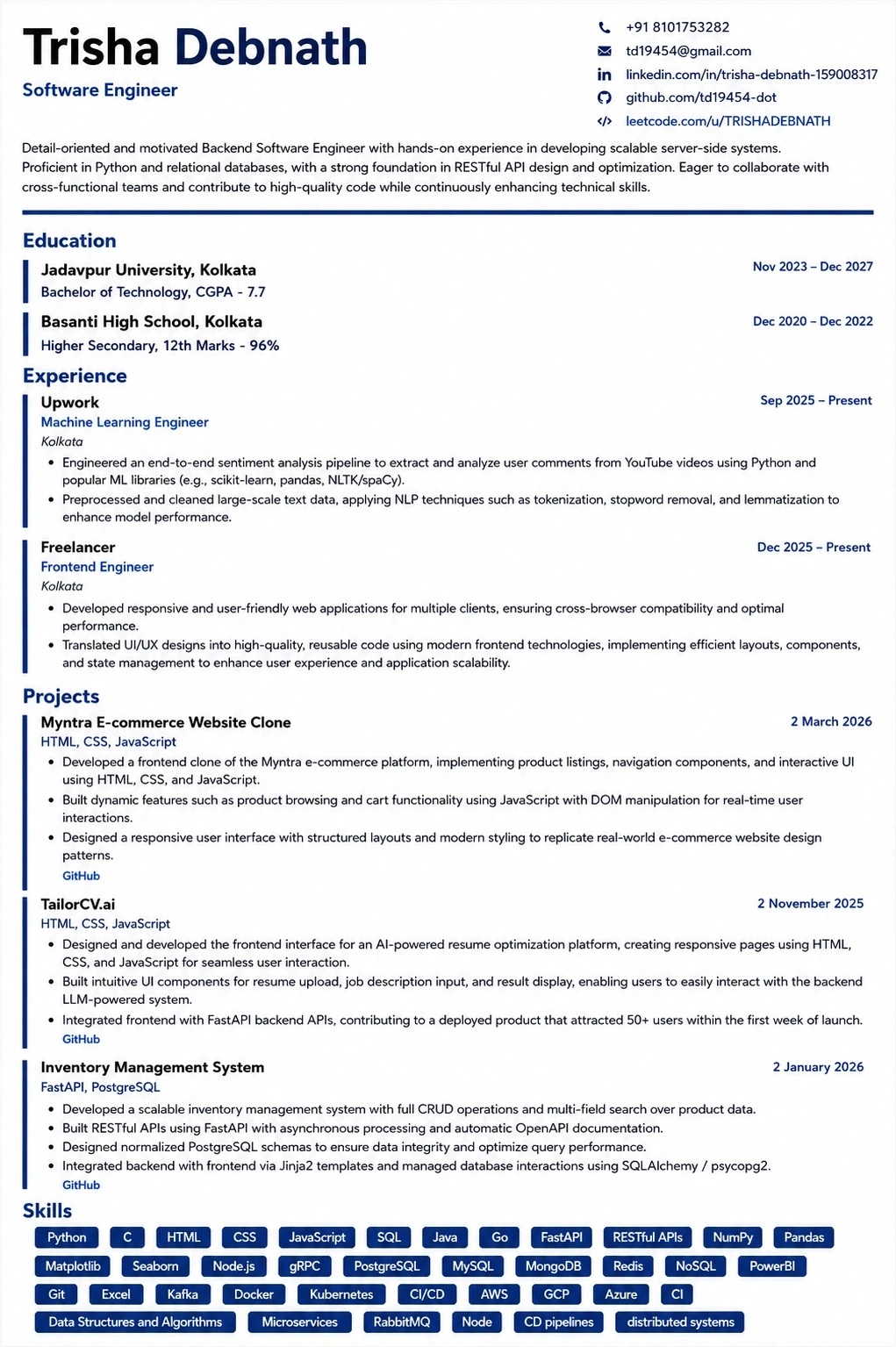
Where those keywords actually go
A layout with a real skills section gives the parser somewhere clean to find every term you just added.
Was this guide useful?
Be the first to rate it.