 TD
TD
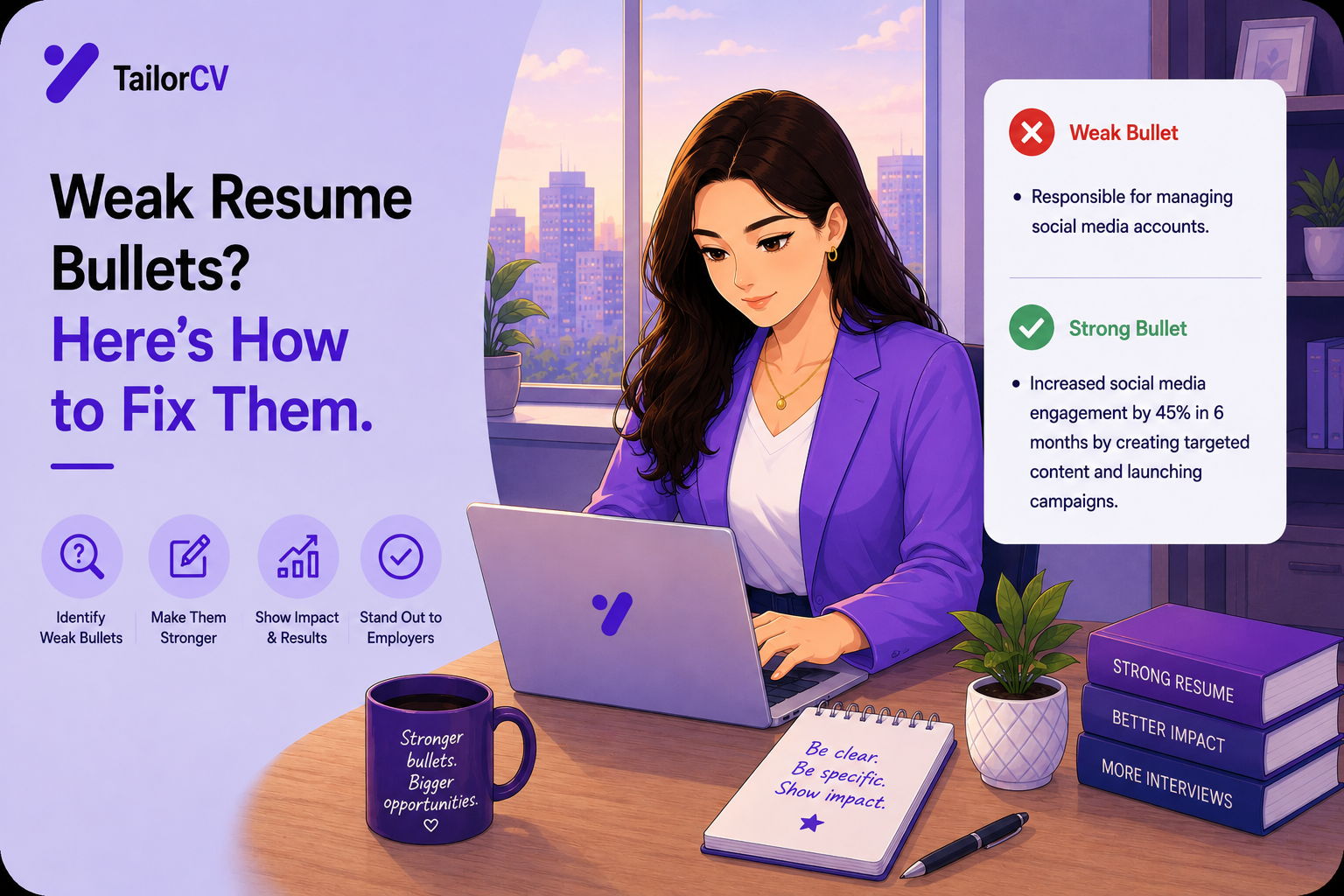
Key Takeaways
- A weak bullet describes a duty; a strong one describes a result.
- The test is whether anyone would doubt it. Nobody doubts that a developer wrote code.
- Numbers help but are not mandatory, and scope or outcome works when figures are unavailable.
- Responsible for is the most reliable marker of a bullet that has not been thought about.
- Fixing bullets is the highest-return resume work available after tailoring.
How to spot a weak bullet
The recognisable patterns.
It starts with responsible for, which announces a job description rather than an achievement.
It describes the role, not your performance in it. Anyone holding the title did this, so it distinguishes you from nobody.
It contains no outcome. The work happened; what changed as a result is absent.
It uses intensifiers instead of specifics — extensive, significant, various, multiple — all of which occupy space without carrying information.
It could appear on a colleague's resume unchanged, which is the clearest test available.
It lists tools without context, naming what you touched rather than what you did with it.
And it is uncheckable, making a claim with nothing behind it that an interviewer could ask about productively.
The repair pattern
Turning duties into evidence.
| Weak | Stronger |
|---|---|
| Responsible for managing social media accounts | Grew the primary channel's engagement by reworking the posting schedule and format |
| Worked on the checkout redesign | Rebuilt the checkout flow, cutting abandonment at the payment step |
| Handled customer support queries | Resolved a daily queue of support tickets while reducing repeat contacts through documentation |
| Used SQL for reporting | Replaced a manual weekly report with a SQL pipeline, freeing a day of analyst time each week |
| Assisted with recruitment | Screened applicants and ran first-round interviews for three engineering roles |
The pattern is action, method, result. What you did, how you did it, and what changed because of it.
The result is the part people omit, and it is the part that makes a bullet worth reading.
Method matters more than it appears, because it is where your judgement shows. Two people can achieve the same outcome and the one who explains how did the more interesting work.
And specificity beats scale. A small concrete result is more persuasive than a large vague one.
Verbs that carry weight
The opening word does more than people expect.
Ownership verbs — built, designed, led, owned, launched — claim responsibility and should only be used where you genuinely had it.
Contribution verbs — implemented, developed, delivered, produced — describe substantial work without overclaiming the whole.
Improvement verbs — reduced, increased, streamlined, automated — imply a before and after, which is why they read as achievements almost automatically.
Support verbs — assisted, supported, participated — are honest but weak, and should be used sparingly and only where accurate.
Avoid the empty ones. Utilised, leveraged and facilitated add syllables rather than meaning, and they signal a resume trying to sound senior.
Match the verb to the truth. A support verb on work you genuinely led undersells you, and an ownership verb on work you contributed to fails at interview when the detail is probed.
And vary them across a role, since five bullets all beginning with managed reads as a single undifferentiated blur.
Bullets for different kinds of work
Not every job produces the same evidence.
Project work produces the easiest bullets — a defined start, a defined end and a result.
Operational work is measured by volume, reliability and improvement rather than by discrete projects. Sustained a service level across a growing caseload is a real achievement.
Support and service roles are measured by resolution, satisfaction and prevention. Reducing repeat contacts is worth more than counting tickets.
Research work is measured by findings, decisions influenced and methods established rather than by delivery.
Management work is measured through the team — what they achieved, how retention and capability changed, what you built that outlasted you.
Early-career work is measured by learning speed and expanded responsibility, and taking on more within a year is legitimate evidence.
And creative work is measured by reach, adoption and the brief being met, which frequently requires describing the constraint you worked within.
Mini checklist
- unchecked: No bullet begins with responsible for
- unchecked: Each bullet names something that changed
- unchecked: Intensifiers replaced with specifics
- unchecked: Method included where it shows judgement
- unchecked: Bullets distinguishable from a colleague's
- unchecked: Tools tied to what you did with them
- unchecked: Top three bullets are the strongest ones
- unchecked: Every claim answerable in an interview
Scenarios
Scenario 1: Your work genuinely has no measurable output
Use scope and outcome instead. How many people, how often, how large a system, what changed qualitatively. Not all valuable work produces a percentage.
Scenario 2: You worked in a team and cannot claim the result
Name your contribution inside the team result. Contributed the data model for a system that did X is honest and considerably stronger than a vague duty statement.
Scenario 3: All your bullets look the same
This usually means you are describing the role rather than your time in it. Ask what was different about how you did the job compared with your predecessor.
Tip: Read a bullet and ask whether a colleague in the same role could have written it word for word. If they could, it describes the job rather than you, and it is doing nothing for your application.
Do's and Don'ts
Do
- Lead with what you did, not what you were assigned
- Name the outcome wherever one exists
- Use scope when numbers are unavailable
- Include method where it shows judgement
- Make your strongest bullet the first one
- Keep every claim defensible at interview
Don't
- Open with responsible for
- Rely on intensifiers to add weight
- List tools without context
- Claim team results as solely yours
- Describe duties anyone in the role performed
- Write bullets you could not discuss for five minutes
Common Mistakes
- Responsible for. The clearest sign of an unexamined bullet.
- Duties instead of results. Nobody doubted you had the duties.
- Intensifiers. They add length and no information.
- Uncontextualised tools. Touching a tool is not an achievement.
- Identical bullets across roles. It suggests nothing changed in years.
- Unanswerable claims. They collapse in the interview.
Related Guides
Keep building on this with the related guides in this series:
- How to Rewrite Resume Bullet Points
- How to Quantify Achievements Without Numbers
- How Recruiters Read Your Resume
- Why Your Resume Gets No Responses
- Resume Red Flags Recruiters Notice
You can also check your resume's ATS score for free, generate a tailored cover letter, or build a portfolio website in minutes.
Frequently Asked Questions
What makes a resume bullet weak?
It describes a duty that anyone in the role would have performed, contains no outcome, and could appear unchanged on a colleague's resume. Nobody doubted you had the responsibilities.
Does every bullet need a number?
No. Where figures are unavailable, scope and outcome work well — how many people, how often, what changed. A specific qualitative result beats an invented percentage.
What should a bullet start with?
An action verb describing what you actually did. Avoid responsible for, which announces a job description rather than an achievement.
How do I write bullets for team work?
Name your contribution within the team result. Describing what you specifically built inside a larger outcome is honest and stronger than a vague duty statement.
How many bullets per role?
Three to five for recent relevant roles, fewer for older ones. The first bullet should be the strongest, since it is the one most reliably read.
What if my bullets all look similar?
You are probably describing the role rather than your performance in it. Ask what you did differently from whoever held the job before you.
Which verbs should resume bullets start with?
Ownership verbs where you genuinely led, contribution verbs for substantial work within a team, and improvement verbs where there is a before and after. Avoid utilised, leveraged and facilitated entirely.
How do I write bullets for operational or support work?
Measure volume, reliability and prevention rather than discrete projects. Sustaining a service level as demand grew, or reducing repeat contacts, are genuine achievements.
What is your resume scoring right now?
Scan it against a job description and get your ATS match score in about a minute.
Drop your resume here or choose a file
PDF only. Max 2 MB.
We never share your data or use it to train AI models.

Was this guide useful?
Be the first to rate it.