 SS
SS
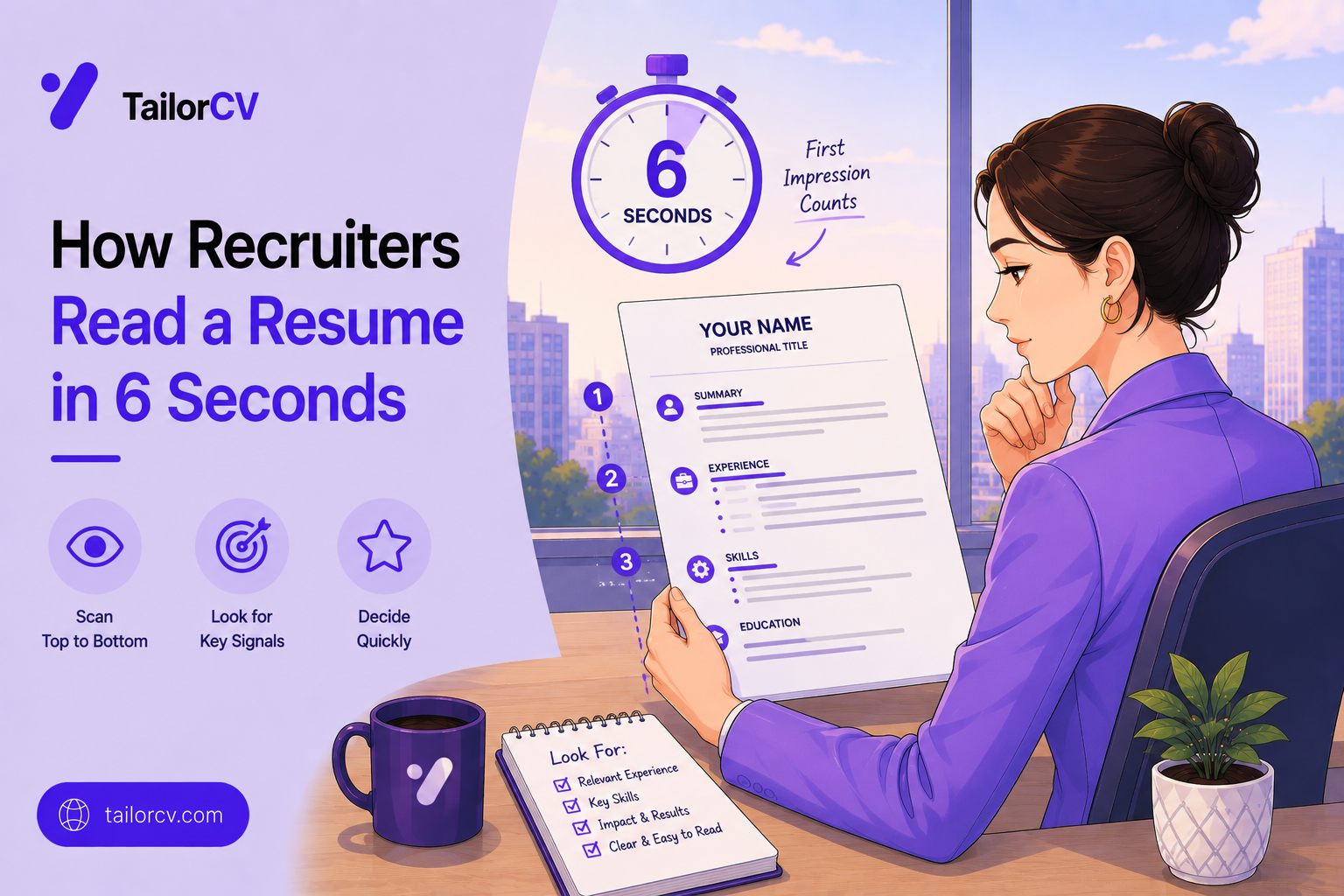
Key Takeaways
- The first pass is a scan, not a read, and it is looking for reasons to continue or stop.
- The top third of page one carries most of the decision, because that is where the scan concentrates.
- They look for four things — current title, recent employer, dates and relevant skills.
- Layout directs attention. A well-structured page guides the scan; a dense one repels it.
- The goal of the scan is not to be impressive, it is to be obviously relevant within seconds.
What the first pass looks for
The sequence, in rough order.
Your most recent title, checked against the role being filled. This is the single strongest relevance signal available and it is read first.
Your current or most recent employer, which provides context about scale, sector and the kind of environment you have worked in.
Dates, scanned for continuity and for how long you have been in your current role.
The skills section, if it is positioned where it can be found quickly, which serves as fast confirmation of the match.
Location, checked against the role's requirements, which can end the review immediately regardless of everything else.
And one or two achievement lines, if something in the layout draws the eye to them.
That is the whole first pass. Anything not visible in that sweep is not part of the initial decision, which is why placement matters more than content at this stage.
Designing for the scan
How structure changes what gets seen.
| Choice | Effect on the scan |
|---|---|
| Summary at the top, three lines | Frames everything; read almost always |
| Skills section high on page one | Fast confirmation of match |
| Reverse chronological order | Matches the expected reading pattern |
| Bullets under six lines each | Scannable; longer blocks get skipped |
| Numbers inside bullets | Draw the eye and slow the scan usefully |
| Dense paragraphs | Reliably skipped entirely |
| Two columns | Unpredictable reading order, parsing risk |
White space is functional. A page with room to breathe is scanned; a page packed to the margins is abandoned.
Consistency reduces effort. Uniform date formats, heading styles and bullet structures let the reader move quickly, and anything irregular costs attention you need spent elsewhere.
And the second page is optional reading. Assume it will not be reached in the first pass, and place nothing decisive there.
After the first pass
What happens to a resume that survives the scan.
The second read is much slower and considerably more sceptical, looking for substance behind the signals that earned attention.
Bullets get read properly at this stage, and vague claims that survived the scan fail here.
Dates get checked carefully. Gaps, overlaps and short tenures become questions rather than scan-level impressions.
Claims get tested against plausibility. A result that seems disproportionate to the role attracts scepticism rather than admiration.
Progression gets assessed. The shape of a career over several roles tells a story, and the reader is checking whether it points toward this position.
Specific detail earns credibility. Named tools, real numbers and concrete scope all read as verifiable, while adjectives read as decoration.
And this is where a tailored resume separates from a merely attractive one, because the second read is looking for fit with the actual work rather than for general competence.
Writing for both readers
Satisfying the scan and the scrutiny at once.
Front-load the signals the scan needs — title, summary, skills, one strong number — without letting the top of the page become a claim you cannot support.
Make every headline claim checkable in the detail below it, so the second reader finds substance where the first reader found a signal.
Use specifics rather than intensifiers. Extensive experience is a scan-level word with nothing behind it; four years across three product teams survives both readings.
Keep the structure predictable so the second reader can find what they are looking for without effort.
Do not hide the weaknesses, since the second read finds them anyway and an unexplained gap is worse than a briefly explained one.
And write the bullets to be read alone, because that is how they are encountered — scanned individually rather than as a paragraph with a build-up.
Mini checklist
- unchecked: Most recent title reads close to the target role
- unchecked: Summary in the top three lines and role-specific
- unchecked: Skills section high and reordered per application
- unchecked: Dates consistent and continuous
- unchecked: Location visible if it helps you
- unchecked: Strongest achievement on page one
- unchecked: Bullets short enough to scan
- unchecked: Numbers present to anchor the eye
- unchecked: Nothing decisive placed on page two
Scenarios
Scenario 1: Your title does not match the target role
Add a clarifying line under your title describing the work in the target role's terms, or use a summary that immediately reframes it. Do not invent a title you did not hold.
Scenario 2: Your best achievement is in an older role
Bring it forward into the summary rather than leaving it buried on page two. The summary is the one place where you control what gets read first.
Scenario 3: Your resume is visually dense
This is worth fixing before anything else. Cut older detail, shorten bullets and add spacing, because a page that is not scanned cannot be assessed at all.
Tip: Look at your resume for six seconds and then look away. Whatever you can still recall is what a recruiter takes from the first pass. If it is not the case for this specific role, the layout is working against you rather than the content.
Do's and Don'ts
Do
- Put the summary in the top three lines
- Keep the skills section high
- Use consistent formatting throughout
- Include numbers to anchor attention
- Keep bullets short and scannable
- Assume page two is unread in the first pass
Don't
- Bury relevance below the fold
- Write dense unbroken paragraphs
- Use two columns for parsed applications
- Vary date and heading formats
- Rely on page two for anything decisive
- Confuse visual complexity with substance
Common Mistakes
- Relevance below the fold. The scan never reaches it.
- Dense paragraphs. They are skipped rather than read.
- Inconsistent formatting. It costs attention you need elsewhere.
- A generic summary. The most valuable space on the page, wasted.
- Decisive content on page two. Frequently not opened.
- Design over clarity. The scan rewards structure, not decoration.
Related Guides
Keep building on this with the related guides in this series:
- What Recruiters Actually Search For
- Resume Red Flags Recruiters Notice
- Why the Same Resume for Different Jobs Fails
- How to Write a Resume Summary
- Why Your Resume Gets No Responses
You can also check your resume's ATS score for free, generate a tailored cover letter, or build a portfolio website in minutes.
Frequently Asked Questions
Do recruiters really only spend seconds on a resume?
On the first pass, yes. That pass decides whether to read properly, and resumes that survive it receive considerably more attention afterwards.
What do they look at first?
Most recent title, then employer, then dates, then skills, then location. Title against the target role is the strongest single signal.
Where should my most important content go?
The top third of page one. The summary and the skills section are the two positions that are almost always seen.
Does the second page get read?
Rarely on the first pass. Include it if you need the space, but place nothing decisive there.
Do numbers actually help?
Yes. They interrupt scanning and draw the eye, which is exactly what you want at the point where a reader is deciding whether to slow down.
Should I use a two column layout?
Not for applications that will be parsed. Reading order becomes unpredictable and content can be lost entirely during processing.
What happens after the six second scan?
A slower, more sceptical read. Bullets are examined properly, dates are checked for gaps and tenure, claims are tested for plausibility, and career progression is assessed for whether it points toward this role.
How do I write for both the scan and the closer read?
Front-load the signals the scan needs, then make every headline claim checkable in the detail beneath it. Use specifics rather than intensifiers, and write each bullet so it stands alone.
What is your resume scoring right now?
Scan it against a job description and get your ATS match score in about a minute.
Drop your resume here or choose a file
PDF only. Max 2 MB.
We never share your data or use it to train AI models.

Was this guide useful?
Be the first to rate it.