 SS
SS
Key Takeaways
- Content decides length, not a rule. Fill the space you have earned and stop.
- One page suits early careers; two is normal with several years of relevant work.
- A second page of filler is far worse than a full single page.
- The real question is what to cut, and older detail is almost always the answer.
- Regional and sector conventions vary, and academic and public sector formats differ substantially.
The working rule
What actually determines the right length.
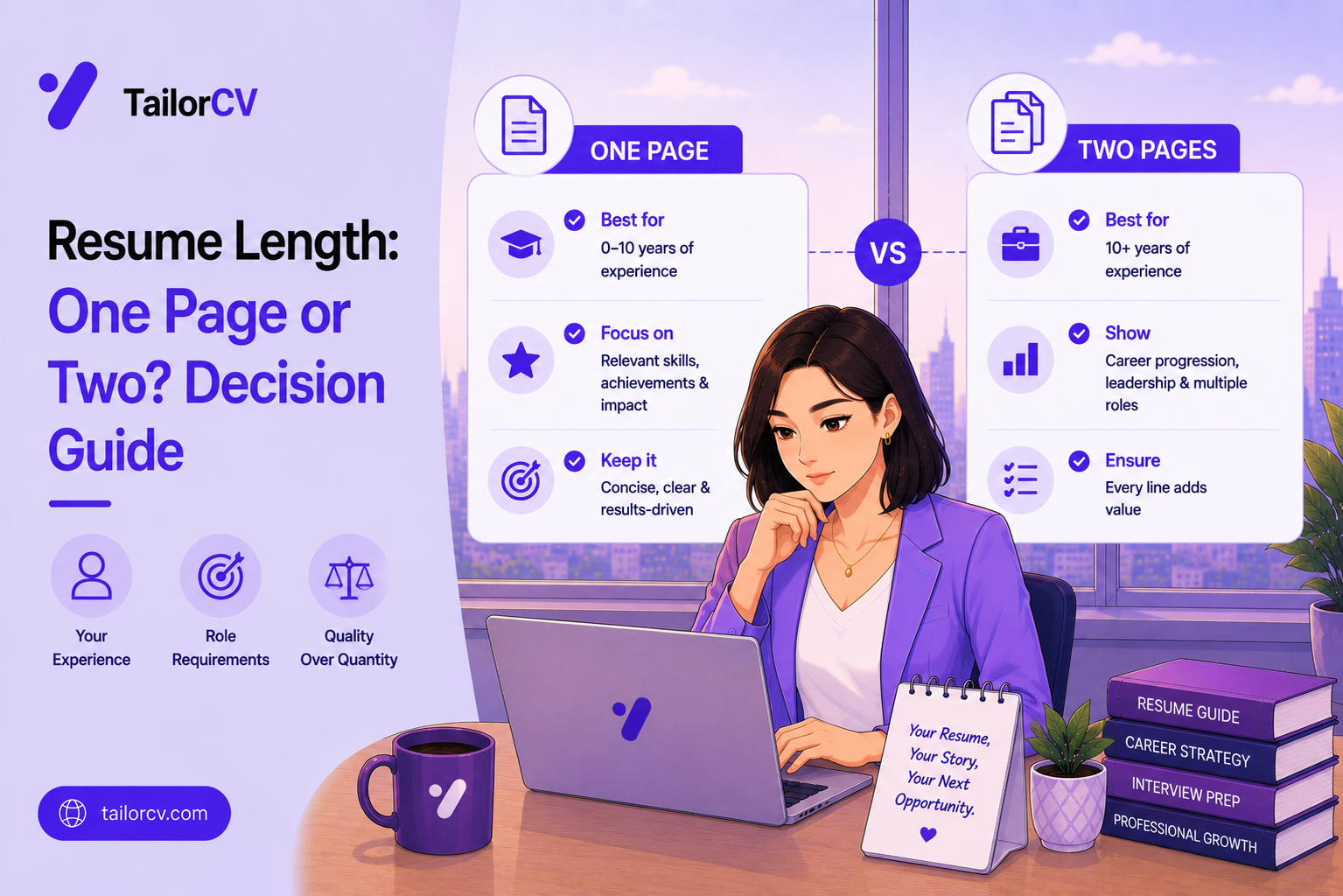
Under roughly three years of experience, one page. There is rarely enough relevant material to justify more, and stretching produces visible padding.
Three to ten years, one or two pages depending on how much of the work is relevant to the target role.
Beyond ten years, two pages is normal and expected, with older roles compressed heavily.
Senior and executive roles can run longer, since scope, board exposure and transformation work need describing.
Academic and research formats are different entirely, where a full publication and funding record is expected and length is not a consideration.
Public sector and regulated applications frequently specify a format or a limit, and following it exactly matters more than any general principle.
But the rule underneath all of these is that every line should earn its place, and a resume of the right length by accident is still wrong if half of it is filler.
What to cut first
The order in which space should be reclaimed.
| Cut this | Before this |
|---|---|
| Roles over fifteen years old | Anything from your recent work |
| Duties that describe the job title | Achievements with outcomes |
| Obsolete tools and technologies | Current relevant skills |
| Early education detail | Professional experience |
| Generic interests and hobbies | Anything role-relevant |
| Referees available on request | Everything, always |
Old roles compress to a line each — title, employer, dates — which preserves the chronology without spending space on detail nobody reads.
Duplicated skills across roles can go, since listing the same tool under four employers adds nothing after the first mention.
The address block can shrink to a city and region, which is all anyone needs and is better practice besides.
And referees available on request is dead space in every case, since it is assumed and asked for when needed.
What belongs on page one
If you use two pages, the split is not arbitrary.
Contact details and summary open the document and are never split across a page break.
The skills section belongs on page one, since it is the fastest confirmation of match and it is frequently the only section read closely on a first pass.
Your current and most recent role must be complete on page one, because a role split across the break loses its strongest bullets to a page nobody turns to.
The second most recent role can begin on page one and continue overleaf if necessary, though finishing it there is better.
Education moves to page two for anyone with several years of experience, unless the qualification is a hard requirement for the role.
Older roles, certifications and additional sections live on page two, compressed.
And nothing decisive belongs on page two at all, since the first pass frequently does not reach it.
Regional and sector differences
Where the general rule does not apply.
Academic and research applications use a full curriculum vitae with complete publication, funding and teaching records, and length is not a consideration at all.
Public sector recruitment in many countries specifies a format, a page limit or a competency-based structure, and following it exactly is more important than any general advice.
Some European markets expect additional detail that would be unusual elsewhere, though photographs and personal data are increasingly discouraged.
Medical, legal and regulated professions frequently expect registration numbers, licences and detailed training records regardless of length.
Consulting and finance tend toward strict one-page formats early in a career, even where general advice would allow two.
And graduate schemes often specify their own template or form entirely, which replaces the resume rather than supplementing it.
Check the convention for your market and sector before applying a general rule, because a format mismatch is noticed immediately by anyone who reads those documents daily.
Mini checklist
- unchecked: Length matched to actual relevant experience
- unchecked: Every line assessed for whether it earns space
- unchecked: Roles over fifteen years old compressed to one line
- unchecked: Duplicate skills listed once
- unchecked: Obsolete tools removed
- unchecked: Hobbies removed unless genuinely relevant
- unchecked: Referees line deleted
- unchecked: No orphaned line spilling onto an extra page
- unchecked: Regional or sector format requirements followed
Scenarios
Scenario 1: You have two years of experience and a page and a half
Cut to one page. The half page is almost certainly early education detail, duties rather than achievements, or a hobbies section, and removing it strengthens the document.
Scenario 2: You have twelve years and are forcing one page
Stop forcing it. Two pages is normal at that stage, and the compression required to reach one page removes the evidence that makes you competitive.
Scenario 3: Your resume runs to two pages plus three lines
Fix this. A third page holding three lines looks careless, and finding three lines to cut is always possible.
Tip: Page count is a symptom rather than the problem. If you cannot fill one page, you are describing duties instead of achievements; if you cannot fit two, you are keeping detail from roles that stopped mattering years ago.
Do's and Don'ts
Do
- Let content determine length
- Compress roles over fifteen years old
- List each skill once
- Follow specified formats exactly
- Use two pages when you have earned them
- Remove any orphaned overflow line
Don't
- Force one page by cutting real evidence
- Pad a second page to look experienced
- Repeat skills under every role
- Keep obsolete tools for volume
- Include a referees line
- Assume one rule applies to every market
Common Mistakes
- Padding to two pages. Filler reads worse than brevity.
- Forcing one page. It removes the evidence you need.
- Keeping old detail. Roles from fifteen years ago need one line.
- Repeating skills. Once is enough.
- A third page of overflow. It signals carelessness immediately.
- Ignoring specified formats. Where a limit is stated, it is a rule.
Related Guides
Keep building on this with the related guides in this series:
- ATS Resume Length Guide
- How Recruiters Read Your Resume
- Weak Resume Bullets and How to Fix Them
- Resume Update Checklist Before Applying
- Resume Red Flags Recruiters Notice
You can also check your resume's ATS score for free, generate a tailored cover letter, or build a portfolio website in minutes.
When you need to cut to fit a page, cutting irrelevant experience without creating a gap covers which jobs to condense, group or remove safely.
Frequently Asked Questions
Should my resume be one page or two?
One page under roughly three years of experience, one or two from three to ten years, and two beyond that. Content should decide, not an arbitrary rule.
Is a two page resume acceptable?
Yes, with the experience to fill it. The problem is never the second page itself, it is a second page of padding.
What should I cut first?
Roles over fifteen years old, duties that merely describe the job title, obsolete tools, early education detail and hobbies. The referees line goes in every case.
Can I use a smaller font to fit one page?
Not below readable size. Shrinking type and margins to force a page count produces a document nobody wants to read, which defeats the purpose entirely.
Does the rule differ by country or sector?
Yes. Academic formats expect full publication records, and public sector applications frequently specify a limit. Where a format is stated, follow it exactly.
What if I have two pages and three extra lines?
Cut the three lines. A third page containing almost nothing reads as careless, and three lines can always be found.
If I use two pages, what goes on page one?
Contact details, summary, skills and your complete current role. Never split your most recent position across the page break, and place nothing decisive on page two.
Do resume length rules vary by sector or country?
Substantially. Academic CVs have no length limit, public sector applications frequently specify a format, and consulting and finance often expect a strict single page early in a career.
What is your resume scoring right now?
Scan it against a job description and get your ATS match score in about a minute.
Drop your resume here or choose a file
PDF only. Max 2 MB.
We never share your data or use it to train AI models.

Was this guide useful?
Be the first to rate it.