 TD
TD
Key Takeaways
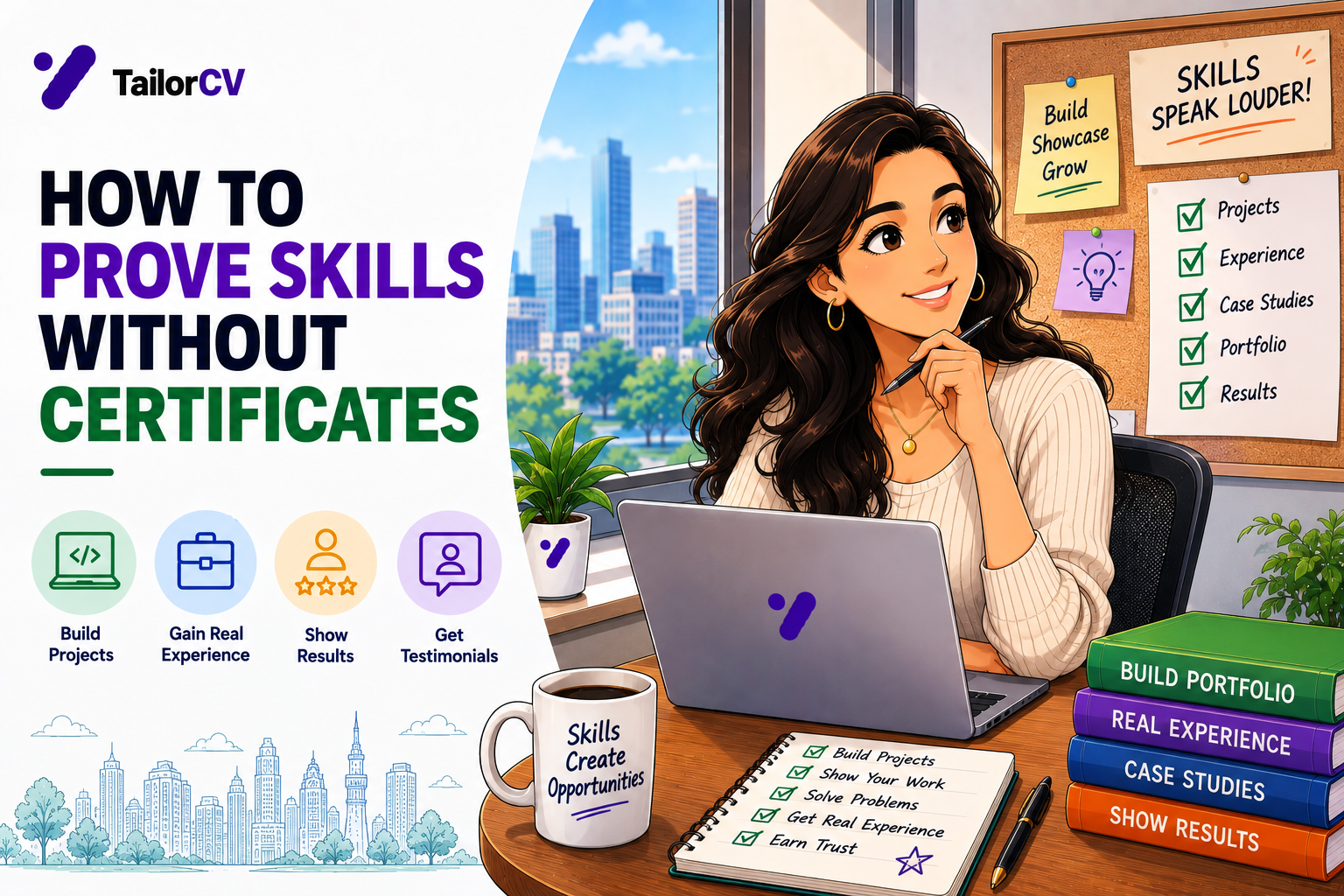
- Evidence of use beats evidence of study in almost every field outside regulated professions.
- Work product is the strongest proof available, and it is usually something you can show.
- Certificates prove attendance, not capability, and experienced readers know the difference.
- Some fields genuinely require credentials, and no substitute exists there.
- Make the evidence findable. A skill nobody can verify is a claim rather than proof.
What counts as evidence
Ordered roughly by persuasive weight.
Shipped work. Something you built, wrote, designed or ran that exists and can be examined. This outranks every other form of proof.
Applied experience. Having used the skill in a real role with real consequences, described concretely with scope and outcome.
A portfolio or public repository, which lets a reader assess quality directly rather than taking your word.
A detailed project description, where the work itself is confidential and cannot be shown.
A reference who can speak to it, which carries real weight at the later stages.
A certificate, which confirms you completed a course and little else.
And a self-assessed skills list, which is the weakest form and carries almost no information on its own.
Notice the ordering. Most people invest in the bottom two and neglect the top three, which is the wrong way round for every field where the work can be shown.
Showing the evidence
Making it visible to the reader.
| Situation | What to show |
|---|---|
| Public work exists | A direct link in your resume header |
| Work is confidential | A written case study of process and outcome |
| Skill used at work | A bullet with scope, method and result |
| Learned independently | A project that uses it, not the course |
| Rarely used but real | Honest framing — familiar, not expert |
| Regulated profession | The actual credential, with no substitute |
Link directly rather than describing. A reader who can see the work in one click assesses it; a reader who must search for it does not.
A confidential project still yields a case study. You can describe the problem, your approach and the outcome without disclosing anything protected, and that description is itself evidence of how you think.
And honesty about level is more persuasive than overclaiming, since an accurate familiar survives a technical conversation while an inflated expert does not.
Building evidence from nothing
Where to start when you have no work to show.
Solve a real problem, not a tutorial one. Anything following a course produces the same output as everyone else on that course and demonstrates very little.
Use your own data or context where possible, since a project rooted in something you know is more interesting and easier to discuss.
Finish something small rather than starting something ambitious. A completed modest project is evidence; an abandoned large one is not.
Document the decisions, because the reasoning is what a reader assesses. What you chose not to do is frequently more revealing than what you built.
Publish it somewhere findable, since work nobody can reach proves nothing.
Ask someone in the field to look at it before you rely on it, which catches the problems that make a portfolio piece count against you.
And one strong piece beats five weak ones. Depth in a single project demonstrates capability far better than a collection of unfinished starts.
Talking about it at interview
Where the evidence gets tested.
Expect specific questions about anything you show, since a portfolio invites scrutiny that a certificate does not.
Know your own decisions. Being unable to explain why you did something the way you did undermines the whole piece.
Be honest about what was hard and what you would do differently, which reads as maturity rather than weakness.
Describe the constraints you worked within, since work is judged against its conditions and unexplained constraints look like poor choices.
Do not oversell scale. A small project described accurately is credible, and the same project inflated becomes a liability the moment a follow-up question lands.
And prepare the confidential ones equally. A case study you cannot discuss in reasonable detail is worse than not mentioning the work at all.
Mini checklist
- unchecked: Strongest available evidence identified per skill
- unchecked: Public work linked directly and tested
- unchecked: Confidential work described as a case study
- unchecked: Skills tied to outcomes in bullets rather than listed alone
- unchecked: Level described honestly
- unchecked: References briefed on what to confirm
- unchecked: Required credentials held where genuinely mandatory
Scenarios
Scenario 1: You are self-taught with no formal qualification
Build and show the work. In most technical and creative fields a strong portfolio outperforms a certificate, and employers who hire on evidence care about what you can do.
Scenario 2: All your work is under a confidentiality agreement
Write case studies describing the problem, your approach and the result without protected detail. Then build one small public thing to demonstrate capability directly.
Scenario 3: The role requires a specific licence
There is no substitute here. Obtain it, or apply to roles that do not require it, since this category is genuinely absolute.
Tip: Before adding a certificate, ask whether you could instead show something you made with the skill. In most fields the second is worth considerably more, and it costs a weekend rather than a course fee.
Do's and Don'ts
Do
- Lead with work product
- Link directly to public examples
- Write case studies for confidential work
- Tie skills to outcomes in bullets
- Describe your level honestly
- Obtain genuinely required credentials
Don't
- Rely on a skills list alone
- Assume a certificate proves capability
- Overclaim a level you cannot defend
- Bury links where nobody finds them
- Ignore mandatory licensing
- Leave confidential work undescribed entirely
Common Mistakes
- Listing skills without evidence. A claim, not proof.
- Certificate as the only support. It proves attendance.
- Unlinked portfolios. Evidence nobody can reach.
- Overclaiming level. It fails in the technical conversation.
- Silence on confidential work. A case study is still possible.
- Ignoring real credential requirements. Some are absolute.
Related Guides
Keep building on this with the related guides in this series:
- How to Quantify Achievements Without Numbers
- How to Apply When You Do Not Meet Every Requirement
- Side Projects on Your Resume
- How to Write a Portfolio Case Study
- Weak Resume Bullets and How to Fix Them
You can also check your resume's ATS score for free, generate a tailored cover letter, or build a portfolio website in minutes.
Frequently Asked Questions
How do I prove a skill without a certificate?
Show work that used it. Shipped work, a portfolio, or a detailed description of a real project all outrank a certificate, which confirms attendance rather than capability.
Are certificates worthless?
No, but they are weaker than most people assume. They help where a field expects them or where they are a hard requirement, and they add little where work product can be shown instead.
What if my work is confidential?
Write a case study covering the problem, your approach and the outcome without protected detail. Then build one small public example to demonstrate the capability directly.
How do I describe a skill I have used only a little?
Honestly. Familiar with survives a technical conversation while an inflated claim of expertise does not, and accuracy is more persuasive than reach.
Where should portfolio links go?
In your resume header, tested and working. A link a reader cannot find in one click is evidence that never gets examined.
Which fields genuinely require credentials?
Regulated professions — medicine, law, engineering, accountancy, teaching and similar. There the credential is a gate and no portfolio substitutes for it.
How do I build evidence when I have nothing to show?
Solve a real problem rather than a tutorial one, finish something small rather than abandoning something ambitious, document your decisions, and publish it where a reader can reach it in one click.
How is portfolio work tested at interview?
With specific questions about your decisions. Know why you made each choice, be honest about what was difficult, describe the constraints you worked within, and never inflate the scale.
What is your resume scoring right now?
Scan it against a job description and get your ATS match score in about a minute.
Drop your resume here or choose a file
PDF only. Max 2 MB.
We never share your data or use it to train AI models.

Was this guide useful?
Be the first to rate it.