 TD
TD

Key Takeaways
- Entry-level candidates can match resumes to job descriptions by organizing various experiences such as academic projects, coursework, and volunteer work.
- ATS systems prioritize keywords over the type of experience, allowing unpaid internships and class projects to count equally with professional experience.
- Extract keywords from job descriptions, categorizing them into must-have and nice-to-have skills for effective matching.
- Map each keyword to relevant experiences, ensuring that coursework and personal projects are considered valid evidence of skills.
- Rewrite experience sections using the exact terminology from the job description to enhance alignment with the employer's requirements.
You have no work experience. But the job description is full of requirements. Skills you might have but have not used professionally. Tools you have heard of but have not been paid to use.
This is the entry-level paradox. And it feels unfair.
Here is the truth: you have more to match than you think. You just have not organized it the right way.
This guide shows you exactly how to match your resume to any job description when you have no formal work experience - and how to do it in a way that passes ATS and gets a recruiter's attention.
Use TailorCV's resume optimizer to find out which entry-level JD keywords your resume is missing. Start with professionally designed resume templates built for entry-level and first-job applicants.
Why Entry-Level Resume Matching Is Different
When you have work experience, matching is about translating professional history into job description language.
When you have no work experience, matching is about organizing everything else you have done:
- Academic projects
- Coursework and certifications
- Internships (even unpaid or brief)
- Extracurricular activities
- Volunteer work
- Personal projects
- Freelance or contract work
- Competitions and hackathons
None of these are "no experience." They are all evidence of skill. The challenge is presenting them in the JD's language.
The question is not "do I have experience?" The question is "have I done anything that demonstrates the skills this job requires?"
What ATS Systems Look For in Entry-Level Resumes
ATS systems do not filter for experience type. They filter for keywords.
An unpaid internship where you used Python scripts is the same keyword credit as two years of professional Python work. A class project where you presented analysis to professors is the same "stakeholder presentation" keyword as a corporate presentation.
This is actually good news. ATS systems are keyword-agnostic. The source of your experience matters less than the keyword presence.
Step-by-Step: How to Match Your No-Experience Resume to a Job Description
Step 1: Extract Keywords from the JD
Read the full job description. Highlight every skill, tool, and qualification. Build a list.
Separate:
- Must-have keywords (required skills)
- Nice-to-have keywords (preferred skills)
Read job description keyword extraction guide for the full process.
Step 2: Map Each Keyword to Something You Have Done
This is the core of entry-level matching.
For each keyword, ask:
- "Did I use this tool in class?"
- "Did I do this activity in a project?"
- "Did I demonstrate this skill in a competition, club, or volunteer role?"
- "Did I complete a certification that covers this?"
Do not dismiss coursework. Do not dismiss projects. Do not dismiss extracurriculars.
If the answer is yes, that experience counts.
| JD Keyword | Matching Experience Source |
|---|---|
| Python | Class project using Python for data analysis |
| SQL | Database design course, final project |
| Agile / Scrum | Group project using Agile methodology in college |
| Data analysis | Research paper analyzing survey data |
| Stakeholder communication | Presentations to professors, student government |
| Team leadership | Led group project of 4 students |
| Customer service | Part-time job at a coffee shop or retail |
| SEO | Personal blog or website optimization |
Step 3: Rewrite Your Experience Sections in JD Language
Use the JD's exact terminology when describing what you did.
Before:
"Worked on a group coding project in Python"
After:
"Built a Python web scraper in a team of 3 to collect and analyze e-commerce pricing data - demonstrated applied data collection and analysis skills"
Before:
"Helped organize a student event"
After:
"Led cross-functional coordination for a 200-person student event, managing logistics, vendor communication, and volunteer team of 12"
The experience is the same. The language is aligned to what employers look for.
Step 4: Lead with Your Most Relevant Section
When you have no work experience, the traditional resume order does not serve you.
Rearrange your sections to lead with your strongest match:
If you have relevant projects:
Education
Projects (pinned to top)
Skills
Certifications
Work Experience (if any, even part-time)
If you have an internship or coursework:
Education
Internships / Relevant Experience
Skills
Projects
Certifications
Put your highest-relevance content first. ATS reads top-to-bottom. So do recruiters.
Step 5: Build a Keyword-Rich Projects Section
projects are your primary experience evidence.
For each relevant project, include:
- Project title (use JD-relevant language in the title)
- Tools and skills used (match JD keywords exactly)
- What you built or achieved
- Scale or scope if possible
Example for a data analyst Role:
Project: E-Commerce Sales Analysis Dashboard
- Queried and cleaned a 50,000-row sales dataset using Python (Pandas) and SQL
- Built interactive Tableau dashboard to visualize revenue trends and customer segmentation
- Presented findings to 15-person audience, identifying 3 product categories with highest growth potential
This project section contains: Python, Pandas, SQL, Tableau, data visualization, customer segmentation, presentation - all likely JD keywords for a data analyst role.
Step 6: Get Certifications for Missing Keywords
If your keyword coverage is low for a specific skill, a certification is the fastest fix.
Many top certifications are free or low-cost and take 4-20 hours to complete:
- Google Analytics (free)
- Google Project Management Certificate (Coursera, auditable free)
- AWS Cloud Practitioner (paid exam, free prep)
- HubSpot Marketing certifications (free)
- SQL via DataCamp, Mode, or Khan Academy (free)
- Python via Codecademy or CS50 (free)
Read best free online certificates for resume for a full list.
Step 7: Write a Summary That Sells Your Potential
Without work experience, your summary must emphasize:
- Your academic background and relevant skills
- Your energy and readiness
- 1-2 specific things that make you a strong fit for this role
Example for Marketing Analyst Role:
"Marketing graduate with hands-on experience in Google Analytics, HubSpot, and Excel-based campaign tracking through coursework and personal projects. Completed Google Analytics certification and built a 3-part content funnel project that generated 2,000+ organic visits over 3 months. Ready to contribute data-driven marketing analysis from day one."
Read how to match your resume summary to a job description.
What to Do When You Cannot Match a Keyword
Sometimes you genuinely do not have a skill. Here is what to do:
- Bridge with adjacent experience - "Experience with Excel; currently transitioning to SQL and Tableau."
- List as currently learning - "Currently completing HubSpot Academy certification" (if true)
- Do not list it - Do not fake a skill you cannot speak to in an interview
- Apply anyway if you match 60-65% of the required keywords - entry-level hiring managers often expect skill gaps
The ATS Match Score Target for Entry-Level Applications
Entry-level roles often have more flexibility than senior roles.
Target: 60-70% match score for entry-level positions.
This is lower than the 75%+ recommended for experienced professionals. Hiring managers for entry-level roles often expect the candidate to grow into some requirements.
Use TailorCV's ATS checker to measure your score and find exactly what is missing.
Make This Practical
Do not guess whether the resume is ready. Upload it to the free ATS score checker, compare the result with the ATS Score Guide, and fix formatting issues using ATS Resume Formatting Mistakes and ATS Resume Parser Friendly Format.
After the technical cleanup, improve relevance. Use Resume Matching With Job Description, strengthen keyword coverage with the Resume Keywords Guide, and avoid overdoing it by checking ATS Keyword Mistakes. If the layout itself is weak, rebuild with an ATS-friendly resume template.
FAQ
Can I get interviews with no work experience?
Yes, absolutely. Especially if your projects, certifications, and coursework demonstrate the skills the employer needs.
Should I list academic projects on my resume?
Yes - especially if they are relevant. A strong relevant project can outweigh generic work experience.
How many keywords should I try to match?
Aim for 60-70% of the required keywords. Cover all technical skills you genuinely have, even if from coursework.
Can I list a bootcamp as work experience?
List it under Education or certifications. Do not list it as a job unless it included paid work.
What if the job requires "2 years of experience" and I have none?
Apply anyway if you match the technical skills. Many "required years" are aspirational. Your projects and certifications can substitute.
Is a cover letter important for entry-level applicants?
Very. For entry-level candidates, a targeted cover letter explains why you are a strong fit despite limited formal experience. Read cover letter guide 2026.
Related Guides
- Resume Matching with Job Description - Complete Guide
- How to Get a Job With No Experience
- How to Write a Resume With No Experience
- How to Add Projects to Resume for Freshers
- Best Free Online Certificates for Resume
- How to Write a Resume Summary
- Internship Resume Guide
- Technical Skills in Resume for Freshers
- Resume Matching Checklist
- Resume Matching for Career Changers - How to Bridge the Gap in 2026
- How to Match Your Resume to a Remote Job Description in 2026
- How to Match Resume Keywords to Job Description - 2026 Guide
- How to Match Your Resume When You're Overqualified for the Job (2026 Guide)
- Resume Matching for Experienced Professionals - How to Stay Relevant in 2026
- 10 Powerful Resume Templates for Beginners With No Experience That Actually Get Interviews
- First Time Resume With No Experience: Complete Guide for Freshers & College Students 2026
Conclusion
No work experience does not mean no match.
It means you need to be more intentional about where you find your evidence and how you describe it.
projects, coursework, certifications, volunteer work - all of these are legitimate experience. Describe them in job description language and they become keyword matches.
Steps:
- Extract keywords from the JD
- Map each keyword to something you have done
- Rewrite your experience in JD language
- Lead with your strongest section
- Build a strong projects section with JD keywords
- Get certifications for key skill gaps
- Check your score at TailorCV
You are not starting from zero. You are starting from a different place. Show the recruiter why that place is relevant.
Match My Entry-Level Resume - Free
Find out where a fresher resume stands
Score yours against a real posting - no account, no cost.
Drop your resume here or choose a file
PDF only. Max 2 MB.
We never share your data or use it to train AI models.

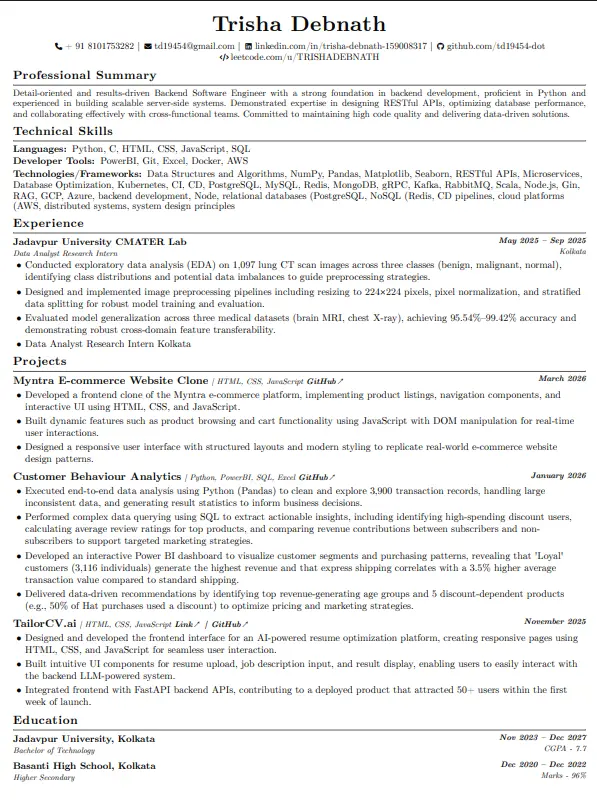
A layout that works with a short history
Leads with skills and projects instead of years of experience you do not have yet.
Was this guide useful?
Be the first to rate it.