 TD
TD
Key Takeaways
- Campus placement is one hiring channel among several, and the majority of companies never visit any campus at all.
- The first useful step is diagnosis - you cannot fix a problem you have not identified, and the four common causes need different responses.
- A gap of a few months after graduation is normal and easily explained; it is not the career-ending event it feels like.
- Off-campus hiring weights skill and projects more heavily and CGPA less, which favours some students who struggled on campus.
- The students who recover fastest treat the next three months as a structured project rather than an open-ended wait.
If you have finished placement season without an offer, the immediate feeling is usually some combination of panic and embarrassment - particularly when classmates are posting offer letters.
Here is the accurate framing: campus placement is one channel. A limited number of companies visit any given college, filtered by their recruitment budget, their relationship with your institution, and their headcount that year. The overwhelming majority of employers in the country hire entirely off-campus, year-round, and many of the better ones never visit campuses at all.
That does not make the situation pleasant, but it makes it workable. This guide covers diagnosing what went wrong, what to do in the next three months, and how to explain the gap.
Start with the document every application depends on - run your resume through the free ATS score checker.
First: Diagnose Honestly
You cannot fix what you have not identified. Work out where you were actually eliminated, because the four common causes require completely different responses.
You did not clear eligibility filters
If your CGPA or backlog history meant you could not sit for most companies, you were never assessed at all.
What this means: your problem is access, not ability. Off-campus routes weight CGPA far less heavily, and many companies have no academic cutoff. This is the most fixable situation of the four.
You were eliminated at aptitude
If you consistently failed at the first round, this is your bottleneck - and it is the most improvable skill in the entire process.
What this means: three months of consistent practice genuinely changes this outcome. See the campus placement aptitude test guide.
You were eliminated at coding or technical rounds
Your fundamentals need building. Slower to fix than aptitude, but entirely achievable in a few months of focused work.
What this means: structured DSA practice and core CS revision, using the campus placement coding round guide and campus placement technical interview questions.
You reached HR rounds and were not selected
This is the most frustrating and often the easiest to fix - it usually means communication, presentation, or how you answered rather than capability.
What this means: practice speaking, not more studying. See campus placement HR interview questions and campus placement communication skills.
If you are unsure where you were eliminated, ask your placement cell. They frequently have round-wise data, and it is worth knowing rather than guessing.
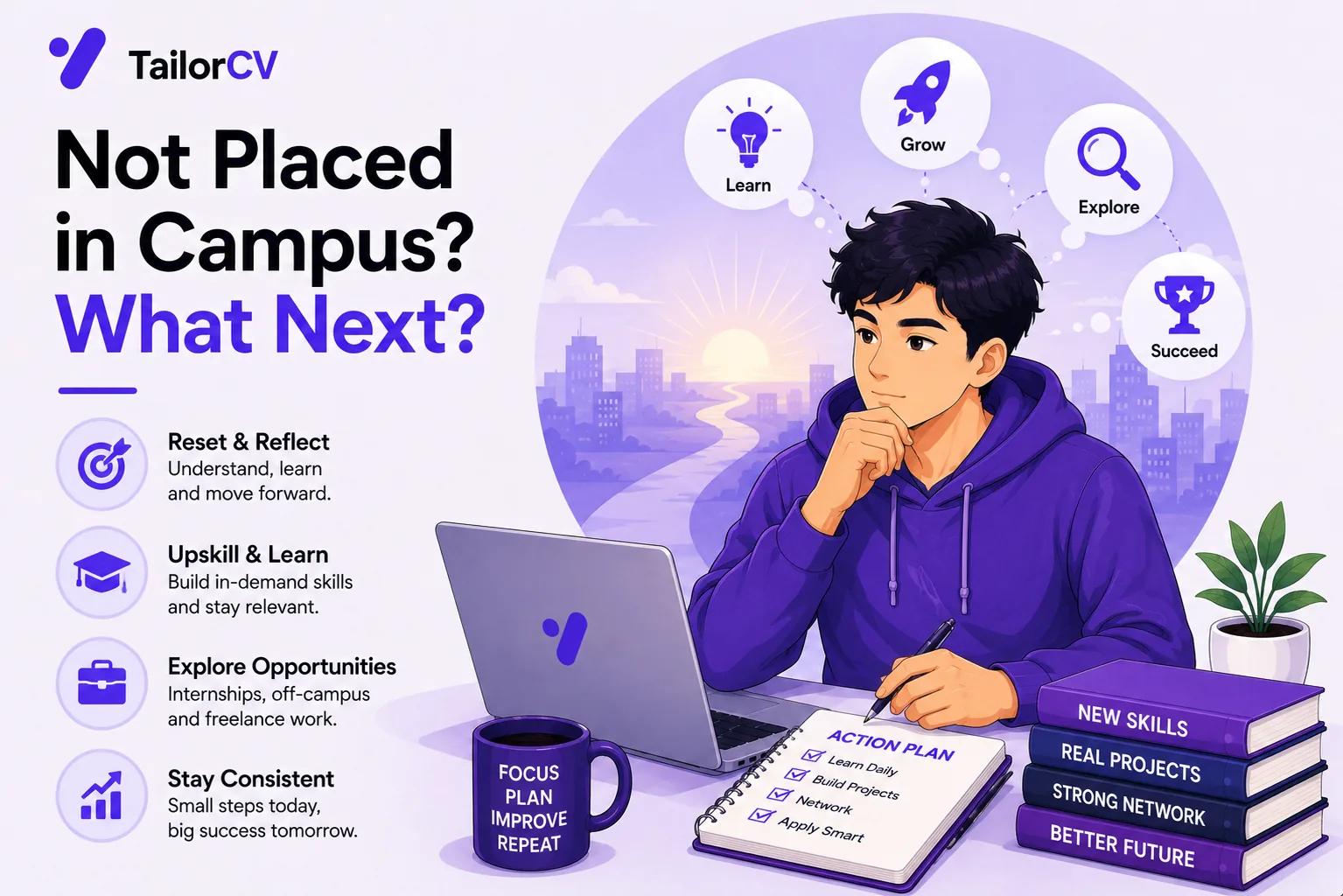
The Next Three Months: A Structured Plan
The single biggest risk is drift. Months pass, nothing changes, and the gap becomes harder to explain. Treat this period as a project with a schedule.
Month 1: Fix the foundations
Rebuild the resume properly. It is used in every application from here. Fix the structural issues, cut the legacy sections, and rewrite projects as outcomes - the specifics are in campus placement resume mistakes and how to get shortlisted for campus placement.
Address your diagnosed weakness daily. Aptitude, DSA, or communication - whichever the diagnosis identified. Two focused hours a day.
Build or finish one substantial project. Deployed, with a live link, solving a real problem. This is now your primary differentiator, since you cannot change your CGPA. See choosing a final year project for placements.
Set up your online presence. GitHub with README files and real commit history, LinkedIn complete and accurate. Recruiters check both - see how to optimise your GitHub profile.
Month 2: Start applying properly
Apply widely but not blindly. Twenty tailored applications beat two hundred identical ones.
Use multiple channels:
- Job boards and company career pages
- LinkedIn, including direct outreach to recruiters - see how to write a cold email to a recruiter
- Referrals from seniors who were placed, which is the highest-conversion channel available to you - see networking messages for referrals
- Off-campus drives and hiring challenges, which several large employers run regularly
- Startups, which hire year-round and care less about pedigree
Track everything. Company, date, round reached, outcome. Patterns emerge within a month and tell you what to fix next.
Month 3: Iterate on the data
By now you should see where you are being eliminated. If you are not getting shortlisted, the resume is the problem. If you are failing tests, the preparation is. If you are reaching final rounds and not converting, it is presentation.
Adjust based on what actually happened rather than on how you feel about it.
Where Off-Campus Hiring Differs
Understanding this helps, because the rules genuinely change in your favour on some dimensions.
CGPA matters less. Many off-campus employers have no academic cutoff at all, and skill assessment carries the weight instead.
Projects and portfolio matter more. With no campus filter doing the screening, your demonstrable work does that job.
Referrals matter enormously. A referred application is dramatically more likely to be reviewed than a cold one.
Timing is continuous. There is no season. Companies hire when they need people, all year.
The process is often longer - more rounds, more waiting, less certainty.
You compete against experienced candidates in some openings, which is why fresher-specific drives and entry-level programmes are worth targeting specifically.
The full comparison is in campus placement vs off-campus.
Options Worth Considering
Internships, including unpaid or low-paid ones. An internship now is worth more than another certificate, and many convert into full-time offers. It also removes the gap from your timeline entirely - see converting an internship into a PPO.
Startups. Hire year-round, care less about academics, give broader responsibility earlier, and are usually faster to decide.
Off-campus drives and hiring challenges. Several large employers run regular open assessments for freshers. These are effectively campus placements without the campus filter.
Contract or entry-level roles at smaller firms. Less prestigious, and real experience that changes your position entirely within a year.
Higher studies - but only if you actually want it. Postgraduate study taken purely to avoid a job search is an expensive way to delay the same problem by two years.
Certification with a project attached. A certificate alone convinces nobody. A certificate plus something you built with it is credible evidence.
Explaining the Gap
This worries students far more than it worries employers.
A few months after graduation is unremarkable. Employers see it constantly and most do not ask. If they do, they want to know what you did with the time, not to hear an apology.
A good answer is short and factual:
I finished in June and wasn't placed on campus. Since then I've been building - I completed a full-stack project that's now deployed and used by a local business, and I've been working through DSA properly, which was where I was falling down in interviews.
What makes this work: it is honest, it takes responsibility without self-flagellation, and it shows the time was used deliberately.
What does not work: blaming the college, the placement cell, the economy, or bad luck. Even where partly true, it reads badly.
The general approach is in how to explain an employment gap and how to explain a career gap in interview.
Common Mistakes
Waiting instead of working. The gap is fine; an empty gap is not.
Only applying to big-name companies. Smaller firms hire more freshers and decide faster.
Not diagnosing what went wrong. Repeating the same approach produces the same result.
Collecting certificates instead of building things. A project beats a certificate almost every time.
Ignoring referrals. The highest-conversion channel available, and students consistently underuse it out of awkwardness.
Comparing yourself to placed classmates. It damages performance and changes nothing.
Applying with the same resume that already failed. Fix it first.
Taking higher studies purely as an escape. Expensive, and the same problem waits at the end.
Isolating yourself. Your placed batchmates are now inside companies with referral schemes. That is a resource, and most of them will help if asked directly.
Frequently Asked Questions
Is it bad if I am not placed in campus placements?
It is disappointing but common, and it is not a verdict on your career. Campus placement covers a limited set of companies chosen by budget and relationship, while most employers hire entirely off-campus and year-round.
How long is too long a gap after graduation?
A few months is unremarkable and rarely questioned. Beyond six to twelve months, employers start asking what you did with the time - which is answerable if you used it building skills, projects, or internship experience.
Should I take any job just to avoid a gap?
A relevant role, yes - experience compounds and changes your position quickly. A completely unrelated role is more of a judgement call, though it is generally better than an empty gap if the alternative is drifting.
Can I still get into a good company after missing campus placements?
Yes. Off-campus hiring weights skill, projects, and referrals more heavily than academics, which favours some students who were filtered out on campus by CGPA criteria.
Should I do a master's degree instead?
Only if you genuinely want the qualification and have a reason for it. Postgraduate study undertaken to avoid a job search is expensive and postpones the same problem.
How do I get referrals if I do not know anyone?
Start with seniors from your college who were placed - most will help if you ask directly and specifically. Beyond that, targeted LinkedIn outreach works better than people expect when the message is short and specific.
Are off-campus drives worth applying to?
Yes. Several large employers run regular open hiring challenges for freshers, which function as campus placements without the campus eligibility filter.
Fix the document every application depends on. Check your ATS score free.
Make This Practical
Diagnose before you plan. Find out from your placement cell which round you were actually eliminated in most often, because eligibility filters, aptitude, technical rounds, and HR rounds need four completely different responses - and working on the wrong one wastes months.
Then give the next ninety days a structure. Month one: rebuild the resume using campus placement resume mistakes, fix your diagnosed weakness with two focused hours daily, and build one deployed project with a live link. Month two: apply through job boards, LinkedIn, referrals, and off-campus drives, tracking every application. Month three: adjust based on where you are actually being eliminated.
Finally, use the channel most students neglect. Ask placed seniors for referrals directly and specifically - it is the highest-conversion route available to you, and the approach is in networking messages for referrals. Verify your resume parses with the free ATS score checker, and prepare a short, factual answer for the gap that says what you built rather than what went wrong.
What is your resume scoring right now?
Scan it against a job description and get your ATS match score in about a minute.
Drop your resume here or choose a file
PDF only. Max 2 MB.
We never share your data or use it to train AI models.

Was this guide useful?
Be the first to rate it.