SS
SS

Key Takeaways
- Your credentials line is the first thing screened: name, MSN/DNP, APRN, board certification — in that order, at the top.
- Licensure and DEA/prescriptive authority belong above experience, not buried at the bottom. Recruiters check these before reading anything else.
- Population focus (FNP, AGACNP, PMHNP) is a keyword, not a detail. If the posting says FNP and your resume says "nurse practitioner," you may not match.
- Clinical hours and patient panel size are the numbers that separate NP resumes. Most candidates omit both.
- An NP resume can run two pages. Cutting clinical detail to fit one page costs you more than the extra page does.
A nurse practitioner resume is screened differently from an RN resume, and the difference matters. Recruiters and credentialing staff are checking for specific, verifiable qualifications — board certification, state licensure, prescriptive authority — before they assess your experience at all. Miss one and the application stalls regardless of how strong your clinical background is.
If you are moving from bedside nursing into an NP role, our nursing resume guide covers the RN side; this one covers what changes at the advanced practice level.
Best Nurse Practitioner Resume Format for 2026
Reverse-chronological, two pages, single column.
The one-page rule does not apply here. NP resumes carry licensure, certifications, clinical rotations, and often procedures — compressing that into one page means cutting the content credentialing needs to see. Two pages is standard and expected.
Single column matters for parsing. Multi-column layouts and text boxes are the most common cause of a resume being read out of order by an applicant tracking system — our ATS formatting guide covers why. Healthcare systems in particular run large, older ATS installations that handle complex layouts badly.
Section order that works:
- Header with credentials
- Licensure and certifications
- Professional summary
- Clinical experience
- Education
- Procedures and skills
- Professional memberships
Licensure sits high deliberately. It is the first thing checked and the fastest disqualifier.
Header and Credentials Line
Your credentials go after your name, in conventional order — highest degree, licensure, certification:
Maria Delgado, DNP, APRN, FNP-BC
Denver, CO · (303) 555-0142 · m.delgado@email.com · linkedin.com/in/mariadelgado
Use the postnominals the field actually uses. FNP-BC (board certified through ANCC) and FNP-C (through AANP) are different credentials and recruiters know the difference. Write whichever you hold — do not average them into something generic.
Do not include a photo, date of birth, or full street address. City and state is enough.
Licensure and Certification Section
This section is why NP resumes get read or discarded. Put it directly under the header.
LICENSURE & CERTIFICATION
Registered Nurse, Colorado, License #RN-284719, active through 06/2028
Advanced Practice Registered Nurse, Colorado, License #APRN-9924, active through 06/2028
Family Nurse Practitioner, Board Certified (ANCC), certified 2019
DEA Registration, active, Schedule II-V
BLS, ACLS, PALS — current through 03/2027
Include license numbers and expiry dates. Credentialing staff verify these, and a resume that already has them speeds up the process visibly. If you hold a multistate compact license, say so — it is a genuine advantage for employers hiring across state lines.
Prescriptive authority is a keyword. Many postings require it explicitly. If you have DEA registration and state prescriptive authority, both belong here in those words.
Professional Summary
Three or four lines. Population focus, years of practice, setting, and one measurable result.
Family Nurse Practitioner with 6 years of independent practice in primary care, managing a panel of 1,400+ patients across two clinic sites. Full prescriptive authority in Colorado. Reduced uncontrolled A1C rates in the diabetic cohort from 34% to 19% over 18 months through a nurse-led follow-up protocol.
Compare that with what most NP summaries actually say — "compassionate nurse practitioner dedicated to providing high-quality patient care." That sentence is true of every NP who has ever applied and tells a hiring manager nothing. Our guide to quantifying achievements covers finding numbers when your work does not feel countable.
Population Focus Is a Matching Keyword
This is the most common ATS failure on NP resumes and it is easily avoided.
NP roles are specific: FNP, AGACNP, AGPCNP, PMHNP, PNP, WHNP, NNP. A posting for an acute care NP is not looking for a family NP, and the systems doing the first pass match on those exact strings.
If the posting says "Family Nurse Practitioner (FNP-C or FNP-BC)" and your resume only says "Nurse Practitioner," you may score as a partial match. Write your actual population focus in full and in abbreviation at least once each. This is the same principle as any keyword matching — use the language the posting uses, where it is true of you.
Best ATS Keywords for a Nurse Practitioner Resume
Pull these from the posting, but these recur across NP roles:
Clinical: differential diagnosis, patient assessment, treatment planning, chronic disease management, preventive care, health promotion, acute care, primary care, diagnostic interpretation, referral coordination
Credentials: APRN, board certified, prescriptive authority, DEA registration, collaborative practice agreement, compact license, credentialing, privileging
Systems: Epic, Cerner, Meditech, Athenahealth, EMR documentation, e-prescribing, CPT coding, ICD-10, quality metrics, HEDIS
Practice: independent practice, collaborative practice, scope of practice, evidence-based practice, patient education, interdisciplinary team, care coordination
Only include what is true. A resume claiming Epic experience you do not have fails at the first practical question in an interview.
Writing Clinical Experience Bullets
The pattern that works: action, clinical context, measurable result.
Weak:
Responsible for providing care to patients in a family practice setting.
Strong:
Managed a primary care panel of 1,400+ patients across two clinic sites, averaging 22 encounters daily, with independent prescriptive authority for chronic and acute conditions.
Weak:
Worked to improve patient outcomes for diabetic patients.
Strong:
Designed and led a nurse-driven diabetes follow-up protocol that reduced uncontrolled A1C (>9%) in a 300-patient cohort from 34% to 19% in 18 months.
Numbers available to almost every NP: panel size, daily encounter volume, clinical hours, procedures performed, wait time reduction, quality metric movement, precepted students, protocols authored. Most NP resumes contain none of these, which is why they read interchangeably.
Procedures and Skills
List procedures you are competent to perform independently. Be specific and honest:
Suturing and wound closure · Incision and drainage · Joint injection and aspiration · Skin biopsy (punch, shave) · Cryotherapy · IUD insertion and removal · Nexplanon insertion · Endometrial biopsy · Spirometry interpretation · Point-of-care ultrasound (basic)
Do not pad this. Anything listed is fair game in an interview, and being unable to describe a procedure you claimed is worse than omitting it.
New Graduate Nurse Practitioners
If you have just finished your program, the resume changes shape but not substance.
Lead with clinical rotation hours, broken out by specialty and setting:
CLINICAL ROTATIONS — 720 supervised hours Family Practice, Cedar Ridge Clinic — 280 hours. Independently managed 8-12 patients daily under preceptor supervision; primary care across the lifespan. Pediatrics, Mountainview Peds — 180 hours. Well-child visits, immunization scheduling, acute presentations. Women's Health, Front Range OB/GYN — 160 hours. Annual exams, contraceptive counselling, prenatal care. Behavioral Health, Community Mental Health — 100 hours. Depression and anxiety screening, medication management support.
Keep your RN experience. Bedside nursing is directly relevant and hiring managers value it. Do not delete five years of ICU experience because you are now applying as an NP — reframe it toward assessment, escalation and clinical judgement.
Our guide to writing a resume with no experience in the role covers the general principle: the experience exists, it is just labelled differently.
Common Nurse Practitioner Resume Mistakes
Burying licensure on page two. Credentialing checks it first. Move it up.
Omitting license numbers and expiry dates. These get verified anyway; including them removes a step.
Writing "Nurse Practitioner" when the posting says "FNP." A matching problem you control entirely.
Leaving out prescriptive authority. Many postings require it explicitly. If you have it, name it.
Cutting to one page. You will lose licensure detail or clinical specifics. Two pages is normal here.
Copying RN bullets unchanged. NP work is diagnostic and prescriptive. Bullets that describe task execution rather than clinical decision-making undersell the role.
No numbers anywhere. Panel size, encounter volume, clinical hours, quality movement — see why generic bullets fail.
Frequently Asked Questions
How long should a nurse practitioner resume be? Two pages. Licensure, certifications and clinical detail do not compress into one page without losing content that gets verified.
Should I include my RN experience? Yes. Bedside experience is relevant and valued. Reframe it toward assessment and clinical judgement rather than task lists.
Where do license numbers go? In a licensure section directly below the header, with expiry dates. Credentialing checks them first.
Do I list FNP-BC or FNP-C? Whichever you actually hold — they are different certifying bodies (ANCC and AANP) and recruiters know the difference.
What if I am changing population focus? Say so in the summary and connect your existing clinical hours to the new setting. Do not claim a certification you have not earned.
Make This Practical
The fastest check on an NP resume is not stylistic. Take the posting you are actually applying to and see which of its stated requirements your resume evidences — population focus, prescriptive authority, EMR system, setting, years of practice.
Scan your resume against the job description and look at what comes back missing. It is free, takes about a minute, and it will usually show that the gap is a credential you hold but did not write down clearly enough — which is a five-minute fix rather than a rewrite.
For more on what an ATS actually reads, see our ATS score guide, and for the wider healthcare picture, the nursing resume guide.
What is your resume scoring right now?
Scan it against a job description and get your ATS match score in about a minute.
Drop your resume here or choose a file
PDF only. Max 2 MB.
We never share your data or use it to train AI models.

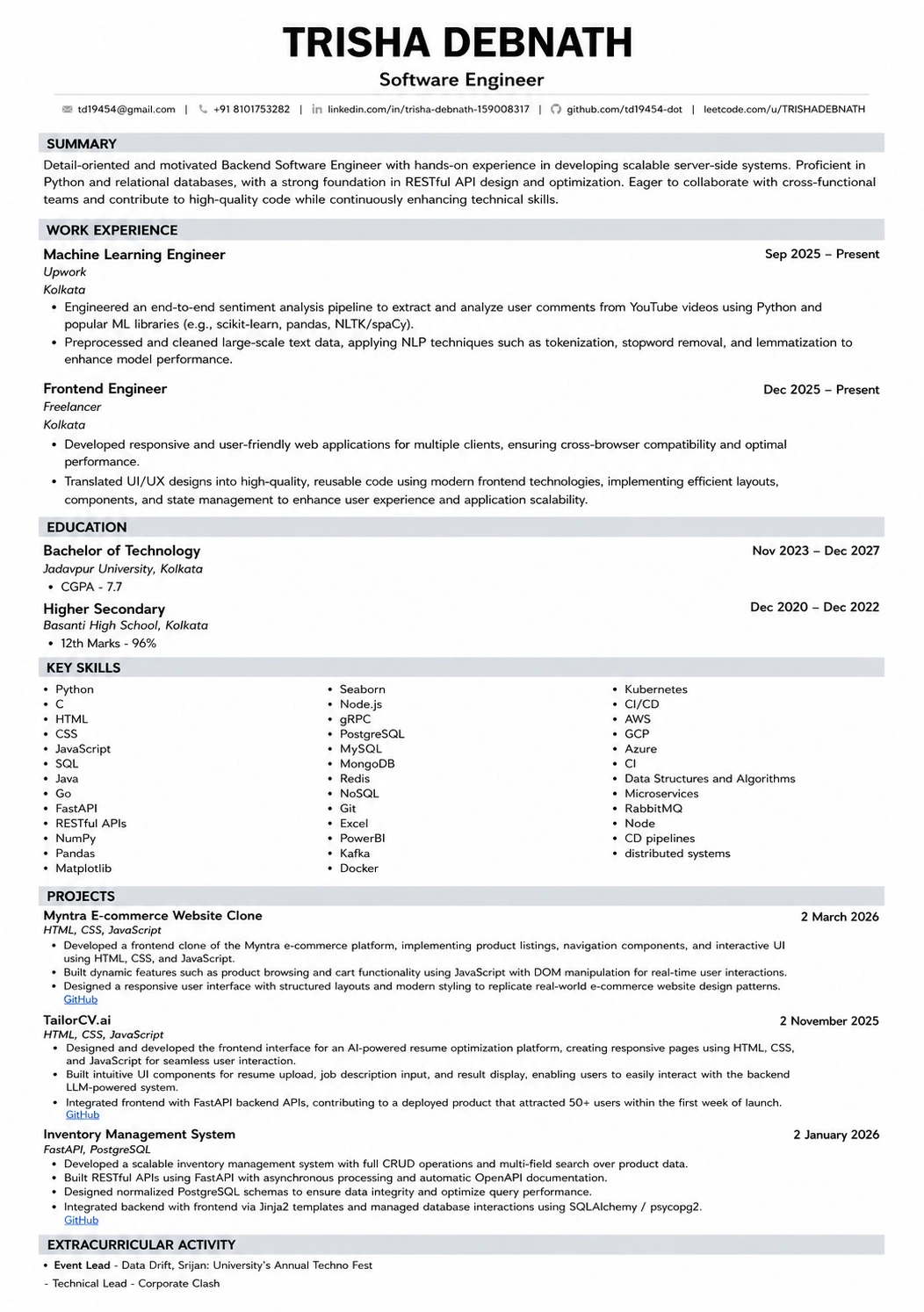
Templates that keep this structure intact
This template is ATS-tested — start from it and the formatting rules in this guide are already handled.
Was this guide useful?
Be the first to rate it.