SS
SS

Key Takeaways
- CGPA cutoffs are absolute filters on campus — no appeal, no discretion, and no amount of skill changes them.
- Off-campus hiring weights CGPA far less, which reverses the disadvantage for candidates with strong demonstrable work.
- A deployed project with real users is the single most effective counterweight to a weak academic record.
- Answer the CGPA question directly and briefly, with what changed rather than what went wrong.
- Your CGPA stops mattering after your first job, so the goal is getting the first one.
A low CGPA is the most demoralising constraint in campus placements because it operates before anyone assesses you. You do not get rejected after an interview; you are filtered out of the eligibility list by a number set months or years ago.
The useful response is not to argue with that. It is to understand precisely which doors it closes, which it does not, and how to build a profile that works through the doors that remain open.
This guide covers all three.
Start with the document every application depends on — run your resume through the free ATS score checker.
What CGPA actually blocks
On-campus eligibility filters. Companies specify a cutoff — commonly 6.0, 6.5, 7.0 or 7.5 — and the placement portal filters automatically. There is no discretion and no appeal, which is worth accepting quickly rather than fighting.
Some companies also screen on tenth and twelfth marks, which catches people out.
Backlogs are frequently a separate filter — many companies require none current, some require none ever. This is often a bigger barrier than CGPA itself — see the campus placement backlog guide.
What it does not block:
- Off-campus applications at companies with no academic cutoff
- Startups, which rarely screen on it
- Off-campus hiring challenges run by large employers
- Anything where you enter through a referral rather than an application filter
Where the filter exists, and where it does not
| Route in | Is CGPA a hard filter? | What actually decides |
|---|---|---|
| On-campus drive | Yes, automatic and absolute | The portal, before a human sees you |
| Off-campus portal application | Sometimes, often not | Resume screening by a recruiter |
| Off-campus hiring challenge | Rarely | Your score on the test |
| Referral from an employee | Usually bypassed | The referrer's word plus your interview |
| Startup application | Almost never | What you have built |
| LinkedIn recruiter outreach | No | Your profile and projects |
| Open source into a job | No | Your contributions |
Read the second column top to bottom. The filter is real in exactly one row and negotiable or absent in the rest — which is the entire strategic point of this guide. Most students spend their whole final year fighting the one row where they cannot win.
The strategy that works
Stop applying to what you cannot access, and get precise about what you can.
Get the criteria list from your TPO early. Know exactly which companies you are eligible for, and prepare specifically for those rather than for a general idea of placements. Students routinely spend weeks preparing for companies they were never eligible to sit for.
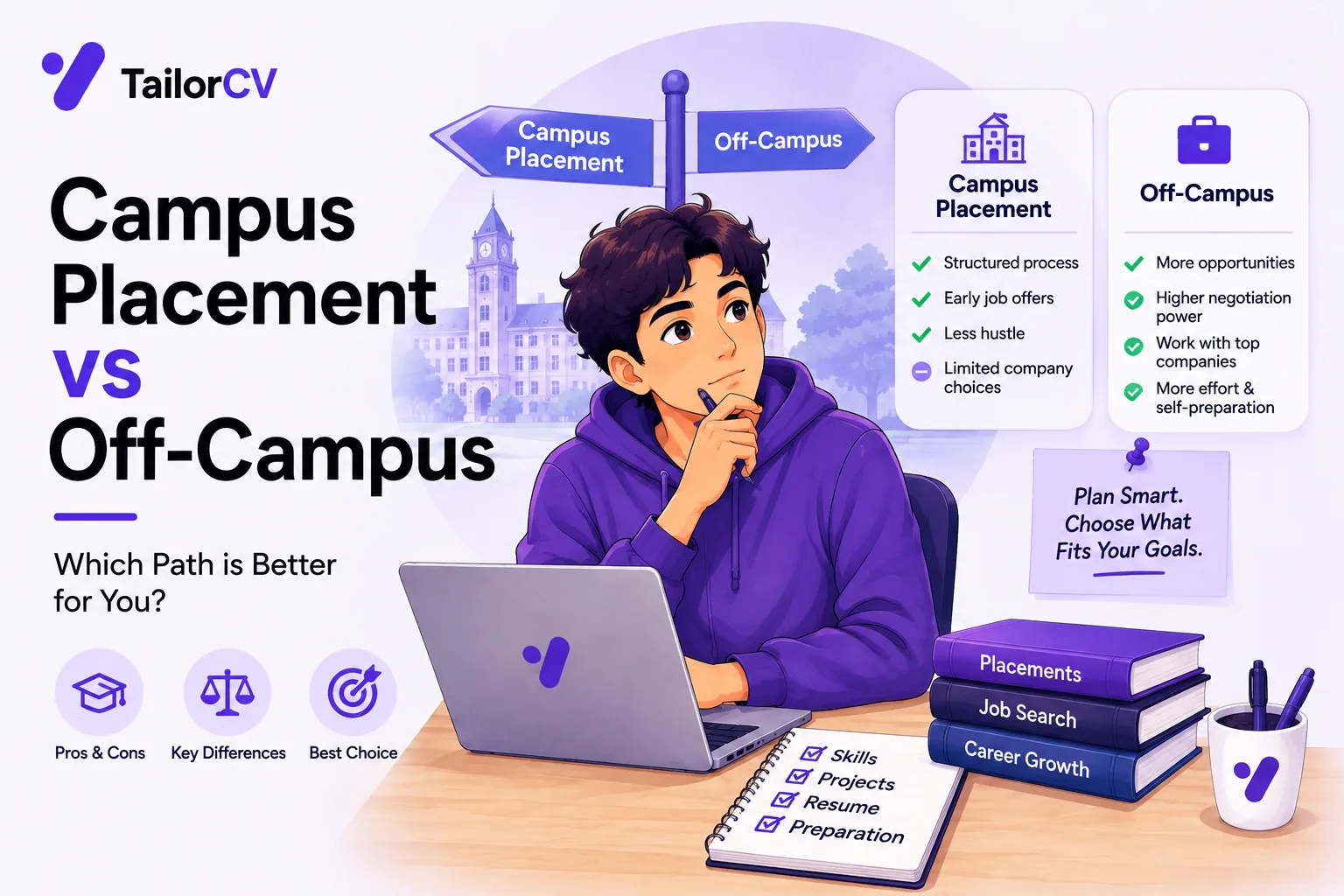
Weight off-campus heavily and start early. This is the structural point: off-campus hiring weights demonstrable skill and projects far more than academics, which is exactly the trade you want. Do not treat it as a fallback after campus season fails — run it in parallel from semester 7 — see campus placement vs off-campus.
Target off-campus hiring challenges. Several large employers run regular open assessments for freshers. These function as campus placements without the campus eligibility filter, and they are the single best-matched route for a low-CGPA candidate with real ability.
Use referrals. A referred application bypasses the filter that would otherwise remove you. Seniors from your college who were placed are the natural starting point — see networking messages for referrals.
Building the counterweight
Your CGPA is fixed. Your evidence is not.
One deployed project with real users. This is the highest-leverage thing available to you. Not a repository — something live, with a link, that someone other than you has used. It demonstrates in one line what your transcript denies, and it gives an interviewer something concrete to discuss instead of your marks. See choosing a final year project for placements.
An internship, however small. External validation carries weight precisely because it comes from someone who is not you and not your college — see converting an internship into a PPO.
A real GitHub profile with commit history and README files. Reviewers open it, and for a candidate whose academics are weak it does disproportionate work — see how to optimise your GitHub profile.
Competitive achievements. Hackathon placings, coding contest ratings, and open-source contributions are all objective third-party signals.
Strong aptitude and DSA. These are tested directly rather than inferred from your CGPA, which makes them the fairest ground available to you — see the campus placement aptitude test guide and the DSA roadmap.
Leave CGPA off the resume where it is below typical cutoffs and not explicitly requested. It is not dishonest — you are not obliged to volunteer every number — and it keeps the reader on your projects. Include it where a form or posting requires it.
What is worth your remaining months
If you have two semesters left, these are not equal. Ranked by what actually moves a low-CGPA application.
| What you could do | Impact | Why |
|---|---|---|
| Deploy one project real people use | Very high | Third-party evidence a transcript cannot contradict |
| Get any internship, even unpaid or remote | Very high | Validation from someone who is not your college |
| Clear every backlog before placement season | Very high | Often a harder filter than CGPA itself |
| Get strong at aptitude | High | Tested directly, and it is where many drives cut first |
| Reach a reliable easy-medium DSA level | High | Also tested directly rather than inferred |
| Build 3-4 seniors into real referral contacts | High | Bypasses the filter entirely |
| Raise CGPA in the last two semesters | Medium | Moves the number slowly, but an upward trend is a real answer |
| Collect online course certificates | Low | Nobody verifies them and everybody has them |
| Add more half-finished GitHub repos | Low | Reviewers open them, which makes this actively negative |
The bottom two rows are where anxious students spend most of their time, because certificates feel like progress and are much easier than shipping something someone uses.
Answering the question
You will be asked. Prepare for it rather than improvising.
A structure that works: what happened, briefly — what changed — what the evidence is now.
My second and third semesters were poor. I was spending most of my time on a startup project with two friends that eventually failed, and I let my coursework slide. From fourth semester my SGPA has been above 8, and the practical work led me to the backend development I've been doing since — including the scheduling tool I mentioned, which the department library uses.
Why this works: it is honest, it takes responsibility without excessive apology, it shows an upward trend, and it connects the period to something real.
What does not work:
- Blaming teachers, evaluation or the college
- Elaborate medical or personal explanations unless genuinely necessary and briefly stated
- Denying it matters
- Sounding defensive
Mention the upward trend if you have one. A rising SGPA across semesters is a genuine argument and interviewers respond to it.
If you do not have an upward trend
Not everyone does, and the honest version still works better than deflection.
My CGPA is 6.4 and it has been fairly flat. I spent most of my time on things outside the syllabus — the deployment work and the two projects on my resume — and in hindsight I should have managed both rather than choosing. What I can say is that the practical side is where I am genuinely strong, and the library system is running with about 200 users a week if you would like to go through it.
Why this still lands. It does not manufacture a story that is not true, it names the trade-off honestly, it accepts the cost, and it moves immediately to evidence. Interviewers are checking self-awareness far more than they are checking the number, and a candidate who can say "I chose badly and here is what I built instead" is more convincing than one reciting a semester-by-semester defence.
Keep it under thirty seconds either way. The longer this answer runs, the more it sounds like something you are anxious about.
Common Mistakes
Preparing for companies you are not eligible for. Get the criteria list early and direct your effort at what is actually accessible.
Treating off-campus as a fallback. It weights skill over academics, which is exactly the trade a low-CGPA candidate needs — start it in parallel, not after campus season fails.
Ignoring off-campus hiring challenges. They function as campus placements without the eligibility filter and are the best-matched route available.
Not using referrals. A referral bypasses the filter that would otherwise remove you before anyone reads your application.
Collecting certificates instead of shipping something. Nobody verifies them, everybody has them, and they feel like progress while producing none.
Leaving backlogs uncleared. For many companies this is a harder filter than CGPA and it is one you can still act on.
Volunteering a low CGPA on the resume. Where it is below cutoffs and not requested, leaving it off keeps the reader on your evidence.
Improvising the CGPA answer in interviews. It is asked reliably enough to prepare properly.
Talking about it for two minutes. Length signals anxiety; thirty seconds and a move to evidence does not.
Blaming the college or evaluation. It reads worse than the marks themselves and confirms the concern the interviewer had.
Frequently Asked Questions
Can I get placed with a low CGPA?
Yes, though the route differs. On-campus eligibility filters are absolute, so the realistic path is off-campus applications, hiring challenges and referrals, backed by demonstrable projects.
What CGPA do most companies require?
Commonly 6.0 to 7.5 depending on the company, sometimes with additional filters on tenth and twelfth marks and on backlog history.
Should I put my CGPA on my resume?
If it is below typical cutoffs and not explicitly requested, leaving it off is reasonable and keeps attention on your projects. Include it wherever a form or posting requires it.
What is the best way to compensate?
One deployed project with real users, plus an internship if possible. Both are third-party evidence that a transcript cannot provide.
I have two semesters left. What should I prioritise?
Deploy one real project, get any internship, and clear every backlog. Those three move a low-CGPA application further than anything else available to you.
Do certificates help?
Very little. Nobody verifies them and every applicant has them. The same hours spent shipping one working project change the conversation entirely.
Do startups care about CGPA?
Rarely. They hire on demonstrable ability, which is why they are a strong target for candidates with weak academics and real skills.
How do I answer the CGPA question in an interview?
Briefly and honestly — what happened, what changed, and what the evidence is now. Mention an upward trend if you have one, and never blame the college.
What if my CGPA never improved?
Say so plainly, name the trade-off you made, accept the cost, and move to what you built. Self-awareness is what is being assessed, not a recovery story.
Does CGPA matter after the first job?
Essentially no. Once you have professional experience, employers assess that instead — which is why the entire goal is getting the first role.
Your resume has to clear screening either way. Check your ATS score free.
Make This Practical
Get the eligibility criteria from your TPO this week and split your target list in two — companies you can sit for, and everything else. The CGPA filter is absolute in exactly one route and negotiable or absent in every other, so stop spending your year fighting the one place you cannot win and run off-campus applications in parallel from the start.
Then pick from the top of the priority list, not the bottom. Deploy one project real people use, get any internship at all, and clear every backlog before the season starts — and stop collecting certificates, which feel like progress precisely because they are easier than shipping something.
Finally, write the answer and time it. Thirty seconds, covering what happened, what changed and what the evidence is now — and if there is no upward trend, say that honestly and move to what you built instead. Interviewers are testing self-awareness, not the number.
Find out why your score is low
Scan your resume against the job description and see exactly which checks fail.
Drop your resume here or choose a file
PDF only. Max 2 MB.
We never share your data or use it to train AI models.

Was this guide useful?
Be the first to rate it.