TD
TD
Key Takeaways
- Campus drives are conservative environments — overdressing is a much smaller error than underdressing.
- The goal is to be unremarkable, so that nothing about your appearance competes with what you say.
- Fit and neatness matter more than the cost of what you are wearing.
- Video rounds still require formal dress from the waist up, and the background is part of the impression.
- Prepare the outfit before the season, because drives are announced with a day or two of notice.
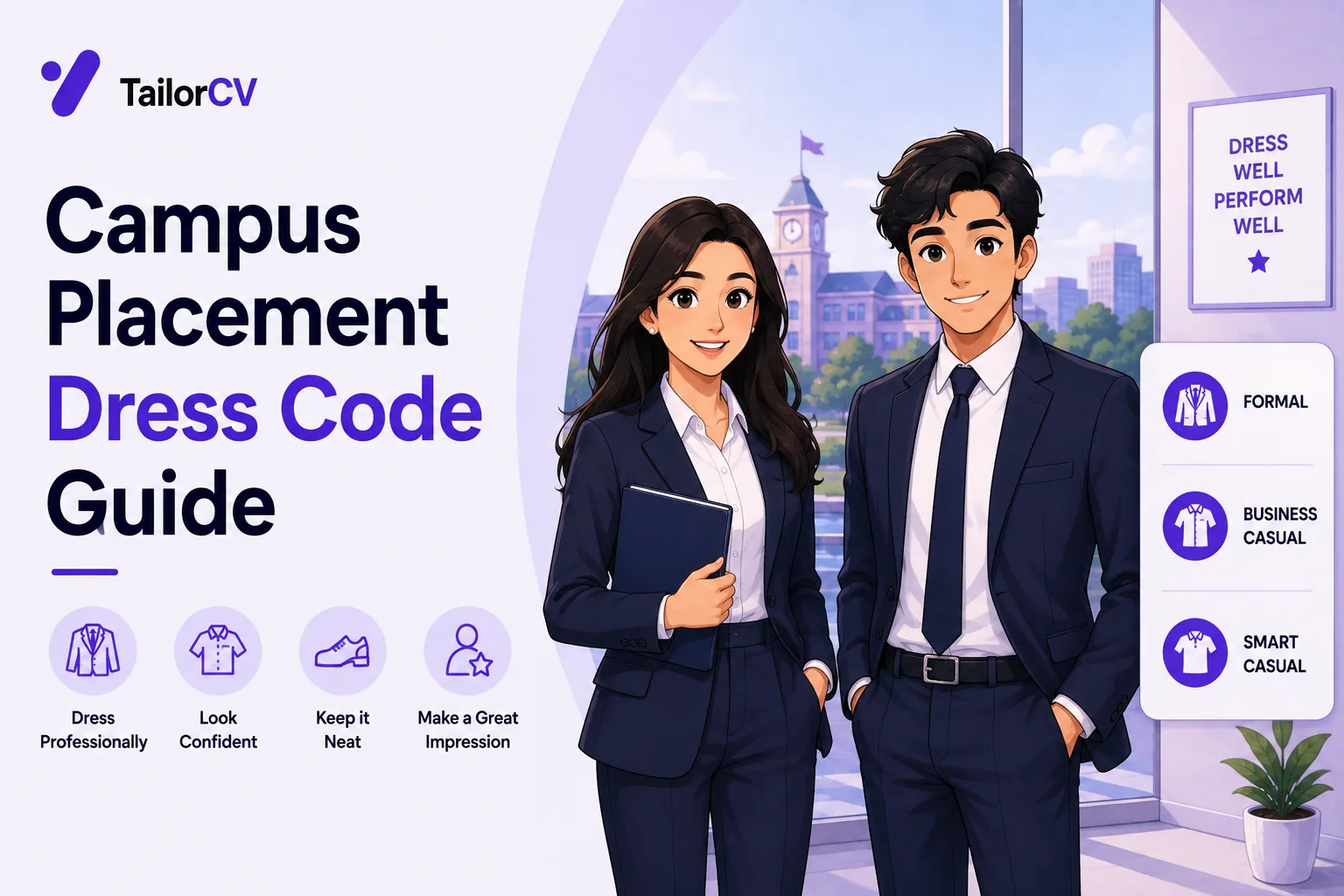
Appearance at a placement drive is not assessed on a rubric, and it still affects how you are received. The purpose of dressing correctly is not to impress — it is to be unremarkable, so that the interviewer's attention goes entirely to your answers.
Students get this wrong in both directions: some arrive in casual clothes assuming skills speak for themselves, others in ill-fitting suits bought the night before that make them visibly uncomfortable.
This guide covers what formal actually means in an Indian campus context.
Before the drive, make sure your resume clears screening — the free ATS score checker.
The principle
Aim to be forgettable. If the interviewer remembers what you wore, something went wrong — either too casual or too flashy.
Overdressing is the smaller error. A formal shirt and trousers at a startup that turns out to be casual is barely noticed. Casual clothes at a bank or a service-based company drive is noticed immediately.
Comfort matters practically. You may be on campus for eight hours across multiple rounds. Shoes that hurt and collars that are too tight affect your performance in ways you will not attribute to the clothes.
Fit beats cost. A well-fitted inexpensive shirt looks considerably better than an expensive one that does not fit. If you are buying something, allow time for basic alterations.
What formal means in practice
For men:
- Formal shirt, plain, light colour — white, light blue, pale grey. Long sleeves. Tucked in.
- Formal trousers in dark neutral — black, navy, charcoal. Not jeans, not chinos.
- Belt matching your shoes.
- Formal shoes, closed and polished. Not sneakers.
- Dark socks, long enough that skin does not show when seated.
- Tie — optional at most drives, expected at banks and some consulting firms. If unsure, bring one and observe others.
- Blazer — optional, useful for final rounds and formal sectors.
For women:
- Formal shirt or blouse with formal trousers, or a formal saree or salwar kameez in a plain, subdued fabric. All are entirely acceptable at Indian campus drives.
- Closed shoes, comfortable enough to stand and walk in.
- Minimal jewellery — nothing that moves or makes noise.
- Hair tidy and off your face.
- Dupatta secured so you are not adjusting it during the interview.
For everyone:
- Clothes ironed. This is noticed more than anything else on the list.
- Nails clean and trimmed.
- Minimal fragrance — a small room with several people is not the place for strong perfume.
- Watch, if you wear one. Useful during timed rounds.
How formal, by company type
Campus drives are more conservative than the same company's office would be, so the floor is higher than you might expect. When in doubt, dress for the row above yours.
| Drive type | Men | Women | Tie / blazer |
|---|---|---|---|
| Bank, financial services | Shirt, trousers, blazer | Formal trousers/saree, blazer | Tie expected, blazer expected |
| Consulting | Shirt, trousers, blazer | Formal, blazer | Tie usually, blazer expected |
| Service-based IT (TCS, Infosys-type) | Shirt and trousers, tucked in | Formal shirt/trousers, saree or salwar | Tie optional, blazer not needed |
| Product company | Shirt and trousers | Formal shirt/trousers, salwar | Neither needed |
| Startup | Shirt and trousers | Formal shirt/trousers, salwar | Neither needed |
| Core engineering / PSU | Shirt and trousers | Formal, conservative | Tie optional |
| Video round, any of the above | As above, waist up | As above, waist up | Blazer helps on camera |
Notice there is no "casual" row. Even at a startup drive, a formal shirt and trousers is the correct answer on campus — the interviewer may be in a t-shirt, and that does not extend to you.
If you own exactly one formal outfit, it should be a plain light shirt with dark trousers. That single combination is correct in every row of the table.
What to avoid
Jeans, in any colour, at a formal drive.
T-shirts, including under a blazer.
Sneakers or sandals.
Loud colours or busy prints that draw attention.
Visible logos.
Excessive jewellery or accessories.
Anything unironed or stained.
Uncomfortable new shoes worn for the first time on the day.
Video rounds
Increasingly common, and students frequently treat them casually.
Dress formally from the waist up, at minimum. You may need to stand, and it affects how you carry yourself even when nobody can see.
Solid colours work better on camera than patterns, which can create visual artefacts.
Avoid pure white, which can blow out under bright lighting. Light blue or pale grey sits better.
Background: plain wall, tidy, no laundry, no bed visible. If your room does not allow it, a neutral virtual background is acceptable.
Lighting: face a window or a lamp. Light behind you makes you a silhouette.
Camera at eye level, not on a desk looking up.
Check the whole setup the day before, not five minutes prior — the same discipline as in remote job interview preparation, with the full camera and audio detail in the remote interview setup guide.
Doing this on a small budget
Nothing above requires spending much, and students frequently assume otherwise.
What you actually need: two plain light formal shirts, one pair of dark formal trousers, one belt, one pair of closed black shoes. That is the complete list, and it covers every drive in the table above.
Where the money is best spent: the shoes, because they have to survive eight hours on campus, and one alteration to get the shirt shoulders and trouser length right. A tailored fit on an inexpensive shirt reads better than an expensive shirt that does not fit.
What you can skip: a suit, a second pair of shoes, more than one belt, and anything branded. A blazer is worth borrowing rather than buying unless you are targeting banking or consulting.
Borrowing is completely normal, and every batch does it. If you borrow a blazer, try it on a week ahead — sleeve length is the giveaway, and it is the one thing that makes borrowed clothing look borrowed.
Ironing costs nothing and is noticed more than anything else on this page. A pressed inexpensive shirt beats an unpressed good one every time.
Practical preparation
Prepare the outfit before the season starts. Drives are frequently announced with a day or two of notice, and finding out on the morning that your only formal shirt has a stain is avoidable.
Have two complete sets. Drives cluster, and laundry does not keep pace.
Try everything on in advance, including shoes. Break new shoes in before the day.
Keep a small kit — a spare shirt, safety pins, a lint roller, tissues. Placement season involves a lot of waiting in warm rooms.
Add clothing to your document checklist so it is prepared alongside everything else — see the campus placement document checklist.
Common Mistakes
Underdressing because the company seems casual. Campus drives are conservative environments regardless of the employer's internal culture, and it is noticed immediately.
Assuming a startup drive means startup clothing. The interviewer may be in a t-shirt; that does not extend to you.
Buying a suit the night before. Poor fit and visible discomfort undermine the point of wearing it.
Borrowing a blazer without trying it on. Sleeve length is the giveaway, and a week's notice fixes it.
New shoes on the day. You may be on campus for eight hours, and pain is distracting in ways you will not attribute to the shoes.
Unironed clothes. This is noticed more reliably than anything else about your appearance.
Strong fragrance. Small rooms with several people make it genuinely unpleasant.
Treating video rounds casually. Formal from the waist up at minimum, plus a plain background and front lighting.
Wearing pure white on camera. It can blow out under bright lighting; light blue or pale grey sits better.
Having only one formal outfit. Drives cluster together and laundry does not keep up.
Frequently Asked Questions
What should I wear to a campus placement drive?
Formal — a plain light shirt with dark formal trousers and closed polished shoes for men; a formal shirt with trousers, or a plain saree or salwar kameez, for women.
What if the company is a startup?
Still formal. Campus drives are more conservative than the same company's office, and there is no drive type where casual clothing is the right answer.
Do I need a tie?
Optional at most drives, expected at banks and some consulting firms. Bring one if unsure and observe what others are wearing.
Is a blazer necessary?
Not usually, though it helps at final rounds and in formal sectors like banking and consulting. Borrowing one is entirely normal.
What is the minimum I need to buy?
Two plain light shirts, one pair of dark formal trousers, a belt and closed black shoes. That covers every type of campus drive.
What about video interviews?
Dress formally from the waist up at minimum, use a plain tidy background, face a light source, and set the camera at eye level.
Are sarees and salwar kameez acceptable?
Entirely, at Indian campus drives, provided the fabric is plain and subdued and everything is secured so you are not adjusting it during the interview.
Does appearance actually affect the outcome?
It is rarely scored explicitly and it does shape the impression you make. The aim is to be unremarkable so attention goes to your answers.
How many outfits do I need?
At least two complete sets, because drives cluster together and laundry does not keep pace.
Appearance gets you a fair hearing; the resume gets you the room. Check your ATS score free.
Make This Practical
Prepare two complete formal outfits before the season begins, including shoes you have already broken in. Drives are announced with a day or two of notice, they cluster together, and discovering a problem on the morning is entirely avoidable.
Then check the table for the kind of companies visiting your campus and dress for the row above yours if unsure. There is no row where casual is correct — a startup interviewer in a t-shirt does not mean the same applies to you — and if you own one formal outfit, a plain light shirt with dark trousers is right everywhere.
Finally, spend nothing you do not need to. Two shirts, one pair of trousers, a belt and black shoes covers the whole season; borrow a blazer rather than buying one and try it on a week ahead; and iron everything, because that is noticed more reliably than anything else on this page.
Was this guide useful?
Be the first to rate it.