 TD
TD
Key Takeaways
- Bridging programs are designed to solve the exact problem newcomers face — needing Canadian experience to get hired and a job to get Canadian experience.
- Most include a supervised work placement, which frequently counts toward licensing requirements.
- Funding is widely available through provincial programs, and many are free or heavily subsidised.
- Employer connections are often the most valuable component, more than the training itself.
- They are consistently underused because most newcomers have never heard of them.
The circular problem is familiar to every internationally trained professional in Canada: employers want Canadian experience, regulators want Canadian experience, and neither will give you the first one.
Bridging programs exist precisely to break that circle. They are funded, structured, and specifically designed for people in your position — and most newcomers never discover them, which is the single biggest reason to write this down.
This guide covers what they are, who runs them, and how to find one.
While you look, get your resume Canadian-ready — the free ATS score checker.
What a bridging program actually is
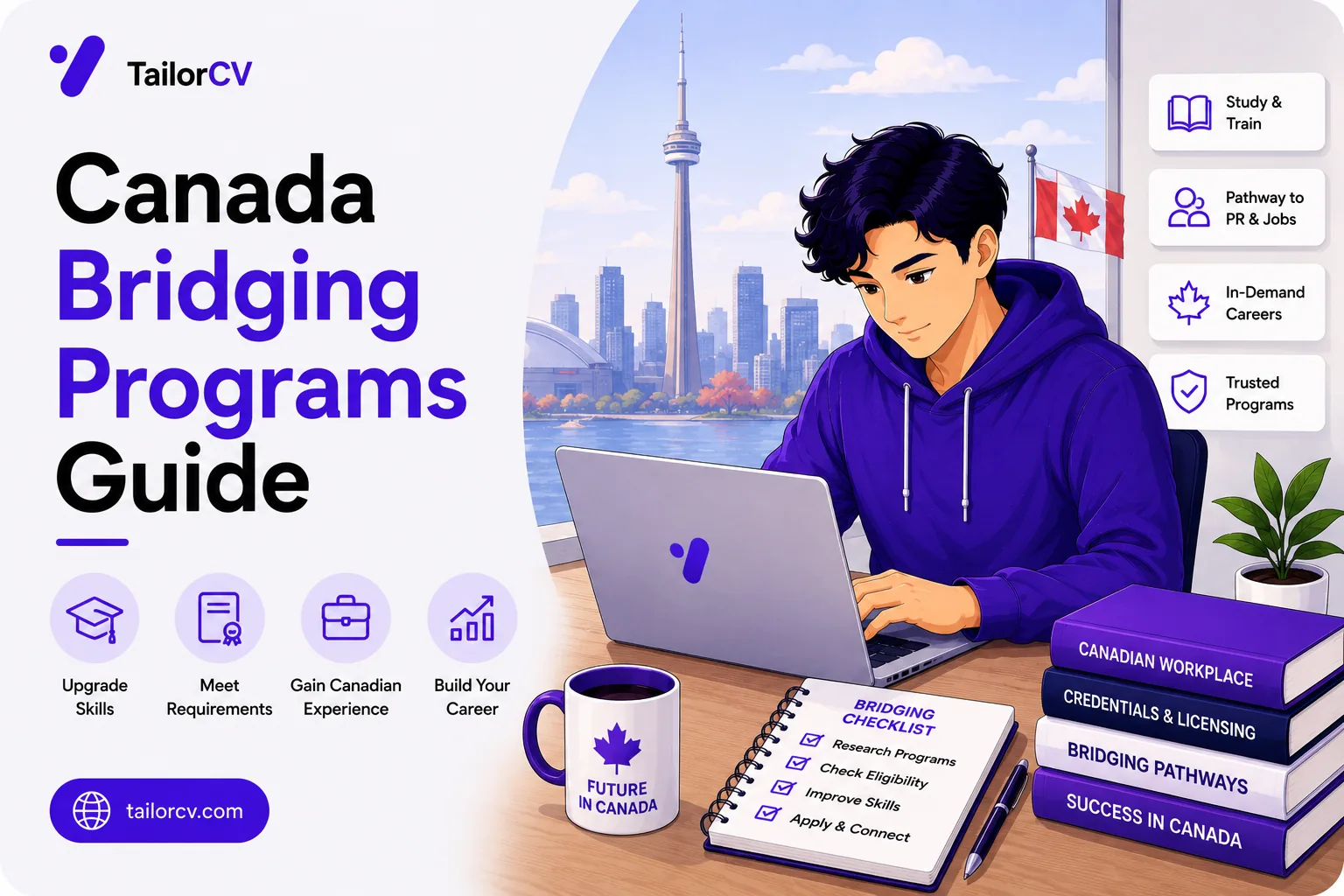
A program at a college, university or immigrant-serving organisation for professionals trained outside Canada, typically combining:
Technical or sector training to close any gap between your qualification and Canadian practice.
Licensing exam preparation, where your profession is regulated — see the Canada regulated professions guide.
Canadian workplace culture and communication, which sounds soft and addresses real differences in how meetings, feedback and self-presentation work here.
A supervised work placement — usually the most valuable component. Frequently counts toward the Canadian experience a regulator requires, and produces the Canadian reference that unlocks everything else.
Employer connections. Programs are built with employer partners, which means introductions rather than cold applications.
Job search support — resume review, interview practice, and networking guidance.
Who they are for
Regulated professions are the classic case — engineering, nursing, medicine, accounting, teaching, pharmacy, social work. The placement component addresses the licensing experience requirement directly.
Unregulated professionals too. Bridging programs exist for IT, finance, project management, supply chain and general business roles, where the barrier is not licensing but the Canadian experience objection described in the Canadian experience problem.
Sector-specific programs exist in healthcare, technology, construction and financial services.
Eligibility usually requires permanent residence or an appropriate status, credentials from outside Canada, and sometimes a language benchmark.
Funding
Many are free or heavily subsidised. Provincial governments fund bridging as settlement policy, because underemployed skilled immigrants are an economic loss.
Loans exist specifically for internationally trained professionals to cover licensing exams, credential assessments and training — often at low or no interest, from provincial programs and specialist non-profit lenders.
Some programs pay a training allowance during the placement.
Ask about funding explicitly, since it is not always advertised alongside the program description.
Finding one
Provincial immigrant-serving organisations are the best starting point. They are government-funded, free to use, and they know which programs exist in your region and profession. Most newcomers never walk in — which is the recurring theme of this whole area.
Colleges and universities list bridging programs on their continuing education pages.
Your professional regulator frequently lists approved bridging routes, since they have an interest in getting qualified people licensed.
Provincial government newcomer portals maintain directories.
Search by profession and province, since programs are regional and offerings differ substantially between provinces.
What to check before enrolling
Does the placement count toward licensing? If your profession is regulated, this is the whole question. Ask the regulator directly rather than relying on the program's marketing.
What is the employment outcome rate, and can they evidence it?
Is the placement guaranteed or competitive? Some programs guarantee a placement; others require you to secure one.
What does it cost, net of funding?
How long, and can you work alongside it? Full-time programs are hard to combine with a survival job, which is a real constraint.
Is the credential recognised by employers and regulators, or only by the provider?
Combining it with a job search
A bridging program is not a substitute for searching — run both.
Keep applying throughout. The program strengthens your application; it does not replace it.
Use the employer connections deliberately. The introductions are frequently worth more than the training, and passive participants get less from them.
Convert the placement. Treat it as an extended interview, exactly as you would an internship — the behaviours that convert are in the internship to PPO conversion guide.
Update your resume immediately with the Canadian placement, which is now your Canadian experience — see the resume for newcomers to Canada guide.
Common Mistakes
Not knowing bridging programs exist. They are funded specifically for your situation and most newcomers never find them.
Not visiting an immigrant-serving organisation. They are free, government-funded, and hold the regional knowledge about which programs run in your profession.
Assuming the placement counts toward licensing. Confirm with the regulator directly rather than relying on the program's description.
Not asking about funding. Grants, subsidised places and specialist low-interest loans for internationally trained professionals are widely available and rarely advertised prominently.
Treating the program as a substitute for job searching. It strengthens your applications; it does not replace them.
Participating passively. The employer connections are frequently the most valuable component and they reward people who engage.
Enrolling without checking the employment outcome. Ask for evidence rather than testimonials.
Not updating the resume with the placement. It is Canadian experience the moment it starts, and it is the asset the whole program exists to produce.
Frequently Asked Questions
What is a bridging program?
A structured program for internationally trained professionals combining technical training, licensing support, Canadian workplace preparation and usually a supervised work placement.
Are they free?
Many are free or heavily subsidised through provincial funding, and specialist low-interest loans exist for internationally trained professionals to cover related costs.
Do they lead to jobs?
Frequently, largely through the employer connections and the placement rather than the training alone. Ask any program for evidence of its employment outcomes.
Are they only for regulated professions?
No. Programs exist for IT, finance, project management, supply chain and general business roles, where the barrier is the Canadian experience objection rather than licensing.
Does the placement count toward licensing requirements?
Often, but confirm with your regulator directly rather than relying on the program's marketing.
How do I find one?
Start with a provincial immigrant-serving organisation — free, government-funded and regionally knowledgeable. Also check colleges, your regulator and provincial newcomer portals.
Can I work while doing one?
Depends on the format. Some are part-time or evening; full-time programs are difficult to combine with a survival job, which is worth checking before enrolling.
Get your resume Canadian-ready alongside. Check your ATS score free.
Make This Practical
Book an appointment at a provincial immigrant-serving organisation this week. They are free, government-funded, and they hold exactly the regional knowledge about which bridging programs run in your profession — and almost no newcomer uses them, which is why this route stays invisible.
Then verify the two things that determine whether a program is worth your time: whether the placement counts toward your regulator's Canadian experience requirement, confirmed with the regulator rather than the provider, and what the program's actual employment outcome is with evidence behind it.
Finally, treat the placement as the point. Engage with the employer connections rather than participating passively, run your job search in parallel rather than pausing it, treat the placement as an extended interview, and update your resume with it the day it begins — it is the Canadian experience the entire program exists to give you.
What is your resume scoring right now?
Scan it against a job description and get your ATS match score in about a minute.
Drop your resume here or choose a file
PDF only. Max 2 MB.
We never share your data or use it to train AI models.

Was this guide useful?
Be the first to rate it.