 TD
TD
Key Takeaways
- US employers use behavioral questions heavily for new grads because there is little work history to assess.
- Most weak answers fail at the Result, not the Situation — candidates describe what happened but never what changed.
- Build six to eight stories, not one per question. Good stories answer several questions with different emphasis.
- Student experience is valid material: group projects, part-time work, clubs, teaching, sport, family responsibility.
- "Tell me about a failure" is testing self-awareness, not looking for a disguised strength.
Why these questions dominate campus interviews
A candidate with eight years of experience can be assessed on what they have shipped. A twenty-one-year-old cannot. So employers assess the next best thing: how you have behaved in situations that resemble work.
The premise is that past behaviour predicts future behaviour. Whether that is entirely true matters less than the fact that they believe it and structure interviews around it. For most US campus processes, behavioral performance is weighted at least as heavily as technical ability, and often decides between technically similar candidates.
STAR, and where it goes wrong
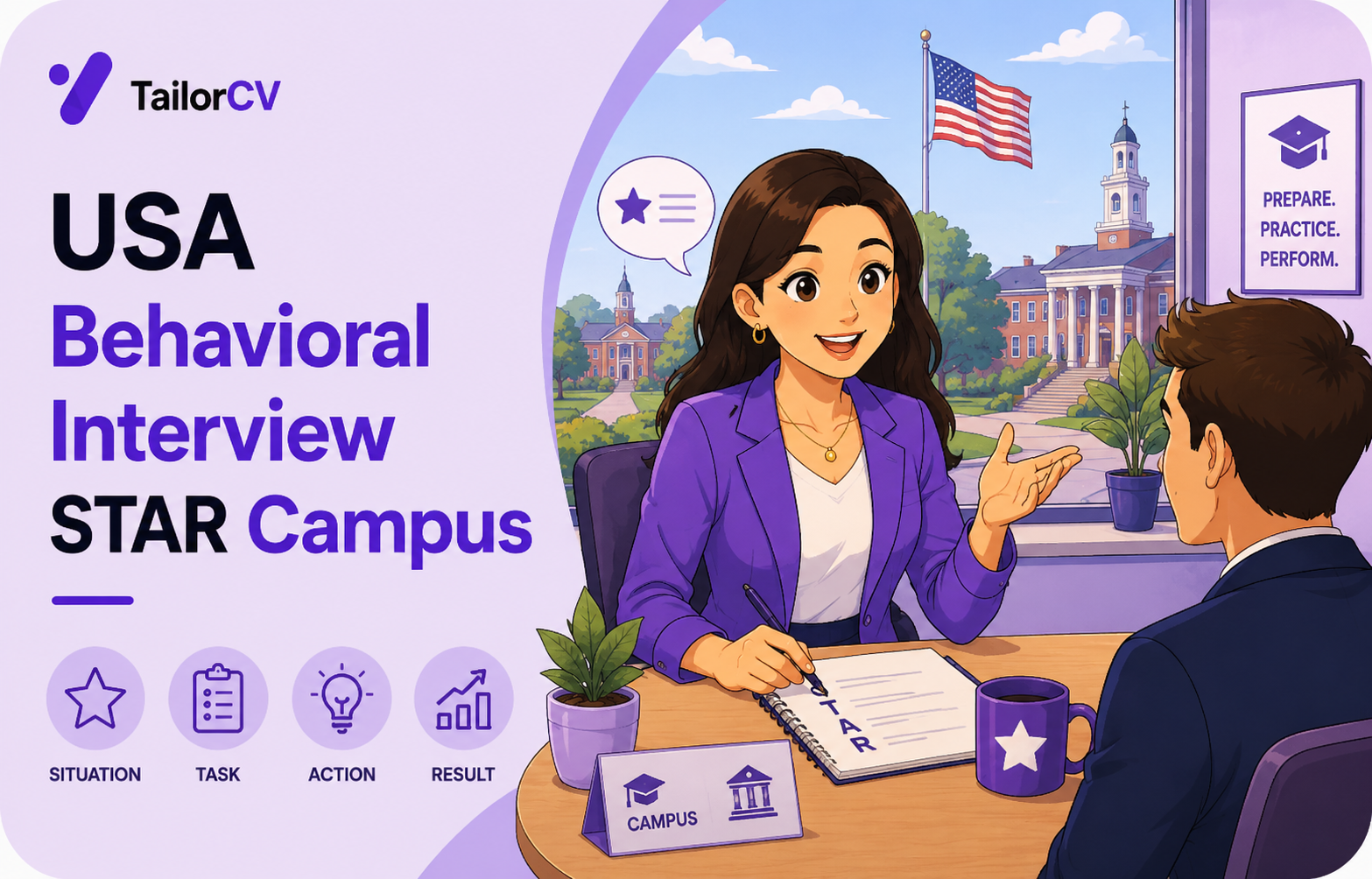
The standard frame is Situation, Task, Action, Result. Most students know it. Most still answer badly, in a predictable way.
Situation — where and when, briefly. Two sentences.
Task — what you specifically were responsible for. Not the team; you.
Action — what you actually did. This should be the longest part.
Result — what changed because of it.
The Result is where answers die
Listen to a typical student answer and it ends somewhere around "...and so we finished the project on time." That is not a result, it is an absence of disaster.
A result answers: what was different afterwards, and how do you know? Numbers help but are not mandatory. What matters is a concrete change.
Weak: "We got the project done and the professor was happy."
Better: "We submitted two days early, and the reliability fix I added took our test failure rate from about one run in three to zero across the final forty runs."
Same project. The second tells the interviewer what you are like when something is broken.
The other common failure: "we"
Interviewers are assessing you, not your team. Answers that say "we decided", "we built", "we fixed" throughout leave them unable to score you.
Say "we" for context and "I" for your contribution. "We had three days left and the integration was failing. I took the parser, isolated the encoding bug, and rewrote the import step."
This is not arrogance. It is answering the question that was asked.
Building a story bank
Do not prepare one answer per question — there are too many questions. Prepare six to eight solid stories and learn to angle them.
Aim to cover:
- A conflict with someone. Teammate, classmate, colleague, customer.
- A failure that was yours. Genuinely yours, with what you changed after.
- Leadership without authority. Getting people to do something when you could not tell them to.
- A hard technical or analytical problem. How you approached it, not just that you solved it.
- Working under time pressure. A real deadline, and the trade-offs you made.
- Something you initiated. Nobody asked you to do it and you did it anyway.
- Receiving difficult feedback. What was said, what you did about it.
- Prioritising between competing demands. How you decided what not to do.
One good story often covers three of these depending on emphasis. The group project that nearly failed can be the conflict story, the time-pressure story and the leadership story with different framing.
Student material is legitimate
Students routinely believe they have nothing to draw on. They almost always do:
- Group projects — the richest source, because they contain real conflict and real deadlines.
- Part-time work — retail and hospitality are full of difficult customers, competing priorities and process improvements.
- Clubs and societies — budgets, events, recruiting volunteers who can leave at any time.
- Teaching or tutoring — explaining hard things to resistant audiences.
- Sport and performance — coaching, failure, recovery.
- Family responsibility — genuine constraint management.
The interviewer knows you are twenty-one. They are not expecting enterprise-scale stories. They want to see how you think.
Questions you should expect
The wording varies; the underlying questions do not.
- Tell me about a time you worked with a difficult teammate.
- Describe a time you failed.
- Tell me about a time you had to learn something quickly.
- Describe a time you disagreed with a decision.
- Tell me about a time you had too much to do.
- Give me an example of when you took initiative.
- Tell me about a time you received critical feedback.
- Describe a project you are proud of.
The last one is not a warm-up. It reveals what you value, and a vague answer wastes the easiest question in the interview. A broader set of behavioral questions and worked answers is worth reading through once you have your stories drafted.
The failure question, specifically
Interviewers are testing whether you can look at your own work honestly. The disguised-strength answer — "I care too much about quality" — is transparent and marks you as either coached or defensive.
A real failure, with a real consequence, followed by a specific change, is far stronger. The change is the part being assessed. "I under-communicated and my teammate duplicated two days of work. Since then I post a short status at the end of every working session, which I have kept doing in my internship."
Practising properly
Say answers aloud. Stories that read well silently frequently run three minutes when spoken. Aim for 90 seconds to two minutes.
Record yourself once. Uncomfortable and unusually effective — filler words, rambling and missing results become obvious.
Practise with follow-ups. Interviewers probe. "Why did you choose that approach?" "What would you do differently?" A prepared story that collapses on the first follow-up is worse than an unprepared one. Mock interview practice is largely about surviving the second and third question, not the first.
Do not memorise word-for-word. Memorised answers sound memorised and break when the question is phrased unexpectedly. Learn the beats, not the script.
Match your stories to the employer. Research what they say they value and lead with the story that demonstrates it — researching the company properly turns a generic answer into a targeted one.
Where answers actually fail
Almost every weak behavioural answer fails in the same three places, and none of them is the place candidates worry about.
The Result is missing. By far the most common. The candidate describes a situation in detail, explains what they did at length, and then stops — leaving the interviewer to guess whether it worked. "And we finished the project" is not a result. What changed, by how much, compared to what.
Weak: "So we reorganised how we were splitting the work and it went a lot better after that."
Strong: "We went from missing two of the first three internal deadlines to hitting every one after that, and we submitted two days early instead of the night before."
The Situation eats the answer. Ninety seconds of background before anything happens. The interviewer needs two sentences of context, not the history of the club. A useful discipline: if you have not said what you did within thirty seconds, you are still in the Situation.
"We" throughout. The interviewer is scoring you, and cannot score a team. Use "we" for context and "I" for your contribution, and check that at least half your sentences are things you personally did.
The fix for all three is mechanical. Write your six stories out, then mark each sentence as context, contribution or outcome. If contribution and outcome together are less than half, rewrite.
Where students find material
The recurring objection is having nothing to talk about. Nearly always false — what is actually missing is permission to treat ordinary experience as valid.
Group projects. The richest single source, because they contain genuine conflict, deadline pressure, uneven contribution and real decisions. Almost every competency can be answered from one good capstone.
Part-time and campus work. Retail, food service, tutoring, library desk, lab assistant. These contain difficult customers, unreasonable pressure, being relied upon, and covering for people who did not turn up. Students omit them as unimpressive; interviewers read them as evidence of reliability under conditions students rarely face otherwise.
Societies and clubs. Particularly anything you ran, organised or budgeted. A society treasurer who overspent and fixed it has a better failure story than most candidates produce.
Sport and performance. Teams, coaching, sustained training. Long-duration commitment is exactly what "tell me about persistence" is asking for.
Teaching, tutoring and mentoring. Explaining something to someone who did not understand it is directly relevant to nearly every graduate job.
Family responsibility. Caring for a relative, translating for parents, managing a household alongside study. Entirely legitimate material, used carefully and without oversharing.
Anything you built or ran. A project, a small business, a channel, an event. Real decisions, real consequences.
What does not work as material: hypotheticals, things you observed rather than did, and stories from before secondary school. Everything else is fair.
Practising so it survives contact
The gap between a written story and a delivered one is larger than candidates expect, and it closes with a specific kind of practice.
Say them aloud, alone, once each. You will discover that the thing that read cleanly takes four minutes to say and loses its thread in the middle. This is the cheapest possible improvement and most people skip it.
Record one and watch it. Unpleasant, and it is where you find out that you say "basically" thirty times, or that your best story has no ending.
Practise with follow-ups. Have someone ask "what specifically did they say?" and "what would you do differently?" after each answer. Stories that survive two layers of probing are ready; ones that dissolve are not, and the fix is nearly always to use a truer story rather than a more impressive one.
Do not memorise word for word. Memorised answers sound memorised — flat, over-smooth, and impossible to adapt when the question is phrased slightly differently. Learn the beats, not the script.
Time yourself. Two minutes is the target. Under one usually means the specifics are missing; over three usually means the Situation ran long.
Two answers to the same question, compared
The gap between a weak and a strong behavioural answer is easier to see than to describe. Same candidate, same event, same question.
Question: "Tell me about a time you had to deal with an unexpected problem."
Weak:
"During my internship I was working on a data pipeline and partway through we discovered there was an issue with the data quality. It was a challenge because it affected the whole project timeline. I worked closely with my team and my manager to come up with a solution, and we were able to resolve it and deliver the project. It taught me the importance of being adaptable and communicating effectively under pressure."
Read it again and notice how little is actually said. What issue? What did you do? What was the solution? Delivered on time or late? The closing sentence is two abstractions doing the work that evidence should do.
Strong:
"Six weeks into my internship I found that about a fifth of the records in our main table had timestamps in two different timezones, because two upstream services had been writing to it since a migration eighteen months earlier. Nobody had noticed because the reports aggregated by month.
I did three things. I wrote a query to size the problem so we knew whether it mattered — it did, about 40,000 rows. I checked with the analytics team whether any published number depended on it, which two did. And I flagged it to my manager the same afternoon rather than trying to fix it quietly first, which was the part I nearly got wrong.
We backfilled with a normalisation script I wrote and added a check at ingestion so it could not recur. The two affected reports were corrected before quarter end.
What I would do differently is check the assumption earlier. I had spent two weeks building on that table without ever looking at the raw values, because I assumed the schema meant what it said."
Roughly two minutes. Specific numbers, a clear personal contribution, an outcome, a named near-mistake, and a genuine reflection. Every sentence is something the interviewer can write down.
Notice what the strong version does not do: claim sole credit, describe the candidate's qualities, or end on a platitude. The evidence carries it.
Common Mistakes
- No result. The most common failure. The story ends without saying what changed.
- "We" throughout. Leaves the interviewer unable to assess your contribution.
- Answers that run four minutes. Detail without structure reads as an inability to prioritise.
- A fake failure. "I work too hard" is heard several times a day and lands badly every time.
- One story reused verbatim across questions. Interviewers compare notes and notice.
- Dismissing student experience. A part-time job contains more usable material than most students think.
- Not preparing follow-ups. The probe is where prepared answers usually fall apart.
The questions, and what each is really testing
Preparing for these ten covers the great majority of US campus behavioural interviews.
| Question | What it is actually assessing |
|---|---|
| Tell me about yourself | Whether you can be concise and relevant. Ninety seconds, ending at why you are here. |
| Why this company? | Whether you researched. Specificity is the whole answer. |
| Tell me about a time you worked in a team | Collaboration, and whether you can describe your own part honestly |
| Tell me about a conflict | Whether you can present the other person's view as reasonable |
| Tell me about a failure | Self-awareness. Disguised strengths score zero. |
| A time you led something | Initiative, not job title. Leading without authority counts. |
| A time you had to learn quickly | The literal daily requirement of a graduate job |
| A time you handled pressure or competing deadlines | Prioritisation, and whether you have a method |
| Something you are proud of | What you value, and whether you can say why |
| Do you have questions for us? | Interest. Having none is a real negative. |
Two notes. The failure question is the highest-variance one — a genuine answer with a real consequence and a changed behaviour afterwards separates candidates more than any other single response, and the disguised-strength version ("I care too much") is transparent to everyone who has run interviews.
"Tell me about yourself" is not an invitation to recite your resume.
The interviewer has it. What they want is a ninety-second narrative that ends at why you are sitting in this particular interview.
Six stories, mapped
Building one story per question produces ten shallow stories. Building six good ones, each usable several ways, produces better answers with less work.
| Story | Answers |
|---|---|
| A group project that went wrong | Teamwork, conflict, pressure, failure, learning |
| Something you built or ran | Initiative, leadership, pride, learning quickly |
| A part-time or campus job situation | Pressure, difficult people, reliability, customer focus |
| A deadline or resource crunch | Prioritisation, pressure, teamwork |
| A time you got difficult feedback | Self-awareness, coachability, growth |
| Something you stuck with for a long time | Persistence, motivation, values |
For each, write down three details you could produce under probing — a name, a number, a date. That row is the one candidates skip and the one that decides whether the story holds up when the interviewer asks a second question.
The same six, with adjusted emphasis, also serve Canadian, UK and Singapore interviews. Building them once is genuinely reusable work.
Handling the questions you dread
Three that reliably unsettle candidates, and what actually works.
"What is your greatest weakness?"
The instinct is to name a strength in disguise, and every interviewer has heard it. What works is a real, bounded weakness plus what you do about it: "I am slow to ask for help — I will spend three hours on something rather than ten minutes asking. On my last project I started setting a timer, and if I am stuck past thirty minutes I ask. It has been a real improvement and I still have to enforce it deliberately." Real, specific, and shows a system rather than an apology.
"Why should we hire you?"
Not an invitation to list adjectives. Answer with fit: the two or three things the role clearly needs, and your evidence for each. "The posting emphasises data pipelines and working with non-technical stakeholders. I have built a pipeline that ran in production for four months, and I spent a year tutoring, which is mostly explaining technical things to people who do not want a technical answer."
"Where do you see yourself in five years?"
Nobody expects accuracy, and "in your company" is a non-answer. What reads well is a direction with a reason and an acknowledgement of uncertainty: "I want to be deep enough in one area that people come to me with questions about it. I do not yet know whether that area is infrastructure or data, which is honestly part of why this role appeals — it touches both."
The pattern across all three: answer the actual question, give evidence, and do not perform certainty you do not have. Interviewers are unusually good at detecting the difference between a considered answer and a rehearsed deflection.
Frequently Asked Questions
What if I genuinely have no work experience?
Group projects, clubs, volunteering, sport and part-time work all qualify. Interviewers hiring students expect student material and are assessing your thinking, not the scale of the setting.
How long should an answer be?
Ninety seconds to two minutes. Long enough to include a real action and result, short enough to leave room for follow-ups.
Can I use the same story twice in one interview?
Once, with genuinely different emphasis, is usually acceptable if you flag it. Three times is not — it suggests a thin bank.
Should I write my answers out?
Write bullet points, not scripts. Full scripts produce delivery that sounds recited and collapses when the wording changes.
What if I cannot remember a relevant example mid-interview?
Ask for a moment — "let me think of a good example" is completely acceptable and better than a rushed non-answer. A short pause reads as considered.
Do behavioral interviews matter as much as technical rounds?
For US campus hiring, usually yes. Where several candidates clear the technical bar, behavioral performance decides. Preparing only the technical side is the more common mistake.
Was this guide useful?
Be the first to rate it.