SS
SS

Key Takeaways
- A foreign degree helps most where the employer is international; it helps least where local networks and local qualifications dominate.
- Returning graduates are frequently out of step with the home hiring calendar, and that costs more than the degree gains.
- Your network at home decayed while you were away. Rebuilding it deliberately is the main task, not the applications.
- Salary expectations calibrated to your study country are the most common source of frustration and bad decisions.
- Being explicit about why you returned removes a question interviewers will otherwise assume an answer to.
When a foreign degree helps, and when it does not
Worth being precise, because the answer varies enormously by employer and knowing which kind you are talking to changes how you present yourself.
It helps most:
At multinationals and international employers. They recognise the institution, they value the exposure, and international experience is genuinely relevant to how they operate.
In fields where the training is globally standardised. Software, data, engineering disciplines, finance. What you learned transfers directly and the credential is legible.
Where language ability matters. Roles serving international clients or coordinating with overseas teams.
In sectors your home market is currently building. Where local expertise is thin, foreign training is a genuine differentiator rather than a nice-to-have.
It helps least:
Where local qualifications are mandatory. Law, medicine, accountancy, teaching and other regulated professions frequently require domestic certification, conversion exams or supervised practice. A foreign degree may be a starting point rather than a qualification, and finding this out after you return is expensive. Check before you choose the course.
Where local networks dominate hiring. Family businesses, tightly-networked sectors, regional employers. Here who you know outweighs where you studied, and three years away has weakened exactly that asset.
Where the institution is unknown. A good university with no local recognition provides no shorthand, which pushes all the weight onto your evidence.
At employers who suspect you will leave again. Some read a foreign degree as a sign that you are using them as a stopgap. The return question is where you address this, and addressing it plainly works.
The practical consequence: sort your target employers into these two groups before you apply. For the first group, the degree is worth foregrounding. For the second, lead entirely with evidence and treat the degree as context — and where regulated qualification is required, start that process immediately rather than applying for roles you are not yet eligible to hold.
Explain it in local terms
The most common mistake is assuming the credential speaks for itself. Local recruiters may not know your institution's standing, your grading scale, or what your course covered.
Practical fixes:
Translate the grade. "First Class Honours", "3.7 GPA" or "Distinction" means little in a system that does not use it. State the scale, or convert it, or give a percentile.
Say what the course involved if the name is unfamiliar. One line on the substance is worth more than the title.
Anchor the institution if it is not widely known locally. A brief factual note — a field ranking, a well-known alumnus in the industry, its position in that country — is enough.
Lead with what you did, not where you were. Projects, internships and outcomes are legible everywhere. The degree is context.
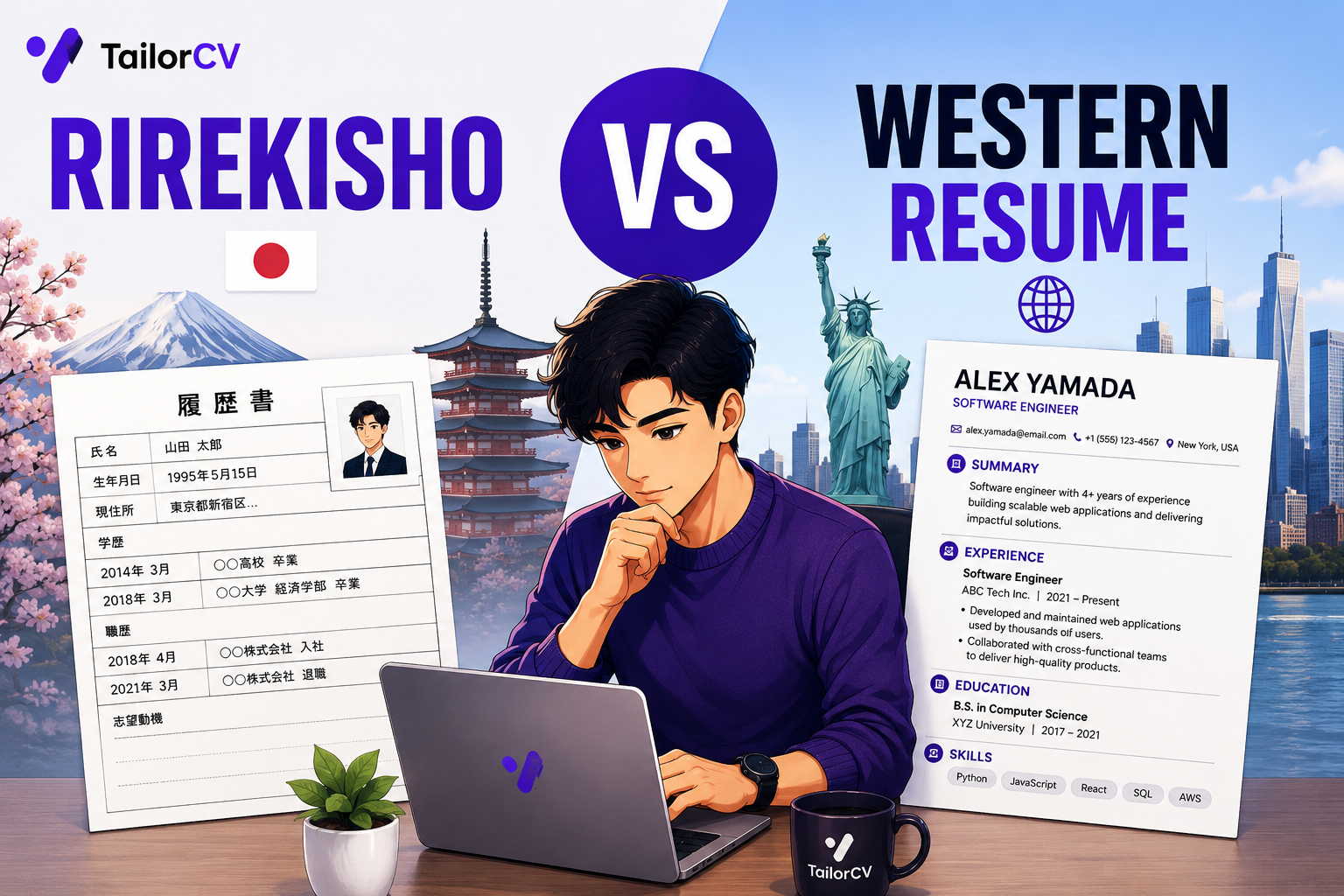
The country-by-country resume differences run in this direction too — a resume built for US conventions may need photos, personal details or different length restored when you apply at home.
The calendar problem
This is the underrated one. Graduating in June abroad and starting to apply in July at home often means arriving mid-cycle in a market whose main hiring window closed months earlier.
Home markets have their own calendars, and they rarely align with where you studied. Find out when yours runs and apply into it, even if that means applying from abroad before you return.
Applying before you return is usually right. Employers hire on availability, and "available from August" is a normal answer. Waiting until you land wastes months and looks less organised than it is.
Your network decayed
Two, three or four years away means school friends dispersed, family contacts are stale, and the people who would have referred you have moved on.
This is the actual work of returning, and it is more important than the applications.
Reconnect before you need to. Message people while you are still abroad — a genuine "I'm finishing in June and coming back, what's the market like?" is easy to answer and reopens a relationship.
Use your overseas university's alumni network in your home country.
Frequently substantial and almost never used. Alumni who also returned understand your exact situation.
Reconnect with pre-degree contacts. Former internship managers, professors from your undergraduate institution, family friends in the industry.
The mechanics are the same as building a network from scratch abroad — ask for a conversation, not a job — and the approach in networking as an international student applies in reverse.
Salary expectations
The most common source of disappointment. Salaries in your study country and your home country may differ by a large multiple, and applying a foreign expectation locally leads to either rejection or resentment.
Do the research properly against the local market for your field and level. A foreign degree may command a modest premium; it rarely closes an international pay gap.
Also compare properly rather than on the headline number — cost of living, tax, healthcare, housing and family proximity all belong in the comparison. A lower nominal salary at home is frequently a higher real standard of living, and that is a legitimate reason to return rather than a consolation.
The "why did you come back" question
It gets asked in almost every interview, and interviewers will assume an answer if you do not give one. The assumption is usually the unflattering one — that you could not find work abroad, or that you will leave again as soon as you can.
Answer it in one or two sentences, unprompted where it fits naturally.
Family reasons are entirely sufficient and widely understood: "My parents are here and I wanted to be closer to them at this stage."
A deliberate career reason is stronger where it is genuine: "The sector I want to work in is growing faster here than where I studied, and I'd rather be early in a growing market than late in a mature one."
Honesty about work rights is fine, delivered without apology: "My post-study visa was two years and I decided I'd rather build something here than spend that time trying to extend it." That is a considered decision, and it reads as one.
What to avoid: vagueness, which invites the interviewer to fill the gap; and any hint that returning was a defeat, which colours everything afterwards.
The question underneath the question is whether you will stay. Address it directly if you can: "I'm here for the long term — this is where I want to build a career." If that is not true, do not say it; but be clear with yourself, because ambivalence is visible.
What actually transfers
Useful for knowing what to lead with, since not everything from your time abroad carries equal weight at home.
Transfers strongly: technical skills, software, methods and standards; language ability; experience with international clients or teams; any work you did that produced a measurable outcome; and the ability to operate in an unfamiliar environment, which is a genuine competency and rarely claimed well.
Transfers moderately: the institution's name, where it is recognised; sector knowledge, where the sectors are structured similarly; and internships, where the employer has a local presence or is internationally known.
Transfers weakly: local professional qualifications from your study country that are not recognised at home; knowledge of regulatory frameworks that differ; and the network you built abroad, unless it includes people who also returned.
Transfers not at all: an assumption that the foreign degree is self-evidently better.
The practical instruction: lead with the strong column. A returning graduate's resume that opens with what they built, in what tools, with what result, is doing the right thing. One that opens with the university and the country is asking the reader to be impressed by context rather than by evidence — and it is the same error, in a different direction, that international students make abroad when they lead with education instead of work.
Explaining a foreign degree in local terms
The most common self-inflicted problem for returning graduates: describing your education in a vocabulary the local employer does not use, and assuming the prestige speaks for itself.
Translate the grade. "2:1", "3.6 GPA", "Merit", "First Class" — each of these is meaningless in markets that use a different system. State it in the local idiom where an equivalent exists, and where it does not, add a short clarification: "Distinction (equivalent to top 15% of the cohort)". A reader who cannot interpret your grade does not look it up; they skip it.
Say what the course actually involved. A degree title is not self-explanatory across systems. "MSc Data Science — twelve months, taught, with a six-month industry dissertation on demand forecasting" tells a local employer more than the title plus the university name.
Anchor the institution briefly, once. If your university is not well known locally, one clause is enough: "a research university in the north of England" or "ranked in the top 20 nationally for engineering". Do not spend a paragraph on it — a defensive over-explanation reads worse than a brief anchor.
Lead with what you did, not where you were. The instinct is to foreground the foreign degree because it felt like the significant thing. To a local employer, what you built, analysed or ran is the significant thing, and the location is context.
Name the transferable specifics. Software, methods, standards, languages. These travel unambiguously where the credential does not.
One thing to avoid entirely: implying the foreign degree makes you a stronger candidate than local graduates. It is occasionally true and saying it is always costly. Let the evidence do the work — the same discipline that applies in Singapore's measured interview register applies to returnees everywhere.
Salary expectations, and the anchoring trap
The most common source of frustration for returning graduates, and of genuinely bad decisions.
The problem. You spent two years in a country where graduate salaries were quoted in a different currency at a different level, against a different cost base. Those numbers are now your intuition, and your intuition is calibrated to a market you have left.
Converting the number is not the comparison. A salary that looks small converted into your study country's currency may be entirely normal at home, and may buy considerably more. Compare against local graduate medians and local costs, not against what your classmates who stayed are earning.
The degree does not command a premium by itself. Returning graduates frequently expect one, and where it exists it is modest and concentrated in employers who value the international exposure specifically. Expecting a large premium and being offered a standard graduate rate produces a sense of injustice that leaks into interviews.
What to do:
Research the local market properly before your first conversation.
Published graduate salary surveys, sector reports, job postings with ranges, and — most usefully — people. Three former classmates now working at home will tell you more than any report.
Separate the sunk cost from the market rate. What your degree cost is not an input into what employers pay. This is obvious stated plainly and it is the reasoning behind most unrealistic expectations.
Weight the total position. Cost of living, tax, family support, and — for many returnees — the fact that you are near people you want to be near. These are real components of the decision and they are invisible in a salary comparison.
Take the market rate for a role that teaches you something, and let progression do the work. A returning graduate who holds out for a premium and spends eight months unemployed has lost far more than the premium was worth.
What returning gives you that staying would not
Worth naming, because the conversation about returning is usually framed as loss and it is not entirely.
You are not competing for work authorisation. No permit, no threshold, no lottery, no employer needing to be eligible. That constraint shaped every decision your classmates who stayed are still making, and it is simply gone. The size of that advantage is easy to underestimate until you watch someone lose a job offer over it.
Your network here is real, even if it decayed. Rebuilding a weakened relationship is dramatically easier than building one from nothing, which is what your classmates abroad are doing.
You can move employers freely. No status attached to a job means a bad first role is a role you leave, which is not true for many people on employer-linked permits.
You understand the context. Language, culture, how things work, what employers mean by what they say. Nobody has to explain anything twice.
You are unusual in a way that is legible. A returning graduate with international training is a specific and often desirable profile at employers who work across borders — which is a smaller advantage than the degree's cost, and it is a real one.
And the family and cost-of-living arithmetic is frequently better
than a comparison of gross salaries suggests.
None of this argues that returning is the right choice for everyone. It argues that the frame of returning-as-defeat is inaccurate, and candidates who carry that frame into interviews are audibly carrying it.
Common Mistakes
- Assuming the degree speaks for itself. Local recruiters may not know your institution or your grading scale.
- Missing the home hiring calendar. Frequently costs more than the degree gains.
- Waiting until you land to apply. Employers hire on availability, not on presence.
- Applying foreign salary expectations. The most common source of bad decisions on return.
- Neglecting the network. It decayed while you were away, and rebuilding it is the main task.
- Sounding like the move abroad failed. Interviewers hear it and it raises doubt.
The calendar problem, and the network problem
Two practical issues cost returning graduates more than anything about the degree itself.
You are out of step with the hiring calendar. Graduate recruitment at home ran on a cycle you were not in the country for, and you may return a full season after the intake you should have applied to. Applications frequently open a year ahead, and finishing in June and starting to look in July means the programmes closed the previous autumn.
What to do: apply before you return. This is nearly always right, and it is the single most useful piece of timing advice available. Interview remotely, be explicit about your return date, and treat the last two terms of your degree as the application season rather than the period after it. Employers handle remote interviews routinely now, and a candidate with a stated return date is a known quantity.
Your network decayed while you were away. Not maliciously — people moved, changed jobs, lost touch. The contacts who would have introduced you have their own current concerns, and reappearing after three years with a request is a cold approach wearing a familiar name.
What to do:
Reconnect before you need to. Six months before you return, not the week after. A short message with no ask — what you have been doing, a genuine question about them — reopens the relationship without spending it.
Reconnect with pre-degree contacts specifically. Former classmates, internship colleagues, professors from your first degree. These people are now three years into careers and are exactly the layer that produces referrals.
Use the alumni network from your foreign university too. Graduates of your overseas institution who are working in your home country are an unusually strong contact group — a shared institution plus a shared experience of returning.
Then run it like any other search. The outreach mechanics are identical: ask for a conversation, not a referral; be specific; follow up within a day. The only difference is that some of your contacts already know you, which raises the reply rate considerably.
A plan for the last two terms
The returning graduates who do well treat their final year abroad as the search, not the period after it. This is the sequence.
Two terms before you finish. Reconnect with home contacts — no ask, just reopening the relationship. Former classmates, internship colleagues, professors from your first degree. Ten messages over a month. Simultaneously, find out whether your field requires local qualification or conversion at home, because if it does, that process starts now rather than after you land.
One term before. Research the local graduate calendar and find out what you have already missed and what is still open. Rebuild your resume for the home market — local grade idiom, local conventions, evidence first. Start applying. Say your return date explicitly in every application.
Final term. Interview remotely. This is completely normal now and employers handle it routinely. Be flexible on times and be clear about your availability.
On return. Follow up with everyone you contacted, in person where you can. Attend the industry events you could not attend from abroad. The contacts you warmed up over six months are now reachable in a way they would not be if you had appeared cold.
The mistake this avoids: landing at home with no applications submitted, a decayed network, a resume in a foreign idiom, and a hiring calendar that closed four months ago. That is the default outcome of waiting until you return, and it costs most returning graduates a season.
Managing the expectations of other people
An angle nobody writes about and which affects a lot of returning graduates.
Family may expect a specific outcome. A prestigious employer, a particular salary, a rapid return on what the degree cost. Where those expectations are unrealistic for the local graduate market, the gap creates pressure at exactly the moment you need to make clear-headed decisions.
Peers who stayed have a two-year head start. Classmates from your first degree are now mid-level and you are entering as a graduate. That comparison is real and it is temporary, and treating it as a verdict leads people to hold out for titles rather than for learning.
People will ask why you came back. Repeatedly, and often with an implication. Having a settled one-sentence answer for social situations, separate from your interview answer, saves a surprising amount of energy.
What helps: being explicit with family early about what local graduate salaries actually are, using published data rather than your own assertion. And judging the first job on what it teaches you rather than on how it sounds when described to others — which is the right criterion everywhere, and unusually hard to hold when several people are watching.
Frequently Asked Questions
Is a foreign degree valued at home?
Usually somewhat, and most at internationally-facing employers. It is a differentiator rather than a decisive credential, and it needs explaining in local terms.
When should I start applying?
Before you return, aligned to your home market's hiring calendar. "Available from August" is a normal answer that employers accommodate routinely.
Should I mention I studied abroad prominently?
Include it plainly in education. Lead your resume with what you did — projects, internships, outcomes — rather than with where you were.
Will I earn more because of it?
Sometimes a modest premium, particularly at international employers. It does not close a gap between two countries' salary levels.
What if my professional qualification does not transfer?
Common in regulated fields. Check the local requirements early — recognition processes can take a long time and are better started before you return.
How do I explain a gap between graduating and starting?
Say what you did with it. Job searching from abroad, a project, a certification, a family reason — a specific answer is unremarkable, and vagueness is what invites questions.
What is your resume scoring right now?
Scan it against a job description and get your ATS match score in about a minute.
Drop your resume here or choose a file
PDF only. Max 2 MB.
We never share your data or use it to train AI models.

Was this guide useful?
Be the first to rate it.