TD
TD

Key Takeaways
- ATS systems focus on parsing resumes for structure and keyword relevance, not detecting AI-generated content.
- Human recruiters identify AI-written resumes by spotting generic phrases, vague achievements, and inconsistent tone.
- To avoid sounding generic, always edit AI-generated content to reflect your unique voice and experiences.
- Use specific metrics and context in your resume to create a compelling narrative that stands out to recruiters.
- Practice discussing every bullet point on your resume to ensure you can confidently elaborate during interviews.
Can Recruiters Tell If Your Resume Was Written by AI? What ATS and Humans Actually Check
ATS systems don't run "AI detection" on your resume the way plagiarism checkers scan essays - they're built to parse and score content, not fingerprint its origin. Recruiters, however, absolutely can tell when a resume was generated and never edited: the tell isn't that it's AI-written, it's that it's generic.
The safest path isn't avoiding AI tools - it's using ones built specifically for resumes, which keep your real experience central instead of generating filler. Test yours with the free ATS score checker.
What ATS Systems Actually Check
Applicant tracking systems parse your resume for structure and keyword relevance - they are not scanning for "AI-generated" phrasing patterns. What they do flag:
- Poor formatting that breaks parsing - see ATS resume formatting mistakes
- Missing keywords relevant to the job description - see ats keyword mistakes
- Non-standard section headers or unusual file formats - see ATS resume parser-friendly format
None of this is about detecting AI - it's about whether the content and structure are readable at all.
Key Elements ATS Look For
Understanding what ATS systems prioritize can help you create a more effective resume. Here are some key elements ATS focus on:
- Keywords: Specific terms that match the job description, including industry jargon, skills, and qualifications.
- Formatting: Clear, conventional formatting that allows the ATS to read and categorize your information easily.
- Consistency: Consistent use of terminology and formatting throughout the document.
By ensuring your resume aligns with these elements, you can significantly improve your chances of passing through ATS filters.
What Actually Gives Away an AI-Written Resume to a Human
While ATS focus on structural elements, human recruiters look for nuances that indicate a resume may not be authentic. Here are common red flags:
- Generic phrasing repeated across bullets - "responsible for," "passionate about," "results-driven professional" with no specifics.
- Vague achievements with no numbers - see how to quantify resume achievements.
- A summary that could apply to literally anyone in the role, with no unique detail.
- Inconsistent tone between the resume and how the candidate actually speaks in the interview - a mismatch recruiters notice quickly.
- Overly polished language paired with an inability to explain it in the interview - if you can't discuss a bullet point's details, it reads as unfamiliar or exaggerated.
See how recruiters spot generic resumes and generic resume mistakes that cost interviews for the exact patterns that trigger skepticism.
Real Examples of Generic vs. Tailored Phrasing
To illustrate the difference, consider these examples:
- Generic: "Responsible for managing projects."
- Tailored: "Led a cross-functional team to deliver a $500,000 project two months ahead of schedule, resulting in a 20% increase in client satisfaction."
By providing specific details and outcomes, you create a more compelling narrative that resonates with recruiters.
How to Use AI Without Sounding Generic
- Never accept the first draft as final. Use AI output as a starting point, then edit in your own voice - see AI resume tailoring without losing your voice.
- Add real numbers and context AI can't invent. Only you know the actual scale of your project or result.
- Read it out loud. If it doesn't sound like something you'd say in an interview, rewrite it.
- Use a resume-specific tool, not just generic chat. Tools built for resumes anchor output to your real experience and a real job description rather than generating plausible-sounding filler - see how AI resume matching works.
- Practice explaining every bullet. If you can't confidently expand on it in an interview, cut or rewrite it - rehearse with the AI mock interview tool.
Additional Tips for Tailoring Your Resume
- Customize for Each Application: Tailor your resume for each job application. Use the job description to identify necessary keywords and phrases.
- Highlight Unique Skills: Focus on skills that are unique to you and relevant to the job. This is especially important for roles requiring specialized knowledge.
- Break Down Complex Projects: For technical roles, break down projects into clear components. Describe your role, the challenges faced, and the outcomes achieved.
Common Mistakes to Avoid When Using AI for Resume Writing
Even with AI's assistance, it's easy to make mistakes that can hurt your chances. Here are some common pitfalls to avoid:
| Mistake | Why it costs you |
|---|---|
| Over-reliance on AI | Trusting AI to create your resume without any personal input can result in a lack of authenticity |
| Ignoring Formatting Guidelines | Ensure your resume follows ATS-friendly formatting rules. This includes using standard fonts, avoiding graphics, and keeping it concise |
| Failing to Update Regularly | As you gain new experiences, ensure your resume reflects your most current skills and achievements |
| Neglecting Soft Skills | While hard skills are crucial, soft skills are equally important. See how matching your resume to the soft skills buried in a job description can enhance your application |
Is Using AI to Write Your Resume "Cheating"?
No - using AI to speed up writing is no different than using a template or asking a friend to review your resume. What matters is that the content stays accurate and that you can speak to every claim confidently in an interview. See how to write a resume with AI for a responsible approach.
Your resume after optimization
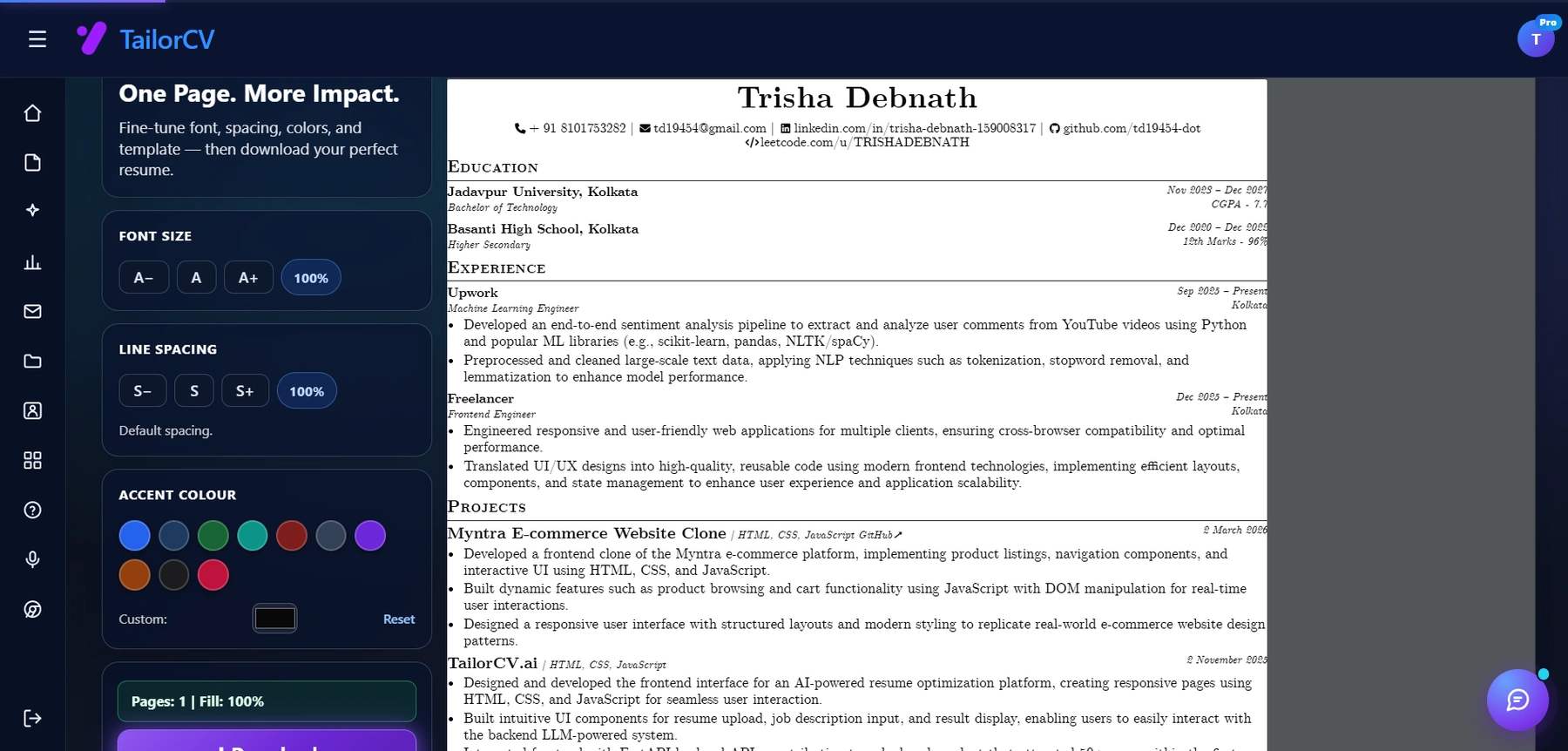
This is the resume after tailoring - the content is already matched, and these controls are how you fit it onto one page.
Embracing AI as a Tool, Not a Crutch
AI should be viewed as a valuable tool that can enhance your resume writing process. Here’s how to maximize its benefits:
- Use AI for Inspiration: Let AI generate ideas or phrases that you can then modify to fit your unique style and experience.
- Combine AI with Human Insight: After using AI, enlist a trusted colleague or mentor to review your resume. Their insights can help you spot areas for improvement.
- Stay Updated on Trends: Keep an eye on resume trends for 2026 to ensure your resume remains relevant in a changing job market.
By incorporating AI thoughtfully into your resume writing process, you can create a document that not only passes ATS scrutiny but also resonates with human recruiters. This approach empowers you to showcase your unique professional narrative effectively.
How to Identify AI-Generated Content in Your Resume
Before you submit your resume, it's essential to assess whether any sections may appear AI-generated. Here’s a step-by-step guide to help you identify potential red flags:
-
Analyze Sentence Structure: AI often generates sentences that are overly complex or too uniform in structure. Read your resume aloud. If the sentences sound robotic or lack natural variation, consider rephrasing them.
-
Check for Clichés: AI tools tend to rely on common phrases and buzzwords. Look for clichés like "hardworking," "team player," or "go-getter." Replace them with specific examples that demonstrate your unique contributions.
-
Evaluate Tone and Voice: Ensure that your resume reflects your personality and professional voice. If the language feels too formal or impersonal, it might indicate AI influence. Personalize it by adding anecdotes or specific achievements.
-
Review Keywords: While keyword optimization is crucial for ATS, overloading your resume with too many industry terms can signal AI usage. Use keywords naturally and only where they genuinely apply.
-
Seek Feedback: Share your resume with trusted friends or mentors. They can provide insights on whether it feels authentic or if any sections come off as generic.
Common Mistakes When Using AI for Resume Writing
Even though AI can assist in crafting a resume, several pitfalls can undermine its effectiveness. Here are common mistakes to avoid:
-
Over-Reliance on Templates: Many AI tools offer templates that may look similar to others in the market. Customize the template to reflect your personal branding and experiences.
-
Neglecting Contextual Relevance: AI might generate content based on general knowledge rather than specific job requirements. Make sure to tailor your resume for each application, highlighting relevant skills and experiences.
-
Ignoring Quantifiable Achievements: AI may create vague statements rather than concrete accomplishments. Always include specific metrics or results (e.g., "increased sales by 20%") to validate your claims.
-
Failing to Update Regularly: If you use AI-generated content, ensure you regularly update your resume. Outdated information can lead to discrepancies during interviews.
Do's and Don'ts for Crafting an AI-Assisted Resume
Do's
-
Do Use AI as a Starting Point: Leverage AI to generate ideas, outlines, or drafts, but make sure to infuse your personality and unique experiences into the final product.
-
Do Focus on Specificity: Ensure that any AI-generated content is paired with specific examples from your career that illustrate your skills and achievements.
-
Do Test Your Resume with ATS Tools: Use tools like ATS checker to ensure your resume is optimized for applicant tracking systems.
Don'ts
-
Don’t Skip the Proofreading Stage: Always review your resume for grammatical errors and awkward phrasing that AI might introduce.
-
Don’t Use Jargon Excessively: While industry-specific terms can enhance your resume, don’t overdo it. Keep it accessible to both ATS and human readers.
-
Don’t Use AI to Avoid Writing: Relying solely on AI can lead to a lack of personal touch. Your resume should reflect your journey and aspirations.
Mini Checklist for a Human-Approved Resume
Before sending out your resume, use this checklist to ensure it meets human and ATS standards:
- unchecked: Is the content personalized and reflective of my voice?
- unchecked: Are there specific metrics supporting my achievements?
- unchecked: Have I avoided clichés and jargon?
- unchecked: Does the format adhere to modern standards? (Refer to our Resume Section Order Guide)
- unchecked: Have I tailored this version for the specific job application?
- unchecked: Is the language clear, concise, and free of grammatical errors?
- unchecked: Have I tested my resume with an ATS checker?
By following these guidelines and utilizing AI thoughtfully, you can create a resume that stands out to both recruiters and applicant tracking systems.
Frequently Asked Questions
Do ATS systems reject resumes for being AI-written?
No - ATS systems score based on keyword relevance and formatting, not the origin of the writing. A well-structured AI-assisted resume can score just as well as one written entirely by hand.
Will an AI-generated resume hurt my interview chances?
Only if it makes claims you can't back up in person, or if the phrasing is so generic it fails to differentiate you. Specificity, not authorship, is what recruiters actually evaluate. For tips on how to enhance your resume's impact, check out our resume trends 2026.
Should I disclose that I used AI to write my resume?
No - there's no expectation to disclose the tools used to draft any application material, just as you wouldn't disclose which word processor you used.
What's the safest way to use AI for my resume?
Use a resume-specific tool that scores against real job descriptions and keeps your actual experience central, like the free ATS score checker, rather than relying solely on generic AI chat output. For more guidance on structuring your resume, refer to our resume section order guide. Additionally, consider exploring our anatomy of a perfect resume for detailed insights on each section.
Make This Practical
Use AI to speed up your draft, then verify it's specific and accurate. Check your resume's real ATS match with the free ATS score checker, tighten generic phrasing with how to stop sounding generic on a resume, and rehearse explaining every claim with the AI mock interview tool.
Conclusion
Recruiters can't detect "AI" - they detect generic. Use AI tools to move faster, but keep the specifics, numbers, and voice unmistakably yours.
What is your resume scoring right now?
Scan it against a job description and get your ATS match score in about a minute.
Drop your resume here or choose a file
PDF only. Max 2 MB.
We never share your data or use it to train AI models.

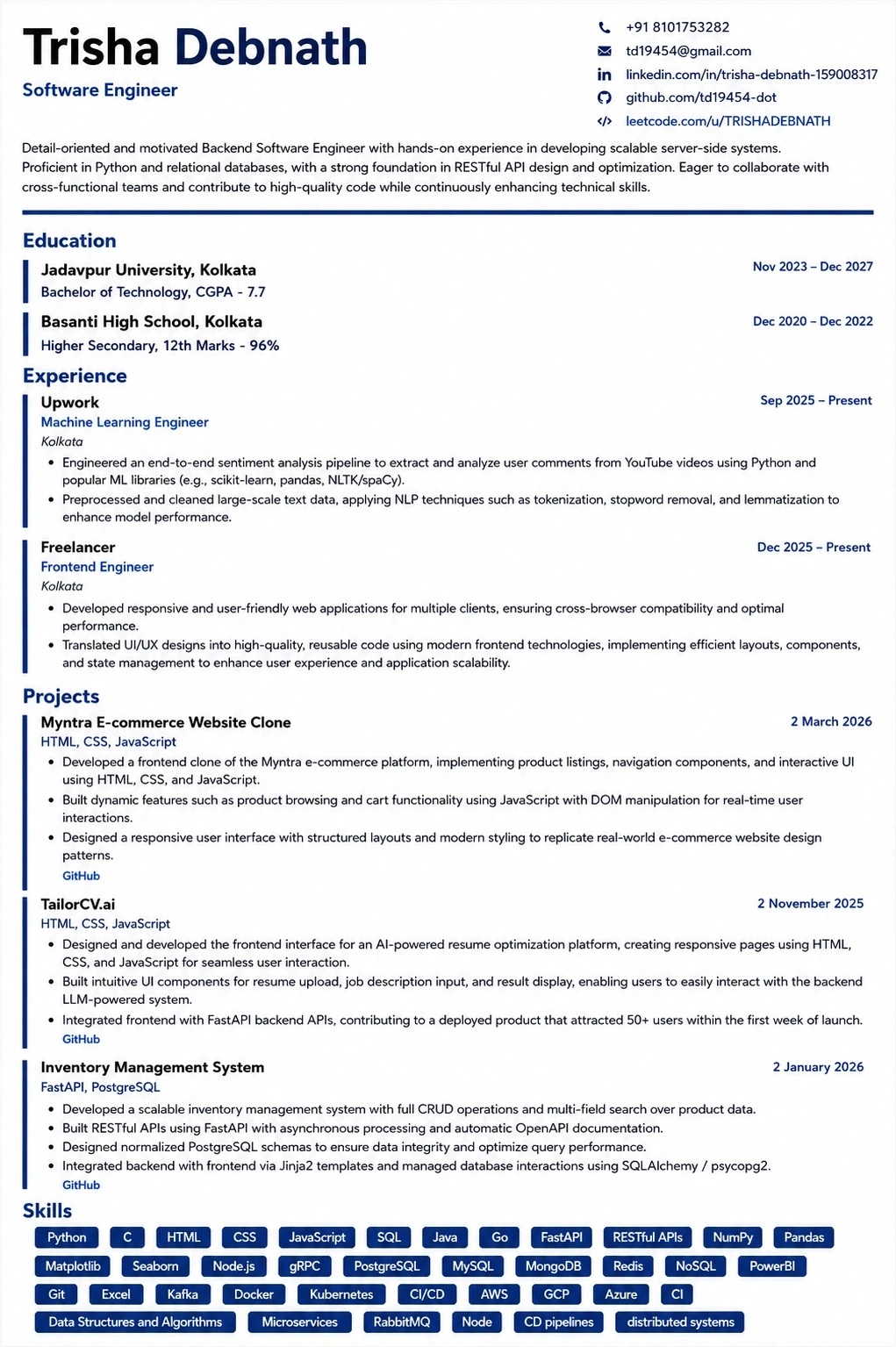
Templates that keep this structure intact
This template is ATS-tested — start from it and the formatting rules in this guide are already handled.
Was this guide useful?
Be the first to rate it.