 TD
TD
Key Takeaways
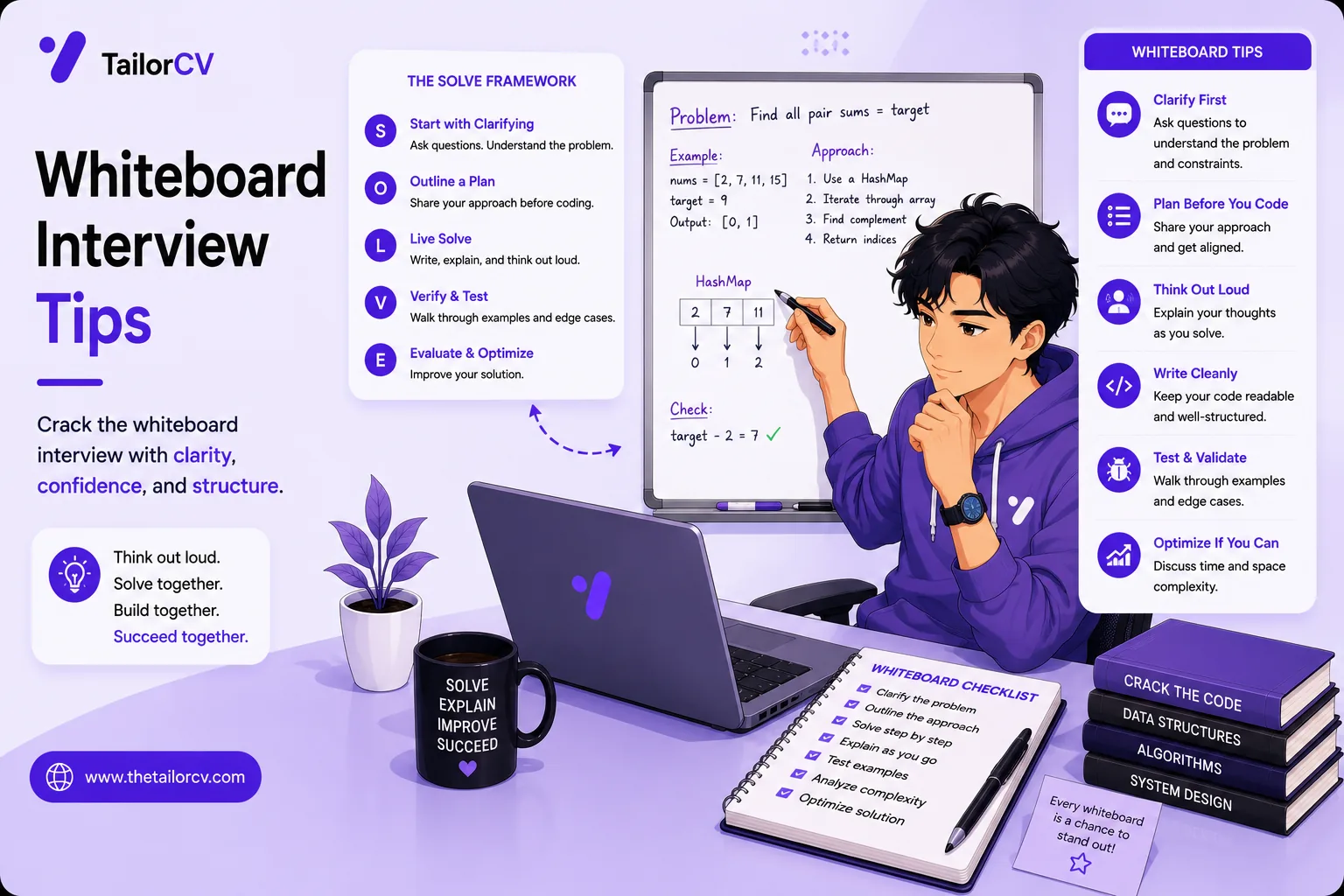
- On a whiteboard the final answer matters less than you would think - the process is what is being evaluated.
- The single biggest mistake is going quiet; if you stop narrating, the interviewer cannot see your reasoning or help you.
- Structure your approach before you start solving, following a clear sequence.
- A working brute-force solution beats an elegant one you never finish.
- Get something correct on the board first, confirm it on your example, then optimise.
Whiteboard interviews — solving a problem live in front of interviewers — test how you think, not just whether you land the perfect answer. Many strong candidates freeze here, not because they lack the skill, but because they lack a process for performing under pressure. The good news: whiteboarding is a learnable skill, and a clear method plus practice will get you through. This guide gives you both.
Whiteboard rounds usually come after you've passed a screen and possibly a take-home assignment, so you've already proven baseline competence. Now you're proving communication and composure. Prepare with a free AI mock interview, the interview prep tool, and the technical interview guide.
What interviewers are actually evaluating
On a whiteboard, the final answer matters less than you'd think. Interviewers are watching your problem-solving process, your communication, how you handle hints, and how you respond when stuck. They want to know what it's like to work through a hard problem with you. Once you internalize that, the pressure drops — you're not performing a magic trick, you're collaborating on a problem out loud.
Think out loud — silence is the enemy
The single biggest mistake is going quiet. If you stop narrating, the interviewer can't see your reasoning and can't help you. Talk through what you're considering, why you're choosing one approach over another, and where you're uncertain. Narrating also invites hints — interviewers often nudge you forward when they hear your thinking. This is the same principle as a strong behavioral answer: make your thought process visible.
Structure before you solve
Don't dive straight into a solution. Follow a clear sequence:
- Restate the problem in your own words to confirm understanding.
- Ask clarifying questions about inputs, constraints, and edge cases.
- Work through an example by hand to build intuition.
- Outline an approach and state its trade-offs before writing anything.
- Then implement, explaining as you go.
This structure signals seniority and prevents the panic of an unplanned start. It mirrors how you'd break down any complex task, including a case interview.
Start simple, then optimize
A working brute-force solution beats an elegant one you never finish. Get something correct on the board first, confirm it works on your example, then discuss how you'd improve it — better time complexity, cleaner structure, edge-case handling. Interviewers would much rather see a complete simple solution plus a thoughtful optimization discussion than a half-finished clever one. This "make it work, then make it better" instinct is exactly what strong engineers show, and it's worth reflecting on your resume too — see the relevant developer resume guides.
Manage the space, the time, and your nerves
Practical execution matters. Write legibly, leave room to insert changes, and keep an eye on the clock. If you're stuck, say what you're considering out loud rather than freezing — interviewers frequently offer a hint at that moment. If nerves hit, slow your breathing and return to your structure; the process is your anchor. For managing anxiety, the interview anxiety tips and how to practice interviews at home guides help.
Handling a problem you don't know
Sometimes you'll get a problem you can't immediately crack. Don't pretend — instead, show how you attack the unknown: break it into smaller pieces, try a simpler version, and reason from first principles out loud. Interviewers value seeing you make progress on something hard far more than seeing you rattle off a memorized answer. Honesty plus method beats bluffing every time, the same way honesty on your resume beats exaggeration.
Practice the format, not just the content
Whiteboarding is a performance skill, and you get better by rehearsing it out loud, ideally in front of someone or a recording. Practice narrating your thinking, managing time, and staying calm — the content knowledge you already have. Run repeated sessions with a free AI mock interview, and for engineering roles prep fundamentals with the coding interview guide and system design interview guide.
See it in action: a resume-based mock interview
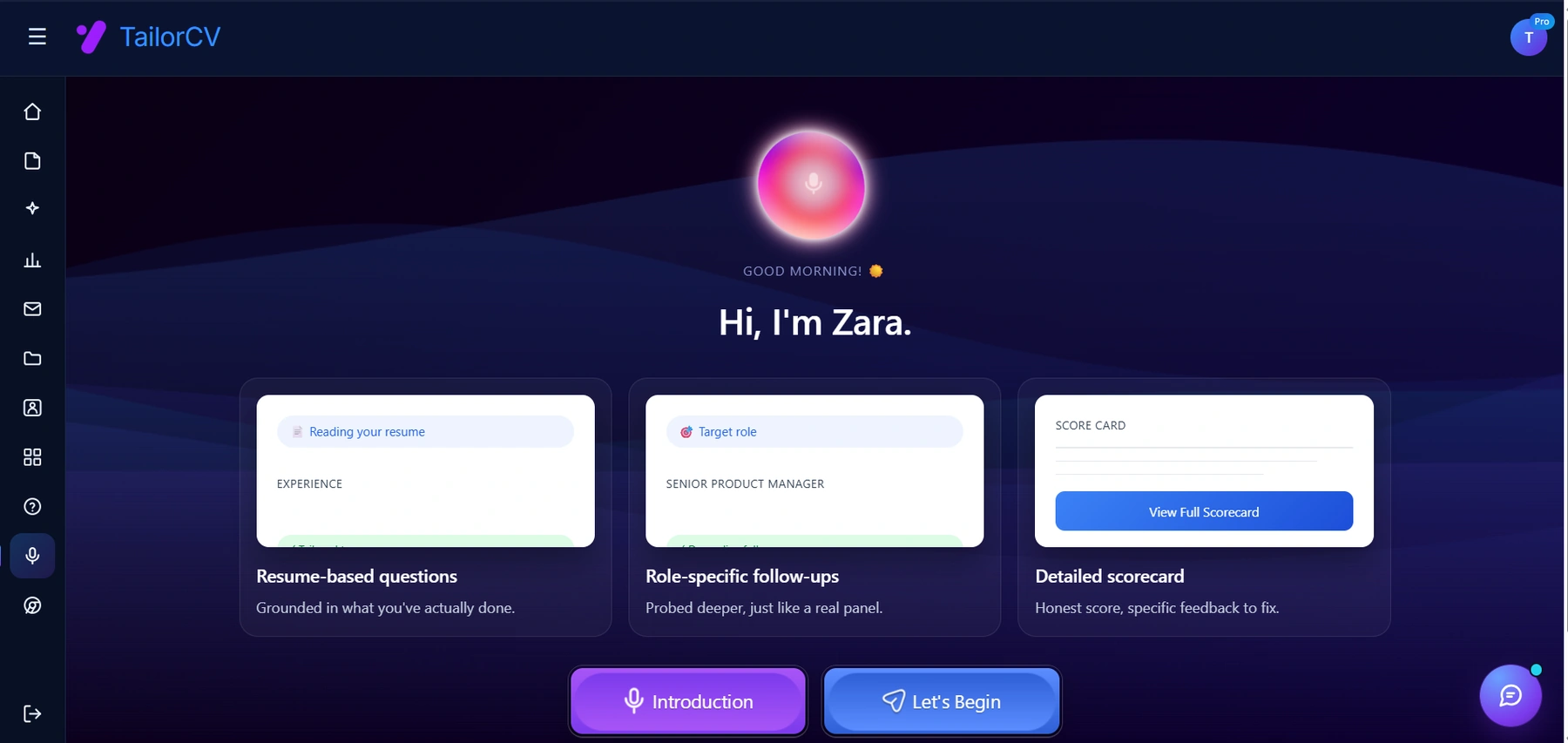
You can rehearse this before the real thing. The interviewer reads your resume first, so the questions come from your actual experience rather than a generic list.
Whiteboard interview checklist
Walk in ready to:
- unchecked: Think out loud the entire time.
- unchecked: Structure first — restate, clarify, example, approach, implement.
- unchecked: Start simple, then optimize.
- unchecked: Manage space, time, and nerves with your process as anchor.
- unchecked: Show progress even on unfamiliar problems.
Do those and you'll turn a stressful format into a showcase of how you think. Round out your process with a tailored resume, the ATS checker, and a thank-you email afterward.
Was this guide useful?
Be the first to rate it.