TD
TD
Key Takeaways
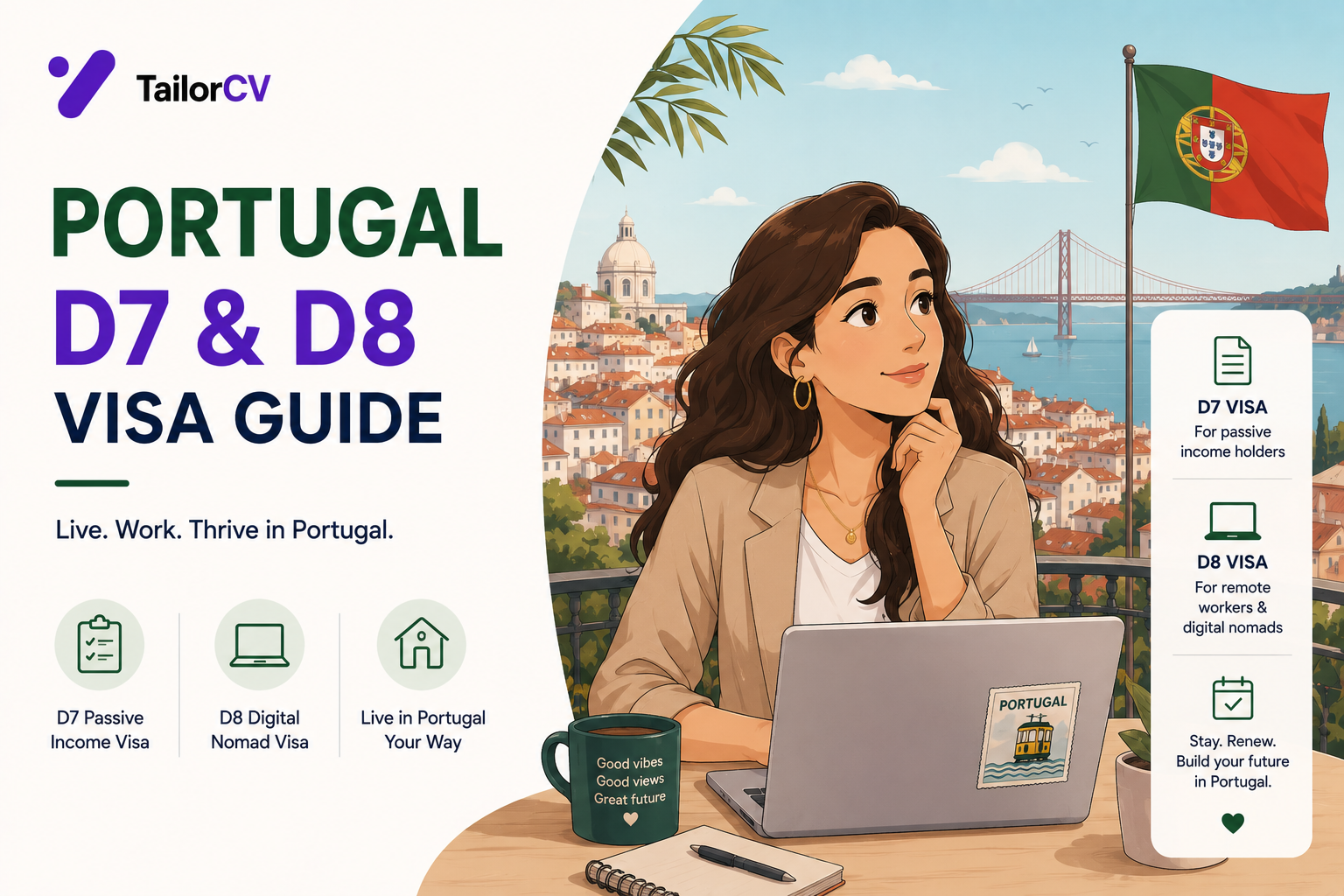
- The D7 is for people with stable passive or remote-derived income — pensions, rents, dividends, royalties.
- The D8 is the digital nomad visa, created specifically for remote workers employed by or contracting with companies outside Portugal.
- Portugal also has a job seeker visa allowing you to enter and look for work, which very few countries offer.
- Both routes lead to residence permits and eventually to permanent residence and citizenship, on a comparatively short timeline.
- AIMA replaced SEF as the immigration authority, and the transition has affected processing — plan for delays.
The three routes worth knowing
Portugal's system is unusually open, and three routes matter for most readers.
The D7 (passive income visa). Originally designed for retirees and people with independent means, it requires proof of stable, regular income from sources such as pensions, property rental, dividends, intellectual property or similar. The income threshold is tied to the Portuguese minimum wage, with additional amounts for dependants.
The D8 (digital nomad visa). Created specifically for remote workers. It covers both employees of companies outside Portugal and self-employed people with foreign clients. The income requirement is a multiple of the Portuguese minimum wage and is substantially higher than the D7's.
The job seeker visa. Portugal is one of very few countries offering a visa specifically to enter and look for work. It permits a defined period of stay to find employment, and converts if you succeed. This is genuinely unusual and under-known.
And the standard work visa (D1/D3) for people with a Portuguese job offer, with D3 covering highly qualified activity.
D7 versus D8, in practice
The distinction confuses people and it matters.
| D7 | D8 | |
|---|---|---|
| Designed for | Passive or independent income | Remote work for foreign entities |
| Income type | Pensions, rents, dividends, royalties | Employment or self-employment income |
| Income level | Lower threshold | Higher threshold |
| Work permitted | Generally allows some activity, with conditions | Explicitly for remote work |
| Typical applicant | Retiree, investor, person with independent means | Employed or freelance remote professional |
If you are a salaried remote worker, the D8 is your route. People applied under the D7 for this before the D8 existed, and it created ambiguity that the D8 was designed to resolve.
Both lead to a residence permit once you arrive, and both count toward the residence period for permanent residence and citizenship.
Both allow family reunification under defined conditions.
The tax dimension
The part that materially affects the decision.
Portugal's non-habitual resident regime was the well-known scheme offering favourable treatment to newcomers for a defined period. It was closed to new applicants, with transitional arrangements for those who qualified in time.
A successor regime aimed at scientific research and innovation activity was introduced with a narrower scope than the original NHR.
This matters enormously because a great deal of advice about Portugal online still describes the old NHR as though it were open. Check the current position rather than relying on any article, including this one.
Tax residency triggers after a defined period of presence in Portugal in a year, or by having a habitual residence there.
Get advice before arriving, not after. The sequencing of when you become tax resident, when income is received, and which regime applies is exactly the kind of thing that is easy to optimise in advance and impossible to fix afterwards.
The application process
The sequence, which differs from most European systems in a useful way.
Apply at a Portuguese consulate in your country of residence for the visa itself.
Documents typically required: passport, proof of income at the applicable threshold, proof of accommodation in Portugal, health insurance, criminal record certificate (apostilled), NIF and Portuguese bank account, and evidence of the employment or income relationship.
The visa is issued for an initial period allowing entry.
On arrival, attend an AIMA appointment to convert the visa into a residence permit. This is where the current delays bite hardest.
The residence permit is issued for a defined period and is renewable.
Renewals are applied for before expiry.
Portuguese language requirement appears at the citizenship stage rather than for residence, at a basic level.
Plan generously. Between consular processing, travel, and the AIMA appointment, the full sequence takes considerably longer than the published figures suggest.
Toward permanent residence and citizenship
Portugal's timeline is comparatively short, which is a real part of its appeal.
Permanent residence becomes available after a qualifying period of legal residence.
Citizenship by naturalisation follows a qualifying residence period plus a basic Portuguese language test at A2 level, which is a genuinely modest requirement compared with several European countries.
The residence clock counts time on these residence permits. How pre-permit periods count has been the subject of legal change, so check the current position.
Portugal permits dual citizenship, which is more generous than several neighbours.
And a Portuguese passport is an EU passport, with free movement across the union — which is the underlying reason these routes attract the interest they do.
Note that the rules have been under active revision. Portugal's residence and citizenship provisions have been amended more than once in recent years, so treat any specific period you read as needing verification.
Practical costs and preparation
What to budget and what takes longest.
Consular visa fee plus the residence permit fee on arrival.
Criminal record certificate with apostille from every country you have lived in recently — the slowest single item in most applications.
Sworn translations into Portuguese where documents are in another language.
Health insurance covering you until you are eligible for the SNS.
Proof of accommodation, which usually means a lease or a property purchase — and finding a lease before you have residence is a genuine chicken-and-egg problem that people solve with medium-term rentals.
Proof of funds at the applicable threshold, evidenced over a period rather than as a snapshot.
A Portuguese bank account and NIF, both of which are typically needed before the application rather than after.
Budget several months for the whole sequence, and more if AIMA appointment availability is poor when you arrive.
Choosing between Portugal and its alternatives
Honest comparison for someone weighing options.
Against Spain. Spain has a much larger economy and more actual jobs; Portugal has lower costs and a longer-established international community. Both have accessible remote-worker routes.
Against Greece and Cyprus, which also have digital nomad provisions — Portugal has the larger technology sector and the better-known ecosystem.
Against Estonia, which has its own digital nomad visa and e-Residency — Estonia is better for company formation and administration; Portugal for climate and community.
On citizenship timeline, Portugal is among the shorter routes in Europe with a modest language requirement, which is a genuine long-term advantage.
On tax, the closure of the original NHR regime removed much of Portugal's headline advantage, and this is the single biggest change to the Portuguese proposition in recent years.
The summary: Portugal remains excellent for quality of life, community and a route to an EU passport, and it is no longer the tax arbitrage it was widely marketed as.
Family and dependants
The questions that follow approval.
Family reunification is available on both routes for spouses, partners, dependent children and in some cases dependent parents.
Income thresholds increase with each additional family member, and the figures are tied to the Portuguese minimum wage.
Family members generally receive residence permits with the right to work and to access public services.
Schooling is free and public, taught in Portuguese, with support for newcomers, and international schools exist in Lisbon, Porto and the Algarve at a cost.
Healthcare access follows SNS registration once resident.
Children's residence time counts toward their own citizenship eligibility, and children born in Portugal to legally resident parents have their own provisions worth understanding.
Verify with AIMA for your specific combination. Family provisions are the part of any immigration system that changes most frequently, and Portugal's rules have been under active revision.
Mini checklist
- unchecked: Route identified — D7, D8, job seeker or work visa
- unchecked: Income threshold verified against current figures
- unchecked: Income type matched to the correct route
- unchecked: NIF obtained — required before most steps
- unchecked: Portuguese bank account opened
- unchecked: Accommodation evidence prepared
- unchecked: Health insurance arranged
- unchecked: Criminal record certificate apostilled
- unchecked: Tax position discussed with a professional before arriving
- unchecked: AIMA processing delays factored into your timeline
Scenarios
Scenario 1: You are employed remotely by a company abroad
The D8 is your route. It was created for exactly this, the income requirement is a multiple of the Portuguese minimum wage, and you will need evidence of the employment relationship and its duration.
Scenario 2: Your income is from investments or property
The D7, which has a lower threshold and is designed for stable passive income rather than active work.
Scenario 3: You want to move first and find work after
Portugal's job seeker visa is one of the very few in the world that permits this, and almost nobody knows it exists. It gives a defined period to find employment and convert.
Tip: Get your NIF — the Portuguese tax number — before almost anything else. A bank account, a lease and most of the visa process depend on it, and it is the single most common bottleneck people hit in the first weeks.
Do's and Don'ts
Do
- Match your income type to the right route
- Verify thresholds against current official figures
- Get a NIF early
- Consider the job seeker visa if you have no offer
- Take tax advice before arriving
- Plan for AIMA processing delays
Don't
- Apply under the D7 for salaried remote work
- Rely on articles describing the old NHR regime as open
- Underestimate AIMA appointment waiting times
- Arrive and then think about tax residency
- Assume the D8 threshold matches the D7's
- Leave document apostilles until late
Common Mistakes
- Wrong route. Salaried remote workers belong on the D8, not the D7.
- Outdated tax advice. The original NHR regime closed to new applicants and much online advice has not caught up.
- No NIF. It blocks the bank account, the lease and most of the process.
- Underestimating AIMA delays. The transition from SEF affected processing and appointments.
- Late tax planning. Sequencing matters and cannot be fixed retrospectively.
- Missing the job seeker visa. Genuinely unusual and almost unknown.
Related Guides
Keep building on this with the related guides in this series:
- Working in Portugal as an International Graduate
- Lisbon and Porto's Technology Scene
- Spanish Work Visas and the Digital Nomad Route
- Italian Work Visas and the Nulla Osta
- The EU Blue Card for Graduates
You can also check your resume's ATS score for free, generate a tailored cover letter, or build a portfolio website in minutes.
Frequently Asked Questions
What is the difference between the D7 and D8?
The D7 is for stable passive income — pensions, rents, dividends. The D8 is for remote workers employed by or contracting with companies outside Portugal, with a higher income threshold.
Can I move to Portugal to look for work?
Yes. Portugal offers a job seeker visa permitting a defined period of stay to find employment, which is genuinely unusual internationally and widely unknown.
Is the NHR tax regime still available?
The original non-habitual resident regime closed to new applicants, with transitional arrangements. A narrower successor exists for research and innovation activity. Verify the current position.
What is AIMA?
The agency that replaced SEF as Portugal's immigration authority. The transition affected processing times and appointment availability, so plan your timeline generously.
What is a NIF and when do I need it?
The Portuguese tax number. A bank account, a lease and most of the immigration process depend on it, so obtain it as early as possible.
Do these visas lead to citizenship?
Both count toward the residence period for permanent residence and eventually citizenship, on a comparatively short timeline by European standards.
How long until I can apply for Portuguese citizenship?
After a qualifying residence period plus a basic A2 Portuguese language test — a comparatively short and modest requirement by European standards, though the rules have been under active revision.
Does Portugal allow dual citizenship?
Yes, which is more generous than several European neighbours and part of why these routes attract the interest they do.
What takes longest in a Portuguese visa application?
Obtaining apostilled criminal record certificates from every country you have recently lived in, followed by sworn translations and finding proof of accommodation before you have residence.
How does Portugal compare to Spain for remote workers?
Spain has a larger economy and more jobs; Portugal has lower costs, a longer-established international community and a shorter citizenship timeline with a modest language requirement.
Can my family join me on a D7 or D8?
Yes, for spouses, partners and dependent children, with the income threshold increasing per family member. Family members generally receive permits with the right to work.
What is your resume scoring right now?
Scan it against a job description and get your ATS match score in about a minute.
Drop your resume here or choose a file
PDF only. Max 2 MB.
We never share your data or use it to train AI models.

Was this guide useful?
Be the first to rate it.