TD
TD
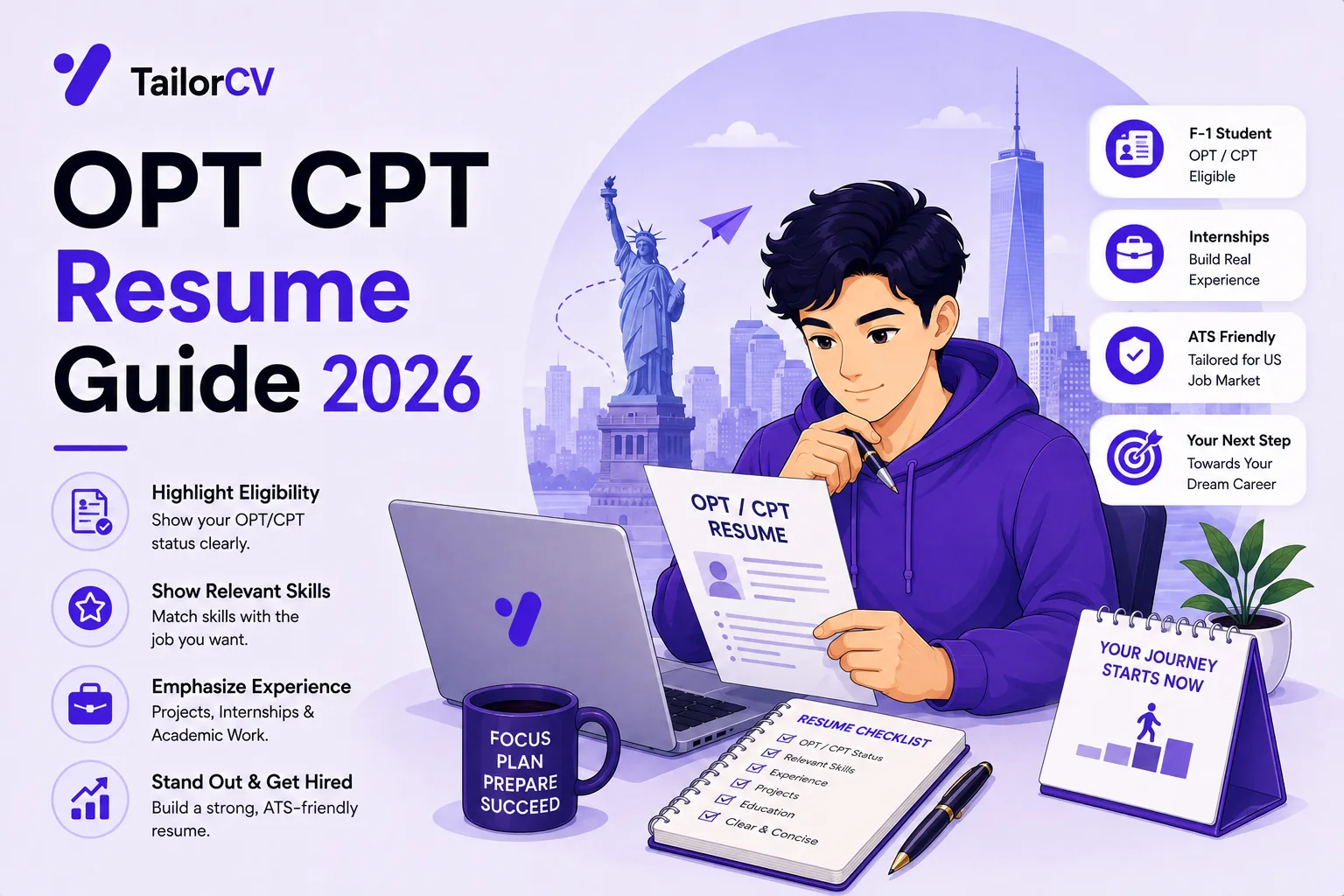
Key Takeaways
- On OPT you can work for employers who do not sponsor, which is the single most useful fact in an international student's job search.
- State your work authorisation positively - "authorized to work through May 2029, no sponsorship required until then" beats silence or vagueness.
- STEM OPT roughly triples your runway and gives you multiple H-1B lottery cycles, so eligibility is worth confirming early.
- Apply months before graduation, because US hiring timelines and OPT application processing both take longer than students expect.
- CPT internships are the strongest route to a full-time offer, since converting an intern is far easier than sponsoring a stranger.
International students in the US occupy an unusual position: you have legal work authorisation that costs employers nothing, and most of you present it as though it were a liability.
That framing error costs interviews. An employer reading "requires visa sponsorship" sees cost and uncertainty. An employer reading "authorized to work in the US through May 2029" sees someone they can hire immediately, with the sponsorship question years away.
Both can describe the same student. The difference is presentation and timing.
This guide covers how to present your status, how to time your search around the deadlines, and how to answer the sponsorship question in a way that keeps you in the process.
Start with the document itself - run your resume through the free ATS score checker.
Understanding What You Actually Have
Be precise about your own status, because vagueness in interviews reads as not knowing your own situation.
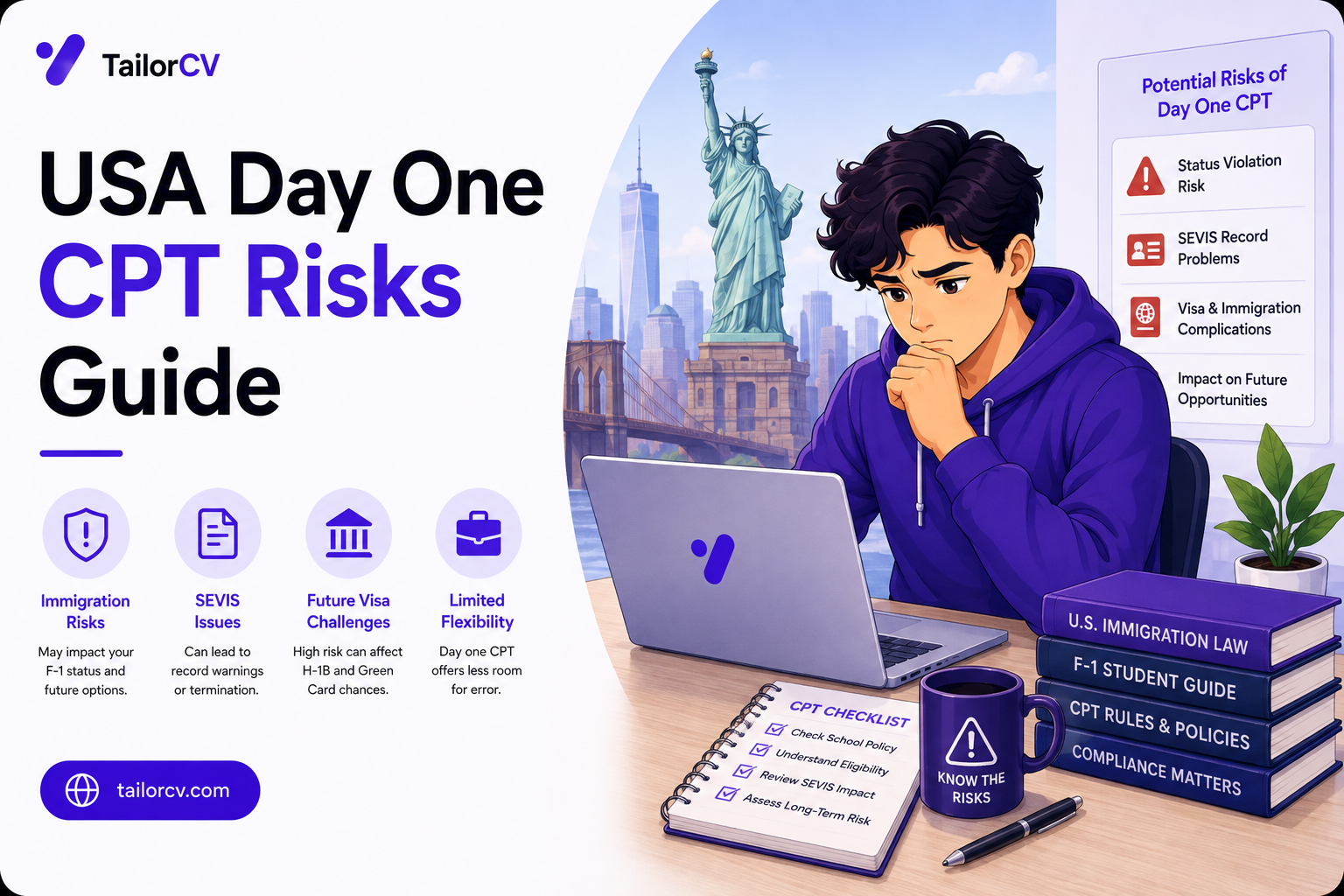
CPT (Curricular Practical Training) authorises work that is an integral part of your curriculum - typically internships during your programme. Authorised by your school's designated official, tied to a specific employer and period.
OPT (Optional Practical Training) provides a period of work authorisation related to your field of study, most commonly used after graduation. Typically 12 months.
STEM OPT extension adds a further period for eligible STEM degrees where the employer is enrolled in E-Verify, giving you substantially longer overall. This matters enormously because it means multiple H-1B lottery cycles rather than one.
The critical point: during OPT you are authorised to work without employer sponsorship. The employer files nothing and pays nothing for your work authorisation. Many recruiters do not fully understand this, which is why stating it clearly is your job.
A note on accuracy: rules, timelines, and eligibility change. Confirm everything with your school's international student office and official USCIS guidance rather than relying on any summary.
How to State It on Your Resume
Put it where a recruiter will see it - the contact line, or the end of your summary. One line.
If you are currently on OPT or approved:
Authorized to work in the US through May 2029 (OPT/STEM OPT). No sponsorship required until then.
If you are a student applying for internships:
F-1 student, eligible for CPT. No sponsorship required.
If you are graduating and will apply for OPT:
F-1 student graduating May 2027; eligible for 12 months OPT plus 24-month STEM extension. No sponsorship required until 2030.
What each of these does: converts an unknown into a known, and leads with the part that costs the employer nothing. It also gives a specific date, which reads as someone who understands their own situation.
What not to do:
- Say nothing and hope it does not come up. It always comes up, usually on the application form.
- Write "requires sponsorship" without qualification, when you have years of authorisation first.
- Overstate. Do not claim authorisation you do not have; it will be verified.
Building the Rest of the Resume
Beyond the status line, the US conventions apply and international students frequently miss them.
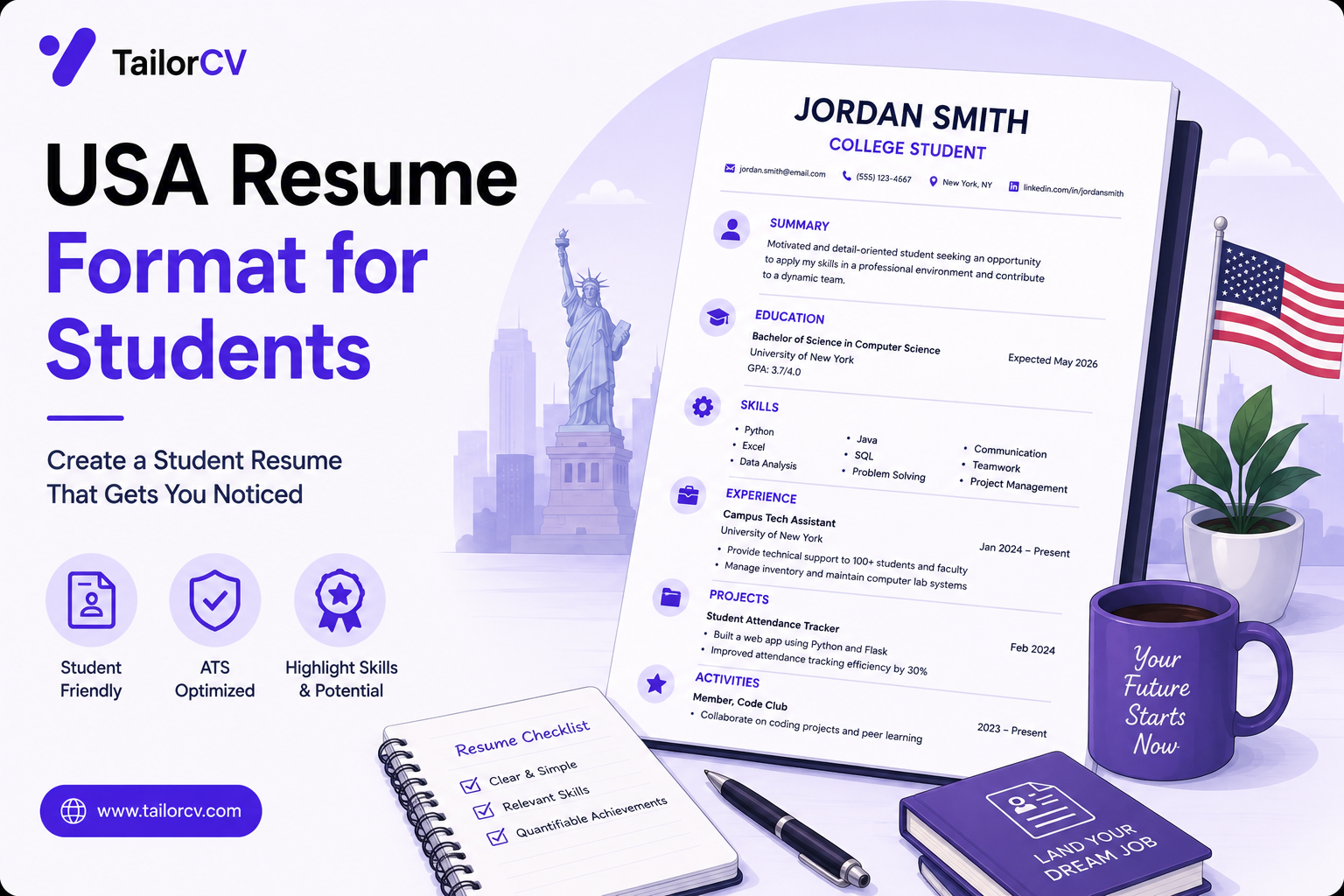
One page. Firmly, for a student. Two-page student resumes read as padding in the US.
No photo, no date of birth, no nationality, no marital status. These are actively avoided in the US and their presence marks the resume as foreign.
Quantify heavily. American resume culture expects numbers - this is more pronounced than in most markets and it is the biggest single content difference. See how to quantify achievements on your resume.
US spelling and date formats. Organize, analyze, optimize. Month/year dates.
Lead with what is relevant, not chronological habit. For a student, projects and internships often belong above coursework.
Explain your prior institutions briefly. A US recruiter may not know your undergraduate university abroad. One clause of context helps.
Include your US address if you have one - it signals you are already in the country, which matters.
Full formatting in the US resume format guide, keyword strategy in the best resume keywords for the USA, and the broader international angle in resume for international candidates in the USA.
Timing: Start Earlier Than You Think
The most common practical failure is starting too late, and the timelines compound.
For CPT internships: many US internship programmes recruit in the autumn for the following summer, particularly at larger employers. Applying in March for a June internship means most positions are gone.
For post-graduation OPT: the OPT application itself must be filed within a defined window relative to your programme end date, and processing takes time. Your school's international office will tell you the exact dates - ask early, not in your final semester.
For the job search: US hiring processes routinely take four to eight weeks from application to offer, sometimes longer. Working backwards from a May graduation, applications should be going out in the preceding autumn and winter.
For the H-1B cycle: registration is typically in March for an October start. If you graduate in May, you have already missed that cycle - which is precisely why OPT matters. It bridges you to the next one. The cycle mechanics are in the H-1B visa job search guide.
There is also an unemployment limit during OPT - a maximum number of days you may be unemployed before your status is affected. Confirm the current limit with your international office and treat it as a hard deadline.
Answering the Sponsorship Question
Almost every US application form asks two questions:
- "Are you legally authorized to work in the United States?"
- "Will you now or in the future require sponsorship for employment visa status?"
Answer both honestly. Misrepresentation on employment paperwork carries consequences far beyond a rejection.
For most students on OPT, the honest answers are "yes" and "yes" - authorised now, sponsorship needed later. That combination worries recruiters who do not read further.
So add context wherever the form allows free text, and certainly in your resume and cover letter:
I am currently authorized to work in the US through May 2029 under STEM OPT and would not require sponsorship before then.
In interviews, be equally direct. A recruiter asking about your status is doing their job, and a clear, confident answer with specific dates reads far better than hesitation. Practise saying it out loud - it comes up in nearly every first call.
CPT Internships Are Your Strongest Route
If there is one strategic point in this guide, it is this.
Converting an intern into a full-time hire is dramatically easier for an employer than hiring an unknown international candidate. They have watched you work for three months. The risk is gone. And when the sponsorship question eventually arrives, they are deciding about someone they know rather than a resume.
Which means:
- Prioritise internships during your programme, even unpaid or modestly paid ones
- Target employers with H-1B filing history, so the eventual conversation is possible - the data is public and searchable
- Treat the internship as an extended interview, because it is
How to run an internship so it converts is covered in converting an internship into a PPO, and the general internship resume in the internship resume guide.
Targeting Employers
Employers with sponsorship history. Public H-1B disclosure data is searchable by employer, role, year, and location. Prioritise employers who have actually filed.
E-Verify employers, if you are counting on STEM OPT - the extension requires the employer to be enrolled.
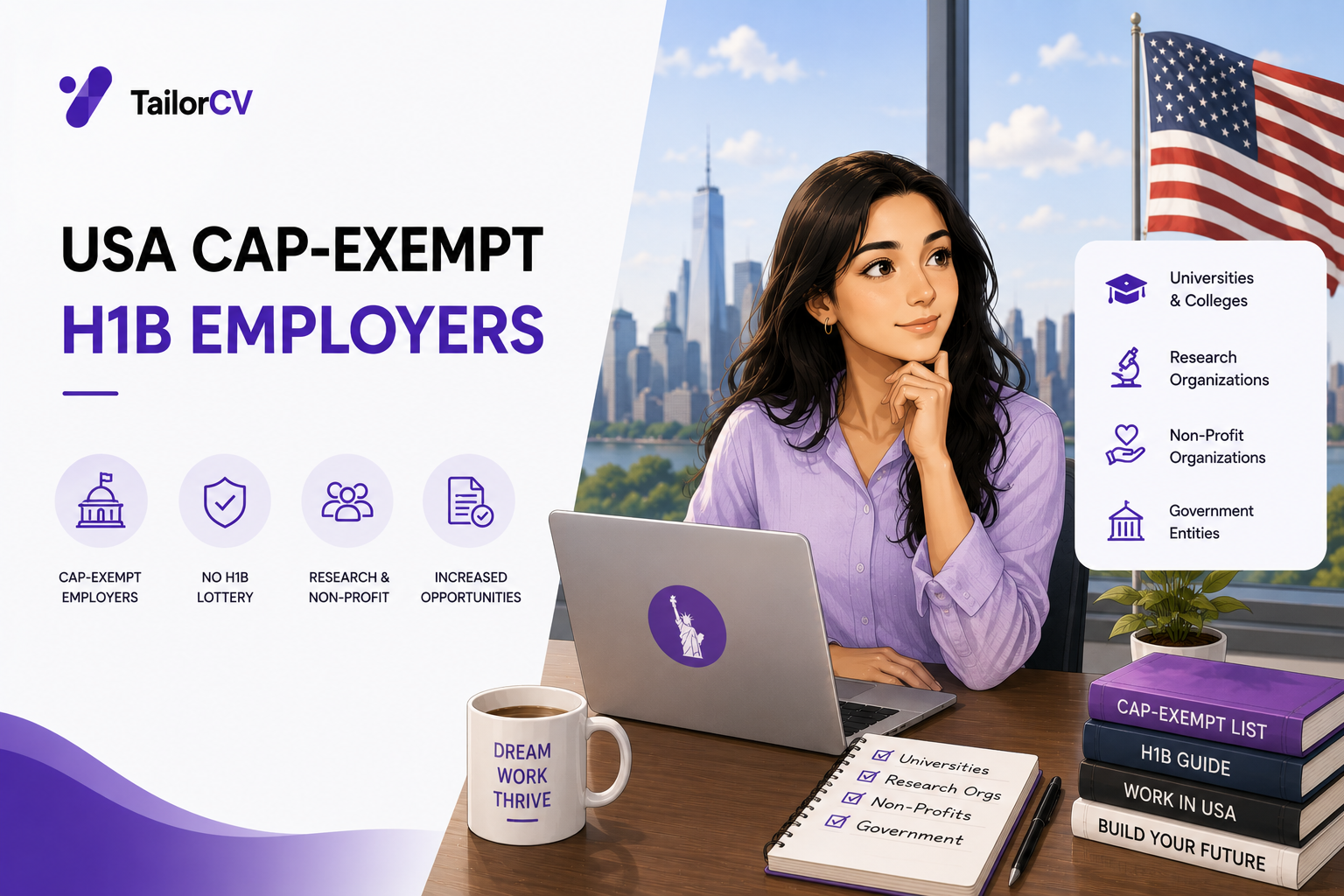
Cap-exempt organisations - universities, affiliated non-profits, research institutions. These avoid the H-1B lottery entirely and consistently go overlooked by students.
Larger employers, generally, since they have established immigration processes.
Avoid roles requiring citizenship or security clearance, which are closed regardless of your qualifications.
Where to find these is in the best job sites in the USA, and the wider strategy in how to get a job in the USA as an international candidate.
Common Mistakes
Leading with "requires sponsorship." True eventually, misleading now, and it stops recruiters reading.
Saying nothing about status. The form asks anyway, and ambiguity is read unfavourably.
Starting the search in the final semester. US hiring timelines and OPT processing both take months.
Not knowing your own dates. Vagueness in interviews suggests you have not managed your situation.
Skipping internships. The single strongest route to a full-time offer.
Applying only to companies with no filing history. Even if they hire you on OPT, the conversation ends when OPT does.
A two-page resume with a photo. Marks the application as foreign.
Ignoring the unemployment day limit during OPT.
Not confirming STEM eligibility early. It changes your runway substantially and is worth knowing in advance.
Frequently Asked Questions
Do employers need to sponsor me during OPT?
No. OPT is your own work authorisation - the employer files nothing and pays nothing for it. This is the most important thing to communicate, because many recruiters do not realise it.
Should I mention OPT on my resume?
Yes, stated positively with dates - "Authorized to work in the US through May 2029" - rather than framed as a future sponsorship requirement.
What is the difference between CPT and OPT?
CPT authorises work that is an integral part of your curriculum, typically during your programme. OPT is work authorisation related to your field of study, most commonly used after graduation.
How long does STEM OPT last?
The STEM extension adds a further period beyond the initial OPT for eligible degrees where the employer is enrolled in E-Verify, giving substantially longer overall. Confirm current durations and eligibility with your international student office.
When should I start applying for jobs?
Months before graduation - autumn and winter for a spring graduation. US processes take four to eight weeks, and internship recruiting for the following summer often happens the previous autumn.
Can I work for any employer on OPT?
The work must be related to your field of study, and STEM OPT adds requirements including E-Verify enrolment and a formal training plan. Your international student office is the authority on what qualifies.
What happens when OPT ends?
You need another status - most commonly H-1B, which is why the lottery cycle timing matters. Some people move to a different visa category, change to another student status, or work for a US employer from abroad.
Make sure your resume reads as American and states your status clearly. Check your ATS score free.
Make This Practical
Rewrite your work authorisation line today, before anything else. Replace silence or "requires sponsorship" with a positive, dated statement - "Authorized to work in the US through May 2029, no sponsorship required until then" - and put it on the contact line where a recruiter cannot miss it.
Then get your timeline straight. Confirm your STEM eligibility, your OPT filing window, and the unemployment day limit with your international student office now rather than in your final semester, and work backwards from graduation to set your application start date - autumn for a spring graduation.
Finally, prioritise internships and target employers who have actually sponsored. Converting an intern is far easier for an employer than hiring an unknown, and public H-1B disclosure data tells you which companies have a working process. Format the resume to US convention with the US resume format guide, run it through the free ATS score checker, and plan the lottery cycle using the H-1B visa job search guide.
Find out where a fresher resume stands
Score yours against a real posting - no account, no cost.
Drop your resume here or choose a file
PDF only. Max 2 MB.
We never share your data or use it to train AI models.

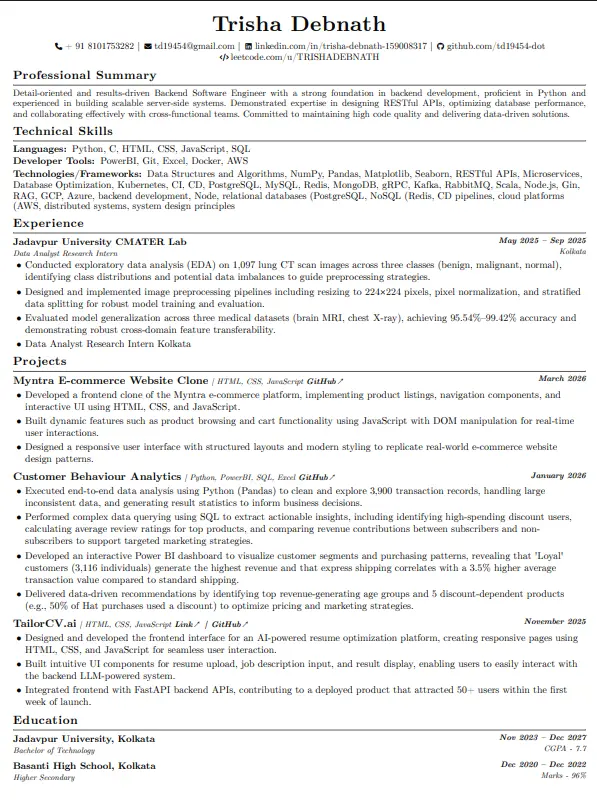
A layout that works with a short history
Leads with skills and projects instead of years of experience you do not have yet.
Was this guide useful?
Be the first to rate it.