 TD
TD
Key Takeaways
- Every employee in the US completes an I-9, citizens and non-citizens alike — it is a universal requirement, not a signal aimed at any one group.
- There is a strict timeline: the form must be completed within three business days of your start date, and the documents you present must be originals.
- A specific, limited list of acceptable document combinations exists, and knowing yours in advance prevents a scramble in week one.
- E-Verify is a separate, additional system some employers use, distinct from the I-9 itself, and it matters more for certain visa categories.
- Preparing your documents before your start date removes nearly all of the risk in this process.
What the I-9 actually is
A form every employer in the US is legally required to have every new employee complete, confirming identity and authorization to work. It applies universally — a US citizen born and raised in the country completes exactly the same form as an international employee on a work visa. This is worth stating plainly, because international students sometimes experience the process with more anxiety than it warrants, assuming it is somehow targeted at their situation specifically. It is not; it is a standard step for every hire, everywhere.
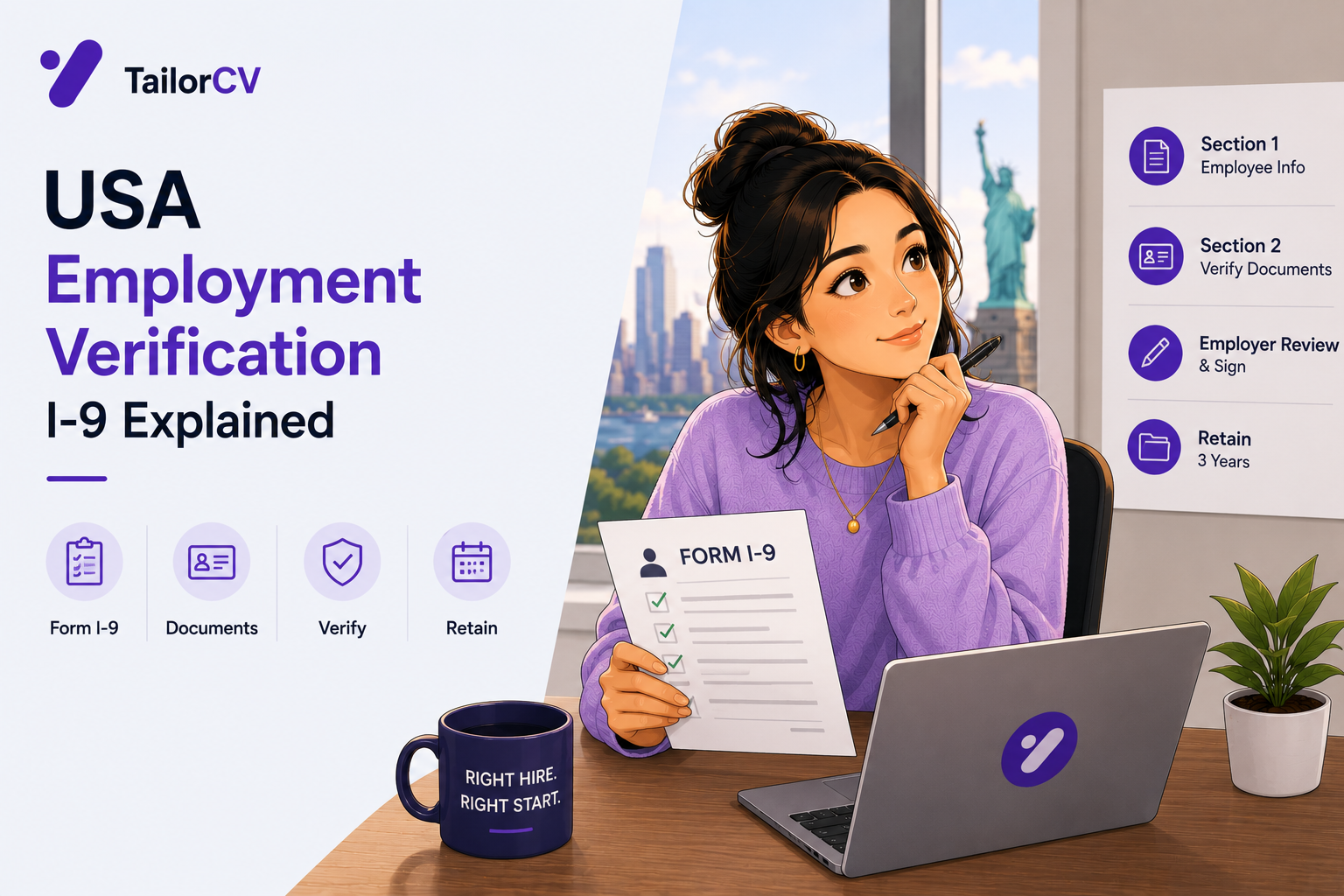
The timeline is strict. Section one, which you complete, is generally required by your first day of work. Section two, where your employer examines your documents, must be completed within three business days of your start date. This is a hard deadline with real consequences if missed, which is why preparation matters.
What happens if the deadline is missed. Employers are required to follow up, and in some cases continued employment can be affected until it is resolved. This is rare in practice because most employers manage the process carefully, but it is entirely avoidable by having your documents ready from day one.
The documents, and how to think about them
The form organizes acceptable documents into lists, and you need to present either one document from a specific list that establishes both identity and work authorization together, or one document from each of two other lists — one establishing identity, one establishing work authorization separately.
The single-document route is generally the simplest where it applies, because it satisfies both requirements with one item rather than requiring you to locate two separate documents.
The two-document route requires one item proving who you are and a separate item proving your authorization to work, and the combination has to be from the correct lists.
Photocopies are not accepted. Original documents, or in specific limited cases a certified copy, are required — this catches people who assume a scan or a copy will do, and it does not.
Expired documents are generally not accepted, with narrow exceptions. Check expiration dates on anything you plan to present well before your start date, not the morning of.
What this means practically: identify exactly which documents you will present before your first day, confirm they are current, and have the originals physically with you or ready to bring in during your first few days. This alone eliminates nearly all the risk in the process.
For international employees specifically
Your work authorization document is central, and its specific type depends on your status — different categories of employment authorization are documented differently, and the relevant one for you should be confirmed with your international student office or immigration advisor before you assume you know which applies.
Bring the actual document, not a description of your status. "I am authorized to work under my training period" is not something an employer's HR team can verify without seeing the specific document itself.
If your authorization document has an expiration date, understand what it means for your employment. Some employers track this and will need updated documentation closer to that date; understanding this in advance prevents an awkward conversation later.
A name mismatch between documents is a common and fixable snag. If your passport, your authorization document and your other identification show your name slightly differently — a middle name included in one and not another, for instance — resolve this before your start date if you can, or be ready to explain it clearly, since it is a common and generally minor issue that HR teams see regularly.
E-Verify, and how it differs from the I-9
A related but separate system, worth understanding because it is frequently confused with the I-9 itself.
The I-9 is a form every employer must complete for every hire. E-Verify is an additional, separate system some employers use to electronically confirm the information against government records. Not every employer uses it — participation varies, and some states or types of employers are required to use it while others are not.
Why this matters for you. Whether an employer is enrolled in E-Verify is directly relevant if you are relying on certain work authorization extensions, where enrollment is one of the specific requirements. This is worth confirming with a prospective employer before accepting an offer if it applies to your situation, rather than assuming and discovering otherwise after you start.
It does not make the process harder for you personally if the documents you present are genuine and current — it simply means the employer's verification step includes an additional electronic check rather than relying on visual document review alone.
Preparing before your start date
- Confirm exactly which documents you will present, using the official list rather than guessing, and note their expiration dates.
- Gather the originals now, not the week before you start. If a document needs to be renewed or requested, that process can take time, and discovering a passport has expired three days before a start date is an entirely avoidable problem.
- If you are an international employee, confirm with your international office which document specifically represents your current status — this is not something to assume based on general knowledge of visa categories, since the specific paperwork varies.
- Resolve any name inconsistencies across your documents in advance where possible.
- Ask your new employer's HR contact what specifically they will need, since some provide a checklist proactively and others expect you to know — asking costs nothing and prevents a first-week scramble.
- Keep copies of everything for your own records, separate from what you hand over to the employer, following the same record-keeping discipline that matters for any work authorization — you will likely need to reference these details again for future paperwork.
What HR is actually doing, and why it feels formal
Understanding the other side removes most of the anxiety from this process.
Your employer has a legal obligation, and it is theirs rather than yours. They must examine your documents, record specific details, and retain the form for a defined period. The formality is compliance with a legal requirement, not scepticism about you personally.
They are required to accept any valid document from the official list. An employer cannot demand a specific document, or insist on more documentation than the form requires, or treat employees differently based on citizenship or national origin. If something feels wrong in how the process is being conducted, that instinct is worth taking seriously.
They are not immigration experts. The person completing the form is usually an HR generalist following a checklist. If your situation is unusual, explaining it clearly and calmly, with the relevant document in hand, works far better than assuming they will recognise your category from a description.
Errors get corrected rather than concealed. If something is filled in wrong, the correct response is to fix it properly with a note, which HR teams do routinely.
Nothing about this determines your employment on its own. Presenting valid documents within the window completes the process, and it is genuinely routine — hundreds of thousands of people complete this form every week without incident.
A pre-start checklist
Ten minutes, done a week before your start date, and it removes essentially all of the risk in this process.
- unchecked: Identify exactly which document or combination you will present, from the official list rather than from memory
- unchecked: Check every expiration date on those documents
- unchecked: Locate the physical originals and put them somewhere you will not have to search for on your first morning
- unchecked: If you are an international employee, confirm with your international office which specific document represents your current authorization
- unchecked: Check whether your name appears consistently across the documents you plan to present
- unchecked: Email your HR contact asking what they will need on day one, and whether anything should be sent in advance
- unchecked: Ask whether the employer uses E-Verify, if that matters for your authorization extension
- unchecked: Photograph or scan everything for your own records, stored somewhere you control
- unchecked: Note the three-business-day deadline in your calendar so it is not a surprise
- unchecked: Bring the originals on your first day, not the second — the deadline is short and the buffer is worth having
None of this is difficult. All of it is much harder to do in a rush during your first week while also learning a new job.
Why this matters more for some people than others
Worth being direct about, because the process is genuinely routine for most people and genuinely consequential for a smaller group.
For a US citizen with a current passport or standard identification, this is fifteen minutes of paperwork and nothing more. The advice in this article amounts to: bring the originals.
For an international employee, the stakes are higher. Your ability to work depends on a document with an expiration date, your employer's willingness to support future authorization depends on questions worth asking before you accept, and errors in this paperwork can compound into problems in applications years later.
For someone whose authorization is transitioning — moving between categories, awaiting a document, or approaching an expiration — this is the moment where an unclear situation becomes visible. Getting advice from your international office before your start date, rather than improvising at the HR desk, is the difference between a routine form and a genuine problem.
For anyone whose documents show inconsistent details, this is where it surfaces, and it is much easier to resolve in advance than under a three-day deadline.
The practical takeaway: if you are in the first group, prepare lightly and move on. If you are in any of the others, treat this as one of the specific administrative items worth handling deliberately before your first day, alongside the broader documentation discipline that pays off repeatedly over an international career.
Keeping your own copies
A small habit with disproportionate value later, and one almost nobody establishes at their first job.
Photograph or scan every document you present, before you hand anything over, and store it somewhere you control — not only in an employer system you lose access to on your last day.
Keep a note of what you presented and when. Which documents, which date, which employer.
Keep every authorization document you have ever held, including expired ones. Future applications frequently ask for a complete history, and expired documents are the hardest thing to reconstruct.
Keep your employer's details as recorded, including the legal entity name, which is sometimes different from the brand name and is what appears on official paperwork.
Store it outside a university or employer account. Both disappear, usually at the least convenient moment.
Why this matters. Immigration and employment paperwork years from now will ask for details nobody remembers — exact dates, exact titles, exact document numbers. Ten minutes of filing at each job removes an entire category of future difficulty, and it is the same discipline that pays off across an international career generally.
The wider first-week paperwork
The I-9 is one of several forms in your first days, and knowing what else is coming prevents a scramble.
Tax withholding forms. You will complete a form determining how much tax is withheld from each paycheck. Filling this in carelessly produces an incorrect withholding all year, which either overcharges you or leaves you with an unexpected bill. Take the ten minutes to complete it thoughtfully.
Direct deposit authorization. Your bank details for payroll. This requires an account, which for someone who has just relocated may not exist yet — one more reason the order of operations after a move matters.
Benefits enrollment. Time-limited, and covered in full in the benefits guide. Do not defer it.
Emergency contact and personal details.
Confidentiality, IP assignment and policy acknowledgements. Worth actually reading, particularly any clause about work you do outside the job if you maintain side projects.
A background check authorization at many employers, which is separate from the I-9 and verifies employment history, education and sometimes more. Everything you claimed should survive it, which is why accuracy on the resume matters at exactly this moment.
Keep a copy of everything you sign, in a folder you control rather than only in an employer system you may lose access to.
Tip: Gather your I-9 documents before your start date. The form must be completed within three business days of starting, and scrambling for original documents in week one is entirely avoidable.
Common Mistakes
- Assuming the I-9 is specific to non-citizens. It applies to every employee, universally, with no exception.
- Bringing photocopies instead of originals. Photocopies are not accepted in the standard process.
- Not checking document expiration dates in advance. Not checking document expiration dates in advance an expired document discovered on day one causes an entirely avoidable delay.
- Confusing E-Verify with the I-9 itself. They are related but distinct, and not every employer uses the former.
- Ignoring a name mismatch across documents. Ignoring a name mismatch across documents a common, fixable issue that becomes a bigger problem if raised for the first time on your start date.
- Waiting until the first day to think. Every part of this process can and should be prepared for in advance.
Related Guides
Keep building on this with the related guides in this series:
- 401(k) and Benefits Explained for New Graduates
- US Background Checks - What Employers Actually See
- Cap-Exempt H-1B Employers - The Route Around the Lottery
- Community College Transfer Students - Building a Career Strategy That Works
- US Data Science New Grad Hiring - The Roles, the Loop and the Preparation
- Day-One CPT - What It Is and Why It Carries Real Risk
You can also check your resume's ATS score for free, generate a tailored cover letter, or build a portfolio website in minutes.
Frequently Asked Questions
What if I am starting before my authorization document arrives?
Speak to your employer's HR contact and your international office immediately, before your start date if possible. There are established ways this is handled and none of them work well if raised for the first time on day three.
Does completing an I-9 mean my employer knows my immigration status?
They see the document you present, which necessarily indicates your work authorization category. This is a required part of the process and is confidential employment information — it is not something they may use to treat you differently.
Will I need to do this again if I change jobs?
Yes. Every new employer completes a new I-9 for every new hire, so the preparation described here applies each time you move.
What if my employer asks for a specific document I do not have?
Employers must accept any valid document or combination from the official list and cannot demand a particular one. If this happens, it is worth raising politely and referring to the list itself, since it is usually a misunderstanding by someone following an internal habit rather than the rule.
Can I complete any of this before my first day?
Section one is frequently available to complete in advance through an onboarding portal, and some employers encourage it. The document examination generally needs to happen in person or through an authorised representative, so ask what your employer's process is rather than assuming.
What if I lose a document before starting?
Report it and begin the replacement process immediately, and tell your employer's HR contact as soon as you know. Replacement timelines vary and starting early is the only thing that helps.
Does this process differ for a remote role?
The requirement is the same; the mechanics differ. Employers use authorised representatives or specific remote procedures to examine documents, and your HR contact will tell you which applies. It is not a reason the form can be skipped.
Does every employee really need to complete this, even US citizens?
Yes, without exception. It is a universal requirement for every employer and every new hire, regardless of citizenship or immigration status.
What if I do not have my documents ready by day three?
Speak to your employer's HR contact immediately and honestly. Most have seen this before and can advise on next steps, but missing the deadline can affect your employment status, so this should be addressed proactively rather than left unresolved.
Can I use a copy of my passport instead of the original?
Generally no. Original documents, or in narrow specified cases a certified copy, are required — a standard photocopy or a photo on your phone is not sufficient.
What is the difference between the I-9 and E-Verify?
The I-9 is a form every employer completes for every employee. E-Verify is a separate, optional-for-many electronic system some employers use as an additional check against government records, and enrollment matters specifically for certain work authorization extensions.
My documents show my name slightly differently across them — is this a problem?
It is a common issue and usually resolvable, but it is far better addressed before your start date than discovered during the verification window. Speak with your international office or HR contact if this applies to you.
Should I ask my employer what documents they need before I start?
Yes, and most employers welcome the question. It demonstrates preparation and prevents a rushed or incomplete first week.
What is your resume scoring right now?
Scan it against a job description and get your ATS match score in about a minute.
Drop your resume here or choose a file
PDF only. Max 2 MB.
We never share your data or use it to train AI models.

Was this guide useful?
Be the first to rate it.