 SS
SS
Key Takeaways
- Whether a separate cover letter is expected depends on the employer — common at global/English roles, less so at traditional firms (where motivation lives in the rirekisho).
- The tone Japanese employers value is sincere, humble, respectful, and specific to their company.
- Your motivation (shibō dōki) — why this company — is the heart of any Japanese application.
- Emphasise commitment, teamwork, and long-term fit, not just individual achievement.
- Keep it concise, polished, and tailored to each role.
The cover letter's role in Japan depends heavily on the employer. Traditional Japanese hiring centres on the rirekisho and shokumu-keirekisho, where your motivation is expressed in the shibō dōki (motivation) section rather than a separate letter. But at global companies, tech firms, and international roles — the ones many foreigners target — a Western-style cover letter is often expected, and a strong one can set you apart. Either way, the tone that wins in Japan is consistent: sincere, respectful, specific to the company, and focused on long-term commitment.
This guide explains how to write a cover letter for jobs in Japan in 2026: when it's needed, how to structure it, the tone to strike, and how foreigners can make a respectful, compelling case.
Do You Need a Cover Letter in Japan?
- Traditional Japanese companies: typically rely on the rirekisho + shokumu-keirekisho. Your motivation is expressed in the rirekisho's shibō dōki section rather than a separate cover letter — see the Japanese resume guide.
- Global companies, tech firms, startups, international roles: frequently expect (or welcome) a Western-style English cover letter alongside your resume.
If a posting requests a cover letter, always include one. If it's optional at a global employer, a strong letter is usually worth it. For the wider picture, see how to get a job in Japan as a foreigner.
The Tone That Wins in Japan
Across formats, Japanese employers respond to:
- Sincerity and humility: genuine, modest, and respectful — avoid boasting.
- Specific motivation: a clear, well-researched reason for wanting this company.
- Commitment and long-term thinking: signal you want to grow with the company, not just take a job.
- Teamwork and harmony: frame your value in terms of contributing to the group.
- Politeness and formality: respectful, professional language throughout.
This tone applies whether you're writing a separate cover letter or the shibō dōki section.
How to Structure an English Cover Letter for Japan
For global and English-language roles, use a clean, professional structure:
What the finished letter looks like
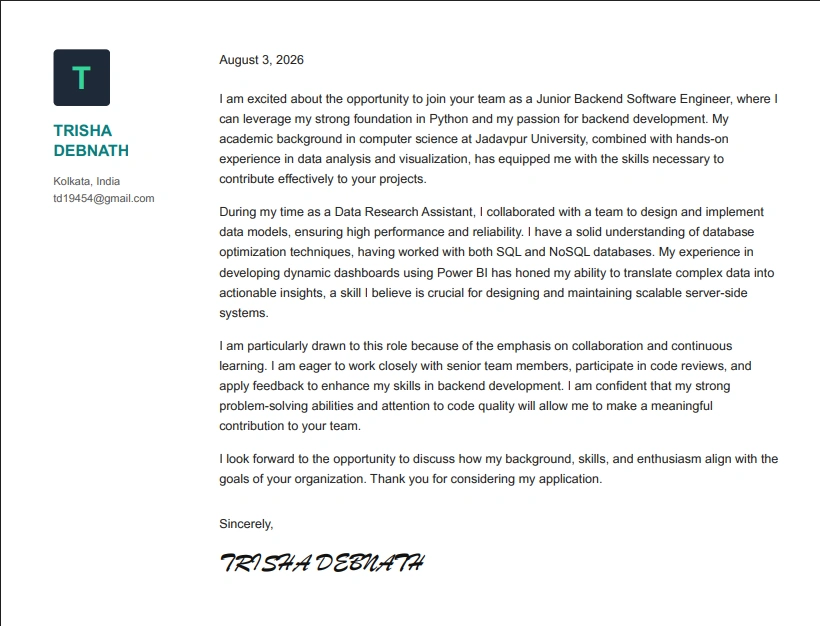
The same rules with a little more styling: the header is real text, not an image, so the layout stays readable to both a recruiter and a parser.
Generating the letter from a job description
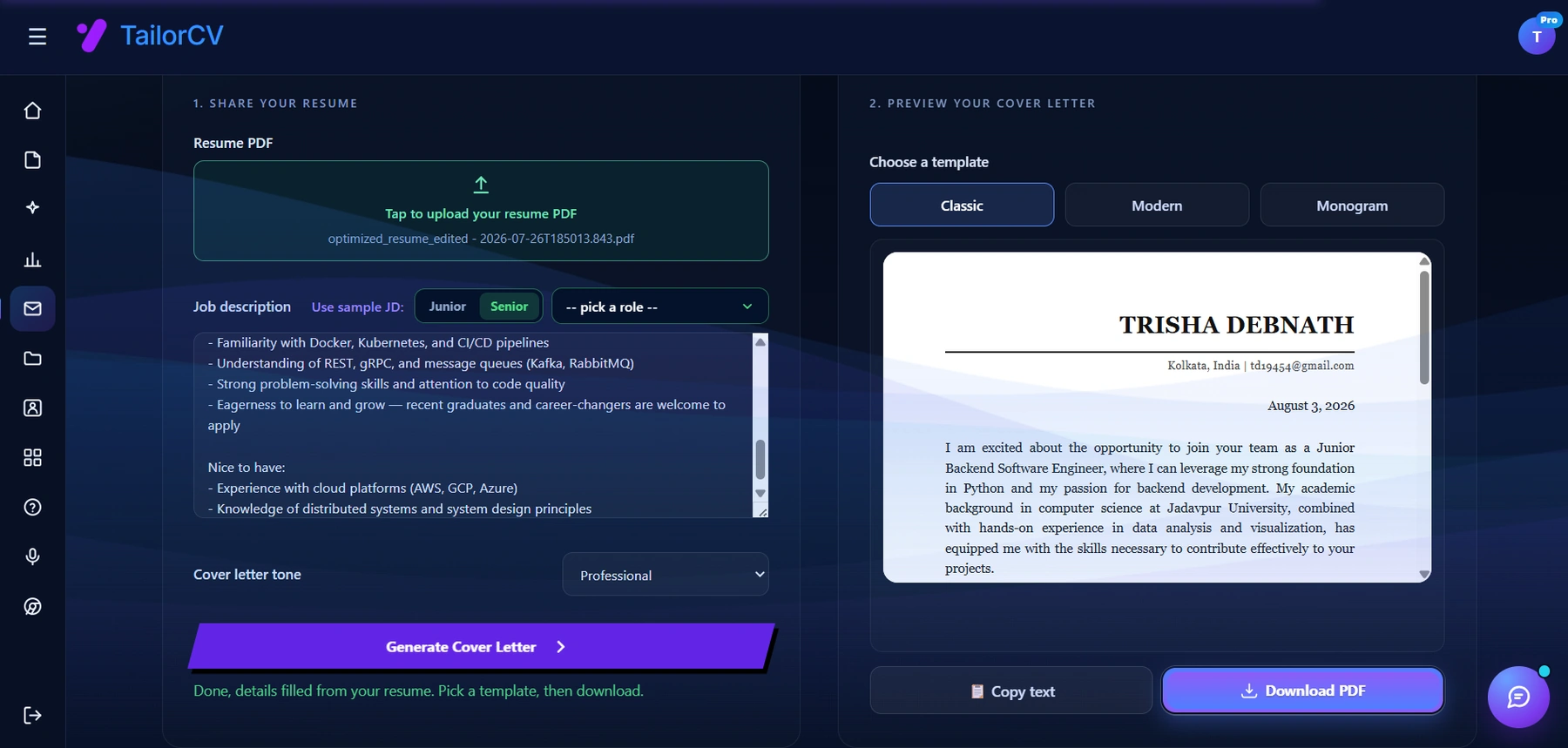
Having the preview beside the inputs is what makes this fast: change the tone or template and you see the result immediately.
1. Header and Greeting
Your contact details, the date, and the company details, then a polite greeting (address a named person where possible; otherwise a respectful general greeting).
2. Opening Paragraph
State the role you're applying for and a brief, sincere statement of your interest — ideally something specific about the company that draws you.
3. Body Paragraph(s)
Connect your skills and experience to the role's requirements, with a concrete example or two. Show how you'd contribute — and, in the Japanese context, emphasise reliability, teamwork, and genuine interest in growing with the company.
4. Motivation Paragraph (Shibō Dōki)
The crucial element: explain why this company. Reference its philosophy, products, or reputation, and connect it sincerely to your goals. This is what Japanese employers weigh most.
5. Closing
A respectful, forward-looking close — thank them for their consideration, express hope for the opportunity to contribute, and sign off politely.
Keep it to one page, polished and specific.
Writing the Motivation (Shibō Dōki)
Whether in a cover letter or the rirekisho section, the shibō dōki is the heart of a Japanese application. To write a strong one:
| Section | What goes in it |
|---|---|
| Research the company deeply | its philosophy, products, and recent developments |
| Be specific | generic praise ("I admire your company") is weak; cite concrete reasons |
| Connect to your goals | show how this company fits your long-term aspirations |
| Signal commitment | Japanese firms value candidates who want to stay and grow |
Tailor Every Letter
Never send a generic letter. For each application:
- Reflect the specific role and company.
- Mirror the key requirements from the job description.
- Keep your resume aligned — build it with the TailorCV resume builder and tailor it with the resume optimizer. For which terms to feature, see best resume keywords for Japan.
A tailored letter shows exactly the diligence and sincerity Japanese employers reward.
Feature Your Language Credentials
If relevant, note your JLPT and TOEIC levels — trusted, concrete signals in the Japanese market — and any Japan-relevant experience. These reassure employers about your fit.
Language: English or Japanese?
- For English-language roles, an English cover letter is appropriate — clear, polished, professional.
- For Japanese-language roles, the application (and any motivation writing) is expected in polite Japanese (keigo); if your Japanese is limited, target English-friendly employers, or get help ensuring the Japanese is correct and respectful.
Common Cover Letter Mistakes for Japan
- Generic motivation. The shibō dōki must be specific to the company.
- Boasting. Humility and teamwork are valued over self-promotion.
- Too casual. Keep the tone polite and formal.
- Wrong assumption about format. Know whether the employer wants a cover letter or relies on the rirekisho.
- Not tailoring. A one-size-fits-all letter signals low interest.
- Ignoring long-term fit. Signal commitment, not just capability.
Pair It With a Strong Application
- Match your resume format to the employer — see ATS and English resumes for Japan and rirekisho vs Western resume.
- Prepare for Japan's interview etiquette — see Japan interview etiquette and rehearse with the AI mock interview.
- Find the right roles via the best job sites for Japan and how to find a job in Tokyo.
Frequently Asked Questions
Do I need a cover letter for jobs in Japan? It depends on the employer. Global and English-language roles often expect one; traditional Japanese firms rely on the rirekisho, where motivation is expressed in the shibō dōki section. Always include one if the posting asks.
What is shibō dōki? It's your motivation for applying — specifically, why you want to work for this company. It's the most important element of a Japanese application, whether in a cover letter or the rirekisho.
Should my cover letter for Japan be in English or Japanese? Match the role: English for English-language positions, polite Japanese (keigo) for Japanese-language roles. If your Japanese is limited, target English-friendly employers.
What tone should a Japanese cover letter have? Sincere, humble, respectful, and specific — emphasising genuine motivation, teamwork, and long-term commitment rather than self-promotion.
Final Thoughts
A cover letter for jobs in Japan succeeds on sincerity and specificity: a genuine, well-researched reason for wanting this company, expressed with humility, respect, and a commitment to long-term contribution. Match the format to the employer — a Western-style letter for global roles, a strong shibō dōki for traditional ones — and tailor every word.
Build a matching resume with the TailorCV resume builder, tailor it with the resume optimizer, and prepare for the interview with the AI mock interview. Sincere, specific, and respectful — that's the letter that opens doors in Japan.
Was this guide useful?
Be the first to rate it.