TD
TD

Key Takeaways
- The line is simple: reordering and renaming true things is tailoring; adding untrue things is fabrication.
- Fabrication does not fail at the ATS. It fails in the interview, which is a worse place to fail.
- Most score gaps are wording problems, not skill gaps — which means most of the gain is available honestly.
- The test for any edit: could you talk about this for two minutes under questioning?
- Six techniques below raise scores legitimately. None of them require claiming anything new.
Every guide tells you to tailor your resume to the job description. Almost none of them say where tailoring stops. That ambiguity is why people either under-tailor and get filtered, or over-tailor and get caught.
Here is the line, and six things you can do on the honest side of it.
The Line
Tailoring: choosing which true things to lead with, and describing them in the language the reader uses.
Fabrication: claiming experience, skills, or results you do not have.
A useful test: could you talk about this for two minutes if someone asked? Not recite a definition — describe what you actually did, what went wrong, what you would change. If yes, it belongs on the resume. If no, it does not, regardless of how much the score would improve.
Why Fabrication Fails Where It Hurts
Adding a skill you lack works, briefly. The filter is text-matching, so the word does its job and your score rises.
Then you reach an interview where someone who does the work asks a specific question. The failure there is more expensive than a rejection:
- You have spent hours preparing for a role you will not get.
- You look either dishonest or self-deceiving, and both close the door on future openings at that company.
- In regulated fields, claiming a licence or credential you do not hold has consequences beyond the hiring process.
A rejection at the filter costs you one application. A collapse at the interview costs you the company and the time.
This is why our tailoring enforces the constraint structurally — it rewrites bullets to carry the posting's language only where your existing experience supports the claim, and it will not add a skill your resume shows no evidence for.
Six Honest Techniques
1. Name the thing you already did
The single largest source of honest score gain. Your resume describes real work in your own words; the posting uses different words for the same thing.
Posting: "experience with ETL pipelines" Your resume: "Built the nightly job that moved Salesforce data into Redshift." Fixed: "Built and maintained nightly ETL pipelines moving Salesforce data into Redshift."
Nothing was added. The claim is identical. It is now matchable.
Do this for every item in your missing list that you genuinely do — usually most of it. See which missing skills actually matter for the triage.
2. Rewrite the summary for this posting
Your summary is the highest-leverage text on the page and most people write it once and never change it. Rewriting two or three lines to name the target role and the posting's central requirements is entirely honest and moves the score more than any other single edit.
Generic: "Results-driven analyst with 5 years of experience in fast-paced environments." Targeted: "Data analyst with 5 years in retail, focused on SQL reporting and stakeholder-facing dashboards for merchandising and supply chain teams."
The second one is not a bigger claim. It is a more specific one.
3. Reorder, do not add
Your skills section probably lists twenty things in the order you thought of them. Put the posting's required items first.
This changes nothing about what you claim — only what is read first, by both the parser and the human. Free, honest, effective.
4. Use both the acronym and the full term
Parsers match strings. A posting saying "Applicant Tracking System (ATS)" and a resume saying only "ATS" may not connect.
Write both once: "Search Engine Optimisation (SEO)", "Certified Public Accountant (CPA)", "Continuous Integration/Continuous Deployment (CI/CD)". Purely mechanical, entirely truthful. See acronyms vs full terms.
5. State your industry and context explicitly
People routinely omit the most matchable fact about their experience. If the posting wants retail experience and your last job was at a retailer, say "retail" — do not assume the company name conveys it.
Same for scale ("a 40-person engineering org"), setting ("B2B SaaS"), and regulatory context ("HIPAA-covered environment"). All true, all frequently missing, all matched against.
6. Attach numbers to what you already claim
Quantifying does not add claims — it makes existing ones credible, and credible bullets read better to humans even when the score is unchanged.
Before: Managed the reporting process for the sales team. After: Managed weekly reporting for a 40-person sales org, cutting turnaround from 3 days to same-day.
Our guide to quantifying achievements covers finding numbers when work does not feel countable.
Three Things That Are Over the Line
Adding tools you have not used. Even "familiar with" is a stretch if you have only read documentation.
Inflating titles. "Senior" when you were not, "Lead" when you were not, "Manager" when nobody reported to you. Clarifying a confusing internal title is fine — see job titles that don't match your industry. Upgrading one is not.
Stretching dates to hide gaps. It surfaces in background checks, and an employment gap is a far smaller problem than a discovered misrepresentation. Handle it directly — see explaining employment gaps.
What About Keyword Stuffing?
Repeating a term to game the count is a bad trade even setting honesty aside.
Modern matching weighs context, not just frequency, so the tenth repetition adds little. And the resume still reaches a human, who reads the stuffing as either desperate or manipulative. Our keyword density guide covers what actually helps.
One repetition in the right place — the bullet that proves it — beats ten scattered mentions.
The Realistic Ceiling
Honest tailoring will not take every resume to 95%. If a posting genuinely requires something you do not have, your ceiling on that posting is lower, and that is correct information rather than a problem to engineer around.
For most people on most postings, honest tailoring moves a score from roughly 65% to 85%, because most gaps are wording rather than substance. That is a large, real improvement — and it survives the interview.
Frequently Asked Questions
Is tailoring my resume dishonest? No. Choosing which true things to emphasise is what every resume does. It becomes dishonest when you add things that are not true.
Can I list a skill I learned in a course? Yes, labelled accurately as coursework or certification. Do not let it imply work experience.
What if I used a tool once, years ago? List it honestly and low. If asked, say exactly that — brief exposure is not a disqualifier unless you claimed more.
Is it lying to use the posting's exact words? No, provided the underlying claim is true. That is just speaking the reader's language.
How do I know if I have gone too far? The two-minute test. If you could not discuss it under questioning, take it out.
Find the Honest Gains First
Most of the score you are missing is available without claiming anything new — it is sitting in work you have done but described differently.
Scan your resume against the posting and read the missing list. Sort it into "I do this but did not name it" and "I genuinely do not do this." The first pile is your honest upside, and for most people it is the larger one.
Free, about a minute. See also what is a good ATS match score and can recruiters tell if your resume was written by AI.
What is your resume scoring right now?
Scan it against a job description and get your ATS match score in about a minute.
Drop your resume here or choose a file
PDF only. Max 2 MB.
We never share your data or use it to train AI models.

Templates that keep this structure intact
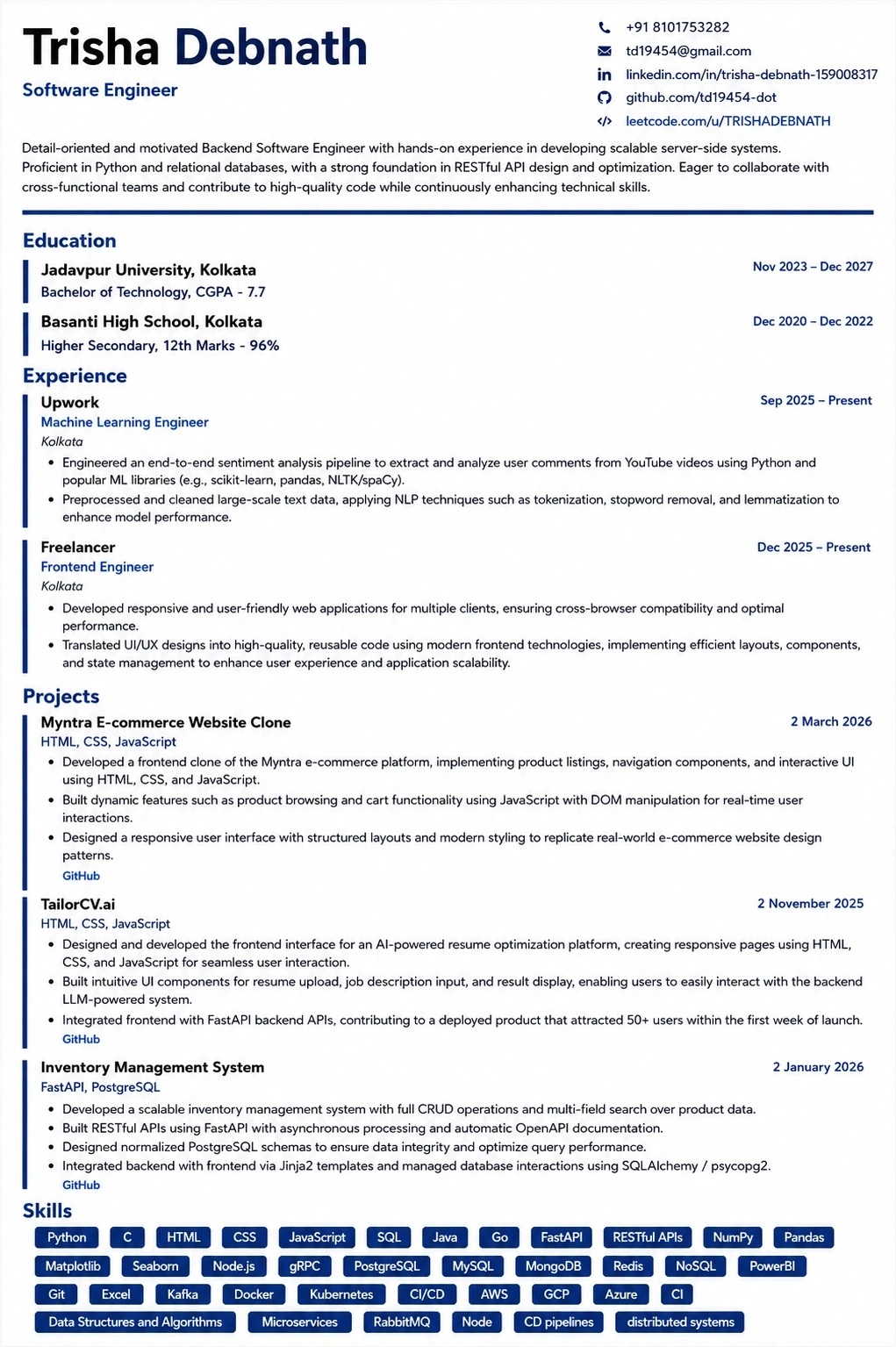
This template is ATS-tested — start from it and the formatting rules in this guide are already handled.
Was this guide useful?
Be the first to rate it.