 TD
TD

Key Takeaways
- Matching weighs job titles heavily. A title nobody recognises costs you more than most people realise.
- Clarifying a confusing title is honest. Inflating it is not, and it surfaces in reference checks.
- The safe format: recognisable title, with the official one alongside.
- The same applies in reverse — a title that sounds senior in your company but junior elsewhere.
- Do not change the title on official documents. Your resume is not a payroll record.
If your company called you a "Growth Ninja", a "Member of Technical Staff II", or an "Associate Partner" that means something different everywhere else, your resume has a matching problem that has nothing to do with your skills.
Why Titles Carry So Much Weight
Titles are one of the strongest signals in resume matching, because they are a compact summary of level and function. A requisition for "Senior Data Analyst" matches strongly against a resume containing that exact string, and weakly against one titled "Insights Ninja" — even when the underlying work is identical.
Titles also drive the human read. A recruiter scanning quickly uses the title column to judge trajectory and level before reading a single bullet. Our post on how recruiters read a resume in six seconds covers where their eyes go.
The Four Problem Types
1. Creative or branded titles. "Growth Ninja", "Customer Happiness Hero", "Code Wrangler". Common in startups. Meaningless outside the company.
2. Internal level codes. "Member of Technical Staff II", "Engineer III", "Grade 7 Officer". Precise internally, opaque externally.
3. Titles that mean different things elsewhere. "Associate" is junior in consulting and senior in law. "Engineer" in some countries requires a licence. "Analyst" in banking is entry-level; in analytics it is not.
4. Titles that undersell the work. Common at small companies, where one person does the work of a whole function under a modest title.
The Fix: Clarify, Don't Inflate
The standard, honest solution is to write the recognisable title and keep the official one visible:
Senior Software Engineer (internal title: Member of Technical Staff II) Acme Corp · 2022-Present
Digital Marketing Manager (official title: Growth Ninja) Startup Inc · 2021-2024
This is honest — you are translating, not upgrading. The official title is right there for anyone verifying, and the recognisable one does the matching work.
An alternative that also works:
Growth Ninja (Digital Marketing Manager)
Either format is fine. What matters is that both strings appear.
Where the Line Is
Clarifying (fine): - Translating an internal code to the industry-standard equivalent at the same level - Adding the common name for a function alongside a branded title - Using the country-standard equivalent when applying internationally
Inflating (not fine): - "Senior" when you were not senior - "Manager" when nobody reported to you - "Lead" when you were a team member - "Director" because you did some strategic work
The distinction is level, not wording. Reference checks and background screens routinely verify titles and dates with the employer, and a discovered mismatch ends the process at the worst possible moment. This is the same line covered in raising your score without lying.
The Underselling Case
If you did a manager's job under a coordinator's title, do not promote yourself in the title. Show the scope in the bullets instead:
Marketing Coordinator · Acme Ltd · 2022-2025 - Owned the full marketing function for a 30-person company: budget of £180k, agency relationships, and the entire content calendar. - Line-managed two junior coordinators and one contractor. - Reported campaign performance directly to the CEO monthly.
The title stays accurate; the scope is unmistakable. A hiring manager reads that and understands the level immediately — and you have said nothing you cannot defend.
Matching to the Posting's Title
Once your title is recognisable, check it against the posting's own title. If the posting says "Data Analyst" and you write "Business Intelligence Analyst", those are close but not identical strings.
Where the roles are genuinely the same work, you can bridge it in the summary rather than by changing the title:
Business Intelligence Analyst with 4 years in retail data analysis, covering the reporting, dashboarding and stakeholder work this Data Analyst role describes.
That puts the posting's term on the page honestly, without touching your employment history. See matching keywords to a job description.
Career Changers and Cross-Industry Moves
If you are moving industries, your title may be recognisable but irrelevant — a "Ward Sister" applying to project management, say.
The title stays as it is. The translation happens in the summary and bullets, where you frame the work in the target industry's language: rota planning becomes resource scheduling, incident escalation becomes stakeholder communication. Our career-changer guidance covers this in more depth.
What Not to Do
Do not change titles on your LinkedIn but not your resume, or vice versa. Recruiters compare them and inconsistency reads as carelessness or worse. See LinkedIn profile vs resume differences.
Do not invent a title that never existed. Translation has a real referent; invention does not.
Do not use the branded title alone because you like it. It costs you matches for no benefit.
Do not add "Senior" because you were there a long time. Tenure is not level.
Frequently Asked Questions
Can I change my job title on my resume? You can clarify it — write the industry-standard equivalent alongside the official one. You should not inflate the level.
Will the company confirm my title in a reference check? Frequently yes. Many verify title and dates only, which is exactly the thing an inflated title fails.
What if my title was accurate but sounds junior? Keep it and show the scope in bullets. Reviewers read level from responsibility, not just the word.
Should I use the posting's exact title as my title? Not as your employment title. Bridge it in the summary instead.
What about a title from a different country? Give the local-equivalent title alongside the original where the meanings differ.
Check How Your Title Reads to a Machine
If you suspect your title is costing you, the fastest confirmation is a scan.
Run your resume against a posting for a role you know you can do. If the match is low despite genuinely relevant experience, an unrecognisable title is one of the first suspects — along with skills you have but described in different words.
Free, about a minute. See also which missing skills actually matter and why is my ATS score low.
What is your resume scoring right now?
Scan it against a job description and get your ATS match score in about a minute.
Drop your resume here or choose a file
PDF only. Max 2 MB.
We never share your data or use it to train AI models.

Templates that keep this structure intact
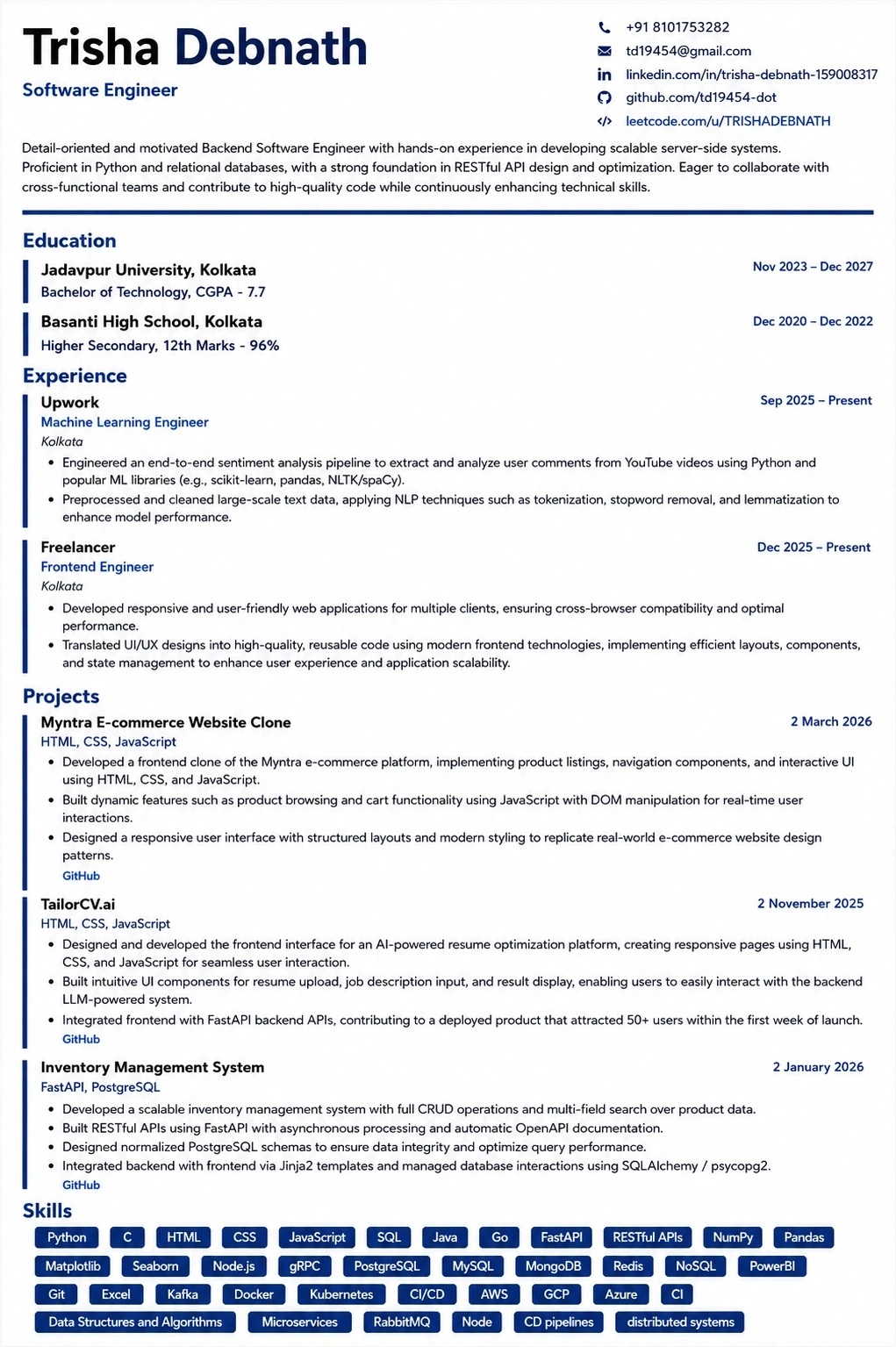
This template is ATS-tested — start from it and the formatting rules in this guide are already handled.
Was this guide useful?
Be the first to rate it.