 TD
TD
Key Takeaways
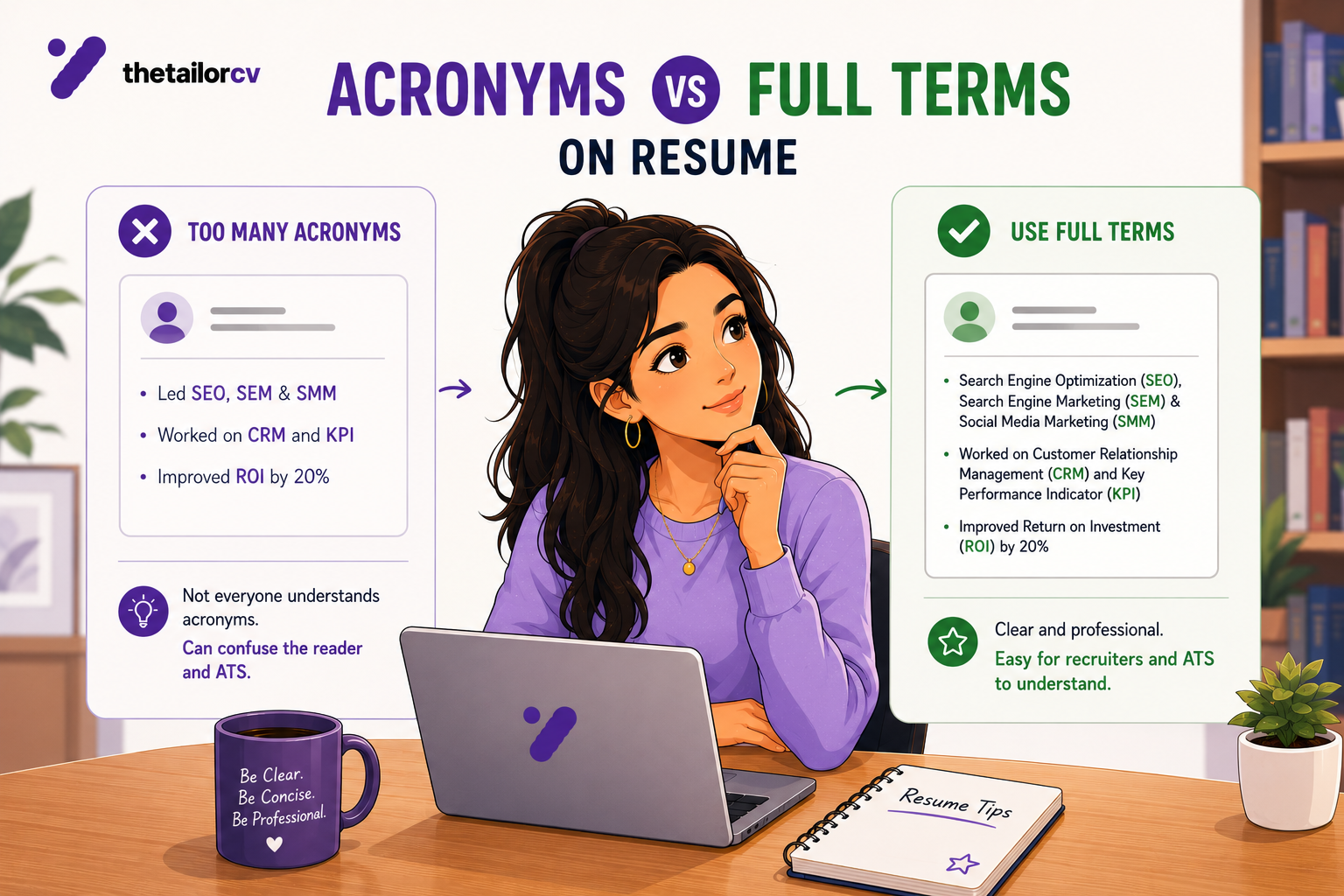
- Write both forms once: "Search Engine Optimization (SEO)". That covers whichever the posting used.
- Matching is string-based. "CPA" and "Certified Public Accountant" are not automatically the same to a parser.
- Do it once per term, in the most important place — not everywhere, which reads badly.
- Certifications, degrees and licences are the highest-risk category to abbreviate.
- Industry-standard acronyms that nobody spells out (SQL, HTML, API) are fine alone.
This is one of the smallest resume fixes with a real effect on matching, and almost nobody does it deliberately.
The Problem
An applicant tracking system matches text. If the posting says "Certified Public Accountant" and your resume says only "CPA", the connection may not be made — and vice versa.
You cannot know which form the posting used until you read it. Some write "Applicant Tracking System (ATS)"; some write only "ATS". The safe move is to cover both.
The Rule
Write the full term followed by the acronym in parentheses, once, in the place it matters most. After that, use whichever form reads naturally.
Search Engine Optimization (SEO) · Certified Public Accountant (CPA) · Continuous Integration/Continuous Deployment (CI/CD) · Customer Relationship Management (CRM) · Key Performance Indicator (KPI)
One occurrence is enough. Repeating both forms in every bullet is stuffing — it reads badly to the human who eventually gets the resume, and adds little for the parser. See keyword density.
Where to Put It
Put the paired form in the section where the term carries the most weight:
Certifications section for credentials:
Certified Public Accountant (CPA), Illinois — 2021 Project Management Professional (PMP), PMI — 2023
Skills section for tools and methods:
Search Engine Optimization (SEO) · Customer Relationship Management (CRM: Salesforce, HubSpot)
The relevant bullet where it describes real work:
Ran Continuous Integration/Continuous Deployment (CI/CD) pipelines in GitHub Actions for a 12-service platform.
Then elsewhere, just use the short form. Your resume should still read like English.
Which Acronyms Actually Need This
Not all of them. Spelling out universally-understood technical acronyms looks odd and wastes space.
Spell out — high risk if abbreviated:
- Professional credentials: CPA, PMP, CFA, PHR, SHRM-CP, RN, PA-C, RRT, CMA
- Degrees: MBA, MPH, MSW, DNP
- Methods that vary by industry: SEO, SEM, CRM, ERP, KPI, OKR, SLA, QA
- Regulatory frameworks: GDPR, HIPAA, SOX, PCI DSS, GAAP, IFRS
- Company-specific or niche systems
Leave alone — universally understood in context:
- SQL, HTML, CSS, API, REST, JSON, XML, HTTP
- AWS, iOS, Android, PDF, URL
- IT, HR, CEO, CTO
Nobody writes "Structured Query Language (SQL)" and it would read strangely if you did.
The Reverse Problem: Only the Long Form
Less common, equally costly. If you wrote "Search Engine Optimization" throughout and the posting says "SEO", the same mismatch happens in the other direction.
This shows up most often with credentials on formal resumes — someone writes "Certified Information Systems Security Professional" everywhere and never "CISSP", which is the string almost every posting actually uses.
Job Titles Follow the Same Logic
If your official title contains an abbreviation, or your industry uses a different name for the same job, cover both:
Senior Software Development Engineer (SDE III) Business Development Representative (BDR)
The same applies to internal titles nobody outside your company recognises — see job titles that don't match your industry.
A Quick Audit
Take five minutes on your current resume:
- List every acronym on it. Check each has its full form somewhere, once.
- List every long form. Check the common acronym appears at least once for credentials and methods.
- Read the posting. Note which form it uses for its key requirements, and make sure your resume contains that exact string where it is true.
- Check your certifications section specifically. This is where the mismatch costs most, because credentials are frequently hard requirements.
What This Does Not Fix
Worth being clear: pairing acronyms is a mechanical fix for a mechanical problem. It will not rescue a resume that is missing the underlying experience, and it is not where large score gains come from.
The big gains are in naming skills you have but did not state and rewriting your summary for the posting. Acronym pairing is a two-minute cleanup that removes an avoidable failure — worth doing, not worth over-thinking.
Frequently Asked Questions
Should I spell out an acronym every time it appears? No. Once, in the most relevant section. Repeating it reads as stuffing.
Which comes first, the full term or the acronym? Full term, then acronym in parentheses. That is standard writing convention and both strings are present either way.
Do modern systems handle synonyms automatically? Some do, to a degree. Many do not, and you cannot tell which one you are facing. Covering both costs nothing.
What about acronyms only used inside my company? Do not use them at all, or explain them. An outside reader cannot decode them and neither can a parser.
Does this apply to cover letters? Less so — those are read by humans. Write naturally there.
Check Which Form the Posting Uses
The fastest way to catch a mismatch is to see which terms come back as missing when you know you have the skill.
Scan your resume against the posting. If something appears in the missing list that you are certain you have, an acronym mismatch is one of the first things to check — along with the term sitting in a section the parser did not read.
Free, about a minute. See also matching keywords to a job description and what to expect when you re-scan.
What is your resume scoring right now?
Scan it against a job description and get your ATS match score in about a minute.
Drop your resume here or choose a file
PDF only. Max 2 MB.
We never share your data or use it to train AI models.

Templates that keep this structure intact
This template is ATS-tested — start from it and the formatting rules in this guide are already handled.
Was this guide useful?
Be the first to rate it.