SS
SS
Key Takeaways
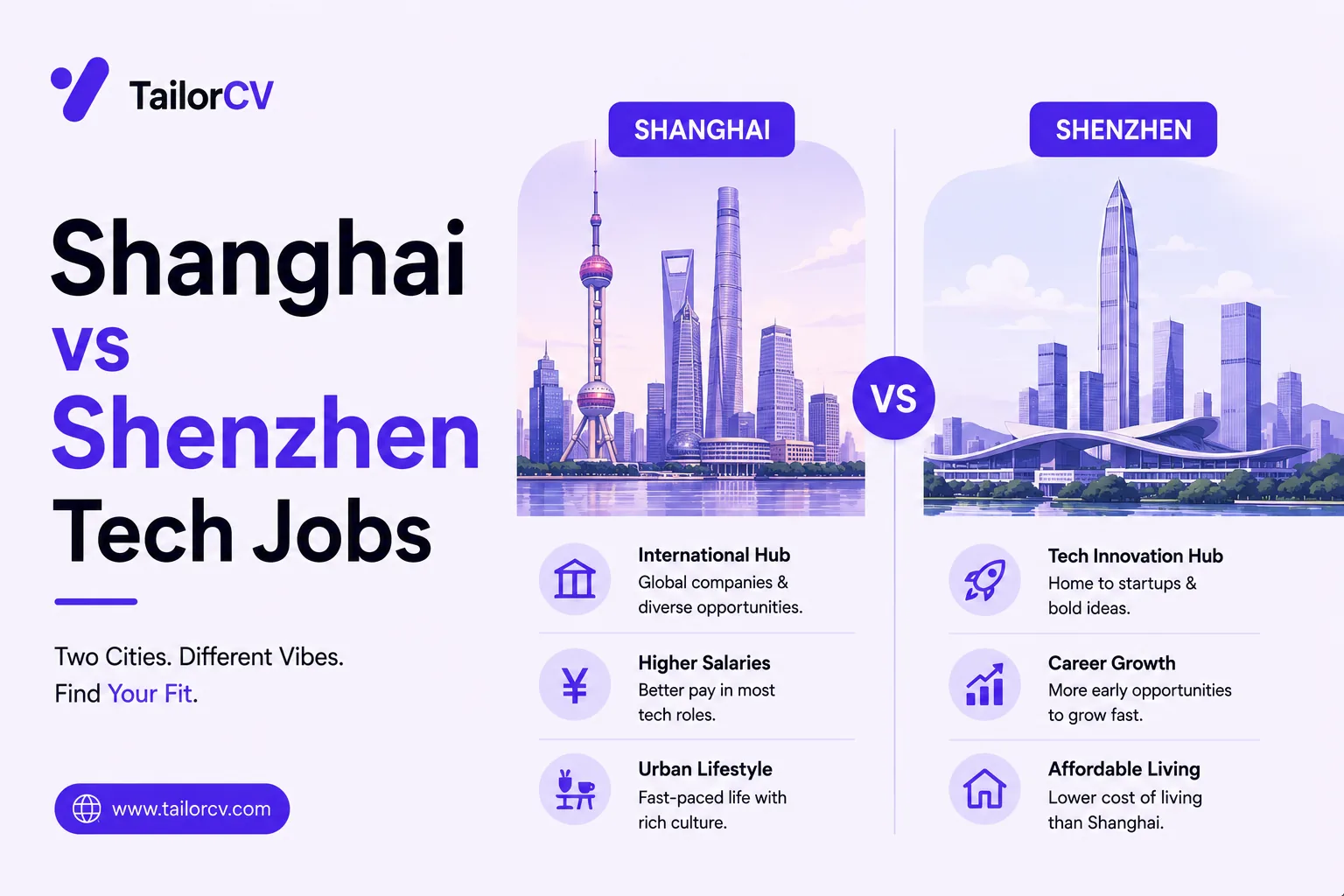
- Shanghai leans toward multinationals, finance, and enterprise software; Shenzhen leans toward hardware, consumer internet, and manufacturing-adjacent technology.
- Shanghai is substantially easier if your Mandarin is limited - the English-working environment is larger and better established.
- Shenzhen's proximity to the Pearl River Delta manufacturing base makes it the stronger choice for anything touching physical products.
- Cost of living is high in both, with housing the dominant variable and Shanghai generally at the higher end.
- Your resume should name the target city explicitly, because platform search is heavily location-filtered.
"Should I go to Shanghai or Shenzhen" is one of the more consequential decisions in a China tech career, and it is usually made on the basis of which city sounds more appealing rather than which one hires for what you do.
The two cities are not interchangeable. They developed differently, they concentrate different industries, and the day-to-day working experience diverges - particularly if you are a foreign national with limited Mandarin.
This guide compares them on the dimensions that actually affect your career.
Whichever you choose, your resume needs to say so - and it needs to parse. Start with the free ATS score checker.
The Short Version
Choose Shanghai if: you work in enterprise software, fintech, data, or consulting; you want multinational employers; your Mandarin is limited; you value an established international community.
Choose Shenzhen if: you work in hardware, IoT, robotics, consumer electronics, or anything touching manufacturing; you want to be near the supply chain; you prefer a younger, faster commercial culture.
The rest of this guide is the detail behind that.
Industry Concentration
Shanghai
The commercial and financial centre. Its technology sector reflects that - enterprise software, fintech, data and analytics, e-commerce operations, and a large services layer around the multinational presence.
If your work involves selling to or building for large organisations, Shanghai has more of them. The finance sector in particular creates demand for engineers, quantitative roles, and risk and data specialists that Shenzhen does not match at the same scale.
It is also the default location for regional Asia-Pacific headquarters, which produces roles that cover multiple markets and often operate in English.
Shenzhen
The hardware capital, and it is not close. The city grew alongside the Pearl River Delta manufacturing base, and that shapes everything - consumer electronics, components, robotics, drones, IoT, and increasingly electric vehicles and battery technology.
The practical advantage is physical proximity. A prototype iteration that takes weeks elsewhere can take days when your supplier is an hour away. For anyone building physical products, this is a genuine career reason to be in the city rather than a lifestyle preference.
Shenzhen also has a strong consumer internet sector, and a startup culture that is generally described as faster-moving and more willing to take risks than Shanghai's.
Company Types and What That Means for You
Shanghai skews toward multinationals, foreign-invested companies, and large domestic firms with international operations. For a foreign applicant this matters a great deal: these are the employers most likely to have an existing process for sponsoring work permits, English-working teams, and colleagues who have worked with foreign staff before.
Shenzhen skews toward domestic companies, including some of the largest technology firms in the country, plus a dense startup ecosystem and an enormous manufacturing supply chain. More of these employers operate primarily in Chinese, and more of them will be sponsoring a foreign hire for the first time.
The consequence is straightforward. If you need sponsorship and your Mandarin is limited, Shanghai is the lower-friction option. The permit process itself is the same either way - see the China work visa guide - but the number of employers set up to run it differs.
Language Requirements
This is the dimension that most often decides the question in practice.
Shanghai has the largest English-working professional environment in mainland China. There are genuine roles where you can operate effectively without Mandarin, particularly inside multinationals and in regional positions. Daily life outside work is also more navigable in English than almost anywhere else in the country.
Shenzhen expects more Mandarin. There are English-working roles, particularly at the larger technology companies and in export-facing positions, but the proportion is lower and the domestic company culture is more dominant.
Neither city makes Mandarin unnecessary for career progression - the ceiling problem described in working in China without Mandarin applies in both. Shanghai delays it; it does not remove it.
Cost of Living and Compensation
Both cities are expensive by Chinese standards, and housing dominates the difference.
Shanghai is generally at the higher end, particularly for central accommodation and for international schooling if you have children. Salaries tend to reflect this, especially in finance and at multinationals.
Shenzhen is also expensive - it is not a cheap alternative - but housing costs are typically somewhat lower than comparable Shanghai locations, and the city is more compact.
Two things worth knowing rather than any specific figure:
Compare the package, not the salary. Housing allowance, schooling support, flights home, and relocation assistance vary enormously and can outweigh a base salary difference. The general approach is in salary negotiation.
Salary interacts with your work permit. For foreign hires, the offered salary is one of the scored eligibility factors, which is a reason to be cautious about an unusually low offer regardless of city.
Working Culture
Generalisations, but consistently reported ones.
Shanghai is described as more international, more process-oriented, and more corporate. Multinational influence shows in how meetings run and how decisions get made. Work-life expectations vary by employer, with foreign firms often closer to their home norms.
Shenzhen is described as younger, faster, and more entrepreneurial - a city where a large share of the population moved there for work. Hours can be demanding, particularly in startups and at the larger technology companies, and the pace of iteration is part of the appeal for some people and the reason others leave.
Interview conventions are broadly similar across both, and the expectations are covered in China interview etiquette.
What This Means for Your Job Search
Pick one and say so. Platform search filters heavily on location. A resume that does not name a city, or says "anywhere in China", performs worse than one that commits. Put the city on your resume and set it in your platform profile - the placement is covered in the Chinese resume format guide.
Tailor the keywords to the city's industries. A Shenzhen hardware application and a Shanghai fintech application should not carry the same skills section. Which terms recruiters actually search is in the best resume keywords for China.
Being already in the city is an advantage. If you are in China, say which city on the first line. If you are relocating, give a date rather than an intention.
Use the domestic platforms. Both markets run on them, and location filtering is built into how they work - see the best job sites in China.
What About Beijing, Hangzhou, and Guangzhou?
Worth naming briefly, since the question is rarely only between two cities.
Beijing - the largest technology sector overall, plus government-adjacent industry, media, and education. Strong for AI research and enterprise technology. Bureaucracy and residence restrictions are more of a factor.
Hangzhou - a major e-commerce and internet hub with a lower cost of living than Shanghai, and a growing draw for people priced out of the first-tier cities. Higher Mandarin requirement.
Guangzhou - trade, export, and manufacturing, with a lower cost base than Shenzhen an hour away.
The broader picture of which sectors hire foreign nationals is in how to get a job in China as a foreigner.
Common Mistakes
Choosing on lifestyle before checking the industry fit. If your field concentrates in the other city, you are competing for a much smaller pool.
Assuming Shanghai means you never need Mandarin. It delays the requirement rather than removing it.
Treating Shenzhen as a cheaper Shanghai. It is not cheap, and the tradeoff is industry, not cost.
Applying to both cities with one resume. Different industries, different keywords, different framing.
Not naming a city at all. You disappear from location-filtered search.
Underestimating the supply chain advantage. If you build hardware, being three hours from your manufacturer is a real cost, every week.
Frequently Asked Questions
Which city is better for foreigners overall?
Shanghai, for most people - a larger English-working environment, more multinationals experienced in sponsoring foreign staff, and a more established international community. Shenzhen is the better choice when your field is hardware or manufacturing-adjacent, where the industry advantage outweighs the friction.
Can I work in Shenzhen without Mandarin?
It is possible, particularly at large technology companies and in export-facing roles, but the proportion of such roles is lower than in Shanghai and daily life is harder. Treat it as workable rather than comfortable.
Which city pays better for tech roles?
It depends far more on your field and employer type than on the city. Shanghai's finance sector supports high compensation for relevant roles; Shenzhen's large technology firms compete hard for engineering talent. Compare full packages rather than headline salaries.
Is Shenzhen only good for hardware?
No - it has a substantial consumer internet and software sector. But hardware is where its advantage over other Chinese cities is decisive rather than marginal.
How hard is it to move between the two later?
Not particularly hard within China, though your work permit is tied to your employer, so a city change usually means a job change with a formal permit transfer. Plan it as a job move rather than a relocation.
Should I visit before deciding?
If you can, yes. The two cities feel very different, and a week in each tells you things no comparison article will. If a business visa visit is feasible before committing, it is worth the cost.
Whichever city you pick, make sure your resume reaches the recruiter. Check your ATS score free.
Make This Practical
Decide on industry fit first, not lifestyle. If you build physical products, Shenzhen's proximity to the supply chain is a career advantage that Shanghai cannot match. If you work in finance, enterprise software, or data, or you need an English-working environment, Shanghai is the stronger base.
Then commit to it in writing. Name the city on your resume and in your platform profiles, tailor your skills section to that city's industries using the best resume keywords for China, and rebuild the file to local convention with the Chinese resume format guide.
Finally, run the process properly. Check your eligibility against the China work visa guide, apply through the platforms in the best job sites in China, verify your file parses with the free ATS score checker, and tailor each application using how to tailor your resume for every job.
What is your resume scoring right now?
Scan it against a job description and get your ATS match score in about a minute.
Drop your resume here or choose a file
PDF only. Max 2 MB.
We never share your data or use it to train AI models.

Was this guide useful?
Be the first to rate it.