TD
TD
Key Takeaways
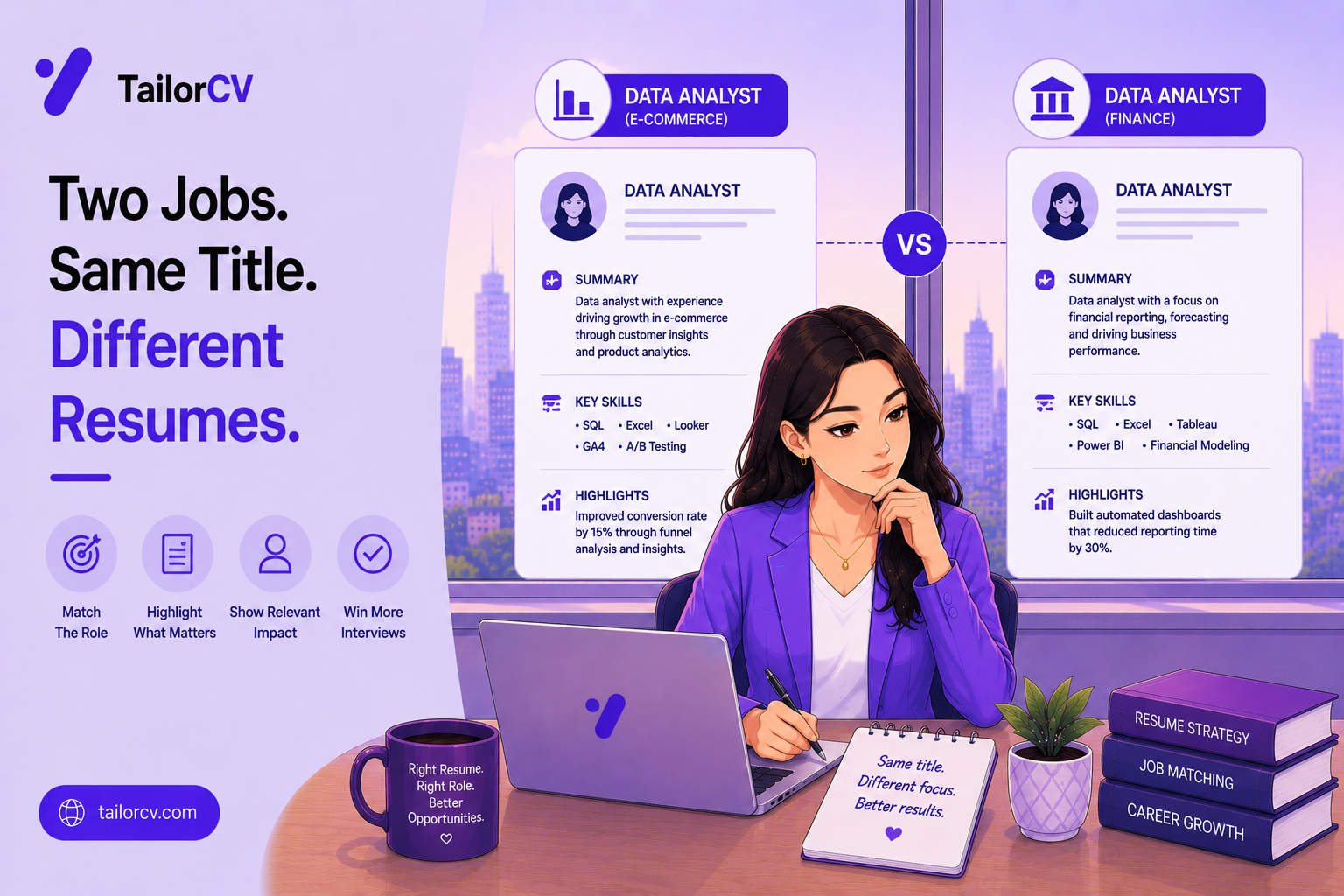
- An identical job title does not guarantee identical requirements — two postings can diverge enough to genuinely need separate versions.
- The decision test is whether the two postings' core requirements actually differ, not whether the titles match.
- Maintaining two base versions is manageable; maintaining many is where the system breaks down.
- A quick per-posting edit on top of the closer-matching base version often beats building a third resume from scratch.
- This is different from asking why your score differed on two postings — that question is diagnostic; this one is about what to build going forward.
You are applying to two "Data Analyst" roles this week. One emphasises SQL and stakeholder reporting at a retail company; the other emphasises Python and experimentation at a product company. Should you maintain two separate resume versions, or is one good enough?
The Title Is Not the Decision Point
This is the key reframe: whether to maintain separate versions should be decided by how much the postings' actual requirements diverge, not by whether their titles match. Two "Data Analyst" postings can require substantially different skill emphasis, as covered in why does my resume score differently for similar-titled jobs — and that divergence, not the shared title, is what determines whether one resume can reasonably serve both.
The Quick Test
Compare the two postings' requirements directly. Ask:
Do they emphasise fundamentally different tools or methods? SQL-and-reporting versus Python-and-experimentation is a real, structural difference, not a minor variation.
Do they imply different scope or seniority, even under an identical title? An analyst role owning end-to-end reporting infrastructure is a different job from one embedded in a larger team doing defined analysis requests, even if both are titled "Data Analyst."
Do they target different industries or contexts that would change which of your experiences you would lead with? Retail analytics experience is more directly relevant to one posting than the other, even if your underlying skill set overlaps.
If two or more of these are true, the postings are different enough that a single, compromise resume will likely underperform two more targeted versions on both.
When One Version Genuinely Is Enough
If the two postings' core requirements substantially overlap — same primary tools, similar scope, similar industry context — maintaining separate versions is unnecessary effort for minimal gain. A single well-tailored resume, with perhaps a few sentence-level tweaks per application, serves both fine.
This is the more common case for postings that are genuinely similar despite being at different companies — do not create version-management overhead you do not actually need.
Why a Compromise Resume Underperforms Both
If you try to write one resume that addresses both a SQL-and-reporting-focused posting and a Python-and-experimentation-focused posting reasonably well, you typically end up with a resume that leads with neither strongly — a diluted middle ground that matches each posting's specific emphasis less precisely than a version built around each would.
This is the same mechanism covered in why one resume cannot serve every application: matching rewards specific, evidenced coverage of what a particular posting emphasises, and a resume trying to serve two different emphases equally tends to serve both less well than two focused versions would.
Building Two Versions Efficiently
You do not need to write two entirely separate resumes from scratch. The efficient approach:
Start from one strong master resume containing your complete, accurate experience — see managing multiple resume versions for the underlying system.
Build two base variants, each emphasising a different core theme — one leaning toward the SQL/reporting framing, one toward the Python/experimentation framing — primarily by adjusting the summary, reordering the skills section, and shifting which bullets from your experience get foregrounded versus mentioned briefly.
Apply light, per-posting edits on top of the closer-matching base version, rather than building a third resume from scratch for every individual posting. Most of the time, one of your two base variants will already be close to what a new, similar posting needs, requiring only minor adjustment.
How Many Versions Is Too Many?
Two base variants for genuinely different emphases within a role type is manageable. Beyond that — say, five or six meaningfully distinct base versions — the system typically becomes harder to maintain than the benefit justifies, and you risk the version-tracking problems covered in managing multiple resume versions, particularly the risk of a stray detail from one version surviving into another.
If you find yourself wanting more than two or three genuinely distinct base versions, it may be worth reconsidering whether you are applying to a coherent set of roles or casting too wide a net across genuinely unrelated positions.
A Practical Decision Flow
- Compare the two postings' core requirements directly, not just their titles.
- If they substantially overlap, use one resume with minor per-posting tweaks.
- If they diverge meaningfully (different core tools, different scope, different context), build two base variants from your master resume.
- For future similar postings, start from whichever base variant is closer and adjust lightly, rather than building from scratch each time.
- Keep a simple log of which variant went where, per the system in managing multiple resume versions.
Frequently Asked Questions
If two postings have the same title, shouldn't one resume work for both? Not necessarily — title similarity does not guarantee requirement similarity. Compare the actual requirements, not the label.
Is maintaining two resume versions a lot of extra work? Building the two initial base variants takes some upfront effort; after that, adapting either for a new similar posting is usually a light edit, not a rebuild.
How do I know which base version to start from for a new posting? Compare the new posting's core emphasis against your two variants and pick whichever is closer, then adjust from there.
Should I ever build more than two variants for one role type? Occasionally, if you are genuinely applying across several distinct sub-types of a role — but beyond two or three, version management typically becomes harder than the benefit justifies.
Does this apply to career changes, not just similar titles? Career changes typically warrant an even more distinct version, closer to a full rebuild — see resume matching for career changers for that specific case.
Compare the Two Postings Directly
The clearest way to decide whether you need two versions is to see exactly where two specific postings' requirements diverge.
Scan your resume against both postings separately and compare the missing-requirements lists side by side. Where they overlap heavily, one resume with light edits will serve both. Where they diverge substantially, that is your signal to build a second base version.
Free, about a minute per scan. See also why does my resume score differently for similar-titled jobs and managing multiple resume versions.
What is your resume scoring right now?
Scan it against a job description and get your ATS match score in about a minute.
Drop your resume here or choose a file
PDF only. Max 2 MB.
We never share your data or use it to train AI models.

Templates that keep this structure intact
This template is ATS-tested — start from it and the formatting rules in this guide are already handled.
Was this guide useful?
Be the first to rate it.