 TD
TD
Key Takeaways
- The standard route is a temporary resident visa with permission to work, initiated by the employer through the INM.
- The canje — exchanging your visa for a residence card after arrival — is mandatory and time-limited.
- A financial solvency route exists for temporary residence without an employer, though it does not automatically confer work rights.
- Permanent residence becomes available after four years of temporary residence, or immediately in certain circumstances.
- The process is comparatively straightforward by regional standards, and the deadlines are unforgiving.
The employment route
How the standard process works.
Your employer applies to the INM — the Instituto Nacional de Migracion — for authorisation to hire you, which requires the employer to be registered as a certified employer with the institute.
INM issues an authorisation referencing a case number, which is what the consulate works from.
You attend a Mexican consulate in your country of residence within the validity period, present documents and are interviewed.
The consulate places a visa in your passport, valid for a single entry within a defined window.
You enter Mexico and receive an entry form marked for the canje.
You complete the canje at an INM office within thirty days of entry, exchanging the visa for a temporary resident card with permission to work.
And you register for CURP, RFC and IMSS, which follow from the residence card.
The thirty-day canje deadline is the part people miss, and missing it creates disproportionate problems relative to how simple the step is.
Routes without an employer
Alternatives worth knowing.
Financial solvency — temporary residence based on demonstrating sufficient income or savings over a defined period. It grants residence and does not automatically include permission to work, which must be applied for separately.
Family unity for spouses, partners and relatives of Mexican citizens or residents, which generally does include work rights.
Mexican children carries strong provisions for parents.
Investment in a Mexican company above a threshold.
Student visas, which permit limited work in defined circumstances.
Permanent residence directly, available in specific cases including retirement with sufficient income, family circumstances and points-based criteria that exist on paper.
And the humanitarian and refugee framework, which is separate.
Note the distinction that catches people: residence and work permission are separate questions on several of these routes, and having one does not automatically give you the other.
Documents and preparation
What the process actually requires.
Passport with adequate validity and blank pages.
INM authorisation with its case number, which your employer obtains and provides.
Photographs to consular specification, which is exacting and worth checking.
Completed forms, which vary slightly by consulate.
Proof of the employment relationship in the form your consulate specifies.
Apostilled documents where required, including qualifications and civil documents.
Translation into Spanish where the consulate requires it.
Fees, payable at the consular stage and again at the canje.
And an appointment, which at busy consulates can be the longest single wait in the process and should be booked the moment the authorisation issues.
After the canje
The registrations that follow.
CURP is generated as part of the residence process and functions as your national identity code.
RFC from the tax authority, required for employment, invoicing and most financial activity.
IMSS enrolment, handled by your employer, giving access to public healthcare and building social security entitlements.
INFONAVIT contributions, the housing fund, which accrue alongside.
Bank account, requiring your residence card and RFC.
Address registration and notification of changes to INM, which is an obligation people forget.
And renewal, which must be started before expiry — temporary residence is granted for a period and renewed up to four years total before permanent residence becomes available.
Professional licensing
A separate question from immigration.
Regulated professions require a cedula profesional to practise, issued by the Direccion General de Profesiones.
Foreign qualifications require revalidation through the education authorities before a cedula can be issued.
Medicine, law, engineering, architecture, accountancy and several other fields are affected.
Some professions carry nationality requirements or reciprocity conditions, which need checking specifically.
Technology and most business roles are unregulated, which is why foreign hiring concentrates there.
And having work authorisation does not mean you may practise — these are genuinely separate systems and conflating them causes real problems for professionals who arrive assuming otherwise.
Family members
The arrangements for dependants.
Spouses, concubinage partners and dependent children can obtain residence on the basis of family unity with your temporary residence.
They apply through the same consular and canje sequence, with their own documents and their own deadlines.
Work permission for a spouse is a separate application rather than automatic, and it can generally be obtained.
Schooling is available through a substantial private and international school sector in the major cities, with public education free and variable.
Healthcare through IMSS for registered family members, with private insurance being a standard employer benefit and effectively expected at professional level.
Apostilled marriage and birth certificates with Spanish translation are required, and this is where family applications usually stall.
And children born in Mexico are Mexican citizens, which has significant and permanent implications for the family that are worth understanding in advance rather than discovering later.
Permanent residence and citizenship
Where the route leads.
Four years of temporary residence generally qualifies you to apply for permanent residence.
Family circumstances can shorten this considerably, particularly marriage to a Mexican citizen or having a Mexican child.
Retirement with sufficient income allows permanent residence directly in some cases.
Permanent residence carries unrestricted work rights and no renewal obligation, which is a genuine simplification.
Naturalisation becomes available after a qualifying residence period, shorter for spouses of Mexican citizens and for nationals of Latin American and Iberian countries.
Spanish language and Mexican history examinations form part of naturalisation.
Mexico permits dual citizenship, and Mexican citizenship carries the additional value of TN visa access to the United States under USMCA for listed professions.
Where to verify
Requirements change and this article should be checked against the sources.
INM for residence categories, the canje, renewals and change notifications.
Your nearest Mexican consulate for visa application specifics, which vary meaningfully by post.
SAT for RFC and tax registration.
IMSS for social security enrolment and entitlements.
The Direccion General de Profesiones for cedula profesional and regulated professions.
And SEP for revalidation of foreign qualifications, which is a separate process from anything immigration-related.
The TN visa, in reverse
Worth mentioning because it shapes career decisions in this region.
Mexican and Canadian nationals have access to the TN visa for professional work in the United States under USMCA, covering a defined list of occupations.
It is considerably simpler than the H-1B — no lottery, no annual cap, and renewable indefinitely in principle.
The occupation list is specific and your role must genuinely map to it, with the degree requirement being strict.
Which matters for anyone weighing Mexico as a destination, since acquiring Mexican citizenship eventually opens this route in a way that most other nationalities cannot access.
And it works in the other direction too, since American and Canadian professionals moving to Mexico frequently do so within companies that operate across the whole USMCA area.
Route comparison
Setting the options side by side.
| Route | Who it suits | Work rights |
|---|---|---|
| Temporary resident with work permission | Employed professionals with an offer | Yes, tied to registered employment |
| Financial solvency | Those with income or savings, no employer | Not automatic, applied for separately |
| Family unity | Spouses and relatives of citizens or residents | Generally yes, separate application for spouses |
| Investor | Those investing above a threshold | Yes, within the business |
| Permanent residence | After four years, or specific circumstances | Unrestricted |
| Student | Enrolled students | Limited, defined circumstances |
The employment route is the default for anyone with an offer, and the financial solvency route is what makes Mexico unusually accessible to people without one — provided they understand that residence and work permission are separate.
Common problems
What actually goes wrong.
Missing the canje. Thirty days, and it is the single most common failure.
Assuming solvency residence permits work. It does not automatically.
Letting the consular visa window lapse between issue and entry.
Working on a tourist entry while waiting, which is more common than it should be and carries real exposure.
Not notifying INM of a change of employer or address.
Late renewal, which turns a routine step into a problem.
And confusing immigration status with professional licensing, which catches regulated professionals who arrive with valid residence and discover they cannot practise.
Mini checklist
- unchecked: Employer confirmed as INM-certified
- unchecked: Consular appointment booked early
- unchecked: Documents apostilled and translated
- unchecked: Canje deadline diarised for thirty days after entry
- unchecked: CURP and RFC planned for
- unchecked: Work permission confirmed rather than assumed
- unchecked: Professional licensing checked if regulated
- unchecked: Renewal timeline understood
- unchecked: Permanent residence path considered from the start
Scenarios
Scenario 1: You have a Mexican job offer
The employer-driven route applies. Confirm your employer is INM-certified, book the consular appointment as soon as the authorisation issues, and diarise the canje deadline before you fly.
Scenario 2: You want to live in Mexico without a job offer
The financial solvency route grants temporary residence on demonstrated income or savings. Note carefully that it does not automatically include permission to work.
Scenario 3: You are married to a Mexican citizen
The family unity route is considerably simpler than the employment one and generally includes work rights, and it is worth pursuing in preference to employer sponsorship.
Tip: Diarise the canje deadline before you get on the plane. You have thirty days from entry to exchange your visa for a residence card, and missing that window causes problems out of all proportion to how simple the step actually is.
Do's and Don'ts
Do
- Confirm your employer is INM-certified
- Book the consular appointment promptly
- Complete the canje within thirty days
- Get CURP and RFC early
- Check whether your route includes work permission
- Start renewals well before expiry
Don't
- Assume residence includes work rights
- Miss the canje window
- Let the consular visa window lapse
- Work on a tourist entry
- Assume the permit transfers between employers without notification
- Rely on outdated requirement summaries
Common Mistakes
- Missing the canje. Thirty days from entry, and it catches people constantly.
- Confusing residence with work rights. They are separate on several routes.
- Working on a tourist entry. It happens and the exposure is real.
- Assuming employer portability. Changes must be notified to INM.
- Late apostille. The usual cause of consular delay.
- Overlooking family routes. Frequently simpler than employment sponsorship.
Related Guides
Keep building on this with the related guides in this series:
- Working in Mexico as an International Graduate
- Technology Jobs in Mexico City
- Nearshoring Careers in Mexico
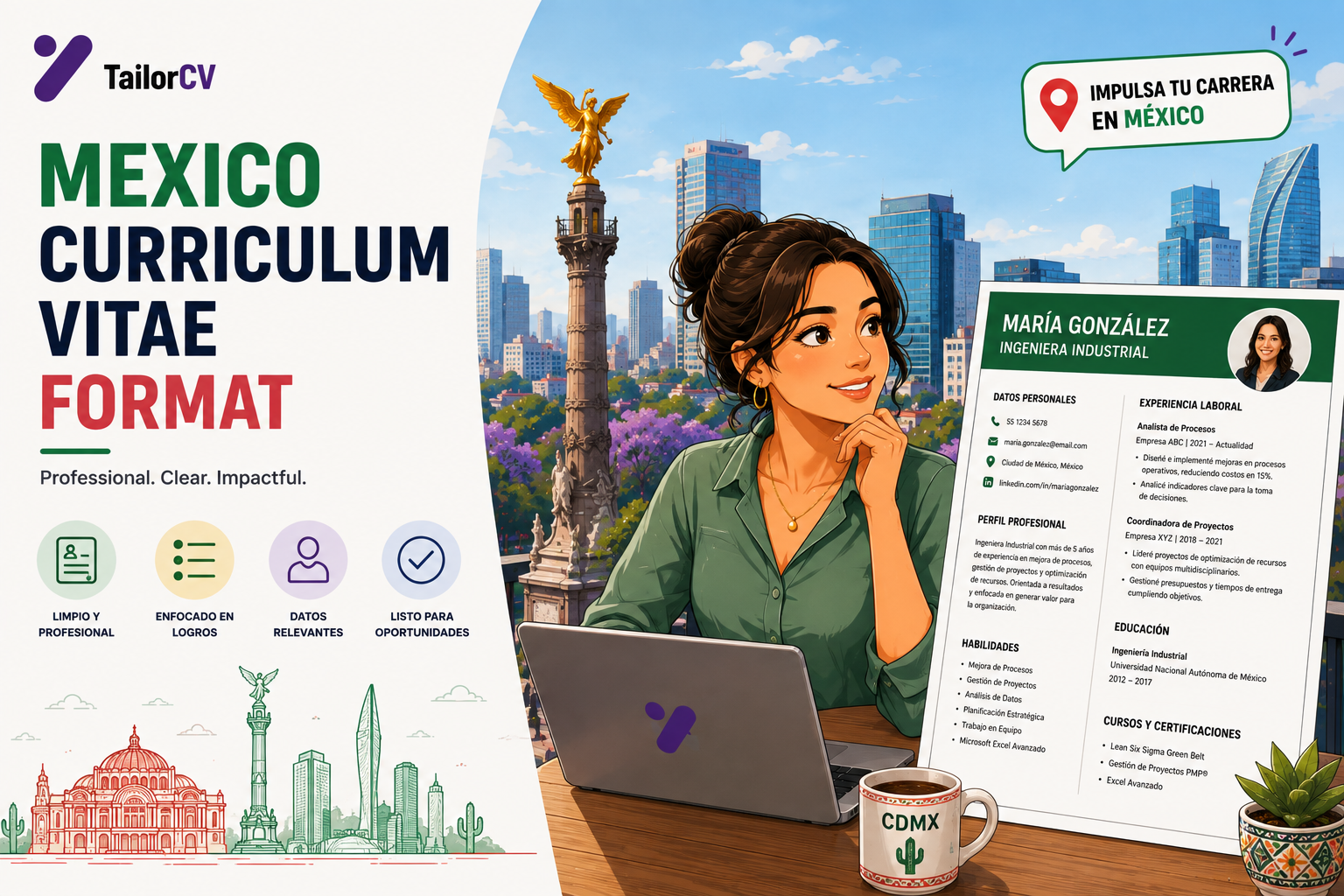
- The Mexican Curriculum Vitae Format
- Brazil Work Visas Explained
You can also check your resume's ATS score for free, generate a tailored cover letter, or build a portfolio website in minutes.
Frequently Asked Questions
What visa do I need to work in Mexico?
A temporary resident visa with permission to work, initiated by your employer through the INM and issued at a Mexican consulate in your country of residence.
What is the canje?
The mandatory exchange of your consular visa for a temporary resident card, completed at an INM office within thirty days of entering Mexico.
Can I get residence without a job offer?
Yes, through the financial solvency route based on demonstrated income or savings. It grants residence and does not automatically include permission to work.
How long until permanent residence?
Generally after four years of temporary residence, with certain circumstances including family and retirement allowing it sooner or directly.
Can I change employers?
Changes must be notified to INM. The permit is tied to your registered employment and a change requires the proper procedure rather than being automatic.
Is the process difficult?
Comparatively straightforward by regional standards. The deadlines, particularly the thirty-day canje, are the part that causes most problems.
What documents does a Mexican work visa need?
Passport, the INM authorisation with its case number, consular-specification photographs, proof of the employment relationship, apostilled qualifications and civil documents, and Spanish translations where required.
Do I need a cedula profesional?
Only for regulated professions, and it requires revalidation of foreign qualifications through the education authorities. It is a separate system from immigration and having work authorisation does not confer it.
Can my family join me in Mexico?
Yes, through family unity residence, following the same consular and canje sequence with their own documents. A spouse's work permission is a separate application rather than automatic.
How long until Mexican permanent residence?
Generally four years of temporary residence, considerably shorter with family circumstances such as marriage to a Mexican citizen or having a Mexican child.
What is the TN visa?
A United States professional work visa available to Mexican and Canadian nationals under USMCA, covering a defined occupation list. It has no lottery or annual cap, making it considerably simpler than the H-1B.
What goes wrong most often?
Missing the thirty-day canje deadline, assuming financial solvency residence includes work rights, letting the consular visa window lapse, and confusing immigration status with professional licensing.
What is your resume scoring right now?
Scan it against a job description and get your ATS match score in about a minute.
Drop your resume here or choose a file
PDF only. Max 2 MB.
We never share your data or use it to train AI models.

Was this guide useful?
Be the first to rate it.