TD
TD

Key Takeaways
- GPA screening is concentrated in finance, consulting and a handful of large graduate programmes. Most US employers never ask.
- A stated minimum is usually a filter in the application system, not a preference — below it, no human sees you.
- Convention is to include GPA on your resume above roughly 3.0, and to omit it below. Omitting is normal and not itself a red flag.
- Employers verify GPA far more often at offer stage than at application, which is why inflating it is a serious risk.
- Where GPA blocks you, the routes around it are referrals, demonstrable projects and smaller employers who screen on evidence instead.
Who actually screens on GPA
The honest answer is that it varies enormously, and students overestimate how widespread it is.
Screens hard: investment banking, management consulting, some quantitative trading firms, and a number of large rotational graduate programmes. In these, a stated cutoff is real and automated.
Screens sometimes: large tech companies, big accounting firms, some engineering employers. Often used as a tiebreaker or an early-career filter that relaxes with experience.
Rarely screens: startups, small and mid-sized companies, most non-profits, most government roles (which have their own criteria), and the overwhelming majority of employers by count.
The pattern: the more applications an employer receives relative to seats, the more likely they use a numeric filter, because it is cheap. Prestige-heavy industries with enormous applicant pools screen hardest.
What a stated minimum actually does
When a posting says "3.0 GPA required", that is usually implemented in the application system. If you enter 2.8, your application is filtered before a human reads it.
Two consequences:
It is not a preference you can argue past. There is nobody to persuade at that stage; the rejection is automatic.
Leaving the field blank sometimes passes and sometimes does not.
Some systems treat blank as failing the filter. Others let it through to a human. This is unknowable from outside, which is why the route around a hard cutoff is a referral rather than a clever form entry.
Where a range is stated as "preferred" rather than "required", it is usually a human judgement and other evidence can outweigh it.
Should you put it on your resume?
The convention in US campus hiring:
- Above 3.5 — include it. It helps.
- 3.0 to 3.5 — usually include, particularly for a first job where there is little else.
- Below 3.0 — omit.
Omitting is unremarkable. Recruiters see resumes without GPA constantly and do not treat the absence as an admission. What they do notice is a GPA that is stated and low, because it occupies space to say something unhelpful.
Do not include a major GPA instead without labelling it clearly.
"Major GPA: 3.6" is honest. Writing "GPA: 3.6" when your cumulative is 2.9 is not, and it is checked.
If your GPA is omitted, the space is better spent on evidence. A student with no GPA on the resume and three projects with real outcomes reads far better than one with a mediocre number and nothing else. This is also why the US resume format puts so much weight on what you actually built.
Verification: where it gets serious
Most employers do not verify GPA at application. Many verify at offer stage, through a background check or by requesting a transcript.
This asymmetry catches people out. Inflating a GPA often survives the application and then fails at the last step, after you have declined other offers. Rescinded offers over falsified academic details are one of the more common reasons offers get pulled.
The rule is simple: you can omit, you cannot invent.
Competing when GPA is your weak point
The useful question is not whether a low GPA hurts — it does, in the places that screen on it. It is what actually works to route around it, and the answers are more effective than students expect.
Referrals bypass the filter entirely. This is the single highest-return move available to you. A referred application at most large employers routes to a recruiter directly rather than through the automated screen that would have rejected you on a number. The outreach approach is the mechanism, and for a candidate with a weak transcript it is worth more than any other single activity.
Target employers who screen on evidence. Most US employers never ask about GPA. Technology companies, startups, mid-sized firms and most of the non-finance economy screen on what you can do. Spending applications on the small number of employers with hard GPA gates, when there is a large market that does not, is the most common strategic error here.
Make the evidence undeniable. A deployed project a reviewer can open in thirty seconds does more for you than a number would have. This is the substitution that actually works: for a candidate with a strong transcript, projects are a bonus; for you, they are the argument.
Use the internship route. Once you have relevant work experience, GPA recedes quickly. An internship — even a small one, even unpaid, even at an unglamorous employer — changes the shape of your resume permanently. Employers screening a candidate with real experience rarely return to the transcript.
Apply early. Filters are applied more mechanically when the pile is large. Early applications get more human attention.
Show an upward trend if you have one. "3.4 in the last two years" or a strong major GPA is legitimately reportable where the overall figure is weaker, provided you label it accurately.
Consider the smaller employers first. A regional firm where a person reads every application is a much better use of your effort than a graduate programme with an automated 3.5 cutoff.
Should you explain a low GPA?
Not on the resume, and not unprompted in an interview. Volunteering it draws attention to the weakest fact about you.
If asked, answer briefly and without excuses, then redirect to evidence:
"My first two years were weak — I was working most of the week to cover costs. My last three semesters were 3.6, and the work I'd point you to is the analytics project I shipped last spring."
Short, honest, and moves to what you want discussed. What does not work is a long explanation, blaming instructors, or a defensive tone.
Where there is genuine context — illness, family responsibility, working through school — a single clause is enough. Interviewers are not looking for a justification; they are checking whether you are self-aware.
Should you explain it?
Usually not, and the exceptions are narrow.
Do not explain it on the resume. It takes space from evidence and draws attention to the thing you would rather they weighed less.
Do not explain it unprompted in an interview. Candidates raise this pre-emptively far more often than interviewers ask, and doing so converts a non-issue into a topic.
Do explain it if asked, briefly, factually, without a plea:
"My first two years were weak — I was working about twenty-five hours a week and I underestimated what that would cost academically. I cut my hours in junior year and my GPA since then is 3.6. The projects on my resume are from that period too."
Three sentences. A real reason, an acknowledgement, evidence of a change. What does not work is a long story, blaming instructors, or a defence that does not concede anything.
Genuine circumstances — illness, bereavement, family crisis — are worth one sentence if asked, and no more. You are not obliged to disclose medical details, and most interviewers will move on immediately.
Where a cover letter is warranted — smaller employers, roles where a person reads applications — a single line can pre-empt the filter. This is one of the narrow cases where the cover letter does real work, because the resume shows a number it cannot contextualise.
What to do with the space you save
If you omit GPA, something has to occupy that line, and what you put there decides whether the omission reads as neutral or as an absence.
A project with a link. The strongest substitute by a distance. Something a reviewer can open and understand quickly says more about your ability than a decimal ever did, and it is the one credential entirely within your control.
Relevant coursework, selectively. Four or five courses that map to the posting, not a transcript. This works best when the courses are genuinely specialised.
Technical skills, honestly stated. Only things you would defend in an interview.
Work experience of any kind. Campus jobs, retail, tutoring. It demonstrates reliability, and for a candidate whose transcript is weak, evidence of being counted on is directly relevant.
Something you sustained. A society role held for two years, a team, a long-running commitment. Duration is evidence of exactly the quality a weak transcript raises doubts about.
The underlying logic is worth stating: a low GPA raises a specific question — will this person do the work consistently. Every item above answers that question with something other than a grade, which is why they substitute effectively while a longer list of coursework does not.
What employers are actually worried about
Understanding the concern behind the number tells you what evidence answers it.
A GPA is a proxy, and employers use it because it is cheap. What they are trying to predict is not intelligence — it is whether you will do the work consistently when nobody is watching. A graduate job contains a great deal of unglamorous, unsupervised effort, and a transcript is a four-year record of exactly that behaviour.
Once you see it that way, two things follow.
The proxy is weak and employers know it. A GPA reflects course difficulty, working hours, health, family circumstances, how many credits you took, and which institution you attended. Employers who screen on it are accepting a crude filter because reading thousands of applications properly is expensive, not because they believe the number is precise.
Anything that answers the underlying question substitutes for it.
A project maintained for two years. A job held throughout your degree. A society role with a visible record. An internship where someone will vouch for your reliability. Each of these speaks directly to consistency, and each is more informative than a decimal.
That is also why "I had a hard first year and then improved" works as an explanation and "the grading was unfair" does not. The first addresses the concern; the second dismisses it.
Where to put it on the resume
Assuming you are including it, the placement matters more than students expect.
In the education section, on the same line as the degree. "BS Computer Science, 3.6" — not a separate line, not a bullet of its own, not bolded. Giving it prominence invites the reader to weigh it more heavily than they otherwise would.
Match the transcript's precision. 3.48 is 3.48, not 3.5. Rounding is where people get caught at verification.
Label anything that is not the overall figure. "Major GPA: 3.7" is honest and useful. An unlabelled major GPA presented as the overall one is exactly what background checks surface.
Only add scale where it is ambiguous. "3.6/4.0" helps if your transcript uses an unusual scale; otherwise it is clutter.
Drop it once you have work experience. After your first full-time role, education moves to the bottom of the resume and the number comes off entirely. Keeping it two years in signals that you think it is still your strongest evidence.
Common Mistakes
- Assuming every employer screens on GPA. Most do not, and this belief narrows searches unnecessarily.
- Inflating the number. Frequently verified at offer stage, where the cost is highest.
- Labelling a major GPA as cumulative. Reads as deception when the transcript arrives.
- Including a GPA below 3.0. Uses space to volunteer your weakest fact.
- Explaining it unprompted. Draws attention to something most interviewers would not have raised.
- Giving up on a whole industry because of one cutoff. Referrals route around automated filters; the cutoff is a system rule, not a judgement.
Verification, and why inflating is a serious risk
Students assume GPA is rarely checked. The assumption is right at application and wrong where it matters.
At application, it is almost never verified. You type a number into a form and nobody looks.
At offer stage, it frequently is. Background checks at large employers, particularly in finance, consulting and government-adjacent work, routinely include education verification — degree, dates, and often GPA — through the university or a third-party service.
The consequence of a discrepancy is not a negotiation. A rescinded offer is the standard outcome, and it happens after you have declined your other options. Candidates have lost entire recruiting seasons this way.
Rounding is where people get caught. 3.48 stated as 3.5 is the common case. It feels harmless and it is a discrepancy on a report. State the figure your transcript states, to the same precision.
Labelling matters. "Major GPA: 3.6" is honest. Presenting a major GPA as your overall GPA is not, and it is exactly what verification surfaces.
This extends beyond GPA. Graduation dates, degree titles, honours, and employment dates are all verified at the same time. The general rule: everything on your resume should survive someone else describing it independently, which is the same standard that applies to reference checks.
Who actually screens, and what a minimum means
Screens hard: investment banking, consulting, some quantitative finance, a handful of large structured graduate programmes, and certain government roles. Here a stated minimum is a real gate.
Screens sometimes: large technology employers with formal new grad programmes, some engineering firms, some healthcare and pharmaceutical graduate schemes. Often collected and lightly weighted.
Rarely screens: most startups, most mid-sized companies, most of the non-finance economy. Evidence and interviews decide.
What a stated minimum actually is. When a posting says "3.5 minimum", that is usually a field in the application system, not a preference a recruiter is weighing. Below it, your application is filtered before a human sees it. This is why arguing the case in a cover letter to a large employer does not work — there is nobody at that stage to read it.
Which is precisely why referrals matter so much here. A referral enters through a different door, and the person receiving it is a recruiter rather than a filter. For a candidate below a stated minimum, that is the difference between an application that is read and one that is not.
Convention on including it: above roughly 3.0, put it on the resume. Below, omit it. Omitting is entirely normal and is not itself a red flag — a great many resumes carry no GPA at all, and recruiters do not treat absence as a confession. What they do notice is a resume with no GPA and no evidence, which is why the space you save must go to something concrete.
A plan for each situation
Advice about GPA is only useful once you know which of four positions you are in.
Above 3.7. Put it on the resume, apply anywhere including the hard-screening industries, and stop thinking about it. Your constraint is something else — usually evidence or timing.
3.3 to 3.7. Include it. You clear most stated minimums and fall below some finance and consulting gates. Apply to those anyway where you have a referral, and do not spend the season on them exclusively. Your GPA is not the thing holding you back, and treating it as a defect wastes energy that belongs on projects and outreach.
3.0 to 3.3. Include it if the posting asks, consider omitting it otherwise. You will be filtered from the hard-screening employers, which is a real constraint and not a verdict. Weight your applications toward technology, startups and mid-sized firms, get a referral wherever possible, and put a substantial project at the top of the resume. Most of the US graduate market is open to you.
Below 3.0. Omit it. Do not apply to postings with a stated minimum unless you have a referral that routes around the filter. Concentrate entirely on evidence and relationships — an internship of any kind changes the picture permanently, and after your first job nobody asks again. This is the position where the non-target strategy applies almost verbatim, because the problem is the same: replacing a filter you cannot pass with a channel that does not use it.
The consistent thread across all four: the number matters most at the moment of the automated screen and decreasingly thereafter. Everything you do that reaches a human directly reduces its weight, which is why referrals and evidence are the answer at every level.
When it stops mattering
Worth stating clearly, because students carry this anxiety far longer than it is warranted.
After your first job, essentially nobody asks. Lateral hiring weighs what you did at work, who will vouch for you, and how you interview. A recruiter filling a role for someone with two years of experience is not reading a transcript.
Some exceptions persist briefly. A few finance and consulting firms ask at the two-year lateral stage, some graduate schools ask, and certain government and clearance processes verify education indefinitely. These are narrow.
The practical horizon is about eighteen months. Get any relevant role, do it well for a year and a half, and the number stops being part of your story permanently.
Which reframes the whole problem: the objective is not to overcome a low GPA in the abstract. It is to get through one door, once, into work that counts. Referrals, projects, smaller employers and internships all exist to do that single job — and after they have done it, the constraint dissolves on its own.
Frequently Asked Questions
Do employers verify GPA?
Many do at offer stage, through background checks or transcripts. Fewer verify at application. This is exactly why inflating it is risky — it usually fails at the point where you have already turned down alternatives.
Is it suspicious to leave GPA off?
No. Recruiters see resumes without it constantly. A stated low GPA draws more attention than an absent one.
What if the application form requires GPA?
Enter it truthfully. If it falls below a stated cutoff, that application is likely filtered — which is why a referral into the same company is a better use of effort than a form entry you cannot win.
Does GPA matter after the first job?
Very little, and it falls away quickly. Once you have a year or two of full-time work, employers are screening on what you did at work. Most stop asking entirely.
Do international grade scales convert cleanly?
Not reliably. If your degree used a different scale, state it in a way a US screener can read — either convert with a recognised service or write the scale alongside the number. An unexplained "First Class" or "8.4/10" means little to an American recruiter.
Is a strong GPA enough on its own?
No. It clears filters; it does not win interviews. A 3.9 with no projects, internships or evidence of applied work loses to a 3.2 with a shipped portfolio in most technical hiring.
What is your resume scoring right now?
Scan it against a job description and get your ATS match score in about a minute.
Drop your resume here or choose a file
PDF only. Max 2 MB.
We never share your data or use it to train AI models.

Templates that keep this structure intact
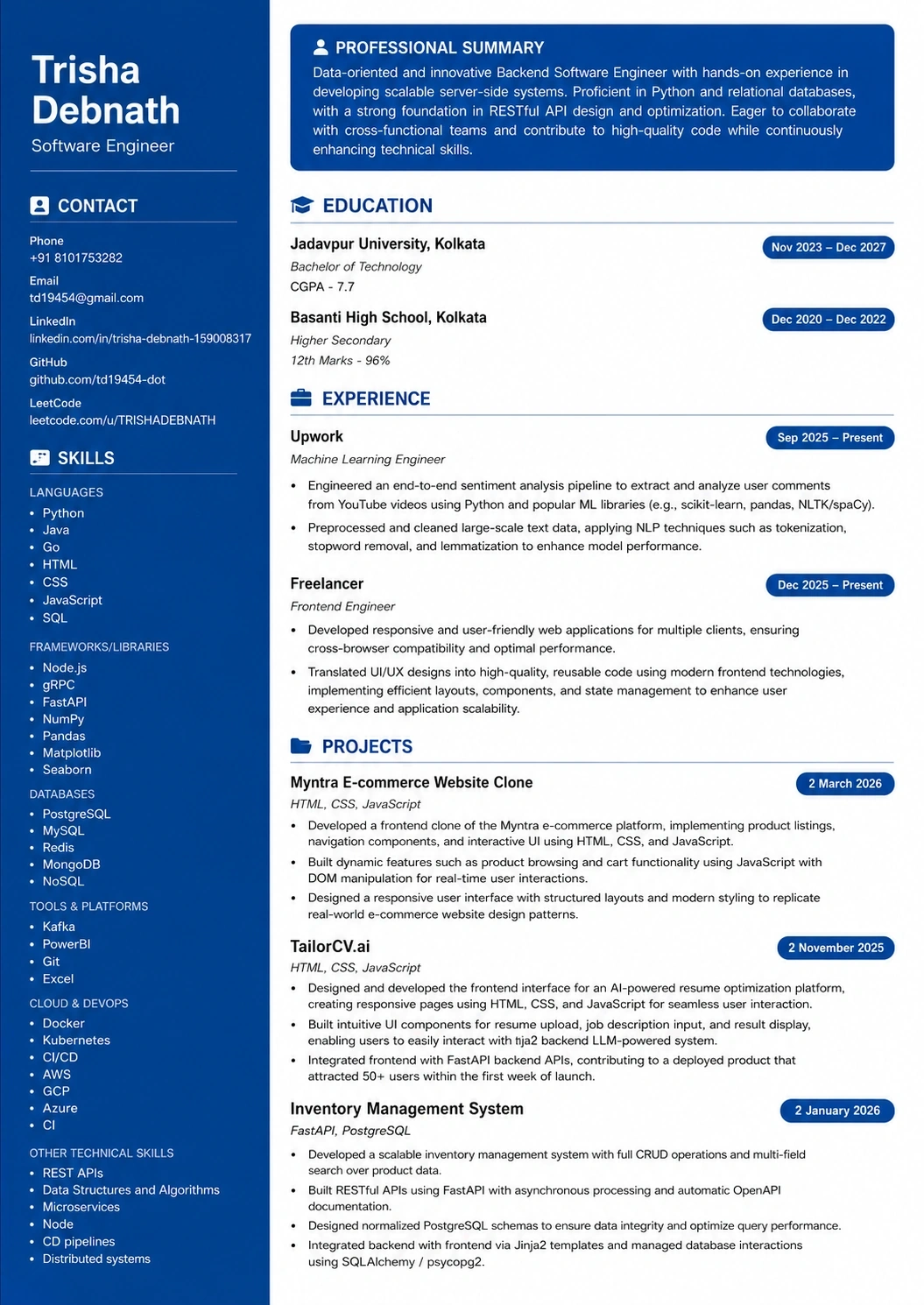
This template is ATS-tested — start from it and the formatting rules in this guide are already handled.
Was this guide useful?
Be the first to rate it.