 SS
SS
Key Takeaways
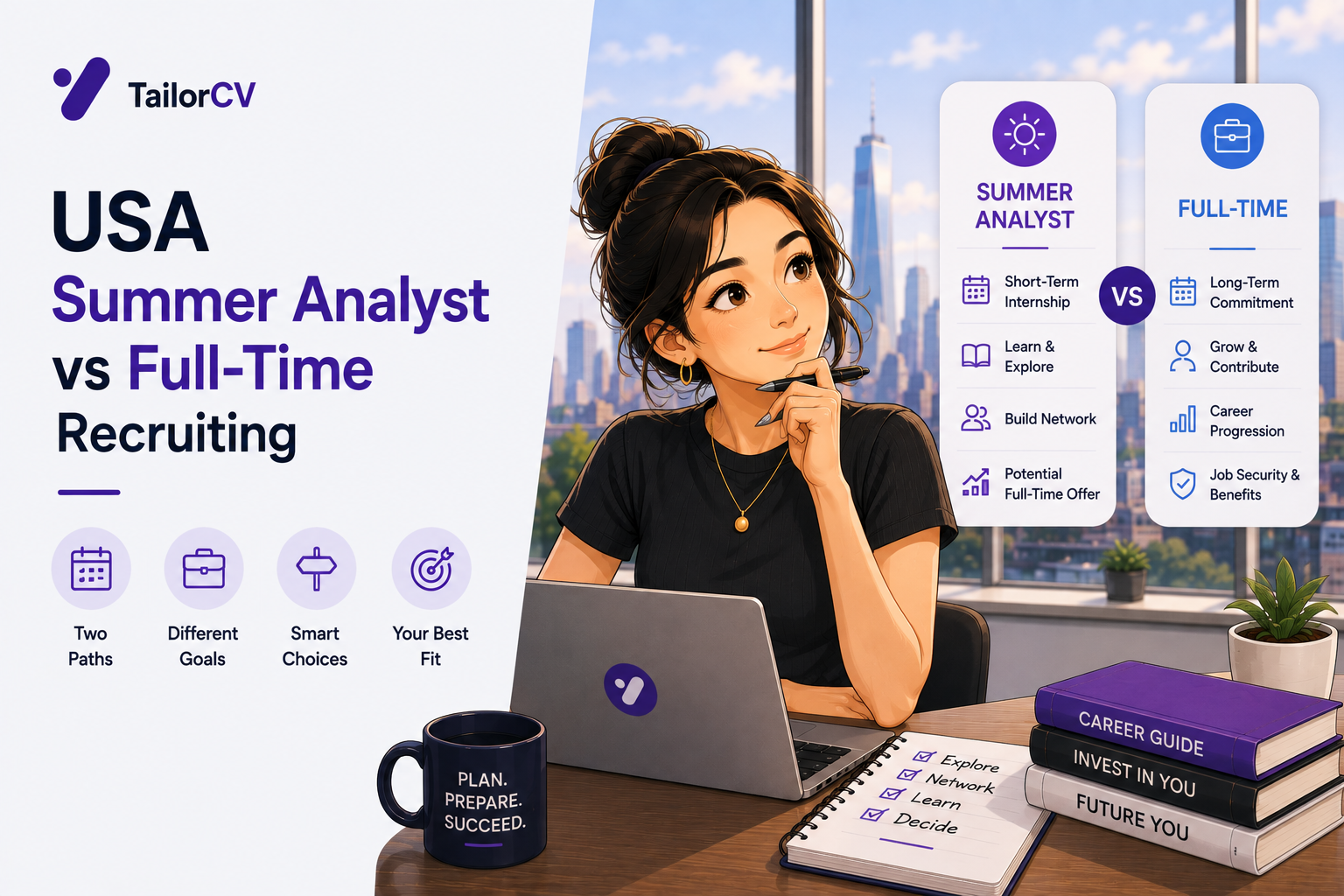
- At many large employers the graduate class is substantially filled by converted interns, which makes the internship round the decisive one.
- The full-time round is a smaller and more contested pool, not an equivalent second chance.
- This is most extreme in banking and consulting, moderate in technology, and weakest across the broader economy.
- The practical consequence is that your penultimate year matters more than your final one for these employers.
- If you are already in the full-time round without an internship, the response is to widen the employer list rather than to compete harder for the same seats.
How the two rounds relate
The summer round recruits students in their penultimate year for an internship the following summer. At most large structured employers this is the primary pipeline.
Conversion is the point. The internship functions as an extended assessment, and employers extend return offers to the interns they want. The proportion converted varies by employer and by year, but publicly reported figures give a sense of scale: investment banks have commonly reported conversion rates in the 80-95% range in strong hiring years, and large technology employers have commonly reported figures somewhere in the 50-75% range — both numbers move meaningfully with the broader hiring environment year to year, so treat them as an indication of the general pattern rather than a specific promise for any given year or employer.
The full-time round then fills what is left, and the arithmetic is worth making concrete. Take a bank running a 200-person structured graduate class, filled roughly 85% by converted interns — that leaves around 30 seats recruited externally, competed for by every candidate at every target school who didn't intern there that summer. That's the actual size of the "full-time round" pool at a firm like this, and it's a considerably smaller and more contested number than the headline graduate-class size suggests.
Which means the two rounds are not equivalent. Students frequently plan as though the full-time round is a fresh, equally-sized opportunity. It is generally neither.
How much this varies by industry
Banking and consulting: most extreme. The summer analyst class is the graduate class in all but name at many firms, and the full-time round can be very small. Missing the summer round here is genuinely costly, and the MBA version follows the same logic.
Large technology employers: significant but softer. Conversion matters and requisitions reopen through the year, which means the full-time round is a real channel rather than a remainder.
Mid-sized and smaller companies: much weaker. Many do not run internship programmes at all and hire graduates directly on need, filling roles as they open rather than through a defined summer-to-full-time pipeline, which is why this segment matters so much for anyone without an internship behind them.
Healthcare, education, government: largely separate. These run on their own calendars with different structures entirely.
The planning consequence: if your target is banking or consulting, treat the penultimate-year summer round as the main event. If your target is broader, the full-time round remains genuinely viable.
"Off-cycle" hiring, the channel most students never search for
Off-cycle hiring refers to roles filled outside the structured, calendar-driven recruiting rounds — a team that lost someone unexpectedly, a business unit that got budget approval mid-year, a role that simply didn't get filled in the structured round. These postings rarely appear on the same career-fair circuit or campus recruiting portal as the structured programs, and they're filled on a rolling basis rather than a fixed decision date.
This matters specifically for students who missed both the internship round and the main full-time round. Off-cycle roles are less visible by design — they're not marketed as a "class" the way structured hiring is — which means they reward direct outreach considerably more than they reward browsing job boards. Searching a target company's careers page directly, rather than relying on the campus recruiting calendar to surface every opening, is the practical way to find these.
They're also less predictable in timing, which cuts both ways: you can't plan around them the way you can plan around a known October deadline, but they also don't disappear once the structured cycle closes for the year, which makes them a genuine year-round channel worth checking periodically rather than a one-time search.
The sophomore programs that push the timeline even earlier
At the most contested employers, the real competition starts before junior year — through named sophomore and freshman programs that function as an early pipeline into the summer analyst class itself. Goldman Sachs' Possibilities Summit, JPMorgan's Winning Women and Launching Leaders programs, and Morgan Stanley's Strategy Lab are well-known examples — early-exposure programs, often but not exclusively aimed at students from specific backgrounds, that give participants a materially easier path into the following year's actual internship round.
The practical implication for a first- or second-year student reading this: these exist, they're searchable by name on each firm's own campus recruiting page, and applying to them is a legitimate way to compress the multi-year timeline this whole article describes. A student who lands one of these in sophomore year effectively secures a version of the "internship round matters most" advantage a full cycle earlier than a peer who only starts engaging with recruiting in junior year.
If you are in the full-time round without an internship
Common, and the response is strategic rather than simply working harder.
Widen the employer list substantially. The seats at the most contested employers are largely allocated. The seats at mid-sized companies, regional employers and organisations without internship pipelines are not. Concretely: a boutique investment bank, a regional bank's corporate function, or a mid-sized tech company's engineering team is a genuinely different competitive environment from a bulge-bracket bank's 30 remaining external seats — not a consolation prize, but a real market where an internship isn't the deciding factor it is at the largest, most visible names.
Lead with evidence rather than experience. Without an internship, a project that exists and runs is what makes your application credible — the project standard applies directly.
Use referrals harder. A referral routes your application past the filter that would otherwise compare you unfavourably against candidates with internship experience — at a firm where the external full-time pool is small and heavily competed, a referral is doing more relative work than it would in a larger, more open hiring round.
Consider adjacent experience seriously. Research with a professor, substantial campus employment, or a self-arranged project all count and all are obtainable on a shorter timeline than a formal internship. A semester of paid research work under a professor, described with the same specificity and outcomes-focus as any internship on a resume, is a genuinely credible substitute in the eyes of a full-time recruiter comparing you against candidates who did intern — the credibility comes from evidence of real, sustained responsibility, not from the specific label "internship" on the line item.
Target the spring wave as a genuine channel rather than a fallback — it opens well before the autumn full-time cycle closes and reaches a different, generally less-saturated set of employers.
And take an adjacent first role if that is what is available. Two years at a mid-sized employer makes you a lateral candidate at organisations that would not have looked at you as a graduate, which is how a great many people actually get there — the path into a top-tier employer for someone who missed both structured rounds is very often lateral hiring two or three years later, not a repeat attempt at the new-graduate process itself.
Tip: Treat the penultimate-year summer round as the main event, not the full-time round. At the most structured employers the graduate class is largely filled before full-time recruiting even opens.
Common Mistakes
- Treating full-time as an equal shot. Treating the full-time round as an equal second chance. At many employers it is a much smaller pool.
- Skipping penultimate-year internships. Not applying to summer internships in the penultimate year. The decisive round for the most structured employers.
- Applying only to employers with heavy conversion. Their remaining seats are the most contested in the market.
- Waiting for the autumn full-time round. The spring and mid-sized channels are open much earlier.
- Assuming an internship else. Any relevant internship materially improves a full-time application, including at a different employer.
Related Guides
Keep building on this with the related guides in this series:
- HBCU Recruiting Pipelines in the US - What Actually Exists
- MBA Internship Recruiting Timeline in the US
- Quant and Trading Campus Recruiting in the US - How the Process Runs
- Spring Recruiting in the US - The Season Most Students Ignore
- 401(k) and Benefits Explained for New Graduates
- US Background Checks - What Employers Actually See
You can also check your resume's ATS score for free, generate a tailored cover letter, or build a portfolio website in minutes.
Frequently Asked Questions
Is it worth applying full-time to a firm that rejected me for an internship?
Usually yes, unless a stated cooldown applies. Different requisition, frequently different reviewers, and a year of additional evidence behind you.
Does an internship at a small company help for large-employer full-time recruiting?
Yes. It demonstrates you have worked, been relied upon and produced something, which is what the internship signal actually conveys.
Where can I actually find a specific firm's conversion rate?
Firms rarely publish this officially, but forums like Wall Street Oasis and site-specific Glassdoor reviews frequently carry self-reported figures and year-over-year discussion from actual interns — treat any single data point as anecdotal, but a consistent pattern across many posts over several years is a reasonable signal of how a specific firm's conversion typically runs.
What if my degree is only three years or I transferred late?
Then your penultimate year arrives sooner, which is precisely the compressed timeline problem — the response is to start earlier rather than to accept a shorter runway.
What is your resume scoring right now?
Scan it against a job description and get your ATS match score in about a minute.
Drop your resume here or choose a file
PDF only. Max 2 MB.
We never share your data or use it to train AI models.

Was this guide useful?
Be the first to rate it.