 TD
TD
Key Takeaways
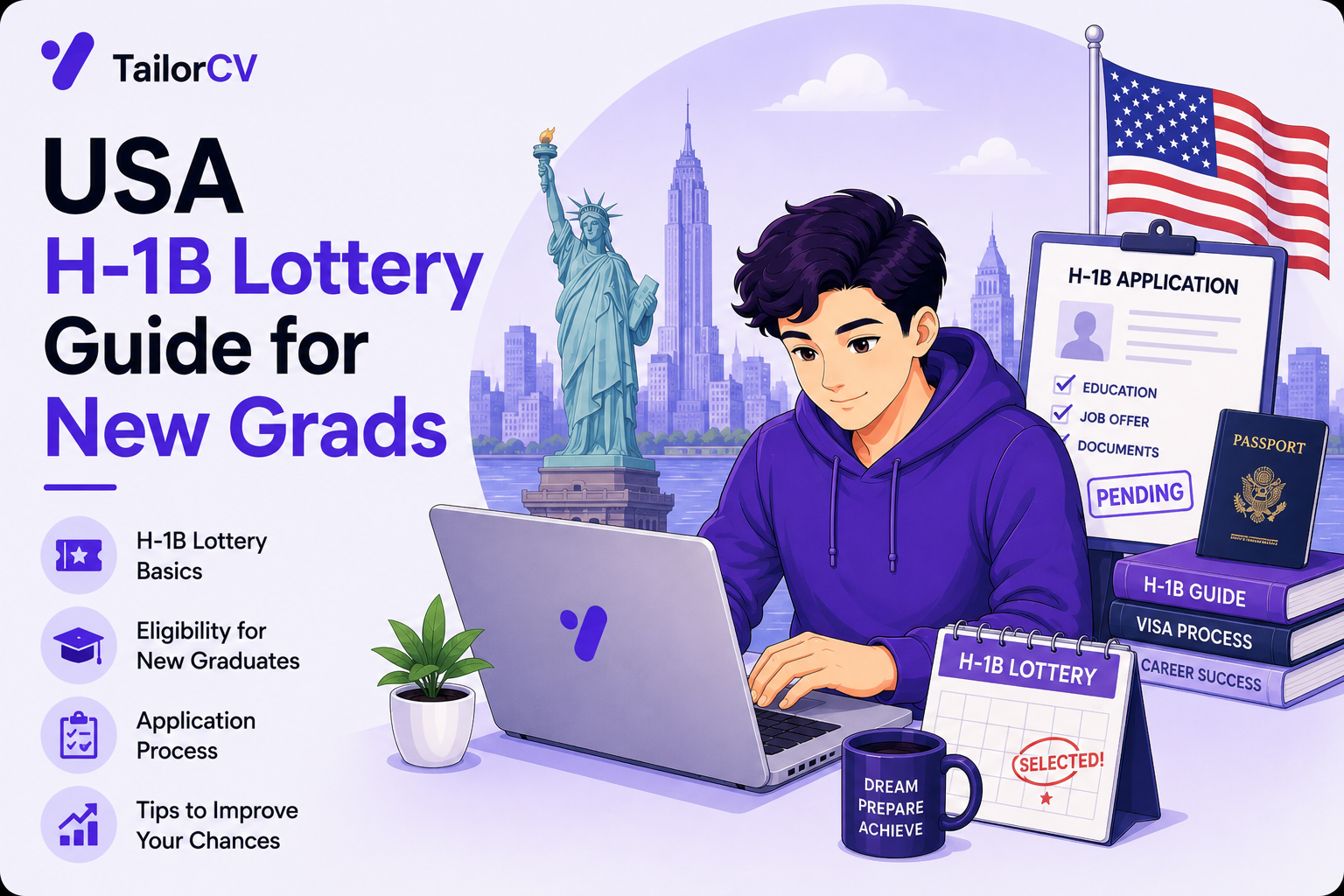
- The H-1B cap is 65,000 general plus 20,000 reserved for US master's degrees or higher, and registration happens once a year in March.
- It is a lottery, not a merit ranking. A stronger candidate does not have better odds within the same pool.
- A US master's degree gets two chances at selection rather than one, which meaningfully changes the arithmetic.
- Cap-exempt employers — universities, affiliated non-profits and some research organisations — can file at any time with no lottery at all.
- Three years of STEM OPT means up to three lottery attempts. One year of standard OPT usually means one.
How the cap actually works
Each fiscal year the H-1B programme has 65,000 visas in the general pool, plus 20,000 reserved for people holding a US master's degree or higher.
Registration runs in March. Employers submit an electronic registration for each candidate. If more registrations arrive than there are visas — which has been the case for years — USCIS runs a random selection. Selected registrations may then file a full petition, and approved workers start on 1 October, the beginning of the federal fiscal year.
Two things follow immediately:
The gap between registration and start is roughly seven months.
You register in March and, if selected, start in October. Your work authorisation has to cover that gap, which is where OPT does the heavy lifting.
Selection is random. Not by GPA, not by salary, not by how much the employer wants you. Within a pool, everyone has the same odds. This is worth internalising because a lot of anxiety goes into trying to "improve your chances" in ways that do not exist.
The master's advantage, explained properly
If you hold a US master's degree or higher, you are entered into both pools.
The mechanics: all registrations go into the general 65,000 selection first. Registrations with an advanced US degree that were not selected then go into the 20,000 advanced-degree selection. So an advanced-degree holder gets two draws; everyone else gets one.
This is why the master's route is so common among international students who intend to stay. It is not that a master's makes you a better candidate in the employer's eyes — it is that it roughly improves your selection odds in a system where the selection is otherwise random.
Note the requirement is a US degree. A master's earned abroad does not qualify for the advanced-degree pool.
Why STEM OPT is the real lever
Because registration happens once a year, the number of times you can enter is decided by how long your work authorisation lasts.
- Standard OPT, 12 months. Realistically one registration. If you graduate in May and start OPT in July, you get the following March. If you are not selected, your authorisation is running out.
- STEM OPT, 36 months total. Three March windows. Three independent draws.
Three attempts versus one is a categorically different position. This is why checking whether your programme is STEM-designated matters more than almost any other administrative decision you make as an international student.
The compounding effect also matters to employers. A company weighing whether to hire you knows that with 36 months of runway they have three shots before the problem becomes urgent. With 12 months they have one, and then a hiring decision to unwind.
Cap-exempt employers: the option most students miss
Not every H-1B is subject to the cap. Cap-exempt employers can file at any time of year, with no lottery.
The main categories:
- Institutions of higher education — universities and colleges
- Non-profits affiliated with or related to a university
- Non-profit research organisations and government research organisations
This covers far more employers than students assume. University hospitals and medical centres, affiliated research institutes, some large non-profits and many academic-adjacent organisations qualify.
Practical consequences:
- There is no March deadline. An offer in July can be filed in July.
- There is no lottery. If you qualify and the petition is approved, you have the visa.
- Pay is often lower than private industry, and this is the honest trade-off.
There is also a concurrent-employment route: someone holding a cap-exempt H-1B can sometimes work for a cap-subject employer simultaneously, though this is complex and needs proper legal advice.
For a graduate facing a second failed lottery, cap-exempt employers are frequently the difference between staying and leaving. They are worth researching before you are desperate.
What happens after you are selected
Selection is not the visa. It is permission for your employer to file a petition, and the process afterwards has its own failure modes worth understanding.
The petition. Your employer's lawyers prepare it — the role, the salary, why it qualifies as a specialty occupation, your qualifications. This is real work and real legal cost, borne by the employer.
The prevailing wage determination. The salary must meet or exceed the official wage level for that occupation in that location. This occasionally forces a salary adjustment, and it is one reason employers sometimes decline to file for lower-paid roles.
Requests for evidence. The agency may come back asking for more, commonly on whether the role genuinely requires a degree in your specific field. A well-prepared petition anticipates this; a rushed one invites it. Responding takes time and legal fees, and it is a normal part of the process rather than a sign of trouble.
The start date. Approved petitions generally take effect on 1 October. Your existing authorisation has to cover the gap between selection in March and that date — which for many graduates means a specific provision that extends work authorisation for those with pending or approved petitions. Confirm the current rules rather than assuming continuity.
The practical implication for you: an employer who has done this before moves faster and makes fewer mistakes. Asking "have you filed H-1B petitions recently, and who handles them?" tells you more than asking whether they sponsor.
Other routes worth knowing about
The lottery dominates the conversation, but it is not the only category, and some graduates qualify for something better without realising.
Country-specific categories. Certain nationalities have dedicated routes with separate, often undersubscribed quotas — an arrangement that exists for a handful of countries under trade agreements. If you hold one of those nationalities, the practical difference is enormous: no lottery, and often a faster process. It is worth checking whether your citizenship opens a category before assuming the general cap applies to you.
Intracompany transfer. If you work for a multinational abroad for a qualifying period, transferring to a US office is a separate route with no annual cap. This is why a graduate job at a multinational's overseas office is a genuine strategy rather than a consolation prize.
Extraordinary ability categories. A high bar, but not as unreachable as the name suggests for people with genuine publications, patents, awards or press. Rarely relevant straight out of an undergraduate degree; occasionally relevant for research-heavy graduates.
Cap-exempt employers, covered above, which remain the most overlooked option.
You are not expected to know which applies to you. You are expected to ask an immigration lawyer once rather than assuming the lottery is the only door — a single consultation is cheap relative to a year of your life.
Planning around March
Because registration is annual, your calendar has one fixed point and everything else arranges around it.
Autumn before. Be employed, or deep in a process, with an employer who will register you. This is why the recruiting timeline matters so much for international students: an offer accepted in April misses that March entirely.
January and February. Confirm with your employer that they intend to register you. Do not assume. Ask explicitly, in writing, and ask who is handling it.
March. Registration. Nothing for you to do but confirm your details are correct.
Late March. Results. If selected, the petition process begins. If not, you have eleven months to change your position before the next window — which is enough time to move to a cap-exempt employer, or to a company more willing to file.
The rest of the year. If you were not selected and your authorisation is finite, this is when to explore the alternatives rather than waiting and hoping.
What this means for your job search
Prioritise employers who have done this before. A company with an established immigration process is dramatically easier than one where you are the first case. Ask directly whether they have sponsored H-1B previously.
Know that timing is fixed. March registration is not negotiable, so an offer accepted in April means waiting nearly a year for the next window. If you are choosing between offers and one employer can register you this March, that has real value.
Do not lead with visa status in applications. Your resume should carry evidence of your work, not your immigration status. Sponsorship comes up during the process and should be handled when the question is asked, not pre-emptively in a document that is being machine-screened.
Apply early and broadly. Because sponsorship narrows your employer pool, you need more applications in flight than a domestic classmate, and earlier — the autumn recruiting window is where the structured roles are. Tailoring each application still matters; volume without targeting produces the same rejection at scale, and a tailored resume is what gets past the first screen.
Realistic alternatives if the lottery does not go your way
This is worth planning before March rather than after.
- Cap-exempt employment, as above.
- A second or third lottery attempt if STEM OPT gives you the runway.
- Transfer to another status — some graduates move to further study, though this should be a considered decision and not a reflex.
- Work for the same employer abroad. Multinationals sometimes place graduates in another office, which can later support an L-1 transfer after qualifying employment.
- Other countries. Canada, the UK and Singapore all have graduate routes that are considerably less lottery-dependent, and plenty of people build strong careers via that path.
None of these are consolation prizes. They are ordinary routes that a large number of people take.
Choosing an employer with the lottery in mind
If you intend to stay, the sponsorship question should influence which offers you pursue, not as the only factor but as a real one alongside salary and team.
Questions worth asking before you accept:
"Have you filed H-1B petitions in the last two years, and roughly how many?"
A company that files regularly has counsel, process and precedent. A company that has never filed is being asked to build all three for you.
"Who handles immigration, in-house or outside counsel?"
Either is fine. Neither, at a company that says it sponsors, is a warning.
"Would you register me in the first March after I join?"
Some employers wait a year. That silently costs you an attempt, which for a graduate on standard OPT may be the only one you get.
"Do you cover the legal fees?"
Most reputable employers do. Being asked to pay is a signal about how the company treats the process.
"Is the role classified in a way that supports the petition?"
A job title that does not obviously require a degree in your field invites a request for evidence. Worth raising gently before the offer is finalised.
None of these are rude questions. They are the questions an employer with a functioning process expects, and the answers tell you as much about the company as about the paperwork.
If you are not selected
Being unselected is the usual outcome rather than the exceptional one, and having a plan before March removes most of the panic.
Check your remaining runway first. How many months of authorisation are left, and does that reach another March? If it does, you have a second attempt and the immediate task is simply to keep working.
Move toward a cap-exempt employer if it does not. Universities, affiliated non-profits and research organisations file year-round with no lottery. Pay is often lower and the certainty is often worth it.
Ask about an overseas placement. Multinationals sometimes move graduates to another office, which can later support an intracompany transfer. That turns a rejection into a two-year detour rather than an ending.
Consider another market seriously. Canada, the UK and Singapore all offer graduate routes that do not depend on a lottery, and work experience in any of them is portable. The four-country comparison sets out what each actually offers.
Do not make the decision at day 85. Every one of these options is easier to arrange with three months of runway than with three weeks.
The employer's side of the decision
Understanding what sponsorship costs an employer explains most of the behaviour you will encounter, including refusals that feel arbitrary.
Filing a petition involves legal fees, government fees, a prevailing wage determination, and staff time from HR and often from the hiring manager. The employer carries all of it, and carries it again for renewals and for a green card process later if you stay.
Against that, they are hiring a graduate whose productivity in year one is limited by definition. The arithmetic is easier for a senior specialist than for an entry-level hire, which is why sponsorship is more common at higher levels.
Three things follow that are useful to know:
Scarcity changes the calculation. Where a company genuinely struggles to hire a skill, the cost of sponsorship is small against the cost of an unfilled role. This is why technical and specialist positions sponsor more readily than general graduate programmes.
Precedent lowers the cost. The tenth petition is far cheaper in effort than the first. An employer who files routinely has templates, counsel and a process; one who has never filed is being asked to build all of that for a single hire.
Timing matters to them too. An employer weighing a March registration is committing before they have seen you work. An intern who converts is a known quantity, which is one more reason the internship route is the strongest path for international students.
None of this means you should be apologetic. It means you should be able to hold the conversation from their side of the table, which is what separates a candidate who seems like a risk from one who seems like a professional.
Common Mistakes
- Assuming a strong profile improves lottery odds. It does not. Selection is random within the pool.
- Not verifying STEM eligibility early. The extension is what buys extra attempts, and it is checked by CIP code, not by how technical the subject sounds.
- Ignoring cap-exempt employers entirely. No lottery and no fixed deadline is a significant structural advantage most students never explore.
- Waiting for an employer to raise sponsorship. By the time it surfaces at offer stage, you have already spent weeks on a process that may not be viable.
- Choosing an offer without asking about their sponsorship history. "Do you sponsor?" and "have you actually done it, and how recently?" are different questions.
- Treating a failed lottery as the end. It is a common outcome with several ordinary routes out of it.
What the lottery does to your decision-making
The randomness has a psychological cost that is worth naming, because it distorts choices in predictable ways.
It encourages over-optimising the controllable. Students spend enormous energy on things that do not affect selection odds, because the thing that does affect them cannot be influenced. Perfecting a resume is useful for getting hired; it does nothing for the draw.
It encourages fatalism. The opposite error. Because the lottery is random, some people conclude the whole enterprise is random, and stop doing the work that genuinely compounds: the STEM extension, the employer choice, the cap-exempt option, the second and third attempts.
The accurate framing is that you control the number of draws you enter and the quality of the petition once selected, and you control neither the draw itself nor the odds within it. That is a smaller surface than people want and larger than they fear.
Practically: make the decisions that add attempts, then stop thinking about March until March.
Green cards, briefly, because it changes the timeline
Most graduates think about the H-1B as the destination. For anyone intending to stay long term it is a waypoint, and the next step affects decisions you make now.
The H-1B is a temporary status with a maximum duration. Permanent residence is a separate, much longer process that the employer usually initiates, and which can take years depending on your country of birth. Applicants from countries with high demand face substantially longer waits than others for the same category.
Two implications for a graduate:
Ask whether the employer sponsors permanent residence, not just H-1B.
Some sponsor the temporary status and decline the permanent process, which leaves you renewing indefinitely and unable to change employers easily. "Do you support green card applications, and at what point in someone's tenure?" is a fair question at offer stage.
Your country of birth matters more than your citizenship. Backlogs are allocated by country of birth, and for some applicants the wait is long enough to make the whole calculation different. This is worth understanding early rather than discovering at year four.
None of this should stop you taking a good job. It should inform whether you treat the US as a five-year plan or a twenty-year one, and that changes which offers are worth taking.
Frequently Asked Questions
What are my actual odds in the H-1B lottery?
They vary year to year with registration volume and are not fixed. What is reliable: an advanced US degree gets two draws instead of one, and more years of work authorisation means more attempts. Both are within your control in a way the odds themselves are not.
Does my employer's size or prestige affect selection?
No. Selection is random. A large employer may have a more practised legal process, which affects the petition quality after selection, but not the draw itself.
Can I be registered by more than one employer?
Yes, if the offers are genuine. Multiple registrations from unrelated employers are permitted. Duplicate registrations by related entities for the same person are not, and are policed.
What happens if I am not selected?
Your OPT continues if it has time left, and you can try again the following March if your authorisation covers it. If it does not, options include cap-exempt employers, further study, or moving to another country's graduate route.
Is a US master's worth doing purely for the lottery odds?
It genuinely improves selection odds and gives another OPT period, so the effect is real. Whether it justifies the cost and time is a personal calculation, and it is worth being honest that this is the main reason many students do it.
Do I need STEM OPT to get an H-1B?
No — you can be selected during standard OPT. STEM OPT does not change your odds in any single lottery; it changes how many lotteries you can enter before running out of authorisation.
What is your resume scoring right now?
Scan it against a job description and get your ATS match score in about a minute.
Drop your resume here or choose a file
PDF only. Max 2 MB.
We never share your data or use it to train AI models.

Was this guide useful?
Be the first to rate it.