SS
SS
Key Takeaways
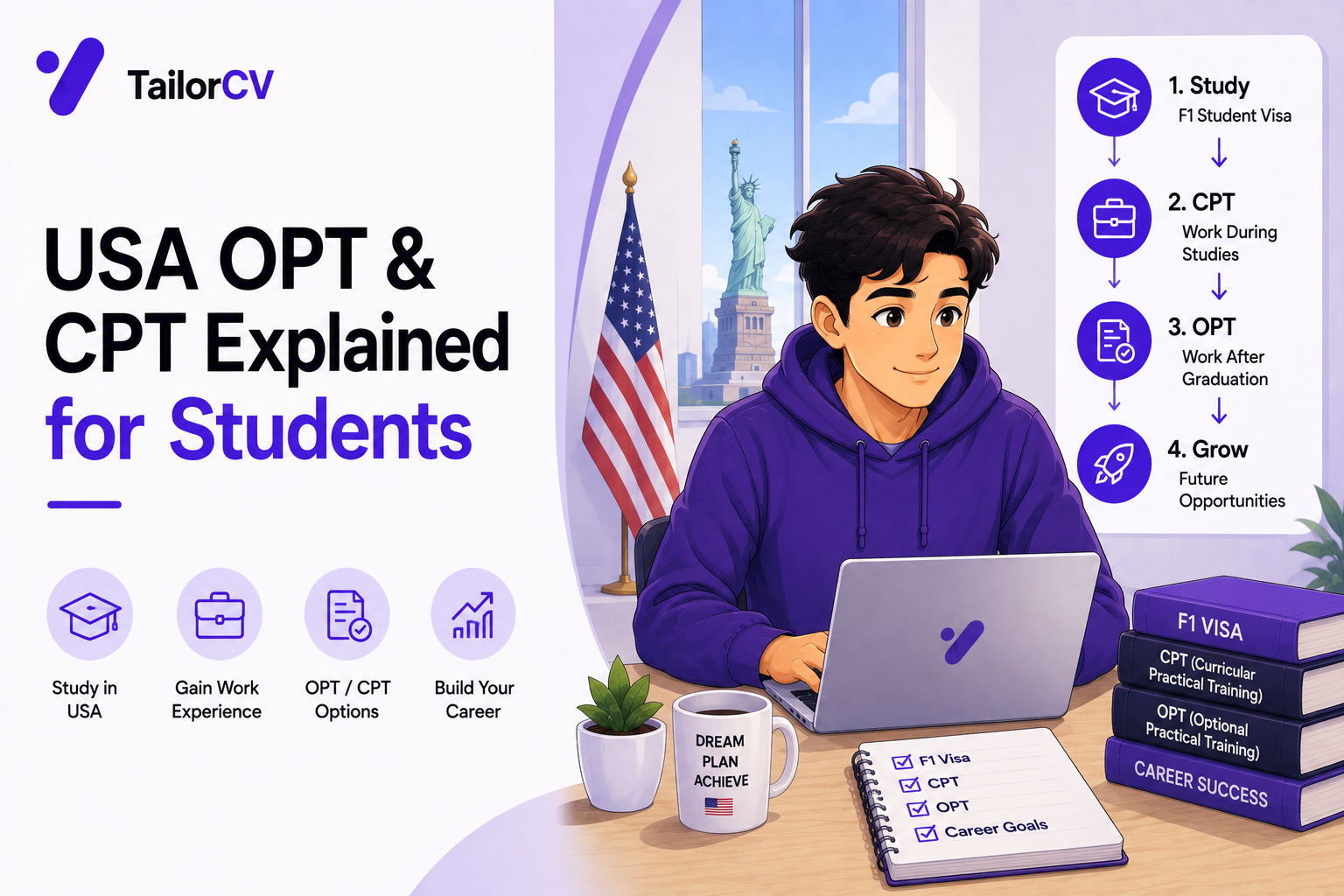
- CPT is for work during your programme and is tied to your curriculum; OPT is for work during or after it and is not tied to a specific employer.
- OPT gives 12 months. A qualifying STEM degree can extend that by a further 24 months, which is the single biggest factor in an international student's US job odds.
- On post-completion OPT you may not accumulate more than 90 days of unemployment. This is a hard clock, and it starts whether or not you are ready.
- Twelve months of full-time CPT eliminates your OPT eligibility. Part-time CPT does not.
- Your Designated School Official is the authority on your specific case. This article explains the shape of the rules, not your individual situation.
The distinction in one paragraph
CPT is work authorisation attached to your academic programme. It exists because the work is part of your curriculum — an internship that earns credit or is required by your degree. Your school authorises it, and it is employer-specific.
OPT is work authorisation attached to your degree field rather than to a course. It is granted by USCIS, not your school, and it is not tied to one employer. You can use part of it before graduating (pre-completion) or, far more commonly, after (post-completion).
The practical difference students care about: CPT is for the internship during your degree, OPT is for the job after it.
CPT, in detail
CPT must be an integral part of your established curriculum. In practice that means either the work earns academic credit, or your programme requires it for the degree.
Key mechanics:
- Employer-specific. Your authorisation names one employer. Change jobs, and you need a new authorisation.
- Authorised by your school, through your DSO, not by USCIS. It is faster than OPT for that reason.
- You must have completed one academic year before becoming eligible, with narrow exceptions for programmes requiring immediate work.
- Part-time is 20 hours or fewer per week; anything above is full-time.
The 12-month trap
This one catches people every year. Twelve months or more of full-time CPT makes you ineligible for OPT. Not reduced — eliminated.
Part-time CPT does not carry this penalty regardless of duration. So a student who works part-time CPT for two years keeps full OPT eligibility, while a student who works full-time CPT for exactly twelve months has lost it entirely.
If you are approaching heavy CPT use, count the months carefully before accepting another term. Trading OPT for a slightly better internship is almost never worth it, because OPT is what carries you through the job search after graduation.
OPT, in detail
Post-completion OPT gives 12 months of work authorisation in your field of study.
What matters practically:
- Not employer-specific. You can change jobs without new paperwork, provided the work relates to your field.
- You apply to USCIS, and processing takes months. This is why the application window matters so much.
- You can apply up to 90 days before your programme end date, and up to 60 days after. Apply early — processing delays are common and your start date is not flexible.
- Work must relate to your degree field. This is checked loosely in practice but is a real requirement.
The 90-day unemployment clock
On post-completion OPT you may not accumulate more than 90 days of unemployment. Exceed it and you fall out of status.
Things students misunderstand about this:
- The clock starts on your OPT start date, not on graduation, and not when you begin looking.
- Days accumulate whether or not you have applied for anything. There is no pause for effort.
- Part-time work counts as employed for this purpose if it is more than 20 hours per week and related to your field.
- Unpaid work can count, if it is genuinely related and meets the hour threshold — but document it.
Ninety days sounds generous until you map it against the US campus recruiting calendar. A May graduate whose OPT starts in July is out of days by early October — which is precisely when autumn recruiting for the following year is happening, not when employers are filling immediate seats. This mismatch is the core structural difficulty for international students, and it is why applying during your penultimate year matters so much more for you than for domestic classmates.
STEM OPT: the 24-month extension
If your degree is on the official STEM designated degree programs list, you can apply for a 24-month extension, giving 36 months total.
Why this is decisive:
- Three years of authorisation means you can be entered into the H-1B lottery multiple times rather than once. Given the odds, multiple attempts change the outcome materially.
- Employers know this. A candidate with 36 months of runway is a substantially easier hire than one with 12, because the company has time before the sponsorship decision becomes urgent.
Requirements that differ from standard OPT:
- Your employer must be enrolled in E-Verify. Many small companies are not, which quietly rules them out.
- A formal training plan (Form I-983) must be completed with the employer. Some smaller employers will not do the paperwork.
- The unemployment allowance increases — an additional 60 days across the extension period.
Check the list, do not assume
The STEM list is specific and based on the CIP code of your programme, not on whether the subject sounds technical. Some business analytics and economics programmes qualify; some computer-adjacent programmes do not. Ask your DSO for your programme's CIP code and check it against the current list rather than assuming.
A worked timeline
Abstract rules are hard to plan against, so here is the shape of a typical year for a spring graduate. Your own dates will differ — this is the structure, not a template to copy.
January. You are in your final semester. OPT applications can be filed up to 90 days before your programme end date, so this is roughly when your window opens. Gather documents now: passport, I-20, previous authorisation records, photos.
February. File. Filing early is the single most useful thing in this list, because processing times are unpredictable and your intended start date is not. An approved authorisation you have not begun using costs you nothing; a pending one on your start date costs you a job.
May. You graduate. Your OPT has not necessarily been approved yet, and you cannot work until it is.
June or July. Approval arrives with a start date on the card. That date is when your unemployment clock begins, not graduation day, and not the day you started looking.
September or October. If you have not started a job, you are approaching 90 accumulated days. This is the pinch point, and it lands precisely when autumn recruiting is filling roles for the following year rather than for immediate start.
Following March. The H-1B registration window. Whether you reach it with authorisation remaining is decided by everything above.
The lesson embedded in that timeline: the search has to begin in your penultimate year, not after graduation. By the time your OPT card arrives you should already be working or deep in a process.
Reporting obligations people forget
OPT is not a permit you receive and then ignore. There are ongoing obligations, and failing them can end your status even while you are employed.
Report your employer. Name, address, start date, and how the work relates to your degree. This is done through the student portal or via your DSO, depending on your school.
Report changes. A new employer, a change of address, a change in your role — these need updating, usually within a short window.
Report periods of unemployment. So the days can be counted correctly.
Keep your own records regardless. Offer letters, pay stubs, job descriptions, dates. Your school's records are not a substitute, and years later — when applying for something that requires your employment history — reconstructing it is genuinely difficult.
Students most often fall down on the change reports. Moving apartment feels unrelated to immigration status. It is not.
Travel, and why it is riskier than it looks
Leaving the country during OPT carries different risk depending on where you are in the process.
Before your OPT is approved. Highest risk. Travelling while the application is pending can create serious complications, and in some circumstances the application can be treated as abandoned.
Approved, but no job yet. Risky. Re-entry generally expects evidence of employment, and arriving without it invites difficult questions.
Approved and employed. The most straightforward case, but you still need the right documents: valid passport, valid visa stamp, your EAD card, your I-20 with a recent travel endorsement, and an employment letter.
The travel signature on your I-20 expires. Getting it renewed before you book is a five-minute task that prevents a very expensive problem.
None of this means you cannot travel. It means the sequencing matters, and the decision should be made with your DSO rather than based on what a friend did last year.
What happens if the 90 days run out
Worth understanding before you are near it, because the options narrow as the clock advances.
Part-time or unpaid work in your field counts if it meets the hour threshold and genuinely relates to your degree. Documented volunteer or research work can preserve status where a paid role has not materialised.
Returning to study changes your status and stops the clock, though it is a significant decision to make under time pressure rather than a convenient reset.
A shorter-term or contract role in your field counts the same as a permanent one for this purpose.
Leaving and returning later is a real option that people treat as a failure. Work experience abroad is portable, and several people who build US careers do so on a second attempt.
The mistake is waiting until day 85 to consider any of this. At day 60, all of these are live options. At day 89, most are not.
How this shapes your job search
The rules are not just paperwork — they change what strategy works.
Apply earlier than everyone else. Sponsorship makes you a slower hire. Being in the pipeline early is worth more to you than to a domestic student.
Filter employers by whether they sponsor. Applying to companies that never sponsor is wasted effort. Many state this on careers pages. For STEM OPT specifically, E-Verify enrolment is a hard filter.
Have your dates ready. When an employer asks about authorisation, a precise answer — how many months you have, what happens after, whether you need sponsorship immediately — reads as competence. Vagueness reads as risk. How to handle the visa sponsorship question in interviews is worth rehearsing before it comes up.
Do not hide your status. It surfaces during the offer process regardless, and discovering it late costs you goodwill you cannot rebuild.
Your resume should not mention visa status — it is not relevant to the screen and takes space from your work. Focus that space on evidence, and make sure the document parses cleanly, since ATS rejection removes you before any human considers sponsorship at all.
Explaining your status to an employer
Most hiring managers do not know what OPT is. Recruiters at large employers usually do; a hiring manager at a fifty-person company frequently does not, and will assume any international candidate means expense and legal risk.
That assumption is wrong for OPT and you should correct it early, in plain terms:
"I'm authorised to work now on OPT — it's a federal work permit tied to my degree, not to an employer. There's no sponsorship, no petition and no cost on your side. It runs through August 2028, and after that I'd need sponsorship."
Three facts, no jargon, and it removes an objection that was never real. Candidates who leave it unsaid lose to domestic applicants for a reason that does not exist.
Two refinements worth knowing:
Do not use the word "visa" for OPT. It sounds like a petition the employer must file. Say "work permit" or "work authorisation."
Separate now from later. Employers conflate "authorised now" with "will need sponsorship eventually." Answering both explicitly, in one sentence, prevents the confusion that kills applications.
If the extension matters to you, the employer requirements are a separate and more demanding conversation — E-Verify enrolment and a training plan, covered in STEM OPT employer requirements.
Paperwork errors that cost weeks
The application itself is where avoidable delays happen. The common failures:
Filing outside the window. Too early is rejected outright; too late can cost eligibility entirely.
Photos that do not meet specification. Rejected applications over photo formatting are more common than they should be.
Requesting a start date you have not thought about. You choose your requested start date, and it sets your unemployment clock. Choosing one too early means burning days before you are realistically going to be working.
An I-20 that has not been updated for the OPT recommendation.
Your DSO must recommend the OPT in the system and issue a new I-20 before you file.
Signature and date errors. Trivial, common, and they restart the clock.
Not tracking the case afterwards. Requests for evidence arrive by post and have deadlines. Missing one is fatal in a way that responding to one is not.
None of this is difficult. All of it is time-sensitive, and the cost of an error is measured in weeks you do not have.
CPT during your degree: getting the sequencing right
Because CPT is authorised by your school rather than by USCIS, it feels administratively light, and students treat it casually. The sequencing decisions you make here constrain everything afterwards.
Do the internship in the summer of your penultimate year. That is when structured programmes run, when conversion to a graduate offer is possible, and when a full-time CPT term is short enough not to threaten your OPT.
Prefer part-time CPT during term. It does not count toward the twelve-month threshold at all, so a part-time research or industry role across two academic years costs you nothing in OPT eligibility.
Count before you accept a second full-time term. Two full summers is usually fine. A summer plus a full-time year-long placement is where people cross the line without noticing.
Get the authorisation before you start. Working before CPT is approved is unauthorised employment, and the consequences are severe and not discretionary. A verbal go-ahead from an employer is not authorisation.
One practical detail people miss: CPT is employer-specific and often role-specific. If the internship changes substantially — a different team, a different manager, a different scope — check whether the authorisation still covers it rather than assuming.
Common Mistakes
- Accumulating 12 months of full-time CPT. It destroys OPT eligibility, and students often discover this after the fact.
- Applying for OPT late. Processing takes months. Applying at the last legal moment means unpaid gaps you cannot control.
- Assuming the 90-day clock starts when you begin job hunting. It starts on your OPT start date.
- Assuming your degree is STEM. Verify the CIP code rather than guessing from the subject name.
- Not confirming E-Verify enrolment before relying on a STEM extension. A job offer from a non-enrolled employer cannot support the extension.
- Taking immigration advice from other students. Rules change and individual cases vary. Your DSO is the authority; forums are not.
A note on advice quality
Immigration rules are the area where bad advice circulates most freely, because everyone has been through some version of it and each version was true at the time.
Three sources worth weighting differently:
Your DSO. Authoritative for your specific case, and the only person who can see your actual record. Their advice supersedes anything here.
Government publications. Authoritative on the rules, and current. Slower to read than a forum post and correct, which is the trade.
Other students and online forums. Useful for the experience of the process, such as how long something took or which employer was helpful. Unreliable on the rules themselves, because the rules changed and nobody updated the post.
The pattern to watch for is confident specificity from someone with no reason to be confident. "You definitely cannot do that" and "everyone does this, it is fine" are both worth verifying before you act on them.
Frequently Asked Questions
Can I work on CPT and OPT for the same employer?
Yes. Many students intern on CPT and then continue with the same employer on OPT after graduating. The authorisations are separate and you must have OPT approved before the CPT work ends.
Does part-time CPT affect my OPT?
No. Only full-time CPT counts toward the 12-month threshold that eliminates OPT eligibility. Part-time CPT of any duration leaves OPT intact.
What counts as employment for the 90-day rule?
Paid or unpaid work related to your field, generally at more than 20 hours per week. Volunteer and unpaid roles can count if genuinely related, but keep documentation — the burden of proof is yours.
Can I be self-employed or freelance on OPT?
It is possible on standard post-completion OPT if the work relates to your field and you can document it properly. STEM OPT is much more restrictive because it requires an E-Verify employer and a formal training plan.
When exactly should I apply for OPT?
As early as the rules allow — up to 90 days before your programme end date. Processing times vary and there is no benefit to waiting. An approved authorisation you have not started using is far better than a pending one on your intended start date.
Can I work for more than one employer on OPT?
Generally yes on standard post-completion OPT, provided each role relates to your field and you report each one. This matters for the unemployment clock — two part-time roles that together exceed the hour threshold can keep you compliant while you look for something permanent. STEM OPT is more restrictive, since it requires an E-Verify employer and a training plan for the qualifying employment.
What counts as "related to my field of study"?
The standard is looser than students fear but not unlimited. The work should draw on what your degree taught you, and you should be able to explain the connection in a sentence. A computer science graduate doing data engineering is obviously fine. The same graduate working in unrelated retail management is not. If you are genuinely unsure, document your reasoning at the time rather than trying to reconstruct it later.
Does an unpaid internship count as employment?
It can, if it genuinely relates to your field and meets the hour threshold, and if the arrangement is lawful in other respects. Document it carefully — the hours, the work, the supervisor — because the burden of demonstrating it falls on you.
What if my employer goes out of business?
Your OPT does not end, because it is not tied to that employer. Report the change, and your unemployment days resume accruing from the end of the job. This is precisely why the open nature of OPT matters, and why it differs from employer-sponsored status where losing the job is a status problem.
Should I apply for OPT even if I have a job lined up?
Yes, and early. The offer does not authorise you to work; the OPT does. Students with signed offers have lost start dates because they filed late and the card had not arrived.
Does travelling abroad affect OPT?
It can, and the rules differ depending on whether OPT is pending or approved and whether you have a job. This is exactly the kind of question to take to your DSO before booking anything, not after.
Find out where a fresher resume stands
Score yours against a real posting - no account, no cost.
Drop your resume here or choose a file
PDF only. Max 2 MB.
We never share your data or use it to train AI models.

Was this guide useful?
Be the first to rate it.