SS
SS
Key Takeaways
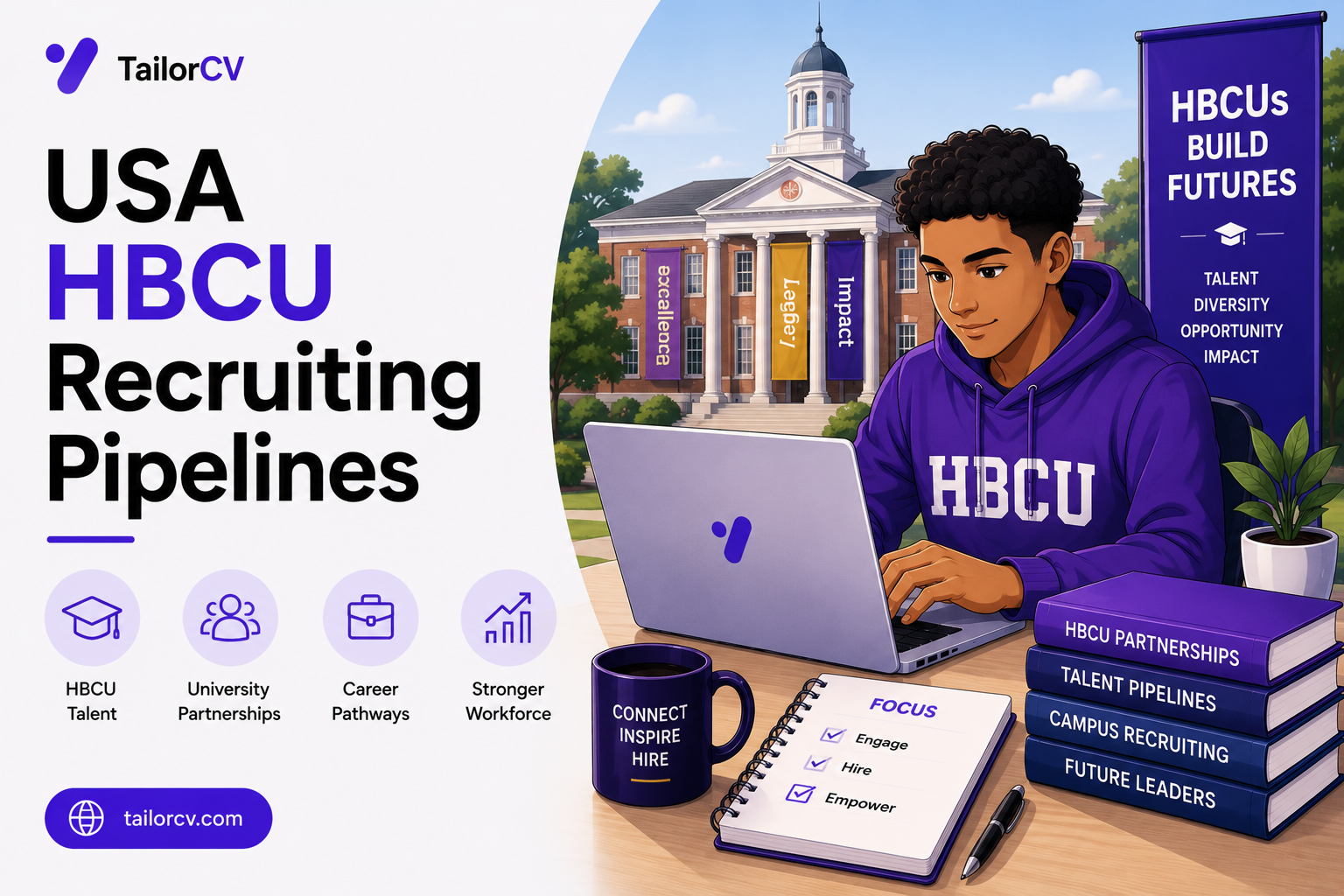
- Many large employers run named, funded pipelines specifically for HBCU students, and the relationships are often deeper than general campus recruiting.
- The pipelines cluster in technology, finance and consulting, and they are frequently less contested than the general applicant pool at the same firms.
- Career fairs, both individual-campus and multi-campus, are a genuine hiring channel here, not a branding exercise.
- Scholarship and fellowship programmes tied to HBCUs often include structured internship placement, and they open earlier than students expect.
- The same general job-search fundamentals apply — a parsing resume, tailoring, outreach — layered on top of channels that are specific to this population.
What the pipelines actually are
Several large employers, particularly in technology, finance and consulting, run named programmes specifically targeting HBCU students. These are not informal gestures — they typically involve dedicated recruiting staff, funded scholarships, structured internship tracks, and direct relationships with specific departments at specific institutions.
Why they exist. Employers building genuinely diverse pipelines have found that general campus recruiting under-reaches this population relative to its size and quality, and they have built dedicated channels to correct it. The scale varies by employer, and at the larger ones it is substantial — sometimes the single largest structured early-career pipeline the employer runs outside its flagship university list.
What this means practically. A student at an HBCU with an engineering, business or computer science programme has access to structured pathways at major employers that a student at a similar-sized non-HBCU institution frequently does not. This is a genuine asset, and it is under-used because students do not always realise how deep the relationship goes at their own institution.
Where to find out what exists. The careers office, without exception, knows which employers have a standing relationship with the school and which have named scholarship or fellowship programmes. This is the single highest-value conversation available to a student in this position, and it is worth having in the first month rather than the final semester.
Where the pipelines concentrate
Technology. Several major technology employers run explicit HBCU-focused engineering and technical scholarship programmes, frequently starting as early as the first or second year, with summer programming built in from the start rather than added later.
Finance. Banks and asset managers run structured analyst pipelines with HBCU-specific components, often paired with named scholarships and a defined summer internship track feeding a full-time offer.
Consulting. Several firms run HBCU-specific recruiting events and sometimes fast-tracked interview processes.
Corporate and government-adjacent employers. Utilities, defence contractors and large industrials frequently maintain relationships that are less visible nationally and very active locally.
What this means for targeting. If your field is one of these, checking whether your specific employer target has a named HBCU programme is worth the search — the application often runs through a different, less contested portal than the general one, even at the same company.
Career fairs and multi-campus events
Structured events specifically serving HBCU students are a genuine hiring channel, not a symbolic one, and they function differently from a general campus fair.
Individual-campus fairs. Employers attending an HBCU career fair have frequently made a deliberate choice to be there rather than at a larger, more generic fair nearby, which means the recruiters in the room are specifically interested in this population.
Multi-campus and consortium fairs. Some events bring together students from several HBCUs to meet a concentrated set of major employers, at a scale an individual campus could not host alone. These are worth travelling for.
National conferences tied to professional societies — engineering, business, technology — frequently run large-scale recruiting alongside the technical programme, and HBCU students are core to their membership.
How to use them. Exactly as you would any career fair: apply online first, research your target employers, prepare a specific opening, and follow up within a day. The difference here is that the recruiters are more likely to have discretion and budget specifically allocated to hiring from this pool, which raises the value of a strong impression.
Scholarships and fellowships with a career attached
A category worth understanding separately from ordinary financial aid, because many of these programmes include structured career placement as a core feature rather than an afterthought.
What they typically include. Funding, a summer internship track running across multiple years rather than a single placement, mentorship from company employees, and — at the strongest programmes — an expectation of a full-time offer on graduation, contingent on performance.
When they open. Often earlier than general internship recruiting, sometimes as early as the first or second year of study, because the employer is investing in a multi-year relationship rather than filling a single summer role.
Why this matters for timing. A student who waits until junior year to start engaging with career services may have missed a scholarship-and-pipeline programme that opened in freshman year. The general timing lesson about starting earlier than feels necessary applies with particular force here.
How to find them. The careers office again, plus direct searches of major employers' diversity and inclusion or HBCU-specific programme pages, plus the professional societies in your field, which frequently administer or co-sponsor these funds.
Applying well, on top of the pipeline
The pipeline gets you access. What happens after is the same as anywhere else.
Tailor the resume to the specific posting, not just to the pipeline's general theme. A document that only says "I am part of this scholarship programme" and nothing about the actual role underperforms one that matches the posting's language.
Confirm it parses. Every employer of size screens with software regardless of which door you came through — an ATS check is worth the minute.
Build a project or evidence base, exactly as any technical or analytical candidate should. Access shortens the path to an interview; it does not replace the interview itself.
Use the mentorship seriously if the programme includes it. A mentor inside the company is a resource almost nobody uses to its full extent — ask specific questions about the team, the process and what to prepare.
Network beyond the programme. Alumni of your institution now at your target employer, whether or not they came through the same pipeline, are worth contacting using the same outreach approach that works anywhere.
Prepare for the same interviews everyone else faces. A pipeline application still goes through the technical loop or the behavioural round that any candidate for the role would face — the door is different; the bar generally is not.
Talking to alumni and mentors properly
The mentorship and alumni access that come with these pipelines are frequently under-used, and the difference between using them well and using them badly is specific.
Come with a real question, not a general request. "What does the first six months on your team actually look like?" produces a useful answer. "Any advice?" does not.
Ask about the interview process specifically. Someone who went through the same pipeline recently knows exactly what to expect, and that information is not published anywhere.
Ask what they wish they had asked at your stage. This single question routinely surfaces the most useful advice of the conversation.
Follow up after any interview you have, whether it went well or not. A mentor who hears nothing until you need something again is a resource being wasted.
Say thank you specifically, referencing what helped. It is a small thing and it is the reason people keep making time for students.
And use more than one connection. A single mentor gives one perspective; three conversations across the same employer give you a much more reliable picture of the actual role and team.
Applying to multiple pipelines at once
Students sometimes assume they must choose one employer relationship to focus on. In practice, running several in parallel is normal and effective.
Track each relationship separately, since deadlines, contacts and requirements differ by employer even when the underlying opportunity type is similar.
Prioritise by fit, not by prestige. A scholarship-and-pipeline programme at a company doing work you find genuinely interesting is worth more than a bigger name attached to work you would not enjoy.
Be honest in each conversation about your other applications if asked. Recruiters running these programmes understand that strong candidates apply broadly, and it is not viewed as a lack of commitment.
Do not let one pipeline's timeline dictate your whole search. If a scholarship programme's decision is delayed, keep the general application channel running rather than pausing everything to wait.
And treat rejection from one pipeline as information, not a verdict. Programmes have limited seats and a strong candidate can be unselected in one and thrive in another — the broader placement-season arithmetic applies here exactly as it does everywhere else.
Preparing for the interview behind the pipeline
Access gets you a conversation. The conversation itself is the same assessment every candidate faces, and preparing for it deliberately is where the pipeline advantage converts into an offer.
For technical roles, the loop is standard. Online assessment, phone screen, then a full technical round covering data structures, algorithms and problem solving out loud. The preparation plan applies without modification — depth on arrays, strings, hash maps, trees and graphs, practised under a timer and solved while narrating.
For finance roles, expect technicals plus a heavy fit component. Accounting fundamentals, valuation basics, and a genuinely good answer to why this firm — the superday structure is the same regardless of which channel brought you in.
For consulting, the case interview is the whole assessment. Twenty to thirty live cases with a partner is the realistic preparation volume, and the case approach covers what separates candidates.
For every one of them, build the behavioural stories. Six of them, covering teamwork, conflict, failure, leading without authority, learning fast, and something you are proud of. The story bank method is the efficient way to do it, and it serves every interview you will face rather than just one.
Use your mentor for the specific version. Someone inside the company who went through the same process recently knows what the rounds actually look like this year, which is information no general guide can give you.
And do not assume the pipeline lowers the bar. In nearly every case it changes how you are found, not how you are evaluated. Candidates who prepare on the assumption that access equals an offer are the ones who are surprised.
When the pipeline is not the right fit
Worth saying plainly, because these programmes are presented as unambiguously good and the fit still matters.
A pipeline at a company doing work you find dull is a fast route into a job you will want to leave in eighteen months. The access is genuine; it does not change whether you would enjoy the role.
A programme with a service commitment — some scholarship arrangements carry an expectation of employment for a defined period — is a real obligation worth reading fully before signing, exactly as with any bonded arrangement.
A location you would not choose is a legitimate reason to decline. Two years somewhere you are unhappy is a real cost, and pipelines rarely offer much flexibility on office.
A function that does not match your strengths. Being recruited into a rotational programme when you know you want technical depth is the rotational trade-off in a different wrapper.
None of this argues against applying broadly. It argues for evaluating an offer from a pipeline on the same terms as any other offer — the work, the team, the trajectory — rather than treating the access itself as the reason to accept.
The general playbook still applies
Everything specific to these pipelines sits on top of the fundamentals, and candidates who lean entirely on the pipeline and neglect the basics underperform candidates who do both.
The resume still has to survive the screen. Every employer of size parses your document before a human reads it, whichever channel you came through. An ATS check is a one-time job that removes an entire category of silent failure.
It still has to match each posting. Tailoring the language to the specific role moves your interview rate more than any single other change, and a pipeline application is not exempt from it.
Evidence still carries entry-level applications. One substantial project that exists and runs outweighs a longer list of coursework, in exactly the way it does for any technical candidate.
Applying early still matters. Some requisitions cap applications within days of opening, and checking career pages weekly during the season is the highest-return routine available.
Referrals still work. Alumni from your institution at your target employer are worth contacting regardless of whether a formal programme exists.
And the spring wave is still there if the autumn produces nothing, which it does for a large share of strong candidates every year.
The pipeline changes how you are found. Everything after that is the same job everyone else is doing, and doing it well is what converts access into an offer.
Building the target list
A practical approach to identifying which employers actually have a meaningful relationship with your specific institution, since "there is a pipeline somewhere" is not actionable on its own.
Start with your own careers office, and ask for it in writing if possible — a list of employers with named scholarships, standing recruiting relationships, or historical hiring volume from your school specifically.
Cross-reference with your department. Engineering, business and computer science departments frequently maintain their own relationships independent of the central careers office, particularly where alumni now work at specific companies.
Search major employers' early-careers and diversity programme pages directly, using the name of your institution or type of institution as a search term.
Ask upperclassmen and recent graduates which employers they interviewed with and how they found the opening — the answer is often a specific named programme rather than the general application.
Check professional society chapters at your school. Many maintain active employer relationships tied to national conference recruiting.
Build a simple two-column list: employers with a confirmed relationship to your institution, and employers you are applying to through the general channel. Prioritise your time on the first column, and treat the second as the baseline every student runs regardless.
What to do in each year
The pipelines reward starting early, so it helps to see what is available at each stage rather than assuming everything happens in junior year.
First year. Find out what exists — the careers office conversation, the scholarship programmes that open this early, and the professional society chapters on campus. Several multi-year employer programmes recruit first-years specifically, and almost nobody applies to them because students assume recruiting starts later.
Second year. Apply to sophomore-focused programmes and insight events, which are frequently the entry point to a junior internship rather than a standalone experience. Attend the career fair even with a thin resume — recruiters remember returning faces.
Third year. The main internship recruiting year, and the one that feeds graduate offers. Apply through both the pipeline channel and the general one where possible.
Fourth year. Full-time recruiting, with a return offer if the internship converted, plus the spring wave if it did not.
Throughout. Build one substantial project, keep the resume parsing cleanly, and treat the alumni network as a standing resource rather than something to activate when you need a job.
The pattern worth noticing: the programmes with the deepest employer investment recruit earliest, which means the students who benefit most are the ones who found out in first year that they existed at all.
Tip: Ask your career centre which employers have dedicated HBCU partnerships. These are separate, smaller pipelines with materially better odds than the general campus process.
Common Mistakes
- Not asking the careers office what exists. Not asking the careers office what exists the single highest-value question and the one most students skip.
- Assuming general recruiting is everything. Assuming general campus recruiting is the whole picture. Named pipelines often run through a separate, less contested channel.
- Starting the search in junior year. Several scholarship-and-pipeline programmes open in the first or second year.
- Treating the pipeline as the whole application. Treating the pipeline as the whole application the interview bar is generally unchanged; access is not the same as an offer.
- Under-using an assigned mentor. Under-using an assigned mentor a resource most candidates never fully exploit.
- Skipping the multi-campus events. Concentrated employer attendance in one place, and often less contested than individual big-city fairs.
Related Guides
Keep building on this with the related guides in this series:
- MBA Internship Recruiting Timeline in the US
- Quant and Trading Campus Recruiting in the US - How the Process Runs
- Spring Recruiting in the US - The Season Most Students Ignore
- Summer Analyst or Full-Time - Which US Recruiting Round Actually Matters
- 401(k) and Benefits Explained for New Graduates
- US Background Checks - What Employers Actually See
You can also check your resume's ATS score for free, generate a tailored cover letter, or build a portfolio website in minutes.
Frequently Asked Questions
Are these programmes only at large companies?
The named, funded ones concentrate at large employers with the budget for multi-year pipelines. Smaller and mid-sized employers rarely run formal programmes and frequently recruit from HBCUs through ordinary channels, which is why running a general application track alongside the pipeline track matters.
Does a pipeline programme lock me into that employer?
Scholarship programmes sometimes carry expectations or commitments; ordinary recruiting relationships do not. Read what you sign, and ask directly whether accepting funding creates any obligation to accept an offer later.
What if I want to work in a field with no obvious pipeline?
Then the standard playbook applies — referrals, early applications, and evidence that speaks for itself. The pipelines are an additional channel where they exist, not the only route into any field.
Should I apply to a pipeline if I am unsure about the industry?
Applying costs little and an early-stage programme is frequently a good way to find out whether the industry suits you before committing a graduate year to it.
Is it worth attending a career fair at another institution?
Where multi-campus or consortium events exist, yes — they concentrate employers in one place at a scale a single campus cannot match, and travelling for one is frequently worth it. Check what your careers office knows about regional and national events, not just your own.
How do I find out what pipelines exist at my school?
Start with careers services and ask specifically about named HBCU or diversity scholarship and pipeline programmes with your target employers. Then check the diversity or early-careers pages of individual companies directly.
Are these programmes only for certain majors?
They concentrate in technology, finance, consulting and engineering, but exist across many fields including business, communications and the sciences. Check specific employer pages for your field.
Does the pipeline guarantee a job?
No. It generally provides earlier access, sometimes a fast-tracked process, and often a mentor — the actual interview bar is usually the same as the general applicant pool.
Should I still apply through the general channel too?
Yes. Applying through both where possible, or asking the recruiter which is more appropriate for your situation, is sensible and not viewed as duplicative.
What if my school does not have strong pipeline relationships?
Direct outreach and application still work. Search individual employers' HBCU-specific programme pages directly, since some programmes are open to students from any HBCU rather than a specific list.
Do these pipelines help with graduate school too?
Some do — several employer and professional-society programmes include funding or placement support for graduate study alongside the career track, particularly in engineering and the sciences.
What is your resume scoring right now?
Scan it against a job description and get your ATS match score in about a minute.
Drop your resume here or choose a file
PDF only. Max 2 MB.
We never share your data or use it to train AI models.

See what your portfolio could look like
This theme is built straight from your resume — pick one and your portfolio is live in minutes.
Was this guide useful?
Be the first to rate it.