 SS
SS
Key Takeaways
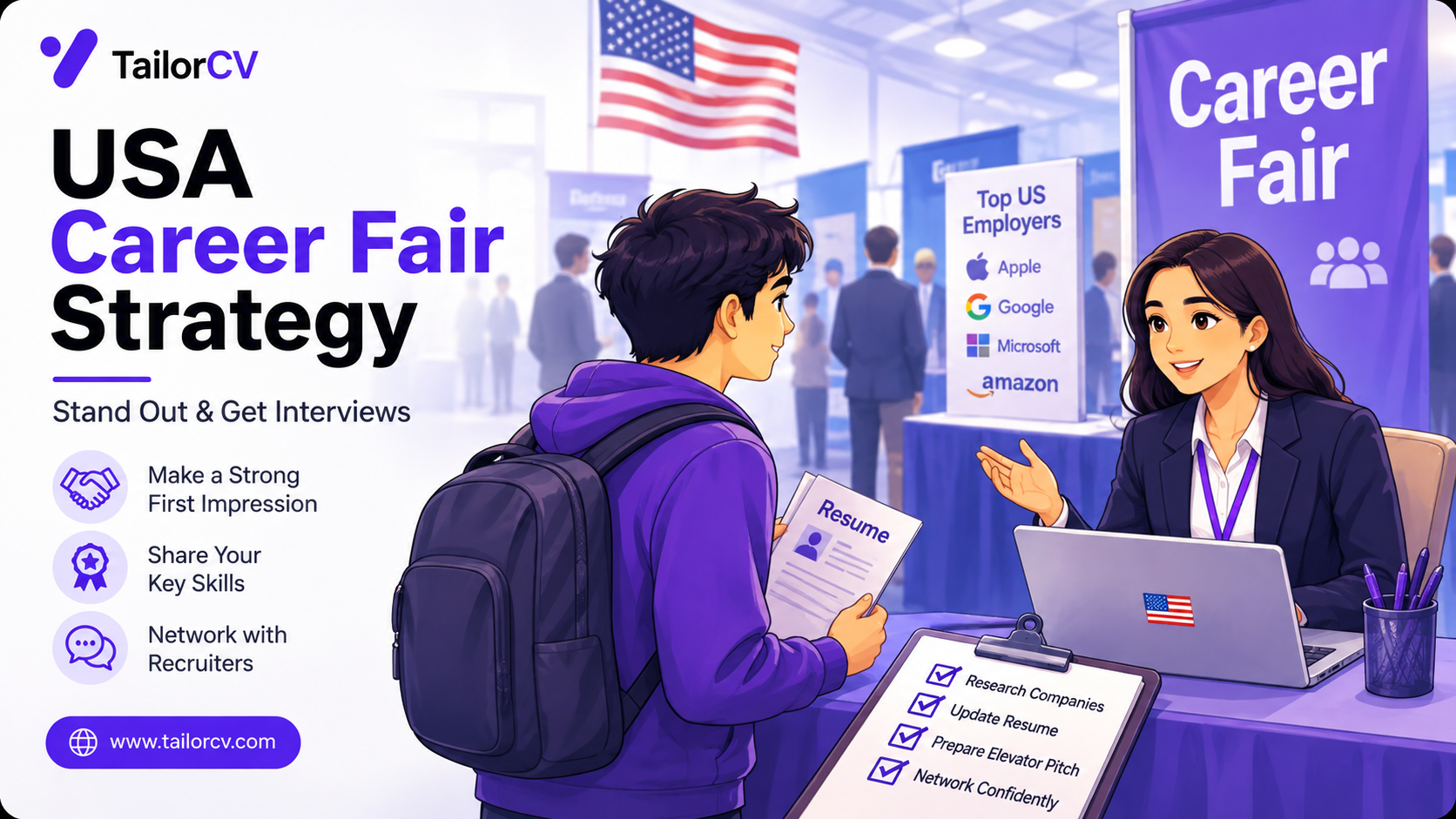
- Apply online before the fair. Most large employers use the fair to meet candidates already in their system, not to collect new ones.
- Recruiters take brief notes and move on. Your goal is to be memorable in one specific way, not to be liked in general.
- Target ten to fifteen employers deliberately rather than walking every aisle collecting merchandise.
- The follow-up within 24 hours is the step that converts a conversation into an interview, and most students skip it.
- Fairs matter far less than the online application for some employers and far more for others. Ask which.
Before: the work that decides the outcome
Apply online first. This is the single highest-value preparation step. Large employers open applications in August, screen continuously, and use the fair to put faces to resumes already in the pipeline. Arriving without having applied means the recruiter has nothing to look up afterwards.
Get the employer list and cut it down. Most fairs publish attendees in advance. Ten to fifteen deliberate targets beats forty drive-bys. Sort them into three groups: must-speak, worth-speaking, and skip.
Check who sponsors, if that applies to you. International students waste a lot of fair time on employers who will not sponsor. Filtering in advance is more useful than any conversation technique — the visa sponsorship question is better resolved before you queue for twenty minutes.
Research three specifics per must-speak employer. Not the mission statement — something concrete. A product they shipped, a team you would want to join, a technology in their stack. Three facts is enough to ask a question nobody else at the fair is asking.
Print resumes, but expect them to be scanned. Bring more than you think. Many recruiters scan a QR code or ask you to apply online instead; the printed copy is a prop that structures the conversation as much as a document they keep. Make sure the version you bring is the one that passes an ATS check, because that is the copy that gets uploaded.
During: what recruiters are actually doing
Understand the recruiter's day. They will speak to somewhere between fifty and two hundred students, standing, for six hours. They remember almost none of it without notes.
What they write down is short: name, school, major, graduation date, and one line about you. Your entire objective is to control what that one line says.
Lead with something specific. "Hi, I'm Priya, I'm a junior in computer science — I applied for your data engineering internship last week and I wanted to ask about the team that works on the ingestion pipeline." That gives them a name, a role, and a reason to remember you.
Compare with "Hi, can you tell me about your company?" That produces the recruiting pitch and a line in their notes that reads: asked what we do.
Ask a question that shows preparation. The best questions are ones the recruiter cannot answer from the brochure. "Do interns on the platform team work on the same codebase as full-time engineers, or on separate projects?" gets a real answer and marks you as someone who has thought about the work.
Keep it to three to five minutes. Queues form. Recruiters notice who monopolises time and who is considerate of it. Leaving on a high note is better than being asked to wrap up.
Get a name and a contact. Ask for a business card or the recruiter's name and email. Without this, follow-up is guesswork.
Ask what happens next. "What's the best next step from here?" produces actionable information: apply online, watch for an assessment, contact a specific person. It also tells you how much the fair actually matters at that company.
What to wear, briefly
Business casual is the safe default at most US university fairs — trousers or a skirt, a collared shirt or blouse, closed shoes. Banking and consulting skew formal; startups and many tech companies do not care at all.
Nobody has ever been rejected for being slightly overdressed. Being visibly underdressed at a finance table does get noticed. If the fair is industry-mixed, dress for the most formal employer on your must-speak list.
After: the step that converts
Follow up within 24 hours. This is where most students lose the value of the fair entirely. A short email while the recruiter still remembers the conversation is worth more than the conversation was.
What it should contain:
- Where you met and roughly when
- One specific detail from the conversation, so they can place you
- What you have done since — usually "I submitted my application for the X role"
- A short, clear ask
"Hi Marcus — we spoke at the Georgia Tech fair yesterday about the ingestion pipeline team. I've now applied for the data engineering internship (req 4471). If it's useful, I'd be glad to send the project I mentioned where I processed the transit dataset. Thanks for the time."
Four sentences. Specific, actionable, no pressure.
Track everything. By November you will not remember which of thirty conversations was which. Name, company, role, date, what was discussed, what you promised to send. A spreadsheet is fine.
Do what you said you would. If you offered to send something, send it that day. This is a surprisingly effective differentiator, because most people do not.
When fairs matter and when they do not
Ask recruiters directly: "Is the fair part of your screening process, or should I focus on the online application?"
Answers vary honestly and usefully. At some employers, fair conversations feed directly into interview selection. At others, the fair is branding and every candidate goes through the same online funnel regardless.
Where fairs matter less, your effort belongs in the autumn application window and in referrals. Where they matter more, prepare properly for a handful of employers rather than spreading thin.
Smaller employers at fairs are systematically underrated. The queue at the famous company is ninety minutes; the regional firm with real openings and no queue will have a ten-minute conversation with you and remember it.
The thirty-second opening, written out
The single most decisive thing at a fair is what you say in the first thirty seconds, because the recruiter is deciding within it whether to keep talking or hand you a flyer.
What most students say:
"Hi, I'm a junior studying computer science and I'm really interested in learning more about opportunities at your company."
Nothing here distinguishes you from the two hundred people the recruiter has already met. There is no hook, no specificity, and nothing to write on the back of your resume.
What works better:
"Hi, I'm Priya, senior in CS. I applied for your data engineering new grad role last week — requisition 4471. I built a pipeline last spring that dedupes job postings across fifteen boards, and the deduplication problem is basically the same one your ingestion team wrote about on your engineering blog. I wanted to ask how that team handles source conflicts."
Thirty seconds, and it contains: a name, a specific role already applied to, one concrete piece of evidence, evidence of research, and a real question. The recruiter now has something to write down.
The structure, generalised: name and year → the specific role you applied to → one concrete thing you made or did → one specific question about their work.
You will not deliver it perfectly and it does not matter. Having the four beats prevents the drift into generic enthusiasm, which is the actual failure mode.
What to have ready alongside it: the requisition number, printed resumes you expect to be scanned rather than read, and a phone note with the names of everyone you spoke to.
The follow-up, which almost nobody sends
The step that converts a conversation into an interview, skipped by the large majority of students, which is exactly why it works.
Within 24 hours, while the recruiter can still place you. After a week, they cannot.
To a named person. Get a card, or ask "what is the best email to follow up on?" before you walk away. Without a name, this step is impossible, which is why getting one is worth the small awkwardness.
Reference the specific thing you discussed. Not "thank you for your time" — "you mentioned the ingestion team handles source conflicts by preferring the most recently updated record, which is the opposite of what I did." That sentence proves you were listening and reminds them who you were.
Restate the role and requisition number, so they can find your application.
Attach the resume again. They collected two hundred and yours is in a stack.
Do what you said you would. If you offered to send a link to your project, send it in that email. A meaningful number of students promise and never do, and the recruiters remember.
One follow-up, then stop. A second is fine after two weeks if there was a concrete next step discussed. A third is not.
Four sentences, five minutes, and it is the highest-conversion activity of the entire day.
What the recruiter is actually doing
Understanding the other side of the table changes what you do at it.
They are meeting between one hundred and three hundred people.
By hour three they have heard the same opening approximately two hundred times. This is not indifference; it is volume.
They are taking two-word notes. On the back of your resume or in an app: "CS senior, pipeline project, strong" or "junior, no specifics". That note is the entire artefact of your conversation. Everything you say is compressed into it, so the goal is to be memorable in one specific way
rather than generally likeable.
Many of them are not recruiters. A large share of booth staff are engineers, analysts and managers doing a rotation, often alumni. They frequently have no ability to advance your application — but they can absolutely tell a recruiter "talk to this person", and they are far more responsive to a genuine technical question than to a polished pitch.
They cannot hire you at the table. No decision is made there. What can happen is a note, a business card, a referral, or an on-campus interview slot. Those are the realistic outcomes and each is worth having.
They are looking for reasons to remember you, not reasons to reject you. The bar for standing out is much lower than students imagine — a specific project, a real question, and a follow-up email puts you ahead of most of the room.
They notice the obvious things. Turning up in the last twenty minutes, asking what the company does, taking merchandise and leaving, having a parent with you. These sound like trivia and they are what gets mentioned afterwards.
Virtual fairs
Increasingly common, run differently, and generally under-exploited because students treat them as a worse version of the in-person event.
The format. Usually a scheduling platform with short one-to-one slots, plus group sessions. Slots are booked in advance and they fill.
Book the moment booking opens. This is the whole game. Popular employers fill within hours, and there is no equivalent of turning up and queuing.
Slots are shorter and stricter. Ten minutes, hard-stopped by the software. Your opening matters more here than in person, because there is no small talk to recover from.
Your setup is being assessed whether or not anyone intends to.
Camera at eye level, light in front of you, plain background, a wired connection if you have one. Two of these are free and the difference is visible.
The chat is a real channel. Group sessions have a question box, and a specific well-phrased question gets you noticed by the person running it. Most attendees never type anything.
Follow up the same day, because virtual conversations blur faster than in-person ones and the recruiter has no resume in their hand to jog the memory.
The genuine advantage: distance is irrelevant. A student at a non-target school far from an employer's campus can attend a virtual fair on equal footing, which is not true of the physical version.
Common Mistakes
- Not applying online beforehand. Leaves the recruiter with no record to attach you to.
- Asking what the company does. Signals zero preparation and produces a forgettable note.
- Collecting merchandise instead of contacts. A tote bag is not a lead.
- Talking for fifteen minutes. Recruiters remember who ignored the queue.
- No follow-up. The most common and most costly omission.
- Leaving without a name. Without a contact, follow-up goes to a generic inbox.
- Only visiting famous companies. Long queues, low conversion, and the accessible employers go unspoken to.
Working the room
A fair is three to four hours and the failure mode is drifting through it. A plan turns it into something closer to a shift.
Cut the list to ten to fifteen. Get the employer list beforehand and split it into must-speak, worth-speaking and skip. Trying to visit forty booths produces forty forgettable conversations.
Do a warm-up. Start with two employers you are lukewarm about. Your first conversation of the day is always the worst one, and it should not be spent on your top choice.
Go to your top targets in the middle of the morning. The queues are shortest at opening and the recruiters are freshest, but you want one or two conversations behind you first. Late afternoon is the worst slot — recruiters have met three hundred people and are running on autopilot.
Watch the queues rather than joining them. A twenty-minute queue for a three-minute conversation is usually a poor trade when a comparable employer two aisles over has nobody waiting. The less-crowded booth frequently belongs to a company that hires more people.
Take notes between conversations, not after the fair. Names blur within an hour. Thirty seconds on your phone after each conversation is what makes the follow-ups possible.
Eat and sit down halfway through. Performance in hour three is visibly worse than in hour one, and everyone who skips this discovers it.
Ask one question at every booth: "how much does this fair actually factor into your process?"
The answers vary enormously — some employers treat it as a genuine screen, others as pure branding with all real hiring done online. Knowing which is which tells you where to spend the follow-up effort.
What to wear, and other practicalities
Dress. Business casual is right almost everywhere. Finance and consulting booths skew more formal; technology employers do not care. Being slightly overdressed is a non-event; being visibly underdressed at a banking table is not. If genuinely unsure, ask what students wore last year.
What to carry. Fifteen to twenty printed resumes, a folder that keeps them flat, a pen, a phone with a charged battery, and water. Not a backpack you have to swing off your shoulder at every table.
What not to carry. The accumulated merchandise. Students end up managing three bags of branded objects instead of managing conversations.
Do not go with friends. Groups approach booths together, one person talks, and the recruiter cannot tell you apart. Split up and compare notes afterwards.
Have your phone note ready with your three-line opening and your target list, so you can glance at it while queuing rather than improvising.
When fairs matter, and when they do not
Worth calibrating, because students either over-invest or dismiss them entirely.
Fairs matter most for smaller and mid-sized employers, regional companies, government agencies, and any employer where a person reads applications. Here a conversation genuinely changes your odds.
Fairs matter least for the largest technology employers, where hiring runs through a standardised online funnel and the booth is a branding exercise. The recruiter at that table frequently has no influence on your application at all.
Fairs matter unusually much at institutions where employers do on-campus interviews, because the fair is often the screen that decides who gets an interview slot the following week.
For non-target schools, fairs are disproportionately valuable, because they are one of the few settings where you are a person rather than a filtered application.
The practical rule: ask each employer directly how the fair connects to their process, then allocate your follow-up energy accordingly. And regardless of the answer, apply online first — most large employers use the fair to meet candidates already in their system, and "I applied last week" is a materially better opening than "how do I apply?"
A checklist for the week around the fair
Seven days before. Get the employer list. Cut it to ten to fifteen. Check which of them sponsor, if that applies to you — the enrolment question determines whether some of these employers were ever realistic.
Five days before. Apply online to every must-speak employer. "I applied last week" is a materially stronger opening than "how do I apply?", and most large employers use the fair to meet people already in their system.
Three days before. Research three specifics per must-speak employer — a product, a team, something recent. Write them in a phone note. Confirm your resume parses cleanly, because it will be scanned rather than read.
Two days before. Print twenty copies. Write your thirty-second opening and say it aloud five times.
The day. Arrive early, warm up on two lukewarm employers, hit your top targets mid-morning, take notes between conversations, eat halfway through.
Within 24 hours. Follow-up emails to everyone whose name you got. This is the step that converts, and it is the one most people skip.
One week after. Update your tracker with statuses. Send a single follow-up where a concrete next step was discussed and nothing has happened.
The whole thing is maybe four hours of preparation spread over a week, and it is the difference between a fair that produces two interviews and one that produces a tote bag.
Frequently Asked Questions
Do I need to bring printed resumes?
Bring them. Many recruiters will direct you to apply online instead, but the printed copy structures the conversation and some still collect them. Ten to fifteen is usually enough.
What if I have not decided what I want to do?
Say so honestly but narrow it to a direction. "I'm deciding between data and backend work" is fine; "I'm open to anything" gives the recruiter nothing to write down.
Should I go to fairs in my first year?
There is little downside and some value in seeing how they run before it matters. Do not expect roles — most fair recruiting targets penultimate-year students.
How do I follow up without an email address?
Ask at the table. Failing that, LinkedIn works — a connection request with a short note referencing the conversation is acceptable and often answered.
Is a virtual career fair worth attending?
Usually yes, and often less competitive because attendance is lower. The mechanics are the same: apply first, prepare specifics, follow up. Queue dynamics are gentler.
What if I am nervous talking to recruiters?
Prepare a two-sentence opening and rehearse it aloud. Nerves fall away after the third conversation, so start with an employer from your worth-speaking list rather than your top choice.
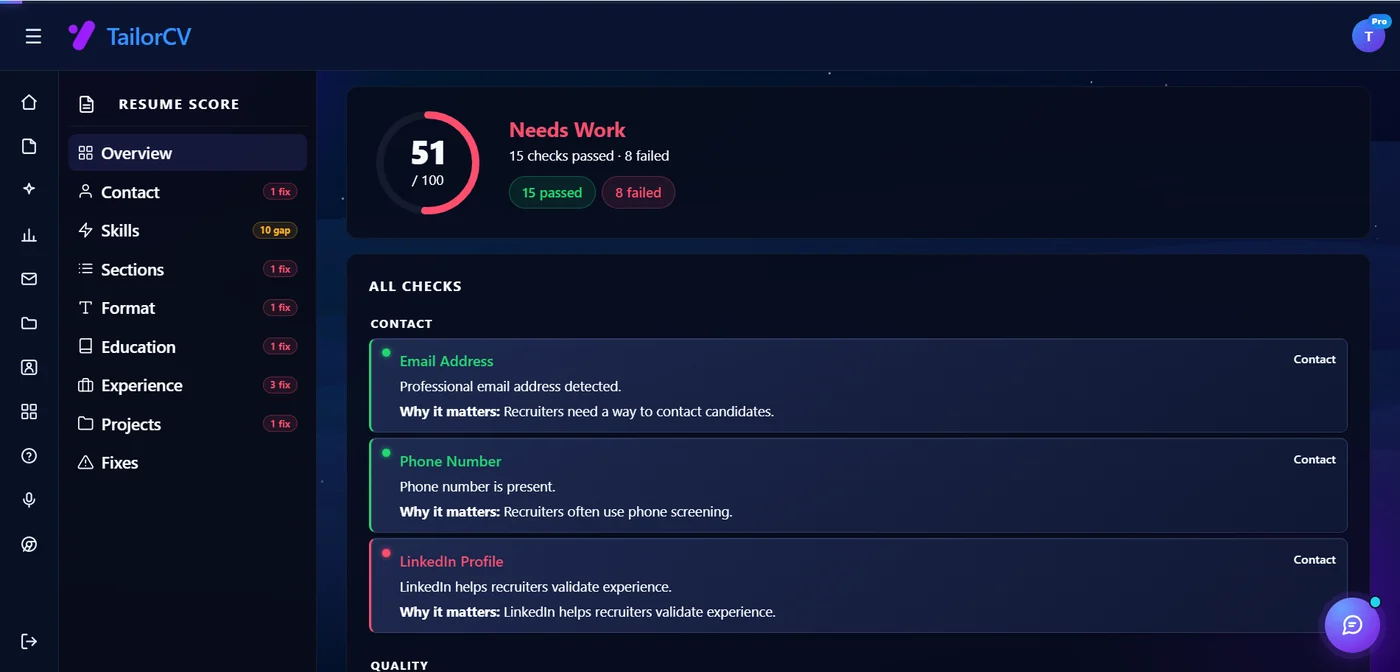
What is your resume scoring right now?
Scan it against a job description and get your ATS match score in about a minute.
Drop your resume here or choose a file
PDF only. Max 2 MB.
We never share your data or use it to train AI models.
Was this guide useful?
Be the first to rate it.