 SS
SS
Key Takeaways
- Working legally in China as a foreign national requires a work permit and the corresponding Z visa, sponsored by an employer.
- A minimum prior work experience requirement, commonly around two years, applies to the standard route and is a real obstacle for recent graduates without an exception.
- Certain categories, including graduates of specific Chinese universities and those in defined shortage fields, can access exceptions to the experience requirement.
- The employer, not the individual, initiates and drives the application process.
- Rules and thresholds are set nationally and applied with some regional variation, verify current specifics with the relevant authority before relying on any summary.
The basic structure
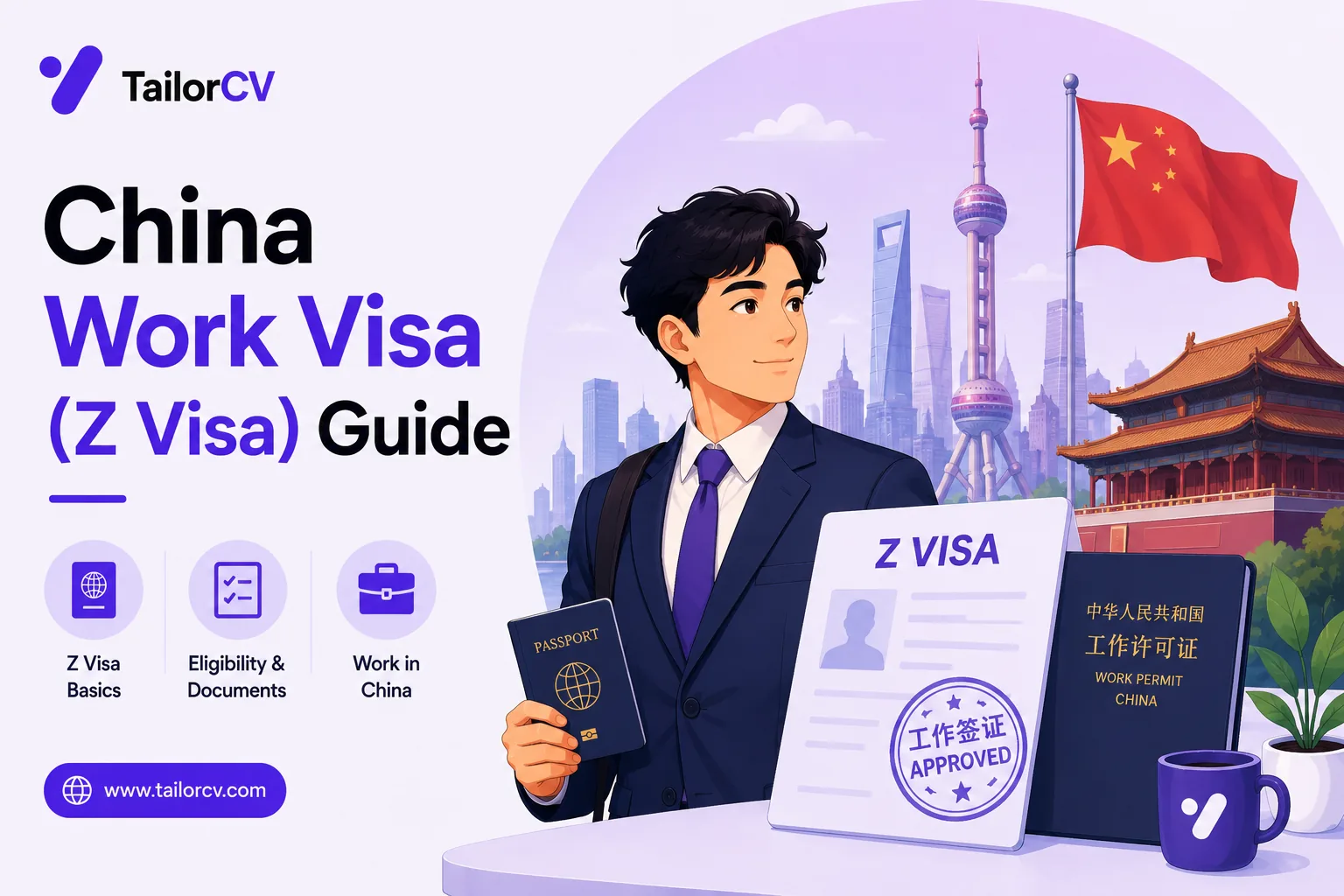
A foreign national working in China needs a valid work permit, issued following an employer's application, alongside the corresponding Z visa for entry and a residence permit for ongoing stay.
The employer sponsors and drives the process. You cannot independently apply for a work permit without an employer initiating it, which means, as with any employer-controlled route, your options are shaped by which employers are willing and able to sponsor.
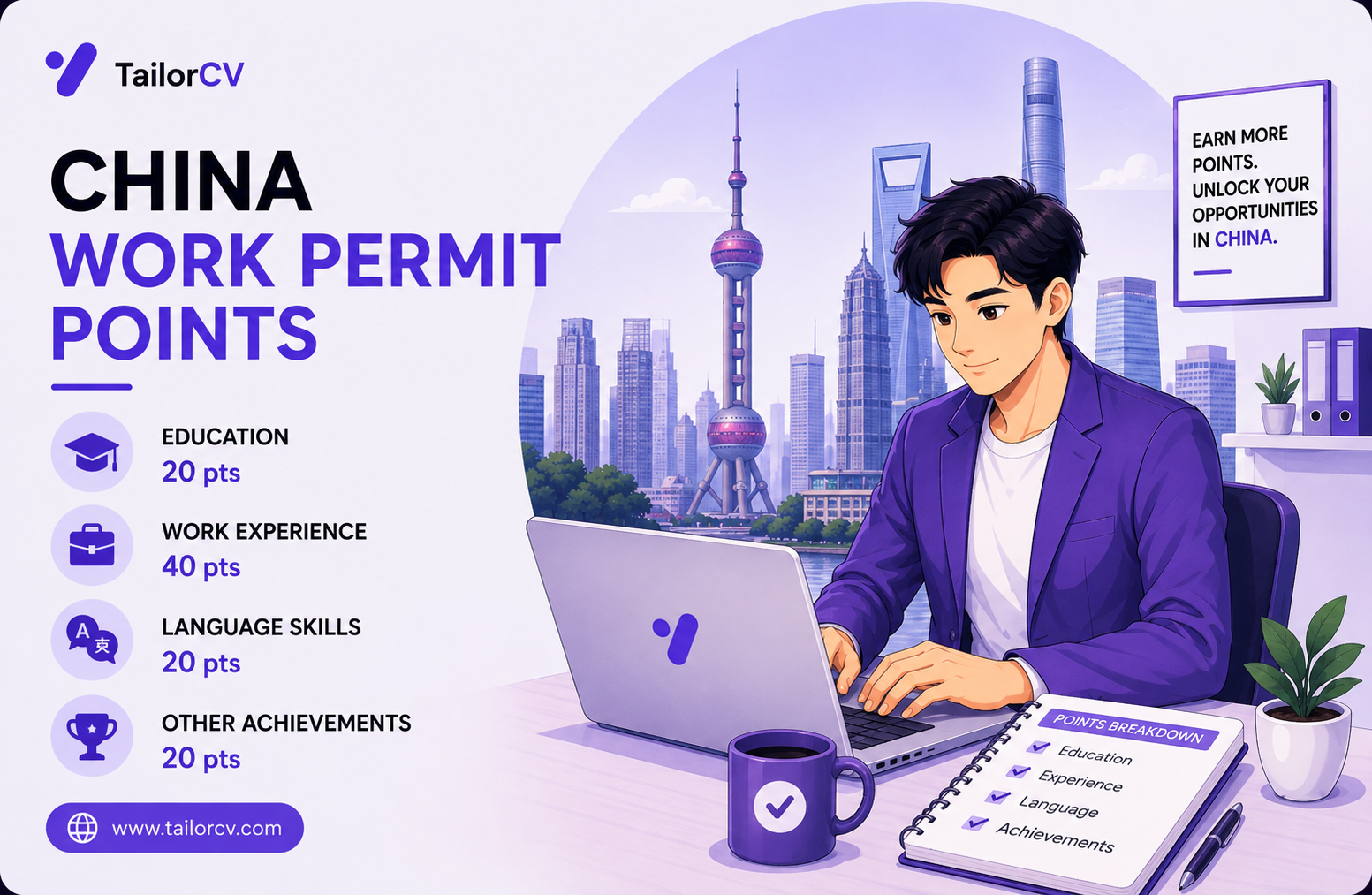
Work permits are sorted into three named categories — A, B, and C — covered in full detail in the points system guide, broadly reflecting the applicant's qualifications, experience and the nature of the role. Category B (professional talent) is where most graduate hires land, and its standard criteria are exactly where the experience requirement below becomes relevant.
The actual application sequence has a specific order worth understanding. Your employer first applies for and receives a Notification Letter of Foreigner's Work Permit on your behalf; you use that letter to apply for the Z visa at a Chinese embassy or consulate before travelling; after arrival, the work permit itself is finalised and you apply for the residence permit that lets you stay and work continuously without needing to re-enter on a fresh visa. Each step depends on the one before it completing correctly, which is why document delays early in the process cascade into delays throughout.
The experience requirement, and why it matters to graduates
A standard requirement under the general work permit route is a minimum period of prior relevant work experience, commonly cited as around two years, which a recent graduate with no prior full-time employment does not, by definition, meet.
This is the single most important structural fact for a graduate to understand before assuming a standard route is available. It is genuinely different from many Western graduate work authorisation routes, which are specifically designed for people with no prior experience.
Exceptions exist, and they matter considerably. Graduates from certain Chinese universities, particularly for roles taken shortly after graduation, can access routes that do not require the standard prior experience threshold. The specific criteria, which universities and programmes qualify, and the conditions attached, are set nationally and are worth verifying directly and currently rather than relying on a general description, since this is exactly the kind of detail that changes and where outdated information is genuinely costly.
Shortage occupations and specific talent categories may also carry different treatment, again varying by category and worth checking specifically against your own qualifications and target role.
What this means for your job search
Ask an employer directly and early whether they have sponsored work permits for recent graduates specifically, rather than assuming general sponsorship willingness translates into eligibility for someone in your position. An employer experienced with senior foreign hires may have no experience with the graduate exception route.
If you studied at a Chinese university, investigate whether your specific institution and programme qualify for a graduate exception route, since this can be the difference between a viable and an unviable path immediately after graduation.
If you studied abroad and are seeking to enter China as a graduate returnee, the standard experience requirement is a genuine and common obstacle, worth understanding clearly before building a search plan around employers who may not be able to sponsor you at all.
Consider whether an internship, a shorter-term arrangement, or study in China first, changes your position relative to any graduate-specific exception, since eligibility criteria are frequently tied to the specifics of where and how you studied.
Points-based and category-specific assessment
Some work permit categories use a points-based framework, assessing factors including salary, qualifications, age and other criteria, broadly analogous in spirit to points-based systems used elsewhere, though the specific mechanics and thresholds are distinct and worth reviewing directly for your category.
Higher categories generally carry more favourable treatment and fewer restrictions, while lower categories may carry more limitations, understanding which category a specific role and your own profile would fall into is worth clarifying with a prospective employer or an immigration advisor before assuming eligibility.
Practical steps
- Confirm the employer's willingness and experience with your specific situation early, exactly the same discipline that applies to any employer-controlled visa route globally, asking the direct question early saves months of misdirected applications.
- Gather your academic and identity documents in advance, since the application process typically requires authenticated copies of degree certificates and other records, and authentication can itself take time.
- Verify current requirements directly with the relevant authority or a qualified immigration advisor, rather than relying on this or any general article, since specific thresholds, exceptions and processes are set by policy that is reviewed and adjusted periodically.
Tip: Ask a prospective employer one specific question: "Have you obtained a Notification Letter of Foreigner's Work Permit for a recent graduate before?" An employer who has done it will answer immediately; one who has not will be vague, and that vagueness is the single most useful signal you will get.
Common Mistakes
- Assuming the standard route is open. Assuming a standard general work permit route is automatically available to a recent graduate. The prior experience requirement is a real and common barrier.
- Not checking your graduate exception. Not checking whether your specific Chinese university and programme qualify for a graduate exception. This can be the deciding factor for a fresh graduate.
- Assuming sponsorship experience transfers. Assuming an employer's general willingness to sponsor translates into experience with the graduate-specific route. Ask directly.
- Underestimating document authentication timelines. Often longer than expected and worth starting early.
- Relying on outdated summaries. Relying on outdated or general online summaries for specific thresholds. Rules are set and adjusted by policy and deserve direct, current verification.
- Not checking your category. Not exploring whether category or points-based factors change your position. Worth clarifying rather than assuming a single standard applies.
Understanding the broader visa category landscape
Beyond the standard general work permit route, other specific categories exist for particular circumstances, including routes for individuals recognised for a specific high level of skill or achievement, worth researching whether any specific category beyond the general route might apply more favourably to your own particular background, rather than assuming only the standard route exists.
If your circumstances are genuinely unusual or complex, a specific consultation with a qualified immigration advisor, rather than relying solely on general published guidance, is worth the investment, this is precisely the kind of situation where a general article, including this one, cannot substitute for advice tailored to your own specific facts.
Practical steps before accepting an offer
Confirm in writing exactly what documentation your prospective employer will need from you, and the realistic timeline they expect for the application process, rather than assuming a standard timeline applies uniformly, since actual processing experience genuinely varies by employer, region and individual case specifics.
Understand what your status and rights are during any gap between your current authorisation ending and a new one being granted, if you are transitioning between roles or categories, this is a genuinely important detail worth clarifying explicitly rather than assuming continuous coverage, since gaps in authorisation carry real consequences.
Related Guides
Keep building on this with the related guides in this series:
- The Points System for Foreign Graduate Work Permits in China
- China Campus Interview Questions - What Is Actually Asked
- China Campus Recruiting - How the Autumn and Spring Cycles Work
- Teaching English in China - A Realistic Guide for Graduates
- Graduate Salary Expectations in China - A Realistic Guide
- HSK Levels and What They Actually Mean for Employment in China
You can also check your resume's ATS score for free, generate a tailored cover letter, or build a portfolio website in minutes.
Frequently Asked Questions
Can I get a work visa in China straight out of university with no prior experience?
Generally the standard route requires prior work experience, commonly around two years, though exceptions exist for graduates of certain Chinese universities and specific categories. Verify current specific criteria directly.
Does the employer or I apply for the work permit?
The employer sponsors and drives the application. You cannot independently apply without an employer initiating the process.
What's the actual sequence of documents I'll deal with?
Your employer secures a Notification Letter of Foreigner's Work Permit first; you use that to apply for the Z visa before travelling; after you arrive, the work permit is finalised and you apply for the residence permit that covers your ongoing stay. Delays early in this chain push everything after it back.
Do these rules apply the same way everywhere in China?
Requirements are set nationally with some regional variation in application, worth checking the specific city or province where you would be working.
What if I studied abroad and want to work in China as a graduate?
The standard prior experience requirement is a genuine obstacle for this group specifically, since a foreign degree does not typically carry the same graduate exception as certain Chinese university programmes, verify eligibility carefully before committing to a search plan.
How do I know which work permit category applies to me?
This depends on your qualifications, the role, and sometimes a points-based assessment, worth clarifying directly with a prospective employer or a qualified immigration advisor rather than assuming.
Where should I get authoritative current information?
The relevant national and local labour and immigration authorities publish official current guidance, and a qualified immigration advisor can review your specific circumstances, both are more reliable than a general summary.
What is your resume scoring right now?
Scan it against a job description and get your ATS match score in about a minute.
Drop your resume here or choose a file
PDF only. Max 2 MB.
We never share your data or use it to train AI models.

Was this guide useful?
Be the first to rate it.