 SS
SS
Key Takeaways
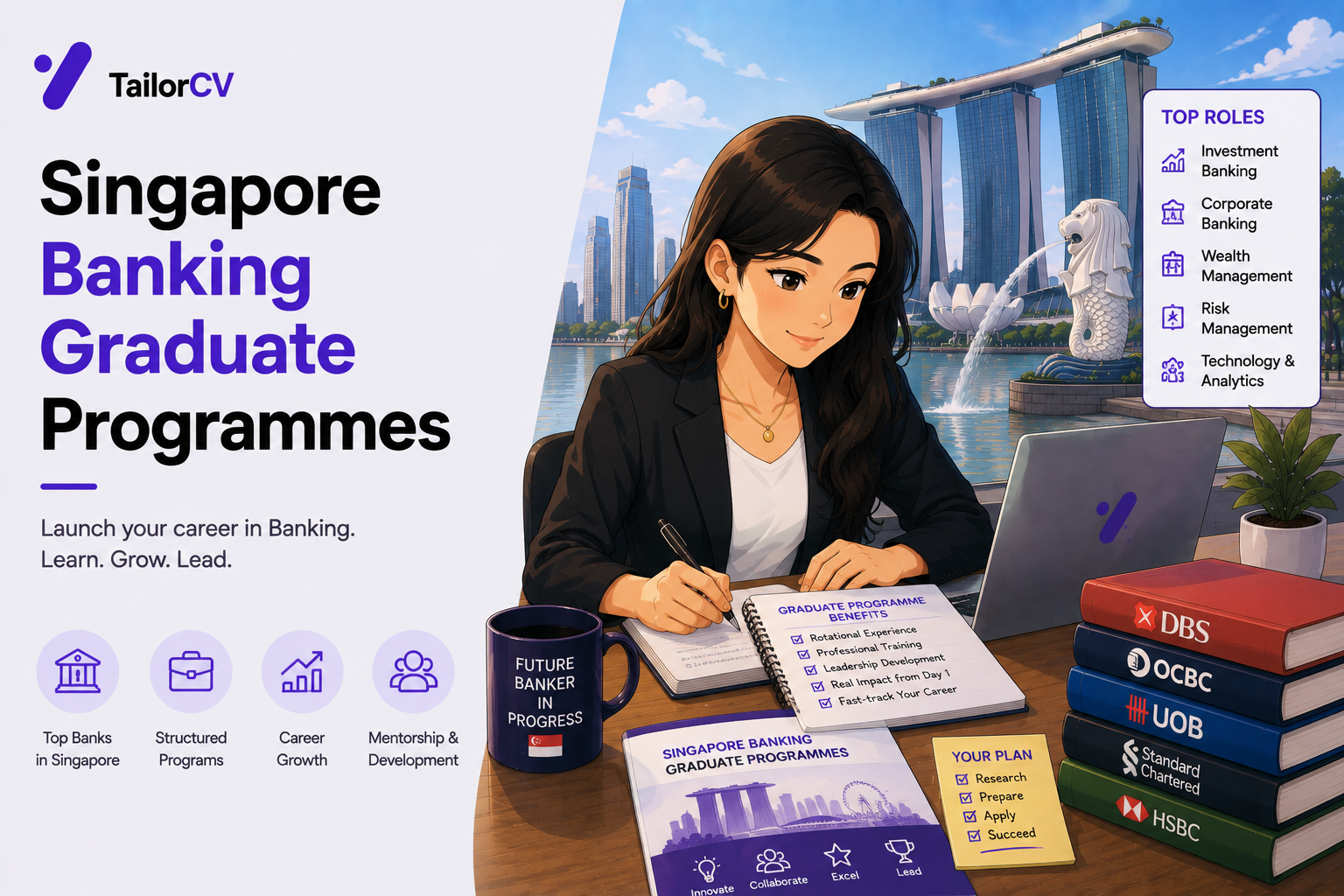
- Singapore banking hiring splits into local banks, global banks with regional operations, and the technology organisations inside both.
- Local banks hire far more graduates than global banks and across a much wider range of functions.
- Technology roles inside banks are the most overlooked route and often the least contested.
- Front office at global banks is the most competitive and recruits earliest.
- Work pass willingness varies by function — technology and specialist roles are generally more open than front office.
The three routes
Local banks. The Singapore banks run large management associate programmes with rotations across retail, corporate, risk, operations and technology. They hire in volume, they are Singapore-headquartered so decisions are made locally, and their programmes are structured with defined progression.
Global banks with regional operations. Singapore is a regional hub for most large international banks. Front-office roles here are highly contested — small intakes, early recruiting, and applicants from across the region. Middle and back office hire more people with less competition.
Bank technology organisations. Both groups employ large engineering teams building payments infrastructure, trading systems, risk platforms and customer applications. These are genuine engineering roles and they are the most systematically overlooked route into banking.
Where the competition actually is
The pattern that repeats everywhere: applicants concentrate on the most visible roles.
Most contested: front office at global banks — markets, investment banking, private banking. Small intakes, early deadlines, applicants from the whole region.
Moderately contested: management associate programmes at local banks. Large intakes, but they are well known and heavily applied to.
Least contested relative to quality: technology and engineering inside banks, risk and compliance, operations at global banks.
The technology point is worth dwelling on. A software engineering graduate applying to a bank competes against far fewer people than one applying to a well-known product company, for work that is often more technically substantial than assumed and with better structure and stability. See Singapore tech jobs for graduates for how the wider technology market compares.
Timing
Structured programmes generally open between August and October for intakes the following year. Global banks recruiting for front office often run earlier and close faster.
Some banks run a second, smaller cycle in the new year, and technology roles are more likely to be filled on a rolling basis rather than through a single annual intake.
The Singapore campus recruiting calendar applies: applying in the same calendar year as the start date usually means the structured programmes have closed.
The process
Longer than the role seems to warrant:
- Online application with written motivational questions
- Online assessments — numerical, situational judgement, sometimes game-based
- Video interview, usually recorded rather than live
- Assessment centre — group exercise, case study, presentation, interviews
- Final interview with senior staff
The written questions carry more weight than candidates expect. With hundreds of similar applications, a generic "why banking" or "why this bank" answer is the most common early rejection.
The assessment centre decides most outcomes. Group exercises assess how you handle other people rather than whether you reach the right answer, and preparation for that format differs from standard interview preparation — the mechanics in the UK assessment centre guide transfer closely, since the format is essentially the same.
For technology roles the process is different: coding assessments and technical interviews replacing much of the above, following international formats.
Work passes by function
Willingness to sponsor varies more by function than by bank.
Technology and specialist risk roles — most open, because the skills are genuinely scarce and the business case is easier.
Management associate programmes — varies. Local banks have local hiring obligations to satisfy, and intake composition reflects that.
Front office at global banks — competitive enough that pass considerations are one factor among many, and candidates are drawn from a regional pool where many already hold status.
The general framework matters here: qualifying salary rises with age, so graduates face the lowest threshold, and a points-based assessment weighs employer-side factors you do not control. The pass mechanics are worth understanding before you decide where to apply.
Ask directly and early. "Does this programme consider candidates requiring an Employment Pass?" is a normal question and saves months.
What a strong application looks like
Specificity about the bank. Not the mission statement — a business line, a recent initiative, something distinguishing this bank from the one next door. Interchangeable answers are visible.
Evidence of commercial awareness. For banking specifically, being able to discuss something happening in the sector, with an actual view, separates candidates. It is asked and it is where many otherwise-strong applicants are thin.
Grades stated. Classification matters more here than in the US and is normally included, particularly at banks.
A resume that parses. Every bank of size screens with software. The Singapore resume format sets out conventions; running an ATS check confirms the document survives extraction.
Internship experience. Banks convert interns, so a prior internship — ideally local — is the strongest single credential. The internship route is frequently the real pipeline.
Building commercial awareness in four weeks
Commercial awareness is assessed at nearly every stage of banking recruitment and is where otherwise-strong candidates are thinnest. It is also entirely learnable, and four weeks of modest effort is enough to move from unprepared to genuinely credible.
Week one: build the habit. Read one financial news source for twenty minutes daily. Not to memorise — to become familiar with the vocabulary and the recurring stories. In the first week almost nothing will connect. That is expected.
Week two: pick three threads and follow them. Three ongoing stories relevant to the bank you are applying to. Interest rate direction and what it does to bank margins. A regional development affecting cross-border business. A regulatory or technology change in the sector. Following three stories in depth is worth more than reading everything shallowly.
Week three: form views. For each thread, write three sentences: what is happening, why it matters to this bank specifically, what you think happens next. Writing it is what turns reading into a usable answer, and the third sentence is the one interviewers actually respond to.
Week four: connect it to the employer. Read the bank's most recent results announcement and annual report summary. These are public, and almost no graduate candidate reads them. You are looking for what management says the priorities are, which business lines are growing, and what they identify as risks. A candidate who can say "your last results showed the wealth business growing faster than the rest and management flagged funding costs as the pressure — is that shaping graduate hiring?" is in a different category from one who read the About page.
What a good answer sounds like when asked "tell me something happening in the sector":
"The thing I have been following is what higher-for-longer rates do to bank margins — good for net interest income in the short run, but it also raises funding costs as deposits reprice, and it puts pressure on borrowers, so provisions become the thing to watch. For a bank with a large regional corporate book that seems like the tension: the margin looks good now and the credit quality question is the one that decides whether it lasts."
That is not expert analysis. It is a candidate who has read for a month and formed a view, which is exactly the standard being assessed.
The assessment centre, exercise by exercise
The centre usually decides the outcome, and each exercise is scored against a different competency.
The group exercise. Four to six candidates, a scenario, a decision to reach, thirty to forty minutes. Assessors circulate and score individuals, not the group.
The universal misunderstanding is that reaching the right answer matters. It does not, particularly. What is scored is how you operate with other people: whether you bring others in, whether you build on what has been said, whether you help the group manage time, whether you can disagree without a fight.
Three behaviours that score well and are easy to execute deliberately: summarise where the group has got to at about the halfway point, which almost nobody does and every assessor notices. Bring in the person who has not spoken — "we have not heard from you, what do you think?" — which scores on multiple competencies at once. Watch the clock and say so — "we have ten minutes and we still need a recommendation."
Two behaviours that fail: dominating, and disappearing. Of the two, disappearing is more common and equally fatal — an assessor cannot score what you did not do.
The case study or written exercise. A pack of information, a limited time, and a recommendation to produce. Being scored on structure and judgement, not on the correct answer, which usually does not exist.
Spend the first fifth of the time reading and deciding your structure. State your recommendation first, then the reasons, then the risks and what you would want to know. Almost every weak submission buries the recommendation at the end after a summary of the material, which reads as someone who could not decide.
The presentation. Usually from the case, five to ten minutes, with questions. Prepared candidates rehearse the presentation and neglect the questions, which are where the assessment actually happens. Expect to be challenged on your recommendation, and expect that changing your view under a good argument is scored positively while defending an indefensible position is not.
The interviews. Competency-based, scored against a framework. Prepare six strong examples covering teamwork, conflict, failure, leadership, pressure and something you are proud of, and be ready for each to be probed two layers deeper than you expect.
What the jobs actually are
Candidates apply to "front office" without knowing what a Tuesday looks like. The daily reality differs enormously.
Markets and trading. Early starts tied to market hours, intense during trading, quiet after the close. Analytical, fast-feedback, and highly measurable. Suits people who like being scored daily and tolerate being wrong publicly.
Investment banking coverage and advisory. Long hours, document-heavy, deadline-driven around live transactions. The graduate work is modelling, pitch material and analysis. High compensation, high attrition, and a genuinely demanding first two years.
Corporate and commercial banking. Client relationships, credit analysis, structuring facilities. Slower rhythm than markets, and more sustained client contact. Frequently the better route into a long banking career and much less contested at entry.
Risk. Credit risk, market risk, operational risk. Analytical, model-heavy in parts, and increasingly technical. Underrated by candidates and central to how a bank actually runs.
Operations. The machinery: settlement, payments, reconciliation, client onboarding. Less glamorous, genuinely large-scale, and unusually good preparation for anyone who later wants to work on the technology that automates it.
Compliance and financial crime. Growing fast, analytically demanding, and one of the more portable skill sets in the industry.
Technology. Covered below and the most overlooked of all of them.
What you would actually build in bank technology
The stereotype is legacy maintenance. The reality at the larger institutions is closer to this:
Payments infrastructure — real-time transfer systems, cross-border payment rails, reconciliation at volumes where a rounding error is a regulatory incident. This is genuinely hard distributed systems work with correctness requirements most consumer companies never face.
Trading and risk platforms — low-latency systems, pricing engines, exposure calculations that must complete before markets open. Performance-critical work with real constraints.
Customer-facing applications — the banking apps used by millions daily, with the mobile and backend engineering that implies.
Data platforms — regulatory reporting, financial crime detection, credit models. Large-scale data engineering with unusual accuracy requirements.
Two things a graduate should understand about this environment. First, the correctness bar is higher than in most product companies, and the release process reflects that — this is frustrating if you expect to ship daily and reassuring if you like systems that cannot be wrong. Second, the compensation for engineers at banks is competitive with the broader Singapore technology market, and the competition for those seats is markedly lower.
The recorded video interview
Nearly every structured programme includes one, and it is the stage candidates most often treat as a formality.
The format: questions appear on screen, you get a short preparation window, then a fixed answering time, usually with one retake or none. No human is present.
What makes it hard is the absence of feedback. There is no interviewer nodding, so candidates ramble to fill time or stop early in panic.
Practical points that materially improve the outcome: look at the camera, not the screen, because that is where eye contact lives. Set up somewhere plain and quiet, with light in front of you rather than behind. Answer to roughly three-quarters of the time allowed rather than filling it. Have your six competency examples on a sheet just off camera — reading is obvious, but glancing at three-word prompts is not. And record yourself once beforehand and watch it, which is unpleasant and is the single most useful thing you can do. The video interview guide covers the format in more depth and the mechanics are identical here.
Pay structure at banks
Graduate pay in banking is quoted monthly, comes with a thirteenth month at most established institutions, and is topped by a performance bonus that is the largest source of variation between employers and between years.
For structured graduate programmes, base pay is generally fixed across the cohort and not negotiable — the negotiation everyone reads about applies to lateral hires, not to management associate intakes. What is occasionally negotiable is a signing bonus, and start date is nearly always negotiable.
Front office at global banks pays the most and demands the most hours. Technology and risk pay well relative to hours worked, which is a comparison worth making explicitly before choosing based on the headline number. The salary expectations guide covers the ranges, and the honest framing is that at graduate level the differences between these routes matter less than which one you can still stand doing in year three.
Common Mistakes
- Applying only to front office. The most contested roles by a wide margin.
- Ignoring bank technology. Substantial engineering organisations, far less competition.
- Generic motivational answers. The most common early rejection in written applications.
- No view on the sector. Commercial awareness is assessed and often absent.
- Preparing for interviews but not the assessment centre. The centre usually decides.
- Leaving pass questions until late. Willingness varies by function and is answerable early.
Choosing between offers
A good problem, and one that arrives with a deadline attached.
Compare the annual package, not the monthly base. Base times twelve, plus the thirteenth month where it exists, plus a realistic bonus based on what last year's cohort actually received. Two offers quoted as monthly figures can differ by twenty percent annually once the structure is counted.
Weight the hours honestly. A front-office offer paying meaningfully more for eighty-hour weeks and a technology or risk offer paying less for fifty is not a simple comparison, and the hourly arithmetic is worth doing once even if you then ignore it. What decides it is whether you can still stand doing the work in year three.
Ask what proportion of the last cohort was placed, and where.
A programme that places everyone into two functions is offering less choice than the brochure implies.
Prefer the team over the brand where they conflict. At graduate level the brand on your resume matters for the first two years and the quality of your manager matters for the next twenty. This advice is easy to give and hard to take, and it is still correct.
Ask about the pass position explicitly if it applies to you.
An offer contingent on an application that has not been made is not the same as an offer from an employer who has done this thirty times.
Deadlines are more negotiable than they look. Asking for two more weeks, once, politely, with a reason, is normal and frequently granted — particularly when you are waiting on another process that is nearly complete. The negotiation principles transfer, with the caveat that graduate programme pay itself is usually fixed and the negotiable items are start date, signing bonus and occasionally placement.
If you do not get in this year
The structured intakes are annual, which makes rejection feel terminal. It is not, and there are three routes back.
Off-cycle and rolling roles. Banks hire outside the graduate programme constantly — analyst positions in risk, operations, technology and compliance are frequently filled as they open rather than through an annual cohort. These are less visible and much less contested.
A different function, then move internally. Getting into a bank through operations or risk and moving toward the function you wanted after eighteen months is a well-worn path and considerably easier than getting in through the front door of the most contested programme.
Reapply once, with something new. Reapplication is generally permitted the following cycle, and it is much stronger when something has changed — an internship, a project, a clearly better answer to the commercial awareness question.
Frequently Asked Questions
Do local banks hire international graduates?
Some do, with variation by function and year. Technology and specialist roles are generally more open than general management associate intakes. Ask directly rather than assuming.
Is a finance degree required?
No. Banks hire across disciplines, particularly for technology, risk and operations. Front office recruits broadly too, though commercial awareness is expected regardless of degree.
How do local banks compare to global banks?
Local banks hire more graduates, across more functions, with locally-made decisions. Global banks offer international mobility and, in front office, higher compensation with much higher competition.
Are bank technology roles real engineering?
Yes — payments, trading and risk systems at scale. The stereotype of legacy maintenance is outdated at the larger institutions.
When do applications open?
Generally August to October for the following year's intake, earlier for global bank front office. Technology roles are more often filled on a rolling basis.
What is the assessment centre like?
Typically half a day: group exercise, individual case or presentation, and interviews, scored against a competency framework rather than by ranking candidates against each other.
Do I need to have done a finance internship to get in?
It helps considerably for front office and matters much less for technology, risk and operations. Where you have no finance internship, commercial awareness and a clear reason for applying carry more of the weight.
How many banks should I apply to?
All the ones you would genuinely accept, which for most candidates is between six and twelve across local and global institutions. Deadlines cluster, so build the list before the window opens rather than during it.
Is the assessment centre scored against other candidates?
Usually against a competency framework rather than by ranking, which means helping other candidates in the group exercise does not cost you anything. Behaving as though it were a ranking is one of the more visible ways to score badly.
What happens after the graduate programme ends?
Placement into a permanent role, typically in a function you rotated through. Ask what proportion of the last cohort was placed and where, because the answer varies by bank and by year.
What is your resume scoring right now?
Scan it against a job description and get your ATS match score in about a minute.
Drop your resume here or choose a file
PDF only. Max 2 MB.
We never share your data or use it to train AI models.

Was this guide useful?
Be the first to rate it.