 TD
TD
Key Takeaways
- Assessment centres score you against defined competencies, not against the other candidates in the room.
- The group exercise is not a debate to win. Assessors are watching how you handle other people.
- You are being observed during breaks and informal moments, not only in the scored tasks.
- Most tasks reward visible structure — saying what you are doing and why — over reaching the perfect answer.
- Preparing for the format matters as much as preparing the content, because the format is unfamiliar to most candidates.
What an assessment centre is
The final stage of most UK graduate schemes. Half a day to a full day, at an employer's office or online, with several tasks and multiple assessors.
A typical day:
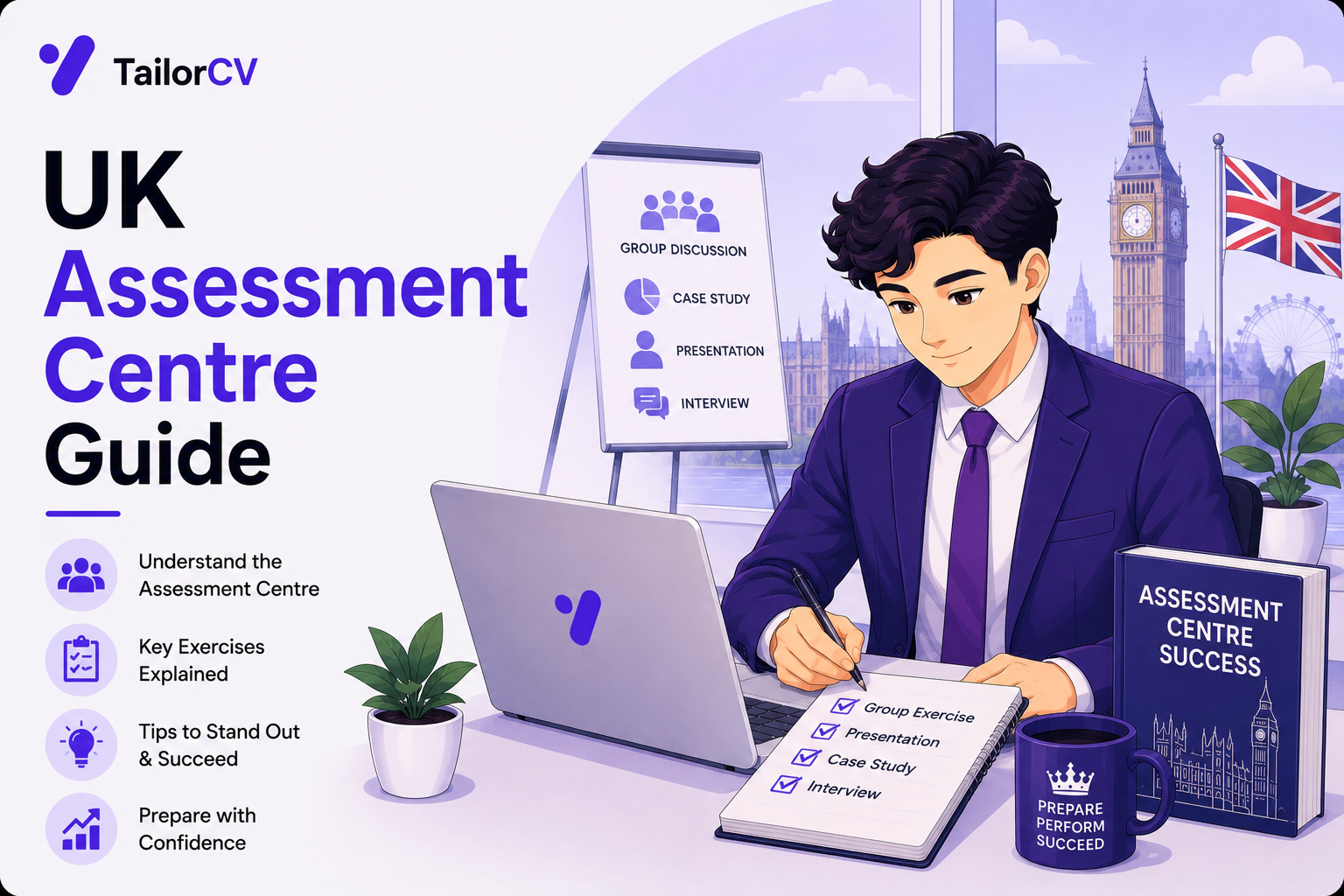
- Group exercise — a problem to solve as a team, 30 to 45 minutes
- Case study — individual analysis, often written, sometimes presented
- Presentation — prepared in advance or on the day
- Competency interview — one or two, structured
- In-tray or situational exercise — prioritising a set of realistic work items
- Informal elements — lunch, a talk from current graduates, time with recruiters
Not every employer runs all of these. The graduate scheme process usually specifies the format in advance, and asking the recruiter directly is normal.
The scoring model
This is the thing most candidates misunderstand, and it changes how you should behave.
Assessors work from a competency framework. Typically five to eight named competencies — commercial awareness, teamwork, analytical thinking, communication, resilience, leadership — each with behavioural indicators and a scale.
During a task, an assessor is watching one or two candidates and writing evidence against those competencies. Afterwards, assessors pool their notes and agree scores.
The consequences:
It is not a competition against the room. You are scored against a standard. In principle everyone can pass, or nobody can. Undermining another candidate does not raise your score and frequently lowers it, because collaboration is usually one of the measured competencies.
Evidence must be visible. An assessor cannot score a thought you did not express. Excellent silent reasoning produces an empty page.
Each task maps to specific competencies. The group exercise is rarely scored on whether the group reached the right answer.
The group exercise
Five to eight candidates, a scenario, a time limit, sometimes conflicting information distributed among you.
What assessors are looking for:
- Do you contribute substance? Not volume — substance. One well-judged intervention beats constant talking.
- Do you bring others in? "We haven't heard from you — what do you think?" is one of the highest-scoring behaviours available and costs nothing.
- Do you manage the time? Someone noticing there are ten minutes left and steering toward a conclusion scores well.
- Do you build on others' points? Explicitly referencing and developing someone else's idea shows listening.
- Do you handle disagreement well? Disagreeing with the point rather than the person.
What loses marks:
- Dominating. The candidate who talks most usually does not score highest.
- Silence. Nothing to write down means nothing to score.
- Ignoring the clock. Groups that run out of time without a conclusion all score poorly.
- Point-scoring off others. Visible, and it reads as poor teamwork.
The counterintuitive part: helping the group succeed is how you succeed. A group that produces a coherent answer gives every member evidence of good collaboration.
The case study
An individual exercise: a pack of information, a question, a time limit, usually a written recommendation or a short presentation.
What works:
Read the question first, then the pack. Reading everything before knowing what you are looking for wastes the time you needed for analysis.
Structure before you write. Two minutes of planning produces a document an assessor can follow.
Answer the question asked. A brilliant analysis of a different question scores badly. If asked whether to proceed, say whether to proceed.
Commit to a recommendation. "It depends" without a decision is the most common weak ending. State a position, give the main reason, name the biggest risk.
Use the numbers. If the pack contains figures, they are there deliberately. An answer that ignores them is incomplete.
Presentations
Sometimes prepared beforehand, sometimes built during the day.
Keep it simple: a clear structure, a small number of points, and a conclusion that answers the brief. Assessors are scoring clarity and structure, not visual design.
Time yourself. Overrunning is scored badly and is entirely avoidable. Expect questions afterwards and prepare for the obvious ones — the questions are often where the real assessment happens.
The interview
Usually competency-based: "tell me about a time when..." with heavy probing.
UK competency interviews go deeper than a single answer. Expect three or four follow-ups on the same story — what was your specific role, why that approach, what would you do differently, how did you know it worked. A story that holds up for ninety seconds and collapses on the second probe is a common failure.
Prepare six to eight solid stories rather than one per question. The approach to building a story bank applies directly, and UK interview conventions cover tone.
The parts nobody tells you are scored
Assessment centres run for half a day or more, and the assessed portion is larger than the timetable suggests.
Lunch and breaks. Often with current graduates or junior staff who are asked afterwards for their impressions. This is not a trap and it is not a rest period. Be normal, be interested, ask people about their actual jobs.
How you treat the other candidates. Watched throughout. Candidates who treat the day as a competition — talking over people in the group exercise, being dismissive in the breaks — are noticed and marked down. The scoring is against a competency framework, not a ranking, so being helpful genuinely costs you nothing.
How you treat everyone else. Reception staff, the person organising the rooms, whoever brings the coffee. Employers ask, and rudeness to junior staff is one of the few things that ends an application outright.
Your questions. At the end of the day, asked of whoever is available. Having none reads as indifference. Two or three specific questions about the work, the team, or the person's own experience is enough.
Your recovery after a bad exercise. If the group exercise went badly, the case study assessor does not know. Candidates who carry a bad hour into the next one turn one weak score into three, and composure across the day is itself observed.
Timekeeping. Being late to a session after a break is remembered out of proportion to its importance.
Preparing properly
Three things, in order of return.
Learn the employer's competency framework. Most UK employers publish what they assess — "what we look for", or the bullets in the posting. That is the marking scheme, handed out in advance, and most candidates never look. Map your six stories against it and find the gaps.
Practise a group exercise at least once. With friends, with your careers service, with anyone. The format is genuinely unfamiliar and the first attempt is always poor. Doing it once beforehand means the real one is your second.
Do one timed case study. Forty minutes, a pack of information, a written recommendation. The constraint you are training for is time, not analysis.
Then the practicalities. Ask what the format is when you are invited — employers tell you, and knowing whether there is a presentation changes what you prepare. Bring a pen, paper, a printed copy of your application, and the address. Eat beforehand. Arrive early enough that a delayed train is not a crisis.
What not to do: memorise answers, prepare a framework to impose on the case, or plan to dominate the group exercise. All three are visible and all three score badly.
The group exercise, behaviour by behaviour
The exercise candidates most fear and most misunderstand. Assessors circulate with a scoring sheet and mark individuals against named competencies — they are not marking the group's answer.
What is actually being scored: whether you contribute substance, whether you listen and build on others, whether you can disagree without damaging the discussion, whether you help the group manage its time, and whether you would be tolerable to work with.
Five behaviours that score reliably, and each is executable deliberately regardless of how confident you feel:
Summarise at the halfway point. "So we've agreed on the first two criteria and we're stuck on the third — shall we park it and come back?" Almost nobody does this and every assessor notices it. It scores on communication, leadership and analysis at once.
Bring in the quiet person. "We haven't heard from you — what do you think?" Scores on teamwork and awareness, costs nothing, and frequently produces the best contribution in the room.
Watch the clock and say so. "We've got eight minutes and we still need a recommendation." Scores on planning and is genuinely useful.
Build explicitly on what someone said. "Building on what Priya said about cost — if that's right, then the second option is weaker than it looks." Demonstrates listening in a way that nodding does not.
Disagree with the idea, not the person. "I see it differently, and here's what's making me hesitate." Handling disagreement well is a named competency at most employers.
Two behaviours that fail:
Dominating. Talking over people, restating your point, treating it as a debate to win. Assessors mark this down hard because it is the behaviour most predictive of being difficult to work with.
Disappearing. More common and equally fatal. An assessor cannot score what you did not do, and a candidate who contributed twice in thirty minutes has given them nothing to write. If you are naturally quiet, the fix is a plan rather than a personality change: commit in advance to contributing in the first three minutes, summarising at the midpoint, and bringing in someone else once.
The answer barely matters. Groups that reach a poor conclusion with good process score better than groups that reach the right answer through one person steamrolling. This is genuinely how it works, and candidates who cannot believe it tend to over-index on being right.
The case study and the presentation
The case study. A pack of information, limited time, and a recommendation to produce.
Read the question first, then the pack. Knowing what you are looking for changes what you notice, and candidates who read everything and then read the question waste a third of their time.
Structure before you write. Five minutes of planning saves fifteen of rambling.
Commit to a recommendation, and put it first. The most common weak submission summarises the material and reaches a tentative conclusion at the end. Recommendation, then reasons, then risks, then what you would want to know. Assessors are marking judgement, and judgement is visible only when you decide.
Use the numbers. Packs contain data because using it is being assessed. A recommendation that ignores the financials scores poorly regardless of how well argued it is.
Answer the question asked. Not an adjacent, more interesting question.
The presentation. Usually from the case, five to ten minutes, with questions afterwards.
Prepare for the questions, not just the presentation. Candidates rehearse the delivery and treat the Q&A as an afterthought, and the Q&A is where the assessment concentrates.
Signpost your structure at the start. "I'll cover my recommendation, the three reasons, and the main risk." Assessors mark structure, and stating it makes it visible.
Changing your view under a good argument scores positively. Defending an indefensible position does not. This surprises candidates who think consistency is being tested — what is being tested is whether you can think, and updating on evidence is thinking.
Do not read your slides or notes. Glancing is fine. Reading is not.
The scoring model, and why it changes your behaviour
Most candidates arrive believing they are competing against the other people in the room. Almost universally they are not, and the misunderstanding causes specific, avoidable errors.
You are scored against a framework. The employer has a list of competencies — commercial awareness, teamwork, communication, problem solving, resilience, whatever they publish — and each exercise maps to some of them. Assessors mark you on a scale against defined behavioural indicators.
Everyone in the room can pass. Or nobody can. Intakes are not fixed at "the top three of these twelve", and at most employers the number of offers from a given day varies with how the day went.
Which means helping other candidates costs you nothing. Bringing in a quiet person in the group exercise scores you on teamwork. It does not transfer marks to them. Candidates who behave competitively are optimising against a model that does not exist, and the behaviour itself is marked down.
Evidence must be visible. An assessor cannot score a thought. If you analysed the problem brilliantly and said nothing, you scored nothing on analysis. This is the single most important consequence of the model, and it is why saying what you are doing and why — in every exercise — is worth more than being right quietly.
Each exercise targets different competencies, which is why a poor group exercise is genuinely recoverable. The case study assessor is marking different boxes and does not know what happened earlier. Candidates who write off the day after a bad hour convert one weak score into a bad day.
The interview within the day is usually competency-based and scored the same way, so the story bank built for the application form is exactly what you need here — the same six stories, delivered at conversational length and expecting probing.
The day before
Small preparations, and they change how the day goes more than another hour of practice would.
Confirm the format in writing. Email the recruiter and ask what the exercises are, how long the day runs, and whether anything needs preparing in advance. They answer, and knowing whether there is a pre-prepared presentation is the difference between doing well and arriving without one.
Print your application. You will be asked about something you wrote in it, possibly months ago. Read it once the night before.
Prepare three questions. One about the role, one about the team, one for the current graduates you will meet.
Plan the journey with an hour of slack. Assessment centres start on time and arriving flustered costs you the first exercise.
Eat properly and sleep. The day runs five or six hours and performance in the final exercise is visibly worse for people running on nothing.
Decide what you are wearing the night before. Business formal unless told otherwise.
And stop preparing by nine o'clock. Cramming competency examples late does not add much and does cost you the composure that the group exercise actually rewards.
Common Mistakes
- Treating the group exercise as a debate to win. Collaboration is usually a scored competency.
- Talking constantly. Volume is mistaken for contribution and scores badly.
- Staying silent. No evidence means no score.
- Ignoring the time limit. Whole groups fail this way.
- No recommendation in the case study. Analysis without a decision reads as indecision.
- Relaxing at lunch. Impressions formed informally are shared formally.
- Not asking what the format is. The information is available for the price of an email.
The day, hour by hour
Knowing the shape removes most of the anxiety, and the format is fairly standard across UK employers.
Arrival and introduction, 30–45 minutes. Presentation about the firm, the day's timetable, sometimes an icebreaker. Not scored formally; you are being observed. Talk to people, including the other candidates.
Group exercise, 40–60 minutes. Usually the first assessed task. A scenario, a decision, assessors circulating with clipboards.
Case study or written exercise, 45–90 minutes. Individual, timed, producing a written recommendation or a set of slides.
Presentation, 10–20 minutes. Frequently from the case study, sometimes prepared in advance and sent to you beforehand — check which when you are invited, because preparing the wrong thing is a real failure mode.
Competency interview, 45–60 minutes. One or two interviewers, structured, probing. For many employers this carries the largest single weight of the day.
Lunch or breaks, throughout. With current graduates. Observed.
Wrap-up and questions, 20–30 minutes. Have questions ready.
Two practical notes. The order varies, and knowing yours in advance lets you plan your energy — the interview is the highest-stakes hour and you want to be sharp for it. And the day is long: five to six hours is normal, performance drops measurably in the final exercises, and eating properly beforehand is not a trivial suggestion.
After the day
Timelines vary widely. Some employers decide within a week, others take a month. Ask before you leave, so you are not refreshing your inbox for three weeks over a decision that was always going to take four.
Feedback is more available here than in most markets. UK employers running structured assessment centres score against a framework and can therefore tell you which competencies were weak. Not all do, and asking politely is worth it — a specific answer like "your group exercise scored low on influencing" is genuinely actionable in a way that a generic rejection is not.
Reapplication is usually permitted the following cycle, sometimes after a stated interval. Where you have feedback, a second attempt with a visible improvement in that competency converts at a decent rate.
If you get through to a final interview, expect it to be with someone senior, less structured, and more about motivation and fit than assessment. Consistency with everything you have said earlier in the process matters — the notes travel.
If you are rejected, the day was still worth something. You now know the format, you have done a real group exercise and a real timed case, and the next one is not your first. A substantial number of successful candidates failed an assessment centre before passing one, and the difference was usually familiarity rather than ability.
Frequently Asked Questions
Are candidates ranked against each other?
Not usually. Scoring is against a competency framework, so in principle all or none could pass. This is why undermining others is counterproductive.
What if the group exercise has a dominant person?
Manage it rather than compete with it. "That's a good point — can we check we've heard from everyone before we decide?" scores well precisely because it demonstrates the competency being tested.
Should I lead the group?
Only if it is genuinely needed and you can do it without steamrolling. Effective contribution scores as well as formal leadership, and forced leadership is transparent.
How long is an assessment centre?
Half a day to a full day. Virtual ones are usually shorter but denser.
What if I do badly in one task?
They are scored separately and pooled. One weak task rarely eliminates you if the others are strong, so recover rather than dwelling on it during the day.
Can I take notes during the group exercise?
Yes, and it usually helps. Noting others' points lets you reference them, which is a scored behaviour.
Was this guide useful?
Be the first to rate it.