 TD
TD
Key Takeaways
- One-way recorded interviews sit between the tests and the assessment centre, and they are a real cut, not a formality.
- You usually get limited preparation time per question and a small number of takes, sometimes only one.
- Reviewers watch many of these in sequence, so the first fifteen seconds of each answer matter disproportionately.
- Technical setup — light, sound, framing, connection — is the most avoidable category of failure.
- Practise aloud with a timer. Answers that read well silently run long when spoken.
What they are
You receive a link with a deadline. Questions appear one at a time. For each, you get a short window to prepare — often 30 seconds — and a fixed time to answer, usually one to three minutes. Some platforms allow a retake or two; many allow none.
Nobody is on the other end. You are recording into a system, and a reviewer watches later, sometimes at speed.
They sit after psychometric tests and before the assessment centre in most graduate scheme processes.
How they are actually reviewed
Understanding the reviewer's experience tells you how to answer.
They are watching many recordings in a session, often with the ability to skip forward. They are scoring against the same competency framework used later in the process. They are frequently looking for reasons to stop watching.
Three consequences:
Front-load your answer. Start with the point, then support it. A thirty-second preamble before you say anything substantive risks the reviewer forming a judgement before you get there.
Keep to the time. Being cut off mid-sentence looks worse than finishing slightly early. Aim to land comfortably inside the limit.
Be clear rather than clever. Complex, winding answers do not survive being watched at pace.
The structure that works with limited prep time
Thirty seconds is not long enough to plan properly, so have a default shape ready before you start.
For competency questions — "tell us about a time when" — use a compressed STAR:
- One sentence of situation
- One sentence of what you specifically were responsible for
- The bulk on what you did
- One clear sentence on the result
For motivational questions — "why this firm", "why this scheme" — use: what specifically attracted you, evidence you have engaged with it, what you would bring.
Having the shape pre-loaded means the 30 seconds is spent choosing which story to use, not deciding how to structure it.
Preparing the content
The setup is the avoidable half. This is the half that decides the score.
Research the employer's competencies first. Most UK employers publish what they assess, and the video interview questions map to it almost directly. This is the marking scheme available in advance, and most candidates never look at it. The competency guide covers how to find it.
Prepare the six standard stories — a team disagreement, a failure, leading without authority, a deadline problem, learning something fast, something you are proud of. Compressed to ninety seconds each.
Prepare the three non-story questions separately, because they come up constantly and cannot be answered from the story bank:
"Why this firm?"
The single most predictive question. Name a business line, something recent, or a conversation you had. Generic answers about reputation and training are what everyone else says.
"Why this role?"
Requires you to know what the role involves. Read the job description properly rather than the programme brochure.
"Tell us about yourself." Ninety seconds, ending at why you are applying. Not your resume read aloud.
Practise aloud with a timer, at least twice per question. This is non-negotiable and it is what most candidates skip. You will discover which stories run long and which have no ending, and both are fixable in one sitting.
Prepare a fallback. Occasionally a question arrives that fits none of your stories. Have one flexible example you know extremely well that can be reframed for several competencies, and practise adapting it. Freezing is worse than a slightly imperfect fit.
Write three-word prompts, not scripts. "Capstone — member left — took section — finished early." Glanceable, and it does not produce the reading-aloud effect.
The setup
The most avoidable failures are technical.
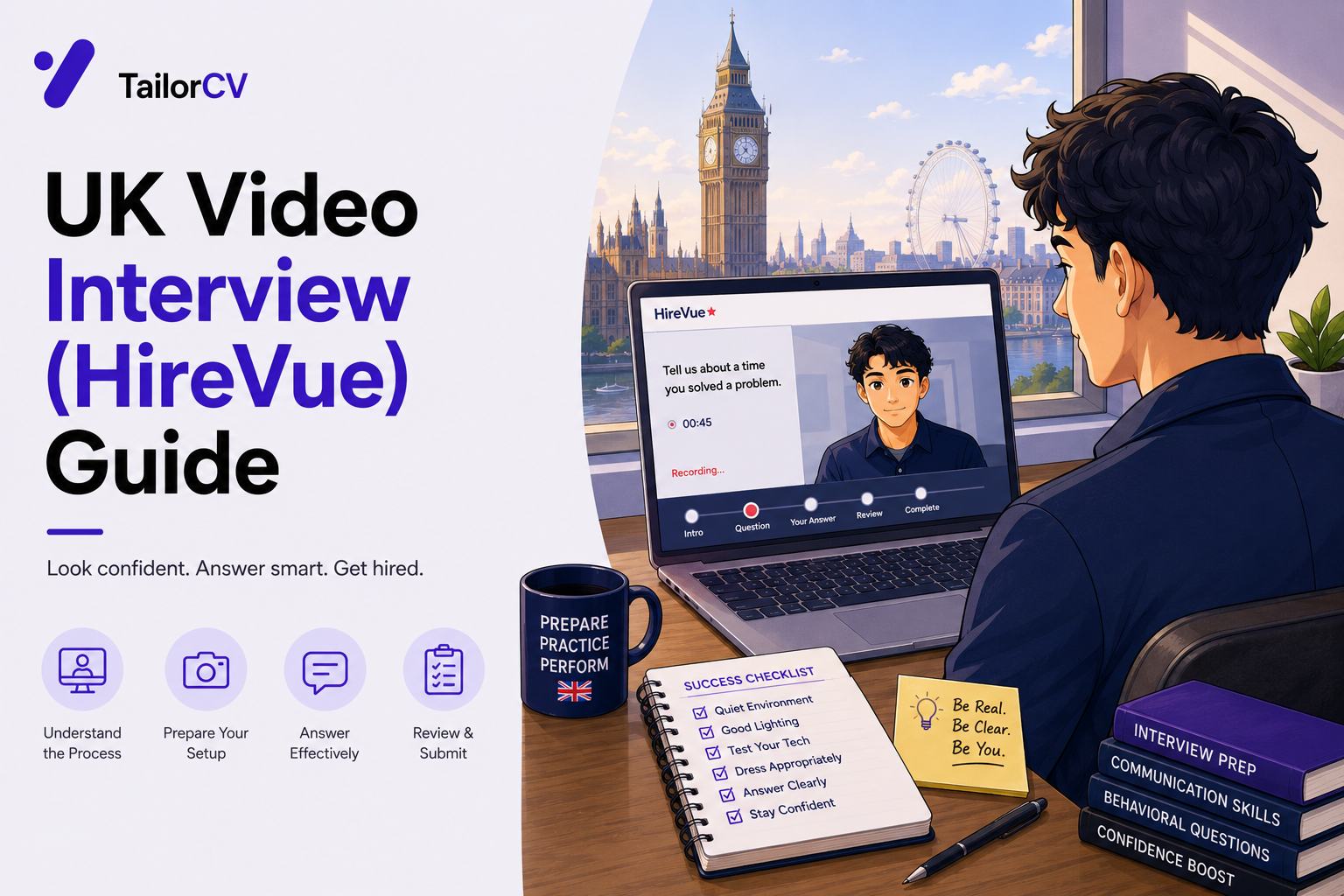
Light on your face, not behind you. A window behind you turns you into a silhouette. Face the light source.
Camera at eye level. A laptop on a desk films up your nose. Raise it on books.
Look at the lens, not the screen. Looking at your own image reads as avoiding eye contact. Some people put a small arrow by the camera as a reminder.
Sound matters more than picture. Quiet room, door closed, notifications off, phone silent. Wired headphones with a mic usually beat laptop audio.
Plain background. Tidy and neutral. A blurred background is fine if the platform supports it.
Test the platform first. Most provide a practice question. Use it — the first time you see the interface should not be the scored attempt.
Check your connection, and have a backup, such as a phone hotspot.
Dress as you would for an in-person interview. Business formal for finance and law, business casual for most else. It also changes how you speak.
Practicalities
- Do it early in the window. Technical problems are recoverable if you have days left, not if you have an hour.
- Check how many takes you get. Some platforms allow one. Knowing before you begin changes how you approach the first question.
- Have water nearby. Sessions run longer than expected.
- Have notes off-camera if permitted — a few bullet prompts, not a script. Reading is obvious on video.
- Do not do it on a phone unless there is no alternative. Framing and stability are worse.
Why candidates underperform here
The stage is treated as a formality more than any other, and it is a real cut.
They do not practise aloud. Answers that read well silently run to four minutes when spoken. The only way to discover this is to say them with a timer running, and it takes twenty minutes to fix.
They read from notes. Visibly. Eyes tracking across a screen is obvious, and it reads worse than a hesitant answer delivered to camera. Three-word prompts on a sticky note beside the lens are fine; a script is not.
They over-rehearse. The opposite failure. A word-perfect memorised answer sounds recited, lands flat, and is oddly harder to watch than a natural one with a stumble in it.
They record at 1am on a phone. These arrive with a multi-day window and get done at the last possible moment in the worst possible conditions.
They panic at the retake rules. Some platforms allow one retake, some none. Check before you start, and if you only get one attempt, use the practice questions until you are calm rather than burning your real answer on nerves.
They forget it is an interview. Because no person is present, candidates drop into a flat, low-energy delivery they would never use in a room. Slightly more animation than feels natural reads as normal on camera.
The fix for nearly all of these is the same and takes half an hour: record yourself answering two questions, watch it back, and fix what you see. It is unpleasant and it is the highest-return thirty minutes available at this stage.
The structure that works with thirty seconds of prep
The constraint that makes these hard is not the camera. It is that you get a short preparation window and then must speak for two minutes with no interviewer to react to.
Front-load the answer. Reviewers watch dozens of these in sequence and form an impression in the first fifteen seconds. Start with the substance, not with a run-up.
Weak opening: "That's a really good question. So I've had a lot of experiences in teams over my time at university, and I think one that particularly stands out to me would probably be..." — eighteen seconds, no information.
Strong opening: "Last year our capstone group lost a member three weeks before the deadline. I took over their section on top of my own." — nine seconds, and the reviewer already knows what the answer is about.
Use a compressed structure. Situation in one sentence. What you did, in three or four. Outcome in one. Reflection in one. That is roughly ninety seconds spoken, which is the right length for a two-minute limit.
Aim for three-quarters of the time allowed. Finishing at ninety seconds of a two-minute window reads as controlled. Being cut off mid-sentence by the timer does not, and it is the most common failure in these interviews.
Be clear rather than clever. No interviewer is present to follow a complicated thread or ask a clarifying question. Simple sentences, one point at a time.
End cleanly. "And that's what I'd point to." Trailing off into silence while the timer runs is uncomfortable to watch and easy to avoid.
Use the thirty seconds of prep to choose, not to script. Pick which of your six stories fits and name the three beats. Attempting to write a full answer in thirty seconds produces a half-written answer you then read badly.
The setup, which is the most avoidable failure
Every reviewer has watched candidates who were plainly capable and impossible to assess because the recording was poor. This is free to fix.
Light on your face, not behind you. Sit facing a window or a lamp. Sitting with a bright window behind you turns you into a silhouette, and it is the single most common setup error.
Camera at eye level. Laptop on a stack of books. A camera looking up at you from a desk is unflattering and, more practically, makes eye contact impossible.
Look at the lens, not at the screen. This feels wrong and it is what creates eye contact in the recording. Watching yourself in the preview window reads as looking away for the entire answer. Some people cover their own preview with a sticky note.
Sound matters more than picture. A reviewer will forgive a slightly dark recording and will not forgive struggling to hear you. Wired earphones with a microphone beat a laptop microphone in almost every room.
Plain background, quiet room. Not a bedroom with the bed in shot. Tell whoever you live with that you are recording.
Test the platform before the real attempt. Nearly all of these offer practice questions that are not scored. Use them — the interface, the countdown and the retake rules differ between providers, and discovering them on your first real question wastes it.
Check your connection, and where possible use a wired one. An upload failure mid-answer is genuinely common on a weak connection.
Dress as you would for an in-person interview, at least from the waist up. It also changes how you speak, which is the less obvious reason to do it.
No audience. A friend in the room to reassure you makes your delivery visibly self-conscious.
A dry run, end to end
Half an hour, done once, and it removes almost every failure mode on this page.
Set up the room properly. Laptop on books, facing a window or lamp, plain wall behind you, door closed, phone silenced, earphones in.
Open your phone's camera and record yourself answering two questions with a two-minute timer running. Use "tell me about a time you worked in a team" and "why this firm".
Watch it back. This is the part people skip and it is the entire point. You are looking for six things: is your face lit, can you be heard clearly, are you looking at the lens, did you say anything substantive in the first fifteen seconds, did you finish before the timer, and did you state a result.
Fix whichever of those failed and record one more.
That is it. Most candidates find two or three problems, all of them mechanical, none of them requiring more preparation — just the knowledge that they were happening. And the difference between a recording that gets a candidate through and one that does not is very often exactly these six things rather than the quality of the underlying story.
If you are asked an unexpected question
Every so often a question arrives that fits none of your prepared stories, and with thirty seconds of preparation and no interviewer to help, that is where candidates freeze.
Use the preparation window to pick, not to panic. Ask yourself which competency the question is really testing — teamwork, resilience, judgement, initiative — and then reach for the story that best serves it. A slightly imperfect fit delivered confidently scores far better than a perfect fit you never reach.
Say the reframe out loud. "I haven't had exactly that situation, but the closest thing is..." is a completely legitimate opening and it buys you five seconds while sounding deliberate.
Answer a smaller version of the question rather than nothing.
Partial and specific beats broad and empty.
Do not apologise for the fit. One clause acknowledging it is fine; a preamble about how you are not sure this quite answers it wastes a third of your time and undercuts what follows.
And keep going if it goes badly. One weak answer among six does not end an application. Candidates who spiral after a bad question turn one poor score into five, and on a recorded interview that is entirely self-inflicted, because nobody in the room saw the first one.
Common Mistakes
- Backlighting. The most common setup error and it makes you unwatchable.
- Reading from a script. Obvious on camera and it kills delivery.
- Long preambles. Reviewers watching at pace form judgements early.
- Running out of time mid-sentence. Looks worse than finishing early.
- Leaving it to the deadline. Removes any margin for technical failure.
- Not practising aloud. The gap between reading and speaking an answer is large.
How these are actually reviewed
Knowing what happens to the recording changes what you optimise for.
A human usually watches, though not always all of it. At high-volume employers a reviewer may watch the first thirty to sixty seconds of each answer and skip forward if the substance has not arrived. This is the entire argument for front-loading.
They are watched in batches, frequently dozens in a sitting. By the twentieth candidate the reviewer has heard the same generic answers repeatedly, and specificity is what registers.
Scoring is against the same competency framework used elsewhere in the process, so the story bank is exactly what you need. Same six stories, compressed.
Some employers use automated scoring as a first pass on some elements. What follows practically is unremarkable: speak clearly, at a normal pace, in complete sentences, and make sure your audio is clean.
There are no follow-up questions. This is the important structural difference from a live interview. Your answer must be self-contained — say the result explicitly rather than leaving it implied, because nobody will prompt you for it.
Recordings can be revisited later. Some employers replay them at the assessment centre stage, so consistency with what you say in person matters.
Practicalities and the things that go wrong
Check the rules before you start. Number of questions, preparation time, answer time, number of retakes, and whether the whole thing must be done in one sitting. These vary by employer and by provider, and assuming is how people lose their one attempt.
Note the deadline and do not use all of it. These usually arrive with a window of several days. Doing it on day one, alert, beats doing it at 11pm on the deadline in a panic about the connection.
Have water, and a glass rather than a bottle. Two minutes of talking dries you out more than you expect, and by question five it is audible.
Silence your phone and close every application. A notification sound lands in the recording.
Tell whoever you live with. A door opening mid-answer is not recoverable on a single-take platform.
If something goes genuinely wrong — the platform crashes, the connection drops mid-answer — contact the employer's recruitment team promptly and explain. They deal with this regularly and will usually reset it. Sitting in silence about a technical failure is the worse option.
If you fluff an answer and cannot retake it, keep going. One weak answer among six does not end an application, and candidates who spiral after a bad question turn one poor score into five.
Do not have a second person off camera. Reviewers notice the eye movement, and at some employers it invalidates the attempt.
What this stage is worth
Worth calibrating, because the effort should be proportionate.
It is a real cut, not a formality — a meaningful share of candidates are removed here, at some employers a larger share than at the assessment centre.
It is also cheap to pass. Half an hour of practising aloud, twenty minutes fixing the lighting and sound, and an hour building stories you need anyway for the assessment centre. Almost nothing at this stage is specific to the format; it is the same evidence, compressed and delivered to a lens.
The candidates who fail are rarely the weakest ones. They are the ones who treated it as an administrative step, recorded it late at night on a laptop in a dark room, ran over time on every question, and never watched themselves back. All four are free to fix.
Which is the summary: this is the stage with the largest gap between how seriously candidates take it and how much it decides.
The single highest-return habit
If you do one thing from this page: record yourself once and watch it.
Not because the recording teaches you interview technique. Because it shows you the three or four mechanical things you are doing that you have no idea you are doing — the silhouette, the eyes tracking a script, the fifteen-second run-up before any content, the answer that stops without a result.
Every one of those is invisible from the inside and obvious on playback. Every one is fixable in a minute. And collectively they are what separates recordings that get a candidate through from recordings that do not, far more often than the quality of the underlying evidence does.
Half an hour, once, and this entire stage stops being a risk.
Frequently Asked Questions
Can I redo an answer?
Depends on the platform — some allow one or two retakes, many allow none. Check before you begin, because it changes how you approach the first question.
Is anyone watching live?
No. It is recorded and reviewed later, sometimes by more than one person and sometimes at speed.
How long are the answers?
Usually one to three minutes, with around 30 seconds to prepare. The platform states the limits before each question.
Can I use notes?
Usually permitted, but keep them to brief prompts placed near the camera. Reading is visible and undermines you.
What if my connection fails partway?
Contact the employer's recruitment team promptly. Genuine technical failures are usually accommodated — which is another reason not to leave it until the deadline.
Do these actually matter?
Yes. They are a substantial cut in most graduate scheme processes and are scored against the same competencies as later rounds. Preparing for them as you would a live interview is the right calibration.
Was this guide useful?
Be the first to rate it.