 TD
TD
Key Takeaways
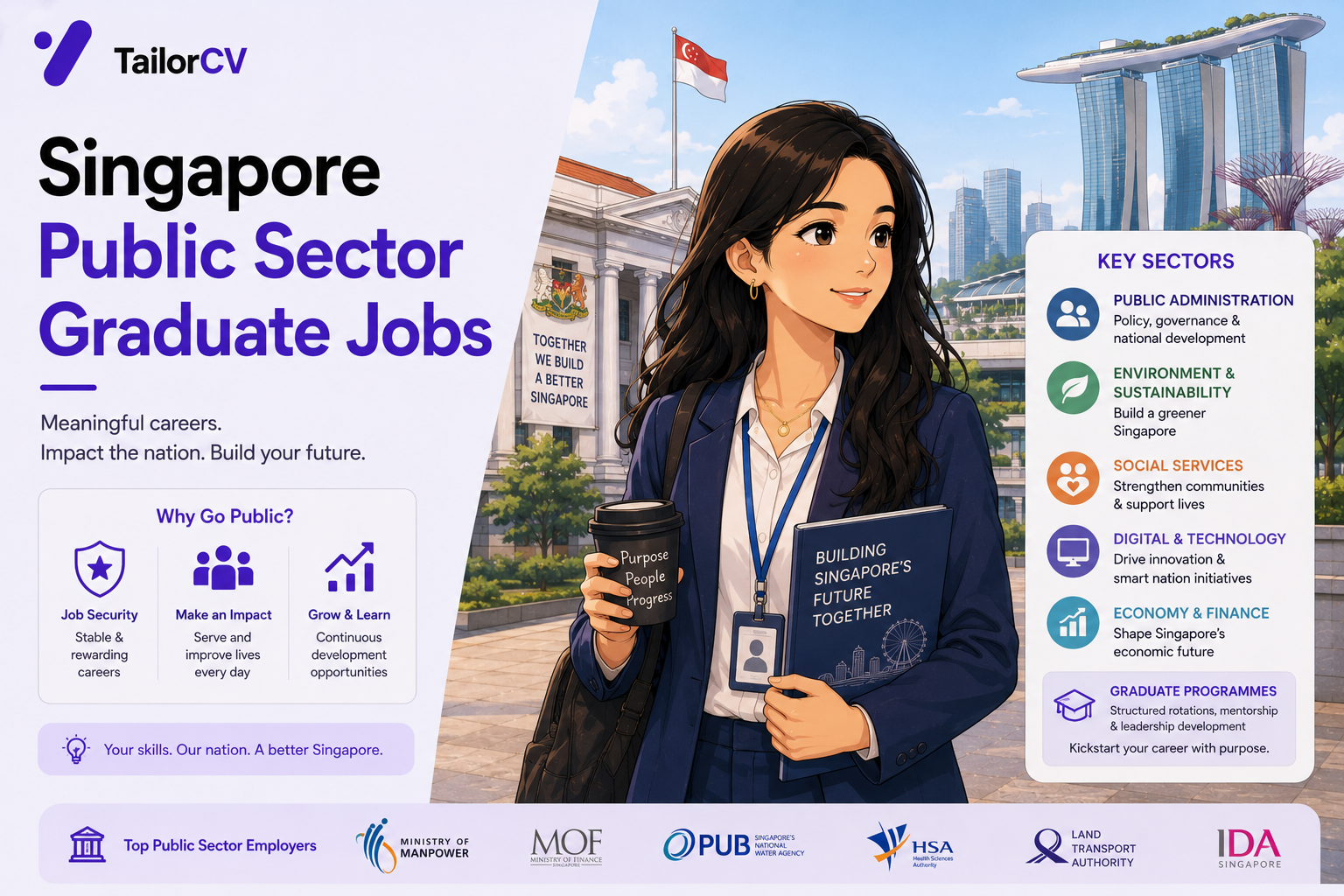
- The public sector is one of Singapore's largest graduate employers and is consistently overlooked by students focused on banking and technology firms.
- Statutory boards operate more like corporations than ministries and hire across engineering, data, policy and operations.
- Selection processes are formal, often including psychometric testing and panel interviews scored against published criteria.
- Some roles are restricted or prioritised toward citizens and permanent residents, particularly where security or policy is involved.
- The work is frequently larger in scale than equivalent private-sector graduate roles.
What the sector covers
Ministries. Policy formulation, regulation, programme delivery. Graduate entry is usually through structured service schemes.
Statutory boards. Bodies with their own boards and considerable operational independence — covering areas like housing, transport, economic development, media, technology, healthcare administration and utilities. They operate closer to corporations than to ministries, and they employ engineers, analysts, planners and specialists in volume.
Government technology. Substantial digital organisations building the services citizens actually use — identity, payments, health records, transport systems. These are genuine engineering roles at national scale.
Public healthcare and education clusters. Large employers in their own right, with both clinical and non-clinical graduate hiring.
The scale surprises people. In aggregate, this is a major graduate employer, and the applicant-to-seat ratio is generally more favourable than at the banks and multinationals everyone applies to.
What the work is actually like
The honest comparison with the private sector:
Scale. A transport or housing system serves millions. A graduate on a government technology team may work on something with more users in year one than a private-sector counterpart sees in a decade.
Pace. Slower. More process, more stakeholders, more approval. This is genuinely frustrating for some people and entirely tolerable for others; knowing which you are matters.
Stability. High, with structured progression and defined pay bands.
Compensation. Competitive at graduate level, particularly when bonuses and benefits are counted, and generally below top-tier finance and the best-paying technology employers at senior levels.
Purpose. Real, and it is the reason many people stay. Whether that outweighs pace and pay is personal.
How selection differs
More formal than most private-sector processes.
Application. Detailed forms with substantial written questions. These are read carefully and weighted heavily — generic answers fail here more visibly than anywhere.
Assessments. Psychometric testing is common — aptitude, situational judgement, sometimes personality inventories.
Panel interviews. Usually multiple interviewers scoring against published competencies. Less conversational than a private-sector interview and more evaluative. Structured answers matter, and rambling is punished harder because several people are scoring independently.
Assessment centres for the larger structured schemes, with group exercises and case work. The format matches what the UK assessment centre guide describes, and preparation transfers directly.
Longer timelines. Processes run for months rather than weeks. Plan accordingly if you are holding other offers with deadlines.
Where competencies are published, prepare one strong example for each — that is the marking scheme, and it is unusual to have it in advance.
Citizenship and residency
This needs stating plainly because it shapes whether the sector is viable for you.
Some roles are restricted to citizens, particularly in security, defence, foreign affairs and sensitive policy areas. Others prioritise citizens and permanent residents without an absolute bar. Others — often technical and specialist positions — are open more broadly.
If you require an Employment Pass, check each specific role rather than assuming the whole sector is closed or open. Job postings usually state requirements, and asking directly is normal.
For international graduates of local institutions, technology and specialist roles are the most realistic entry points.
Applying well
Answer the written questions properly. They are read and scored. A vague "why public service" answer is the most common early rejection, and it is avoidable with a specific reason connected to the actual work.
Research the specific board. Ministries and statutory boards differ enormously in function and culture. Applying to "the government" as an undifferentiated employer is visible in the writing. The application and cover letter conventions apply here more than anywhere, because the writing genuinely gets read.
Show you understand the constraints. Candidates who talk about public service as though it were a startup, or who imply they will cut through the process, read as poor fits. Acknowledging that scale brings process — and being motivated anyway — reads as realistic.
Expect the resume to be screened first. Public sector application systems parse documents like everyone else. Run an ATS check before submitting, and follow the Singapore resume conventions on grades and personal details.
Why it is overlooked
Students concentrate on employers with the strongest brand signal to peers. Banking and the recognisable technology firms carry that signal; statutory boards do not, despite often offering comparable graduate compensation, better structure and larger-scale work.
The result is a systematically less contested route into substantial work — the same pattern as bank technology roles, which are similarly overlooked for similar reasons.
Mapping the sector: where graduates actually go
"Public sector" covers organisations with almost nothing in common. Knowing the shape helps you apply to the right ones rather than to all of them.
Infrastructure and the built environment. Housing, land transport, urban planning, utilities and water. These employ civil, mechanical and electrical engineers in volume, plus planners, data analysts and project managers. The work is unusually tangible — a graduate here can point at a physical thing years later. Project timelines are long, which suits some people and frustrates others.
Digital government. The organisations building national digital services: identity, payments, health records, transport apps, government platforms. These are real software engineering jobs with users numbered in millions, and they hire engineers, product managers, designers and data scientists on terms that are competitive with the private sector. The persistent assumption that this means maintaining legacy systems is roughly a decade out of date.
Economic and industry development. Bodies that attract investment, develop industry sectors, support enterprises and manage trade relationships. Graduate roles here are analytical and commercial — market research, company engagement, policy analysis. Good preparation for private-sector strategy work later, and the people who do it well tend to have unusually good networks.
Health and education administration. The clusters running hospitals and schools are large employers with substantial non-clinical graduate hiring: operations, analytics, finance, HR, planning.
Regulation and enforcement. Financial regulation, media and communications, competition, environment, workplace safety. Analytical, policy-adjacent work with a strong compliance flavour.
Core ministries. Policy formulation and programme delivery, generally entered through structured service schemes with their own selection processes and their own criteria.
Two practical points. First, the applicant-to-seat ratio differs enormously across these — engineering and technology roles at statutory boards are consistently less contested than policy positions at ministries. Second, movement between them later is normal and comparatively easy, which lowers the stakes of your first choice more than students assume.
The written questions, worked
Application forms in this sector carry long-form questions that are genuinely read and scored. This is the single biggest difference from private-sector graduate applications and the place most candidates lose.
Take the standard question: why do you want to work in the public service?
A weak answer, and the most common one:
"I have always been passionate about serving the community and making a positive difference to society. Singapore's public service is world-renowned for its efficiency and integrity, and I would be honoured to contribute to the nation's continued success."
Nothing here is false and nothing here is information. It could be submitted to any of forty organisations without changing a word, which is exactly what the scorer suspects.
A stronger answer to the same question, for an applicant targeting a transport body:
"I spent last summer doing a data project on bus arrival reliability using the public API, and what struck me was how much of the variance came from a small number of interchange points rather than from the network generally. That is the kind of problem I want to work on — where the data is available, the system is measurable, and a change affects a few million journeys a day. I am aware that means working inside a planning cycle much longer than I am used to, and that the interesting technical answer is often not the deployable one."
That is specific, it is verifiable, it demonstrates familiarity with the organisation's actual work, and — importantly — it acknowledges a constraint rather than pretending the job is a startup. Scorers reward that last part more than candidates expect.
The general rule: for every claim you make about wanting to do the work, give one piece of evidence that you have already engaged with it. A project, a module, a volunteer role, something you read and formed a view on. Assertion without evidence scores near zero here, which is not true at every private employer.
The panel interview, mechanically
Panel interviews are different enough from conversational private-sector interviews to be worth preparing for specifically.
Who is in the room. Typically three to five people: a hiring manager, an HR representative, and one or two senior officers from adjacent areas. They are scoring independently against a defined set of competencies, frequently on a numeric scale, and comparing scores afterwards.
What that changes about your answers. Because several people score separately, a rambling answer costs you more than in a one-to-one interview — each scorer independently notices the lack of structure. Answer in a visible shape: situation, what you did, what happened, what you would change. Two minutes, not five.
Address the panel, not just the asker. Begin with the person who asked, then include the others with eye contact as you answer. This sounds like presentation advice and it is, but panels notice candidates who talk to one person and ignore the rest.
Expect the follow-up. Panels probe. "You said the team disagreed — what specifically did the other person want?" is checking whether the example is real. Prepared examples that fall apart under one layer of follow-up are the most common failure, and the fix is to use true stories rather than impressive ones.
Expect a question about a constraint. Something like "how would you handle a policy you personally disagreed with?" or "what would you do if the technically correct answer was not politically feasible?" These are not traps. They are checking whether you understand the environment. An answer that says you would push through regardless reads as a poor fit; an answer that describes making the case properly, documenting the concern, then implementing the decision reads as someone who could actually do the job.
Have questions ready that show you understand the organisation.
"What is the biggest constraint on this team getting things done?" is a better question than anything about culture, and the answer is genuinely useful to you.
Preparing for psychometrics and situational judgement
Aptitude and situational judgement tests are standard here and are frequently the first cut.
Aptitude sections — numerical, verbal, logical reasoning — reward practice for a specific reason: the difficulty is rarely the mathematics, it is doing it under time pressure in an unfamiliar format. Twenty practice sets is usually enough to remove the format penalty entirely. The psychometric test guide covers the mechanics, and the test families used are largely the same internationally.
Situational judgement tests are different and are widely misunderstood. You are given a workplace scenario and asked to rank responses. Candidates try to guess what sounds impressive; the tests are calibrated against how effective employees actually behaved.
Three patterns that score well in a public-sector context specifically:
- Responses that consult the right person before acting usually beat responses that act decisively alone. This is the opposite of the instinct trained by startup-flavoured advice.
- Responses that follow an established process beat responses that route around it, even when routing around it would be faster.
- Responses that escalate genuinely serious issues early beat responses that attempt to contain them.
None of this means passivity. Doing nothing scores badly too. The pattern being rewarded is acting within the system rather than despite it, and that is a real description of the job.
Pay, progression and moving on
Graduate pay is competitive at entry, particularly once the annual bonus structure and benefits are counted. It is structured into defined bands with published progression, which means less negotiation room than the private sector and more predictability. If you are comparing offers, compare total annual package rather than monthly salary — the salary expectations guide covers how the components fit together.
Progression is more structured than most private employers: defined grades, regular review cycles, and in many organisations an explicit expectation that you rotate between roles every two to four years. That internal mobility is a genuine benefit and one of the reasons the first-role choice matters less than it seems.
Scholarships and bonds. Some entry routes come with sponsorship of study in exchange for a service commitment of several years. These are real obligations with real financial consequences for breaking them, and they are worth reading in full rather than skimming. A bond is not automatically a bad deal — it can be an excellent one — but it should be a decision rather than a side effect.
Moving to the private sector later is common and generally straightforward, particularly from technology, analytics and economic development roles. What transfers well is scale, regulatory understanding and stakeholder management. What transfers less well is speed, so expect the first six months in a fast-moving private organisation to be an adjustment. Movement in the other direction — private to public at mid-career — also happens routinely, which means this is not a one-way door.
What the first year actually looks like
Useful for deciding whether you would like it, and almost never described.
You will be given something small and real quite quickly. A section of a policy review, a component of a system, a recurring analysis. The scope is modest and the consequences are not, which is a combination graduates find unfamiliar.
Your work will be read by more people than you expect. Documents move upward through several layers, and each layer may comment. This is why written clarity is weighted so heavily in selection — it is genuinely the core skill of the job in policy-facing roles.
You will spend real time on stakeholder coordination. Getting three departments to agree is often the actual task, and the technical or analytical part is the easy half. People who came expecting to be judged purely on analysis find this frustrating; people who understood it in advance find it interesting.
Decisions take longer than you think reasonable, and usually for a reason you were not told.
The habit worth building early is asking why the process exists rather than assuming it is inertia. Sometimes it is inertia. Often it is a consequence nobody wants to repeat.
You will get formal feedback on a defined cycle. More structured than most private employers, with written assessments against stated criteria. This is genuinely useful early in a career, and it is one of the underrated benefits of the sector.
Common Mistakes
- Treating it as a fallback. It is a major employer with competitive structured programmes.
- Applying to "the government" generically. Boards differ enormously and the writing shows whether you know that.
- Underestimating the written questions. They are read and scored, unlike at many private employers.
- Not checking citizenship requirements per role. They vary; assuming either way wastes applications.
- Preparing for interviews but not psychometrics or panels. Both are standard here.
- Expecting private-sector timelines. Processes run for months.
Where the openings are actually posted
Worth knowing, because this sector does not advertise the way private employers do.
The central public service careers portal carries the bulk of ministry and many statutory board roles, and it is where structured schemes are listed. It is searchable by function and by organisation.
Individual statutory board career pages carry roles that never reach the central portal, particularly technical and specialist positions filled on a rolling basis. If you have a target organisation, check its own page directly rather than relying on the aggregate.
University career portals carry campus-targeted roles and internship listings for local students, and the career services office usually knows about intakes before they are advertised.
Scholarship and structured scheme pages are separate from general hiring and open on their own calendar, usually much earlier. If you are targeting one of these, the deadline is likely a year before you thought.
The practical instruction is the same as for private employers: build a list of the eight or ten organisations you would actually join, and check their own pages weekly during the window rather than waiting for a listing to find you.
Frequently Asked Questions
Can foreigners work in the Singapore public sector?
Some roles yes, particularly technical and specialist ones. Others are restricted to citizens or prioritise citizens and permanent residents. Check the specific posting.
How does pay compare to the private sector?
Competitive at graduate level once benefits are counted; generally below top-tier finance and the best-paying technology employers at senior levels.
Are statutory boards the same as ministries?
No. Statutory boards have their own governance and operate more like corporations, with different cultures and hiring processes. Ministries handle policy and regulation.
Is the technology work genuinely technical?
Yes — national-scale digital services with real engineering. The assumption that it is legacy maintenance is outdated.
How long does the process take?
Months rather than weeks, with multiple stages. Factor that in if you are holding offers with deadlines.
When do applications open?
Many run structured annual intakes aligned with the graduate recruiting calendar, though some roles are filled on a rolling basis. Check each organisation directly.
Do I need a specific degree to apply?
For engineering, technology and healthcare roles, usually yes. For policy, analytical and general administration roles, the degree matters far less than the quality of your written answers and your reasoning in interview. Non-obvious backgrounds are common in policy work.
Is the interview process the same across all boards?
The shape is similar — written application, assessment, panel — but the emphasis differs. Technology organisations run technical assessments closer to private-sector engineering interviews. Policy-facing bodies weight the written answers and the panel much more heavily.
How much do grades matter?
They matter at the screening stage, particularly for the structured schemes, and less afterwards. A strong written application and a clear panel performance can outweigh an unremarkable transcript, but they cannot rescue you if you are filtered before a human reads anything.
Should I apply to several boards at once?
Yes, and it is expected. What is not advisable is submitting the same written answers to all of them — the questions look similar and the scorers can tell. Rewrite the organisation-specific parts each time.
Is there an advantage to interning there first?
A substantial one. Internships and attachments are a common entry route, they give you the internal reference that written applications cannot, and the internship guide covers the authorisation rules that apply.
What is your resume scoring right now?
Scan it against a job description and get your ATS match score in about a minute.
Drop your resume here or choose a file
PDF only. Max 2 MB.
We never share your data or use it to train AI models.

Was this guide useful?
Be the first to rate it.